
LIFESTYLE
Scotland’s Falls Wards Meet a Garage Strength Experiment
Scotland still fills hospital beds with falls while Clare Johnston’s parents rebuilt strength on a garage barbell, exposing the load NHS classes leave out.

Public Health Scotland counted 28,455 emergency injury admissions among people aged 65 and over in 2024/25, and just over 87% followed a fall. Edinburgh journalist Clare Johnston spent that same stretch putting a barbell in her garage and training twice a week with her parents, then argued that strength training for older adults should sit inside national health policy.
The clips look like a family story. The second bill is on the ward. Hip fracture already took 5.2% of all unscheduled hospital bed days in Scotland in 2024, and the same agency that published those injury figures now expects around 8,000 hip fractures a year to become 10,000 by 2034.
A Barbell Rack in an Edinburgh Garage
Johnston is 52, a former editorial director of the Press Association in Scotland and Ireland, and the face of The Honest Channel, which she started seven years ago on YouTube. In an essay for the NHS2048 series at the think tank Enlighten, dated 29 October 2025, she wrote that a scan had shown her mother, Rhoda, then 82, had lost around 80% of the muscle in her back. Rhoda had osteoporosis and could not walk upright without help. Johnston’s father, Michael, then 81, was recovering from hernia surgery and losing confidence.
The turn came after she interviewed Chris Reis, a doctor of physical therapy and head coach at Starting Strength Gyms in Cincinnati. Reis had left clinic work to coach older adults on barbells. One of his clients, 98-year-old Merce Hershey, had reversed bone loss by lifting. Johnston bought a rack, asked her parents to train with her, and Reis began coaching them online.
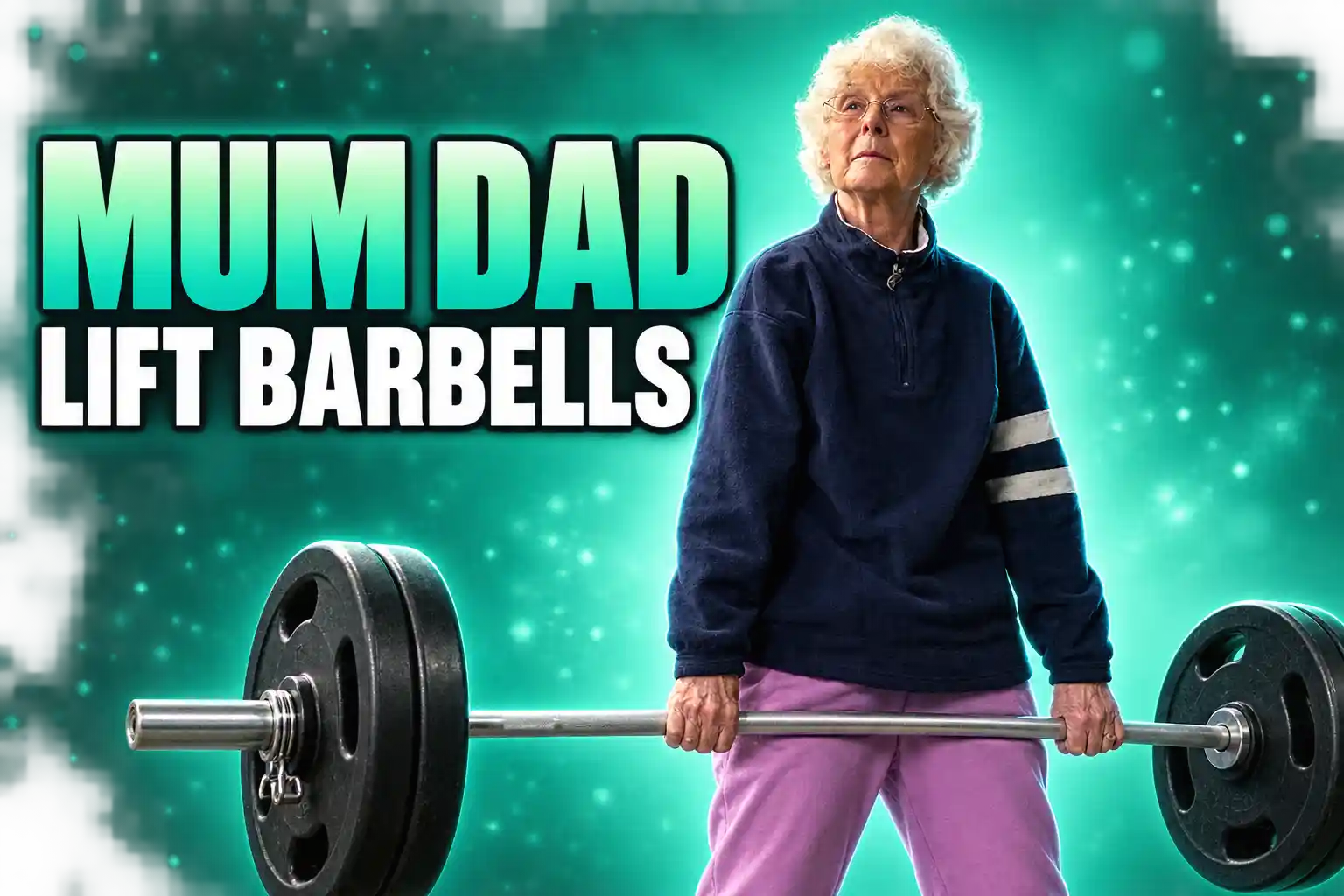
They started in January 2025 on four lifts: the squat, the bench press, the overhead press and the deadlift. Sessions run about 90 minutes, twice a week. The load went up by about 1 kg at a time, sometimes less.
When I turned 80, it felt like a downward path. But now I have no fear of the future, because I’m getting more, rather than less, capable in everyday life.
Michael Johnston, in Clare Johnston’s NHS2048 essay
Starting Strength Gyms later sponsored the YouTube series that follows them, Rebuilding Mum and Dad. Johnston says the series has been watched more than a million times, and that one Instagram reel passed 8 million views. On 29 October 2025 she put the policy ask in plain words: it should be a public health priority.
My parents' strength journey is inspiring MILLIONS to rebuild muscle and in turn their health and mobility. It should be a public health priority. Thanks @enlighten_scot for inviting me to write this article explaining how muscle is key to healthy ageing https://t.co/ejT6ADZY6E pic.twitter.com/kfccH1FcNj
— Clare Johnston (@ClareS_J) October 29, 2025
Falls Still Fill Scottish Hospital Wards
Johnston told Enlighten that one in five Scots is now over 65. National Records of Scotland put the country’s population at 5,545,500 on 30 June 2025. Falls are already how a large share of older patients arrive in hospital, and they are how a large share of injury deaths happen.
In the year to 31 March 2025, Public Health Scotland recorded 54,720 emergency admissions for unintentional injury, 4% lower than the year before, still one in every ten emergency admissions in the country. Among people aged 65 and over the figure was 28,455, and just over 87% of those admissions followed a fall. Around two-thirds of hospital admissions from injury, and nearly half of injury deaths, follow a fall. People aged 65 and over are eight times more likely than younger adults to be admitted as an emergency after one.
SCOTLAND’S INJURY AND FALLS TALLY
| Measure | Figure | Period |
|---|---|---|
| Emergency injury admissions, all ages | 54,720 | 2024/25 |
| Share of all emergency admissions | 1 in 10 | 2024/25 |
| Emergency injury admissions, age 65+ | 28,455 | 2024/25 |
| Share of those 65+ admissions due to falls | just over 87% | 2024/25 |
| Unintentional injury deaths | 2,850 | 2024 |
| Hip fracture share of unscheduled bed days | 5.2% | 2024 |
| Hip fractures | around 8,000 | 2024 |
| Hip fractures, PHS forecast | 10,000 | 2034 |
A fall is not only an A&E visit. Audit Scotland and the Accounts Commission found that patients aged 75 and over occupied 66% of delayed-discharge bed days in 2024/25, across 720,119 days that hospitals could not free. That is the pathway Johnston is trying to interrupt: less muscle, a fall, a fracture, a bed that does not empty.
Why Chair Classes Have Not Cut Hip Fractures
Scotland is not starting from zero. The UK Chief Medical Officers already tell adults to build strength on at least 2 days a week. Older adults are also told to work on muscle, balance and flexibility on at least two days, and to gather 150 minutes of moderate activity across the week. An infographic attached to those guidelines says activity can cut the chance of falls and depression by up to 30%.
Health boards and leisure trusts already run the classes that sit under that advice. They are not the programme in Johnston’s garage.
WHAT SCOTLAND ALREADY OFFERS
- CMO floor: Strength on at least two days a week, plus extra balance work for people aged 65 and over.
- 2014 national framework: The Scottish Government’s falls plan called for individualised strength and balance training of at least 50 hours, and named Edinburgh Leisure’s Steady Steps as a 16-week model.
- Board leaflets: NHS Highland points people to Tai Chi, walking, dancing and local strength and balance classes, often branded as Otago.
- Council programmes: Live Life Aberdeenshire’s Strong and Steady runs 12 weeks of specialist classes free of charge, by self-referral or from a clinician.
- Hospital grounds: NHS Forth Valley has put strength and balance boards outside Forth Valley Royal Hospital and a Clackmannanshire health centre, with community classes behind them.
Those offers matter for people who are already unsteady. They are also a different dose from Reis’s model, which adds kilos to a barbell until an 81-year-old is pulling 94 kg off the floor. Public Health Scotland is still forecasting more hip fractures, not fewer, because the 75-and-over group is growing faster than the current classes can absorb. Chair circuits and a garage rack are not the same intervention with different branding.
94 Kilograms on an 81-Year-Old Deadlift
The 12-month record is specific, and it is on camera. Michael’s first deadlift was 30 kg. By the one-year update he was lifting 94 kg. Rhoda had struggled to walk unaided for 30 seconds. A year later she walked for six minutes, squatted with 20 kg, and deadlifted 45 kg.
WHAT CHANGED IN 12 MONTHS
| Measure | At the start | At 12 months |
|---|---|---|
| Michael, deadlift | 30 kg | 94 kg |
| Rhoda, unaided walk | 30 seconds | 6 minutes |
| Rhoda, squat | not lifting a loaded bar | 20 kg |
| Rhoda, deadlift | very light | 45 kg |
| Training time | twice a week, about 90 minutes |
That is the specimen, not a metaphor. In a later episode Johnston showed why the line is not a straight climb: Reis dropped both parents back in weight in early 2026 to rebuild form after a year of adding load. By August 2026, with Rhoda 83, Johnston said her mother’s back felt “weightless” for the first time in nearly 20 years, and Michael was deadlifting more than 200 lb again.
Kate Duchowny and the Grip-Strength Warning
Johnston’s essay leans on a study in the Journal of Gerontology: Medical Sciences. Kate Duchowny, then finishing a doctorate in epidemiology at the University of Michigan School of Public Health, analysed 8,326 men and women aged 65 and over from the Health and Retirement Study. After adjusting for income, long-term conditions and smoking, people with low muscle strength were 50 percent more likely to die earlier. Using her team’s cut-points, 46% of that sample counted as weak at the start.
Duchowny argued that grip strength should sit in routine care, because it flags decline earlier than waiting for a fall. Johnston’s NHS ask is the Scottish version of that: put muscle-strength numbers into health checks, and stop treating muscle as a gym hobby.
WHAT THE MICHIGAN SAMPLE SHOWED
- The cohort: 8,326 adults aged 65 and over in the Health and Retirement Study.
- The share classed weak: 46% at baseline on the study’s own cut-points.
- The mortality gap: 50% higher chance of earlier death after adjustment.
- The clinical ask: hand-grip testing as a normal part of later-life care.
Sarcopenia, the age-related loss of muscle, starts in the thirties and speeds up in the sixties. Johnston’s point is that the loss answers to load. Reis’s method is not bodybuilding. It is the shopping bag, the chair, and the stair, trained as a squat and a deadlift.
Measure Muscle in the NHS Health Check
The question that follows Johnston around is practical. Viewers ask where they can get the coaching and the rack. On the Enlighten page, Trish Stevens, 77, with osteoporosis and a tight income, wrote that she wished the NHS would subsidise strength training; she was following bone-health videos at home instead. Catherine, in Stirlingshire, said a 2016 DEXA scan had already put her spine in the osteoporotic range. She named Australia’s LIFTMOR work and the ONERO clinics, bought dumbbells, tried an unsupervised gym, and still could not find a place in Stirling or Glasgow to lift under a coach who understood bone density.
That is the gap the existing class list does not close. Otago and Strong and Steady are built for people who are already falling. They are not a standing offer of progressive barbell coaching for an 80-year-old who can still get to a garage. Johnston’s four-part plan is subsidised access to qualified strength coaches for older adults; community gyms set up for progressive loading; campaigns that treat muscle as a longevity organ; and muscle-strength metrics in NHS checks and ageing research.
Reis is in Cincinnati. The parents train in Edinburgh. The method travelled on a broadband link and a rack. Scaling it means coaches who will load a bar for someone with osteoporosis, and rooms that are not reserved for people under 40. Johnston’s line in the essay is blunt: a stronger population is a healthier population.
The 10,000 Hip Fractures Already on the Chart
Public Health Scotland’s injury report, published 28 October 2025, does not wait for a new campaign. It predicts a rise from around 8,000 hip fractures in 2024 to 10,000 in 2034, an extra 2,000 broken hips across ten years, and says the rise in some boards will outrun growth in emergency admissions. Risk sits at about 1% a year at ages 80 to 84, and about 3% a year after 90. The report wants a hip-fracture incidence indicator so boards can watch prevention instead of only counting repairs.
HOW THE PREVENTION FILE HAS MOVED
- October 2014: The Scottish Government publishes a community falls framework and asks for 50 hours of strength and balance work.
- September 2019: UK Chief Medical Officers add a two-day strength floor for adults, with extra balance work for people aged 65 and over.
- November 2023: Enlighten opens NHS2048, named for the health service’s 2048 centenary, and later collects more than 70 reform essays.
- January 2025: Johnston, Rhoda and Michael begin twice-weekly barbell sessions in the garage.
- October 2025: Public Health Scotland publishes the 2024/25 injury figures on the same week Johnston’s essay lands.
- July 2026: The Chief Medical Officers refresh the activity guidelines and keep the two-day strength advice in place.
Scottish Government projections say people aged 75 and over will rise by more than 300,000 between mid-2024 and mid-2049. The Registrar General has already recorded a 43% rise in that age group since 2004. The class timetable from 2014 did not have to carry that many hips. The 2034 forecast assumes it still will not.
Johnston never claimed two people in a garage are a health service. She claimed frailty is not a law, and that the country already knows how to load a bar. Rhoda and Michael are still adding and dropping weight under Reis. The injury report is still counting the other outcome, in advance, at 10,000.
Disclaimer: This article is news reporting and analysis of published injury statistics and one family’s documented training record. It is not medical advice, a training plan, or a recommendation to start heavy lifting without an assessment. Anyone with osteoporosis, recent surgery, heart disease or a history of falls should speak to a GP, a physiotherapist or a qualified strength coach before changing how they exercise. Figures and programme details reflect Public Health Scotland, National Records of Scotland, UK Chief Medical Officers’ guidance and the named studies as they stood when those sources were issued, and clinical advice can change.

TCS Opens Q2 as Mid-Cap IT Keeps the Growth

Bitcoin’s Jobs Rally Fails While December Hike Odds Hold

The Heat Turn a Bucks Rematch Into Vice City Night

The G7 Opens Diesel Tanks While Carriers Head East

Kia Bets Fortuner Money on a Made-in-India Sorento

Volkswagen Sells the Osnabruck Plant to Clear a Board Fight

Tata Motors’ Iveco Tender Opens as Holders Still Decide

Saksham Gaur Finds He Is His Own Company’s Client

Onimusha Way of the Sword Preload Hits a Windows 11 Wall

The Frame Pro’s $1,200 Labor Day Cut Needs a Soundbar
-
 AUTO4 weeks ago
Volkswagen Sells the Osnabruck Plant to Clear a Board Fight
-
 AUTO1 month ago
Tata Motors’ Iveco Tender Opens as Holders Still Decide
-
 BUSINESS1 month ago
Saksham Gaur Finds He Is His Own Company’s Client
-
 GAMING1 month ago
Onimusha Way of the Sword Preload Hits a Windows 11 Wall
-
 NEWS4 weeks ago
The Frame Pro’s $1,200 Labor Day Cut Needs a Soundbar
-

 NEWS1 month ago
Apple’s Foldable iPhone Hinges on Samsung Display Supply
-

 BUSINESS1 month ago
SEBI Reopens How F&O Settles After the Closing Auction
-

 BUSINESS1 month ago
The Rs 4.66 Lakh Crore IPO Queue Is Mostly Paper