
BUSINESS
The Rupee Bounce Is Charged to Oil Firms and Hedgers
The rupee’s bounce to 93.63 is paid for by an oil-company dollar window, a hedge cash lock, and a $239.2 billion forward short.

The rupee touched 93.63 per dollar in mid-November, its strongest level since April.
The bounce followed a private dollar tap for three state oil firms, a cash lock on large hedges, and a record short in the Reserve Bank of India’s forward book.
Three Oil Companies Now Buy Dollars off the Market
On October 10 the RBI said it would meet the entire daily dollar needs of Indian Oil Corporation, Hindustan Petroleum and Bharat Petroleum. The special window for three oil companies opened on October 12 and stays in place until further notice.
The central bank sells the dollars through designated banks. The three firms no longer bid for those dollars in the same spot market as every other importer.
Bankers working from August trade data put the three firms’ combined daily crude bill near $200 million. India imported 23 million tonnes of crude that month, worth $11.7 billion, about $377 million a day, and the three processed about 55 percent of the crude Indian refiners handled.
Dhiraj Nim, FX strategist at ANZ in Mumbai, said meeting the oil companies’ dollar needs “removes one of the largest sources of demand from the FX market, which should help reduce volatility but it will show up in a depletion of reserves.”
The rupee had closed at 96.73 on October 9, a day before the announcement, after testing the all-time low of 96.96 on October 7. Crude was above $100 a barrel when the window opened. India’s crude basket had neared $120 a barrel during the October import spike.
Forex reserves had already fallen from $785.7 billion in the week ended September 4 to $734.6 billion on October 2, then to $726.0 billion on October 9. Bankers at six firms put spot dollar sales and dollar-rupee swaps since June 8 near $75 billion to $80 billion.
A firmer print is already drawing the opposite plea: put the oil companies back into the spot market so the rupee does not strengthen too far for exporters. The window does not cut the oil bill. It moves the bid onto the RBI’s books.
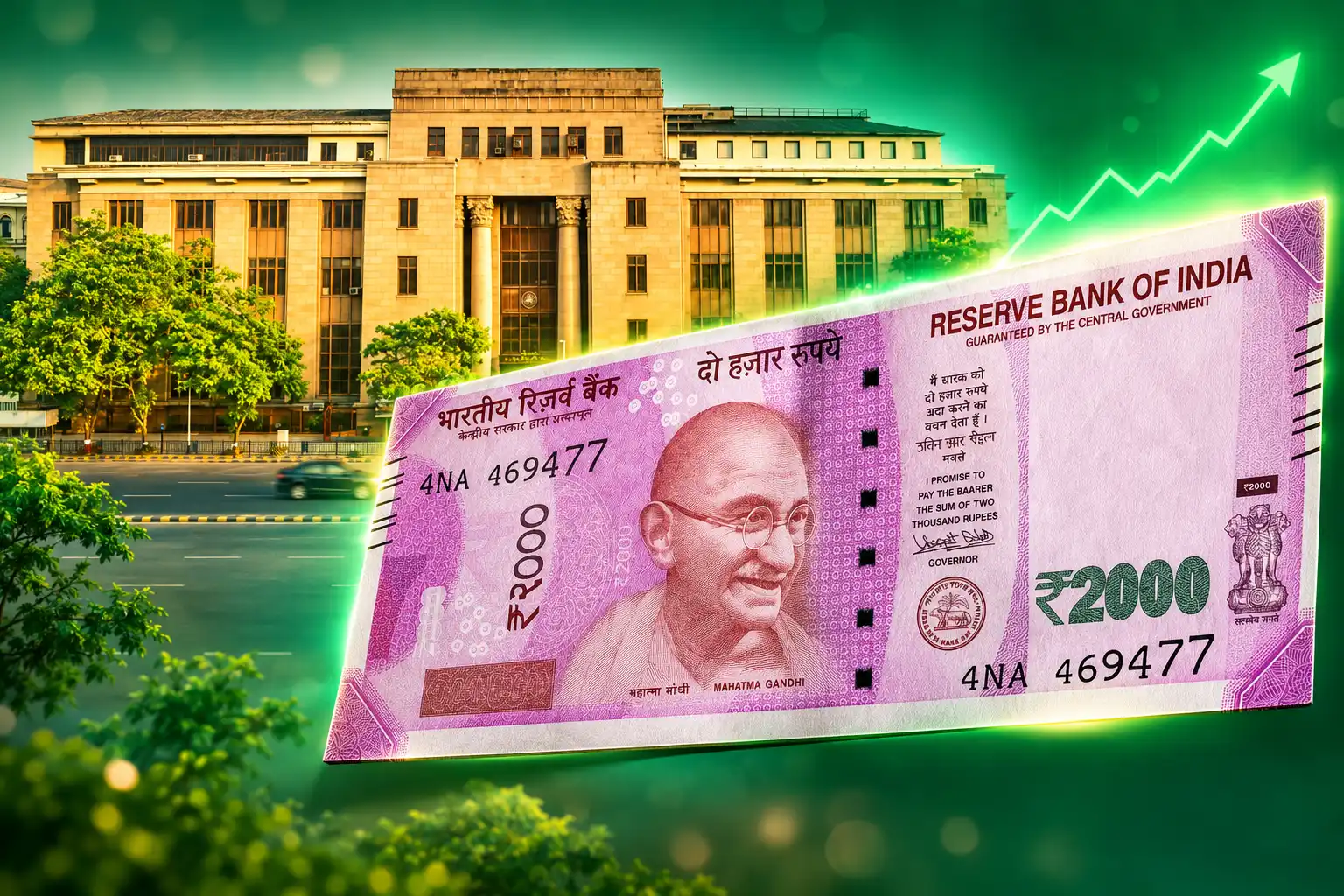
What the New Cash Reserve Costs Importers
The same Saturday the RBI issued two circulars aimed at dollar demand that was not an oil cargo. Authorised dealer banks now post a 20 per cent cash reserve on large hedges with the central bank.
THE OCTOBER 10 FOREX RULES
- The cash lock: Banks must keep a Foreign Exchange Risk Reserve equal to 20 percent of the rupee face value of qualifying INR derivative contracts above $2 million, in cash, on a daily basis until the contract ends.
- Who it hits: The reserve applies where the user is buying foreign currency against the rupee to hedge a current-account exposure, not to banks’ market-making books.
- The worked example: The RBI’s own FAQ puts a $10 million hedge struck at ₹95 at a notional of ₹95 crore and a cash lock of ₹19 crore.
- Rebooking: A cancelled rupee derivative, deliverable or not, cannot be rebooked; rollovers at maturity still can.
- The unproven-exposure cap: The threshold for a hedge without proving the underlying exposure fell from $100 million to $5 million across all dealers.
That cash earns nothing while it sits at the RBI. At the new repo rate of 5.50 percent, the locked rupees are a direct cost that banks can pass into hedge prices. Importers still need cover. They now pay more for it, which is the point of the rule.
On October 7, three days before the circulars, the Monetary Policy Committee had voted unanimously to raise the repo rate by 25 basis points to 5.50 percent, the first increase since February 2023, and to shift the stance to calibrated tightening. The standing deposit facility moved to 5.25 percent and the MSF and Bank Rate to 5.75 percent. The hike did not stop the rupee testing 96.96 that day. The cash lock arrived because the rate move had not.
Diaspora Swaps Left a Record Dollar Short
The dollars that padded reserves earlier in the year were not a gift. From June 8 the RBI ran concessional swap windows so banks could mobilise Foreign Currency Non-Resident (Bank) deposits and some overseas borrowings. Fresh FCNR(B) deposits closed on August 31; banks could still complete swaps through September 11.
Those windows drew $143.5 billion between June 8 and September 18, nearly $133 billion of it FCNR(B) deposits. Banks handed the dollars to the RBI in the spot market and took rupees. The RBI promised to sell the dollars back when the deposits mature, mostly in three to five years. Governor Sanjay Malhotra, asked about the cost of the FCNR(B) scheme, said the cost to the RBI “is secondary.”
The secondary cost is now visible on the forward book. The RBI’s net short dollar position in forwards rose from $200.06 billion at end-August to a record $239.2 billion at end-September. Positions maturing after one year rose to $199 billion.
THE SEPTEMBER FORWARD BOOK
| Item | Amount |
|---|---|
| RBI net dollar short, end-August | $200.06 billion |
| RBI net dollar short, end-September | $239.2 billion |
| Of which, more than one year (September) | $199 billion |
| Due within one year (IDFC First Bank split) | $40 billion |
| Due in one to three years (IDFC First Bank split) | $56 billion |
| Due in three to five years (IDFC First Bank split) | $143 billion |
| FCNR(B) deposits via the special window | $133 billion |
IDFC First Bank Economic Research said the large negative forward book means the RBI “will need to accumulate dollars in order to meet the commitments when these buy-sell swaps mature.” Any pickup in inflows, the note said, “will be absorbed by the RBI, limiting the downward move in USD/INR.”
The 12-month dollar-rupee forward premium rose from 3.36 percent at end-September to 4.57 percent in October. Hedging future dollar payments got dearer just as the cash reserve made the onshore hedge itself more expensive.
Foreign Buyers Returned After Two Months of Sales
The inflow the forward book is built to absorb has started. NSDL figures show foreign portfolio investors bought a net ₹84,291 crore of Indian equities between November 2 and November 13, across nine sessions, after selling ₹34,843 crore in October and ₹35,861 crore in September.
NSDL EQUITY FLOWS
- November 2 to 13: Net buying of ₹84,291 crore.
- October: Net selling of ₹34,843 crore.
- 2026 to 13 November: Net selling of ₹2,10,855 crore.
- March low point: Net selling of ₹1,17,775 crore, the largest monthly outflow of the year.
Nilesh Shah, managing director of Kotak Mahindra AMC, tied the turn to profit-taking on AI stocks abroad, a drop in oil prices, cheaper Indian valuations after two years, talk of capital-gains relief, and less rupee volatility. Domestic institutions, which had been buying through the outflow months, turned into net sellers into the rally.
Each rupee those funds convert still meets a central bank that has $239.2 billion of dollars to buy back later. The FPI burst can support the spot print. It does not retire the swap.
Record Exports Sat Beside a One-Year-High Gap
Goods exporters had a record month in October. They did not earn enough dollars to cover the import bill that arrived with them. The commerce ministry’s October merchandise trade figures show the gap.
GOODS TRADE, SEPTEMBER VS OCTOBER
| Item | September 2026 | October 2026 |
|---|---|---|
| Goods exports | $44.40 billion | $49.47 billion |
| Goods imports | $74.61 billion | $89.35 billion |
| Merchandise trade deficit | $30.21 billion | $39.88 billion |
| Gold imports | $1.8 billion | $5.51 billion |
Commerce Secretary Rajesh Agrawal called $49.47 billion “the highest-ever monthly merchandise export value,” with the highest monthly growth in five years at 45.06 percent from $34.11 billion in October 2025. Petroleum product exports rose 140 percent to $8.89 billion. Electronic goods rose 62 percent to $6.64 billion. Engineering goods rose 36 percent to $12.74 billion. Services exports were $40.51 billion.
Imports still won. The merchandise deficit widened to a one-year high of $39.88 billion, below the $42.58 billion record of October 2025 but $9.67 billion wider than September. Petroleum imports, mainly crude, rose 54.31 percent from a year earlier to $22.82 billion. Gold imports more than tripled from September as jewellers bought ahead of Diwali, though they were down from $14.72 billion in October 2025. India still buys close to 85 percent of the crude it burns.
The oil window can hide that dollar bid in the spot market. It cannot shrink a $22.82 billion petroleum invoice.
The Rupee Is Still Cheap on a 40-Currency Basket
The dollar-rupee print is the number on screens. The RBI’s own competitiveness index says the currency is cheaper against trading partners than it was two years ago.
In the September 25 bulletin, the 40-currency trade-weighted real effective exchange rate, base 2015-16 equals 100, stood at 92.00 in August 2026. It was 91.78 in July, 98.75 in August 2025, 97.44 for 2025-26 as a whole, and 105.41 in 2024-25. A fall in the index is a cheaper rupee. The matching nominal index was 78.04 in August 2026 against 85.41 a year earlier. The export-weighted real index was 89.42.
That cheapness is the backdrop Governor Malhotra pointed to on October 7, when the rupee was still near the floor.
We will ensure that the rupee stabilises, that the rupee finds its correct value, and we will support an orderly movement of the rupee in finding its correct value and at the same time in ensuring that there is no excessive volatility.
Sanjay Malhotra, Governor, Reserve Bank of India, post-policy press conference, October 7, 2026
He also said that by a number of estimates, including the REER, the rupee “may be undervalued.” Markets, he said, can be irrational in the short run. The intra-day high of 93.63 in mid-November, with a close of 93.69 that session, was the strongest since April. By mid-November the rupee was nearer 94.25, up ₹1.97, or about 2 percent, from 96.22 at the start of October.
IDFC First Bank’s desk has the rupee in a 92 to 94 band by December, then 94 to 95 by March 2027 and about 96 by June 2027. That path is a slow fade, not a break, and it sits on top of the forward short.
Who Pays When the Print Looks Stable
The 93.63 print is real. So is the invoice behind it.
WHO HOLDS THE BILL
- Oil PSUs: Indian Oil, HPCL and BPCL get their daily dollars from the RBI instead of competing in the spot market, for as long as the window stays open.
- Hedgers and their banks: A 20 percent cash lock and a $5 million unproven-exposure cap make cover dearer for anyone buying foreign currency forward.
- The reserve book: Dollars sold to oil firms and dollars promised back to FCNR(B) banks both leave the RBI shorter than the headline reserve stock implies.
- Exporters: A move from 96.96 toward 93.63 trims the rupee take on the same dollar invoice, which is why some already want the oil bid back on-market.
- NRI depositors: The $133 billion FCNR(B) stock is a timed claim, not permanent capital, and the $143 billion due in three to five years is the bulk of that claim.
The structural dollar need did not move with the circulars. India still pays for most of its crude in dollars. October still produced a $39.88 billion goods gap even after a record export month. The window, the cash lock and the swap book changed who meets that demand, and when.
The oil window remains open until the RBI says otherwise. Every dollar it feeds still leaves the reserves, and every FCNR(B) dollar still has a date on which it must be fed back.
Disclaimer: This article is news reporting and analysis of currency-market measures and trade data, and it is informational only. It is not investment advice, foreign-exchange advice, or a recommendation to buy, sell or hedge any currency, bond, share or commodity. Readers should consult a qualified financial adviser or an authorised dealer bank before making any currency or investment decision. Figures and policy settings reflect the official releases and data cited here and can change when the Reserve Bank of India or the commerce ministry publishes new numbers.

Gold Prices Fall to a 14-Month Low Despite Strikes

SpiceJet Clears a Rs 5,500 Crore Raise After Mumbai Stalled

Honda Activa’s Record Month Came With a Share Loss

Sony Turns the GTA 6 Launch Into a Firmware Gate

Xiaomi 18 Leak Skips the Rear Screen for Battery

Volkswagen Sells the Osnabruck Plant to Clear a Board Fight

Apple’s Foldable iPhone Hinges on Samsung Display Supply

Saksham Gaur Finds He Is His Own Company’s Client

Tata Motors’ Iveco Tender Opens as Holders Still Decide

What Is SD on Amazon Prime?
-
 AUTO2 months ago
Volkswagen Sells the Osnabruck Plant to Clear a Board Fight
-
 NEWS3 months ago
Apple’s Foldable iPhone Hinges on Samsung Display Supply
-
 BUSINESS3 months ago
Saksham Gaur Finds He Is His Own Company’s Client
-
 AUTO3 months ago
Tata Motors’ Iveco Tender Opens as Holders Still Decide
-
 TECHNOLOGY3 years ago
What Is SD on Amazon Prime?
-

 BUSINESS3 months ago
Hyderabad 22-Carat Gold Jumps After a False Bargain
-

 GAMING3 months ago
Onimusha Way of the Sword Preload Hits a Windows 11 Wall
-
 BUSINESS3 months ago
UltraTech Ultravolt Launch Splits Friday Stocks to Watch