
BUSINESS
Rural Inflation Has Already Broken the RBI’s 6% Ceiling
October CPI hit 6.09% in India, with rural prices already at 6.63%. A 0.7% onion weight added half a point and started a legal clock.

India’s consumer price inflation rose to 6.09% in October, breaking the Reserve Bank’s 6% ceiling for the first time in two years. The National Statistics Office published the provisional consumer price index for October on 12 November, on the 2024=100 series. Combined inflation had been 5.54% in September.
The national figure is a blend. Rural inflation is already 6.63%. Urban inflation is 5.41%, still inside the band the law gives the Reserve Bank of India.
Consumer Price Index and Corresponding Inflation for October, 2026 are 110.05 and 6.09% respectively.
Press Release link of CPI for the month of October, 2026: https://t.co/T9f4MetONg
#KnowYourStats #DataForDevelopment #CPI #retailinflation@Rao_InderjitS @_saurabhgarg…
— Ministry of Statistics & Programme Implementation (@GoIStats) November 12, 2026
Rural India Is Already Above the Legal Ceiling
The RBI is required to keep CPI inflation at 4%, with a tolerance band of 2% on either side. Rural prices crossed the top of that band in September at 6.08% and then accelerated. Urban prices have climbed for months, but they have not yet broken 6%.
Food did most of the damage. The Consumer Food Price Index, which tracks the food group, rose to 8.94% in October from 7.74% in September. Rural food inflation reached 9.09%. Urban food inflation reached 8.68%.
RURAL AND URBAN CPI, SEPTEMBER AND OCTOBER
| Measure | Sep 2026 | Oct 2026 |
|---|---|---|
| Combined CPI | 5.54% | 6.09% |
| Rural CPI | 6.08% | 6.63% |
| Urban CPI | 4.88% | 5.41% |
| Combined food (CFPI) | 7.74% | 8.94% |
| Rural food | 8.06% | 9.09% |
| Urban food | 7.18% | 8.68% |
The all-India index itself moved from 109.49 in September to 110.05 in October, a 0.51% rise in a single month. The food index rose 0.94% over the same stretch. Those sequential gains are the momentum the Monetary Policy Committee watches, because a year-on-year rate can jump on a weak base even when shops are quiet.
The base was weak. Combined inflation was 0.04% in October 2025, the floor of a 12-month climb. That arithmetic inflated the October 2026 reading. The month-on-month move shows prices were still rising in the shops, not only on the spreadsheet.
One Vegetable Added Half a Point by Itself
Food and beverages carry a 36.75% weight in the 2024-base basket and rose 8.51%. A breakdown of MoSPI item weights attributes 3.13 percentage points of the 6.09% headline to that division, more than half the entire reading. The food group inside it, weight 34.78%, is the 8.94% CFPI figure.
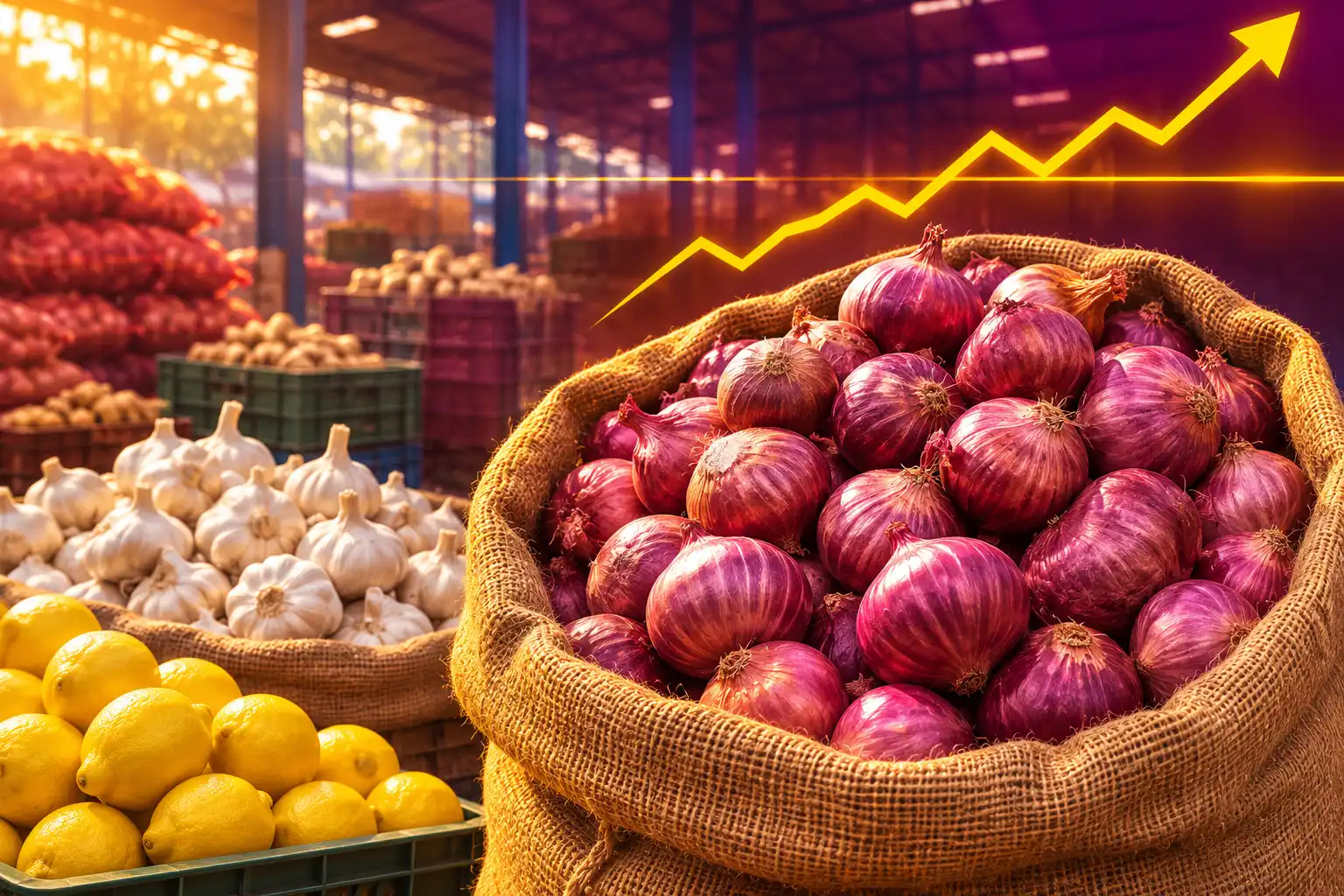
Onion is a sliver of that basket. Its official weight is 0.7006%. Its year-on-year rate was 116.22% in October, up from 108.13% in September. The same weight breakdown credits onion with 0.52 percentage points of headline inflation, almost as much as the entire housing-and-fuels division, which added 0.50 points at 2.90%.
FASTEST AND SOFTEST ITEMS IN OCTOBER
| Item | Weight | Sep 2026 | Oct 2026 |
|---|---|---|---|
| Onion | 0.7006 | 108.13% | 116.22% |
| Garlic | 0.3738 | 54.62% | 60.74% |
| Silver jewellery | 0.3127 | 87.82% | 52.39% |
| Ginger | 0.2556 | 62.85% | 48.32% |
| Lemon | 0.1367 | 36.41% | 47.30% |
| Potato | 0.7549 | -11.52% | -14.24% |
| Cauliflower | 0.2330 | -2.88% | -10.57% |
Potato, which weighs a little more than onion, took about 0.08 points off the headline. Cauliflower, coconut, brinjal and cabbage also fell. The kitchen shock is concentrated, not a uniform vegetable spike, which is why a single monsoon-sensitive crop can still drag a legal target.
Households already know that squeeze. Families that have had to cut grocery spending to pay power bills now face a food index near 9% on top of the power bill. A tracker built from the same item weights put a home-cooked vegetarian thali up 10.56% year on year, faster than the headline.
The objection that this is only onions does not survive the rest of the basket. Inflation rose in 11 of the 12 CPI divisions against September. Restaurants and accommodation services ran at 10.06%. Personal care, social protection and miscellaneous goods and services ran at 10.14%, even after slowing from 13.75%, with silver jewellery still at 52.39%. Clothing and footwear rose to 4.96%. Transport rose to 5.84%. MoSPI does not publish an official core rate. IDFC First Bank put inflation excluding food and fuel at 4.5% in October, up from 4.3% in September.
What a 6% Breach Forces on the Reserve Bank
A single month above 6% is not a legal failure. Failure is defined as average inflation above the upper tolerance level, or below the lower one, for any three consecutive quarters. When that happens, Section 45ZN of the Reserve Bank of India Act requires a report to the Central Government setting out reasons, remedies and a timeline to get back on target.
The RBI’s own October projection already puts the October-December quarter at 6.0%, the ceiling. October has come in at 6.09%. Tanay Dalal, senior vice president of business economic research at Axis Bank, said inflation is likely to stay above 6% until June 2027, and that policy rates may need to rise above an estimated neutral rate of 6%. If that path holds through the October-December, January-March and April-June quarters, the three-quarter test would be met in 2027.
The RBI’s published path is milder: 5.7% in January-March 2027 and 5.6% in April-June 2027, with 5.2% for 2026-27 as a whole, raised from 5.0% in August. Radhika Rao, senior economist at DBS Bank, said the quarterly projection is likely to be revised higher, with headline inflation yet to peak and an unfavourable base still in the numbers.
THE PATH TO THE 6% BREACH
- October 2024: Combined CPI last exceeds 6%, at 6.21% on the 2012-base series.
- October 2025: Combined inflation bottoms at 0.04%, the start of a 12-month rise.
- December 2025: The policy repo rate is cut to 5.25%, then held for four meetings.
- 7 October 2026: The MPC votes unanimously to lift the repo rate by 25 basis points to 5.50% and shifts the stance to calibrated tightening.
- 12 November 2026: October CPI prints 6.09%, the first breach of 6% on the 2024-base series.
- 2 to 4 December 2026: The next MPC meeting is scheduled, with a further hike widely expected.
The only previous 45ZN letter was in 2022. That episode is the template, not a prediction. One hot month starts the clock. Three hot quarters force the paperwork.
The December Meeting Has Little Room to Pause
On 7 October the MPC, chaired by Governor Sanjay Malhotra, raised the policy repo rate to 5.50% from 5.25%. The standing deposit facility moved to 5.25%. The marginal standing facility and the Bank Rate moved to 5.75%. It was the first increase since February 2023, and the vote on the hike was unanimous. Dr Nagesh Kumar and Prof. Ram Singh wanted the stance left at neutral. They were outvoted on that point.
It only signals that given the current conditions, rate cuts are off the table in the near term and policy action ahead can only be a rate hike or a pause, depending on the evolving conditions and the outlook.
Sanjay Malhotra, Governor, Reserve Bank of India, 7 October 2026 monetary policy statement
The minutes of that October meeting recorded that the weighted share of items in headline CPI with inflation above 4% had risen to about 37% in August, from about 20% in March. Malhotra told the committee that inflation and its outlook were not as benign as a year earlier, with headline CPI expected to average almost 5.8% over the next three quarters and core inflation projected at 4.4% for the year.
The statement is blunt about the tool’s limits. On supply-side inflation, it says monetary policy mainly works by curtailing second-round effects such as inflation expectations and firms’ pricing, which take time to show up. A repo rise does not bring a delayed kharif onion crop into the mandi. It can still reprice home loans, working-capital lines and consumer credit for the same households paying 116.22% more for onions.
With the real repo rate at minus 0.59 percentage points, the policy rate sits below the inflation rate it is supposed to restrain. Rao said the 12 November data reinforces a second successive hike in December. Madan Sabnavis, chief economist at Bank of Baroda, said the committee may consider 25 or 50 basis points, with November and December also likely near 6% and FMCG firms starting to raise prices. Aditi Nayar, chief economist at ICRA, called a further 25 basis points in December almost certain and put November headline inflation at about 6.1%, in part because an unfavourable base from GST changes lifts core.
On 13 November, the first full session after the 12 November release, bank stocks lagged and the Sensex and Nifty opened lower as traders priced a December move. That is the market doing the committee’s work in advance.
Growth at 7.8% Gives the MPC Cover to Hike
The same October resolution that tightened policy also raised the growth forecast. Real GDP in the April-June quarter was 7.8%, higher than the RBI had expected. The full-year 2026-27 projection moved to 7.1% from 6.7% in August. The committee’s own quarterly path is 7.2% in July-September, 6.9% in October-December and 6.8% in January-March, then 7.1% again in April-June 2027.
Private forecasters sit even higher on the second quarter. Rahul Bajoria and Smriti Mehra of BofA Securities put July-September growth at 7.7%, against the RBI’s 7.2% and the finance ministry’s 7.35%. That print is due at the end of November. Strong consumption, fixed investment and exports gave Malhotra room to argue that the economy can absorb tighter money.
Bajoria and Mehra also named the cost. They see another 75 basis points of hikes over the next six to nine months, which would reprice credit higher and could soften consumer demand at the margin. Dalal at Axis Bank pointed to clothing seasonality and higher car prices as well as food, and to the transmission of global shocks. The October resolution itself flagged the West Asia conflict, crude volatility and a hawkish turn abroad, the same channel through which inflation has spread beyond the oil shock in other large economies.
Deficient monsoon rains and El Niño are the domestic supply risk the RBI cannot rate away. The resolution said healthy grain stocks and government measures should cushion the hit to agriculture and rural demand. Onion, garlic, ginger and lemon show how thin that cushion is once stored stocks run down and kharif arrivals slip. A weak monsoon also lifts feed costs in maize and soya, so poultry farms feel the same weather that vegetable sellers feel.
Staple-price spikes have a long political memory in India. The legal target is a quarterly average in a Gazette notification. The political target is what a household pays for a kilogram of onions before it votes.
South and Centre Are Running Hotter Than the Headline
MoSPI’s state tables show how uneven the 6.09% reading is. Inflation was above 4% in 31 of 36 states and union territories, and above 6% in 11. Only five prints came in under 4%: Mizoram at 2.85%, the Andaman and Nicobar Islands at 3.46%, Meghalaya at 3.63%, Nagaland at 3.66% and Delhi at 3.80%.
Puducherry was the highest at 7.96%. Among large states, Tamil Nadu led at 7.29%, with rural inflation there at 7.86%. Karnataka recorded the biggest jump, from 5.86% to 7.07%.
READINGS ABOVE THE 6% CEILING
- Puducherry: 7.96% combined, 8.03% rural and 7.93% urban.
- Dadra and Nagar Haveli and Daman and Diu: 7.59% combined.
- Tamil Nadu: 7.29%, the highest among large states, with rural at 7.86%.
- Telangana: 7.26% combined, rural 8.05%.
- Andhra Pradesh: 7.25% combined, rural 7.81%.
- Madhya Pradesh: 7.19% combined, rural 7.66%.
- Odisha: 7.17% combined, rural 7.74% against urban 5.63%.
- Karnataka: 7.07%, up from 5.86% in September.
- Uttar Pradesh: 6.47% combined, with rural at 7.20% and urban at 4.88%.
- Ladakh: 6.34% combined.
- Kerala: 6.22% combined, rural 7.01%.
Rural prices rose faster than urban prices in 32 of the 35 states and territories that publish both. Uttar Pradesh is the clearest split: rural households are already living above the national legal ceiling, urban households are not. A nationwide repo hike does not make that distinction.
The committee meets on 2 to 4 December. The November CPI is due on 14 December. By then the October 6.09% reading will be one month of a quarter the RBI has already pencilled in at the 6% line, and rural India will still be paying for the onions.
Frequently Asked Questions
What Is the Reserve Bank of India’s Inflation Target?
Under Section 45ZA of the RBI Act, the Central Government sets the inflation target in terms of the CPI once every five years and notifies it in the Gazette. The working target is 4% with a band of 2 percentage points on either side, so 2% to 6%, and the MPC’s job is to aim at 4% while supporting growth. The flexible inflation targeting regime has been in force since 2016.
What Happens If Inflation Stays Above 6% for Three Quarters?
Average inflation above 6%, or below 2%, for any three consecutive quarters counts as a failure to meet the target. The RBI must then send the government a report with reasons, proposed remedies and an estimated time to return to target, within a month of the failure. The first such letter covered January to September 2022, when quarterly averages were 6.3%, 7.3% and 7.0%, and the statute does not require the government to publish it.
How Is India’s Consumer Price Index Compiled?
Field staff of the National Statistics Office collect prices each week from 1,407 urban markets, including online markets, and 1,465 villages. The October 2026 round had a 100% response rate in both rural and urban samples. Petrol, diesel and LPG enter the index at prices reported for the 15th of the month, and state-level item indices on the eSankhyiki portal can rest on thin samples, so MoSPI warns they should be used with caution.
When Did India Last Breach the 6% Inflation Ceiling?
Combined CPI last printed above 6% in October 2024, at 6.21% on the old 2012-base series. The current series, with base 2024=100, begins in January 2026, so the October 2026 reading of 6.09% is the first time the new index has crossed the upper tolerance limit. Back-series comparisons with 2024 are therefore not like-for-like.
Disclaimer: This article is news reporting and analysis of official CPI data and monetary-policy statements, and it is for information only. It is not investment, banking, or borrowing advice, and it does not recommend any loan, deposit, security, or interest-rate decision. Readers who are considering a home loan, a deposit, or a change in their borrowing should consult a qualified financial adviser or their own bank before acting. Inflation readings, repo-rate decisions, and growth forecasts are those published by MoSPI, the RBI, and the named economists for the dates given, and later prints or meetings can change them.

Gold Prices Fall to a 14-Month Low Despite Strikes

SpiceJet Clears a Rs 5,500 Crore Raise After Mumbai Stalled

Honda Activa’s Record Month Came With a Share Loss

Sony Turns the GTA 6 Launch Into a Firmware Gate

Xiaomi 18 Leak Skips the Rear Screen for Battery

Volkswagen Sells the Osnabruck Plant to Clear a Board Fight

Apple’s Foldable iPhone Hinges on Samsung Display Supply

Saksham Gaur Finds He Is His Own Company’s Client

Tata Motors’ Iveco Tender Opens as Holders Still Decide

What Is SD on Amazon Prime?
-
 AUTO2 months ago
Volkswagen Sells the Osnabruck Plant to Clear a Board Fight
-
 NEWS3 months ago
Apple’s Foldable iPhone Hinges on Samsung Display Supply
-
 BUSINESS3 months ago
Saksham Gaur Finds He Is His Own Company’s Client
-
 AUTO3 months ago
Tata Motors’ Iveco Tender Opens as Holders Still Decide
-
 TECHNOLOGY3 years ago
What Is SD on Amazon Prime?
-

 BUSINESS3 months ago
Hyderabad 22-Carat Gold Jumps After a False Bargain
-

 GAMING3 months ago
Onimusha Way of the Sword Preload Hits a Windows 11 Wall
-

 BUSINESS3 months ago
UltraTech Ultravolt Launch Splits Friday Stocks to Watch