
AUTO
Hyundai Puts the Ioniq Badge on a Compact India EV
Hyundai named Ioniq P after the Bayon, aiming a sub-four-metre EV at Tata and Kia while Exide cells miss the January 2027 launch.

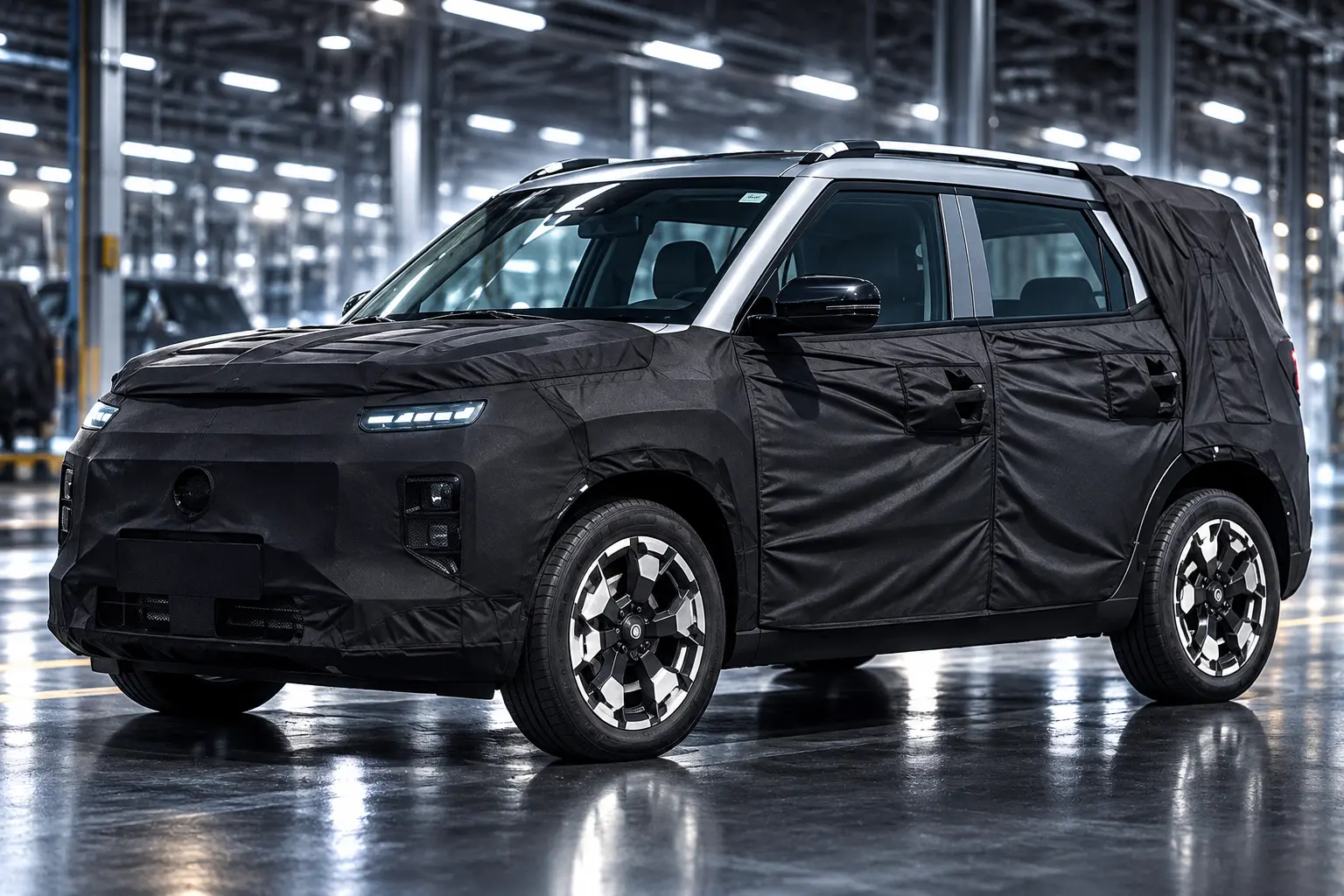
Hyundai named Ioniq P as its next India product after the Bayon on 29 October, a badge now aimed at a sub-four-metre electric SUV. Management used the name on the third-quarter 2026 earnings call while outlining regional product plans, and Hyundai Motor India has not confirmed it or tied it in public to the HE1i project.
The compact EV is due in January 2027 from the Sriperumbudur plant in Tamil Nadu, later than the end-2026 window Tarun Garg, managing director and chief executive of Hyundai Motor India, had flagged. The name is the small leak. The harder fact is that Hyundai still barely sells electric cars in a market that already does, and the local cells that were meant to make this one cheap will miss the first cars.
Hyundai Named Ioniq P Right After the Bayon
On the 29 October call, Hyundai said it would introduce the Ioniq P in India following the Bayon, the mid-size SUV launched on 26 October at Rs 9.99 lakh ex-showroom. Garg has called the Bayon the start of a golden product cycle and said the company is geared up for a dedicated mass-market EV in the fourth quarter of FY27, which covers January to March 2027.
That still leaves a gap the call did not close. Hyundai India has not issued a production name, and the global remarks did not say HE1i and Ioniq P are the same car. The Ioniq P mark has been trademarked in India, which is why most briefings now treat them as one vehicle, but the India unit can still badge it something else.
WHAT WE KNOW
- The call: Hyundai named Ioniq P as the India product after the Bayon on 29 October.
- The code: The made-for-India compact EV is HE1i, due from Sriperumbudur in January 2027.
- The kit: Hyundai has confirmed Level 2 assisted driving and a next-generation infotainment system.
- The plant: Jose Munoz, president and chief executive of Hyundai Motor Company, said a brand-new compact SUV is coming, designed and localised in India.
WHAT IS UNCONFIRMED
- The badge: Hyundai India has not announced Ioniq P as the production name for HE1i.
- The packs: India battery sizes, certified range and prices are unpublished.
- The show: A Bharat Mobility Expo cameo from 4 February has been floated, not scheduled by Hyundai.
Test mules have already been seen on Indian roads, including near the Tamil Nadu plant, so the hardware is further along than the nameplate. The delay from end-2026 into January is a slip of weeks, not a new car.
Hyundai Still Sells Almost No Electric Cars
Garg has said the made-for-India mass-market EV is how Hyundai lifts its electric mix closer to the industry average in FY28. The present gap is wide, and Creta Electric cannot close it on its own.
THE SHARE GAP IN 2026
- Hyundai mix: Electric cars were 1.4 percent of Hyundai’s October car registrations, 676 of 47,459, on Vahan records.
- Industry mix: Electric cars were 7.4 percent of Indian car registrations in October so far, again on Vahan.
- EV market slice: Hyundai registered 792 electric cars in September, 2.2 percent of that month’s electric car market.
- One model: Creta Electric took 810 of Hyundai’s 817 electric registrations in August; Ioniq 5 was a trickle.
Tata still holds about two-fifths of India’s electric cars. Mahindra and MG fill most of the rest. Hyundai’s problem is not a missing halo, because Ioniq 5 is already in the showroom, and it is not a missing family SUV, because Creta Electric is on sale with 42 kWh and 51.4 kWh packs assembled in Tamil Nadu. The hole is a small, cheap EV that can sell in the thousands, which is the job now being hung on HE1i.
Garg has not published a volume target for the new model. Without one, the FY28 mix goal is a direction, not a forecast, and it depends on a car that has yet to be priced.
The Inster Platform Is Coming to Tamil Nadu
HE1i sits on Hyundai’s E-GMP (K) architecture, the same family as the Inster sold overseas, and it is being planned as an India-specific compact SUV rather than a straight import of that city car. It is due in Standard Range and Long Range forms, which is the same split Inster uses, though Hyundai has not published the India kilowatt-hours.
For the overseas car, Hyundai’s own launch sheet lists a 42 kWh pack with 71.1 kW (97 PS) and a 49 kWh long-range pack with 84.5 kW (115 PS), both with 147 Nm, a 3,825 mm body and a 2,580 mm wheelbase. The long-range car was given up to 355 km of targeted range on the WLTP cycle with 15-inch wheels, with the smaller pack described as exceeding 300 km, and both packs quoted at about 30 minutes for a 10 to 80 percent DC charge on a 120 kW point.
Those figures are a floor for the conversation, not an India spec sheet. Certified Indian range uses a different cycle, and the Kia Syros EV, already on sale here on a related compact-electric layout, uses 42 kWh and 51.4 kWh packs rather than Inster’s 49 kWh long-range unit. Until Hyundai publishes homologated numbers, any claim that HE1i will copy Inster’s 355 km or Syros EV’s 526 km is guesswork.
Hyundai has confirmed Level 2 assisted driving. The next-generation infotainment fit, which may be the Pleos Connect system used on newer Hyundais, is still described only as next-generation. Inster’s dual 10.25-inch screens, 360-degree camera and sliding rear bench are overseas kit, not an India promise.
Exide Will Miss the Launch Window
The cost story was supposed to be local cells. On 8 April 2024, Hyundai Motor and Kia signed an MOU with Exide Energy Solutions, a unit of Exide Industries, to put locally produced LFP batteries into future India EVs. Heui Won Yang, then president and head of Hyundai Motor and Kia’s R&D division, tied that deal to price, not to branding.
India is a key market for vehicle electrification due in part to the government’s carbon neutrality goals, which makes securing cost competitiveness through localized battery production crucial. Through this global partnership with Exide Energy Solutions Ltd., we will gain a competitive advantage by equipping Hyundai Motor and Kia’s future EV models in the Indian market with locally produced batteries.
Heui Won Yang, President and Head of R&D, Hyundai Motor and Kia
That advantage will not be on the first HE1i cars. The compact EV will initially use battery cells from Svolt, with a later switch to Exide. Avik Roy, managing director of Exide Industries, told investors in August 2026 that the Hyundai-Kia cell line is a concurrent co-investment, possibly half a dedicated line, and that it will not come this calendar year or this fiscal year. January 2027 still sits inside FY27, so the launch batch is an import-cell car.
Pack assembly is already local. Hyundai Motor India and Mobis India opened a pack plant at the Chennai-area campus with an annual capacity of 75,000 battery packs in its first phase, and Creta Electric was the first model to use those packs. Cells are the expensive piece. Importing them for a mass EV raises the floor under the sticker at the exact moment Hyundai needs that sticker to look like a Tata or Kia price, not like an Ioniq 5.
The Compact Slot Kia Already Priced
By January 2027 the sub-four-metre electric SUV shelf will already hold Tata, Mahindra and, inside the same group, Kia. The Syros EV went on sale from 30 July 2026, so Hyundai is walking into a price list its sister brand wrote.
THE CARS HE1I HAS TO BEAT
| Model | Battery (kWh) | Claimed range | Starting price (ex-showroom) |
|---|---|---|---|
| Kia Syros EV | 42 / 51.4 | 443 km / 526 km ARAI | Rs 13.49 lakh |
| Tata Nexon EV | 30 / 45 | 275 km / 489 km | Rs 12.49 lakh |
| Mahindra XUV 3XO EV | 39.4 | 351 km | Rs 13.89 lakh |
Tata’s Punch EV still sits under all three, from Rs 9.79 lakh, which is the true floor of electric SUVs in India. Nexon EV’s 45 kWh car, from the mid-Rs 14 lakh region in typical quotes, also bundles a home wall-box in Tata’s offer, while Syros EV sells the charger separately. A Hyundai that lands at Syros money without a charger, and with imported cells, is a third compact EV, not a shock.
That is the test people keep returning to on the price. To pressure both Nexon EV and Syros EV, HE1i has to come in under about Rs 14 lakh with a usable long-range pack, because matching Syros EV on sticker and trailing it on claimed kilometres would leave the Ioniq badge doing marketing work the hardware is not doing. Tata’s head start on workshops and home charging still counts in that comparison, and it will not vanish in one Hyundai launch month.
Kia also wrapped Syros EV in an 80 percent three-year buyback, a battery-as-a-service path from Rs 7.99 lakh plus Rs 3.3 per kilometre, and a 15-year unlimited-kilometre battery warranty for the first owner. Hyundai has not said whether HE1i gets any of that. If it does not, the sister car is not only earlier, it is easier to buy.
Why Put Ioniq on a Small SUV?
Ioniq in India still means Ioniq 5, a large, expensive electric crossover. Putting that name on a Punch-sized, Sriperumbudur-built SUV is a bet that the badge will make a mass car feel like an EV people already recognise, rather than another Hyundai compact with a new code. Garg’s mix target is the reason: Creta Electric can double its monthly run and still leave Hyundai at 1.4 percent of its own sales while the industry sits at 7.4 percent.
The risk is the other way. Ioniq 5 buyers paid for a dedicated electric flagship. A sub-four-metre Ioniq P, if that is the name, asks those buyers to share the word with a tax-bracket SUV aimed at Nexon EV money. Some of the early name talk already preferred a plain Hyundai title, or an Ioniq 1, over a letter that reads like a trim code. That is taste, but it is also a warning that the badge can confuse a showroom instead of clarifying it.
Hyundai’s recent small SUVs have also kept the rich kit for high trims. If HE1i repeats that pattern, Level 2 driving aids and the new screen will sit on the expensive versions while the volume car looks sparse next to a loaded Nexon EV. A mass EV that is only fully equipped at Rs 17 lakh is not the mix-fixer Garg described.
January 2027 Turns on Price and Cells
Parent-company money is not the constraint. Hyundai Motor Group has pledged a $15.5 billion India investment through 2032, and Garg has talked up a 26-model cycle that includes six electric products. The compact EV is the one that has to sell in the same postcodes as Punch EV and Syros EV, which is a different job from funding it.
HOW THE DATE SLIPPED
- April 8, 2024: Hyundai and Kia sign the Exide Energy MOU for India LFP cells.
- January 21, 2025: Pack assembly starts at the Tamil Nadu plant, with Creta Electric the first user.
- 2026 CEO Investor Day: Hyundai points to a compact EV debut by March 2027; Munoz calls it designed and localised in India.
- Early September 2026: Garg brings the debut forward to the end of 2026 and confirms Svolt cells first.
- July 23, 2026: Kia prices Syros EV from Rs 13.49 lakh, occupying the compact electric slot inside the group.
- August 2026: Roy says the Hyundai-Kia Exide line will miss this fiscal year.
- October 17, 2026: The debut is reset to January 2027.
- October 29, 2026: Global management names Ioniq P after the Bayon; Hyundai India stays silent on the badge.
Between now and that January reveal, four commercial points still sit open.
WHAT JANUARY HAS TO CLEAR
- The sticker: A starting price that lives near Nexon EV, not above Syros EV by default.
- The range: Homologated kilometres that can be explained next to 443 km and 526 km ARAI claims already in market.
- The base car: Level 2 aids and the new screen on volume trims, not only on the top spec.
- The cells: A dated path off Svolt imports onto Exide, with a price cut attached, or the cheap-EV story stays a later chapter.
Hyundai can still print Ioniq P on a Sriperumbudur SUV in January and mean it. Until the India unit confirms the name, the pack sizes and the sticker, the call on 29 October is a product-plan hint, not a launch. The mix gap is already measured. The car that is supposed to close it will arrive on imported cells, into a segment Kia has already priced.

Gold Prices Fall to a 14-Month Low Despite Strikes

SpiceJet Clears a Rs 5,500 Crore Raise After Mumbai Stalled

Honda Activa’s Record Month Came With a Share Loss

Sony Turns the GTA 6 Launch Into a Firmware Gate

Xiaomi 18 Leak Skips the Rear Screen for Battery

Volkswagen Sells the Osnabruck Plant to Clear a Board Fight

Apple’s Foldable iPhone Hinges on Samsung Display Supply

Saksham Gaur Finds He Is His Own Company’s Client

Tata Motors’ Iveco Tender Opens as Holders Still Decide

What Is SD on Amazon Prime?
-
 AUTO2 months ago
Volkswagen Sells the Osnabruck Plant to Clear a Board Fight
-
 NEWS3 months ago
Apple’s Foldable iPhone Hinges on Samsung Display Supply
-
 BUSINESS3 months ago
Saksham Gaur Finds He Is His Own Company’s Client
-
 AUTO3 months ago
Tata Motors’ Iveco Tender Opens as Holders Still Decide
-
 TECHNOLOGY3 years ago
What Is SD on Amazon Prime?
-

 BUSINESS3 months ago
Hyderabad 22-Carat Gold Jumps After a False Bargain
-

 GAMING3 months ago
Onimusha Way of the Sword Preload Hits a Windows 11 Wall
-
 BUSINESS3 months ago
UltraTech Ultravolt Launch Splits Friday Stocks to Watch