
TRAVEL
Haunted Edinburgh Mausoleum of Bloody Mackenzie: A Visitor’s Guide
Haunted Edinburgh Mausoleum guide: the locked Greyfriars tomb of Bloody Mackenzie, the Covenanter prison beside it, and what the poltergeist tours leave out.

You come to Greyfriars Kirkyard for a round stone temple with a shut door. Night tours call it the haunted Edinburgh mausoleum of Bloody Mackenzie. Sir George Mackenzie of Rosehaugh was the king’s chief lawyer in Scotland, and Presbyterian memory gave him that name for the Covenanters he prosecuted. He died in London, and this tomb is where the city buried him. The poltergeist in the script is a late label for scratches, bruises and faints logged after a break-in at the end of the 1990s.
The prison enclosure and the round tomb are different places, a short walk apart. Tours fold them into one scare. The pages below keep them separate, then tell you which gate actually opens.
The King’s Lawyer From Dundee
Mackenzie was born in Dundee in 1636, a grandson of Lord Mackenzie of Kintail and a nephew of the 2nd Earl of Seaforth. Schooling took him through King’s College in Aberdeen, then St Andrews, and then Bourges in France, a normal road for a Scots lawyer who wanted the civil law.
He entered the Faculty of Advocates in 1659 and was knighted as a young advocate. Away from court he wrote essays on morals and on monarchy, and in 1660 he published Aretina, a romance later described as the first Scottish novel. The fearful nickname came from the prosecutor’s chair, not from that book.
THE OFFICES THAT BUILT THE NAME
- 1661: Sits as a justice-depute and hears criminal trials, witch trials among them.
- 1669: Takes a seat in the Scottish Parliament for the county of Ross.
- August 1677: Becomes Lord Advocate and a member of the Privy Council.
- 1682: Becomes dean of the Faculty of Advocates and starts the Advocates’ Library.
- 1686: Quits as Lord Advocate in a clash over anti-Catholic laws, then returns before the Revolution.
- 8 May 1691: Dies at Westminster.
He opposed the dethroning of James VII and II, and after the Glorious Revolution he left active politics. Britannica’s life of Sir George Mackenzie ties the Bloody Mackenzie nickname to those Covenanter prosecutions and sets him beside Judge Jeffreys in England. For much of his working life the house was on Rosehaugh Close, later Melrose Close, off the Royal Mile and close to Parliament and the courts. His name is cut in a window on the staircase of the National Library of Scotland on George IV Bridge, the collection that grew out of the Advocates’ Library.
The post that put his name on this kirkyard is the prosecutor’s post. The ground that explains the name is not the dome. It is the walled field where Covenanters were held after a lost battle.
The Covenanters Held Beside the Kirk
In 1679 government troops broke a Presbyterian rising at the Battle of Bothwell Bridge. The men who refused the king as head of the church were Covenanters, heirs of the National Covenant. Mackenzie, as Lord Advocate, carried Charles II’s policy against them. Their confinement was on ground the town held south and west of the older burial yard, closed by the Telfer Wall and by the wall of Heriot’s Hospital. There was no roof.
Some of the prisoners died in that enclosure. Others were tried for treason and executed. A martyrs’ monument in the kirkyard, first set up in 1707, remembers Covenanters executed in Edinburgh. The figures tours mix are easier to read side by side.
| What a tour may say | What the record supports |
|---|---|
| He killed nearly 18,000 people | About 100 executions are recorded for the Killing Time, about 1680 to 1688. The larger number is a claim hung on Mackenzie, not a list of sentences he signed. |
| The whole rising was shut in the kirkyard | About 1,200 Covenanters were taken after Bothwell Bridge, and 400 of them were held in the open enclosure. |
| The prisoners were housed and fed | Each man was allowed 4 ounces of bread a day, with no shelter, for more than four months. |
| The bloody name means witch hunter | The name comes from the Covenanter prosecutions. His witchcraft writing argues for stricter proof. |
Presbyterian memory called him Bluidy Mackenzie. Marion Harvey, hanged in 1681, named “that excommunicate tyrant, George Mackenzie, the advocate,” and called her blood down on him. A famous printing of the bloody word comes later, in Walter Scott’s Heart of Midlothian. The hatred did not wait for the novel.
The Killing Time is the later name for the field executions under Privy Council orders. Soldiers in the southwest, Claverhouse among them, did much of that killing. Mackenzie was the prosecutor who shaped the cases and defended the government’s severity. He was not a sword on every road.
Those Covenanter cases are the source of the nickname. Witch trials are a different file, and his own book asks judges to go slower there.
Mackenzie’s Writing on Witchcraft Trials
As a justice-depute he sat through Scotland’s last great witch panic and passed death sentences. The panic ran through 1661 and into 1662, and the memory of those courts stayed with him. He had seen confessions produced in conditions he later described with disgust.
In a speech published in 1672 he wrote that “poor Innocents die in multitudes by an unworthy Martyredom, and Burning comes in fashion.” The line is not a ghost story. It is a lawyer looking back at a bench he had sat on.
The fuller argument sits in his 1678 book on criminal law, which became the first textbook of Scots criminal law. He still told judges that this offence, of all offences, needed the clearest proof. He did not tell his readers that witches were imaginary.
WHAT THE 1678 CHAPTER ASKS OF A JUDGE
- The crime: He accepts that witchcraft is real because scripture and Scots law both treat it as a capital offence.
- The proof: He says this crime needs the clearest proof of any crime on the books.
- The accused: He describes them as poor ignorant people, many of them women, who do not understand the charge.
- The confession: He traces confessions to torture, hunger, fear and a closed prison.
He condemned “those cruel and too forward judges, who burn persons by thousands as guilty of this crime.” One woman who had already confessed told him she was not guilty. She worked for her food, she had been named a witch, and she expected hunger, beatings and dogs set on her, so she wanted out of the world. He put that interview in the book as a brake on the next court.
As Lord Advocate he discouraged witch prosecutions. He saw armed Presbyterian resistance as a danger to the state, and he did not put village witches in that class. The same textbook defends judicial torture as legal in Scotland, and he wrote that courts used it seldom. The warning about false confessions and the defence of torture are both his, and a fair reading keeps both.
Neither chapter is carved on the stone. The tomb is an architect’s building, and the listing tells you what you are looking at.
The Round Temple on the South Wall
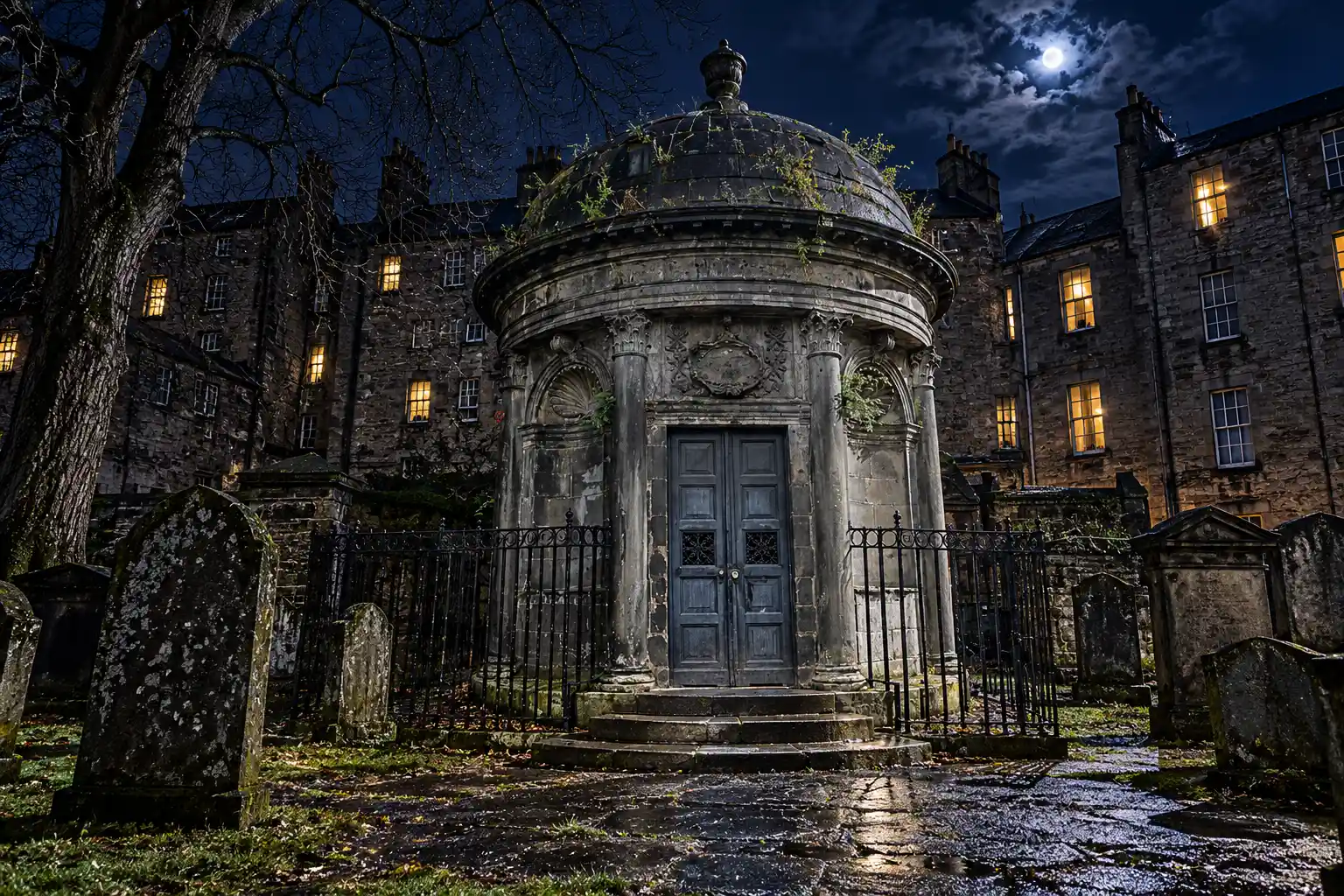
James Smith designed the mausoleum in 1691, the year Mackenzie died. The listed description of the mausoleum sets down a circular temple of smooth stone, domed and topped by an urn, modelled on Bramante’s Tempietto in Rome, the small chapel Palladio had printed. Engaged Corinthian columns flank shell-headed niches, and a later two-leaf wooden door faces north under a carved cartouche.
Inside, a restoration by Rowand Anderson in 1892 left small windows in a ribbed dome and plaster shells on the wall. Tours call the building the Black Mausoleum. The listed name is the mausoleum of George Mackenzie of Rosehaugh, and it stands on the south wall of the main churchyard, inside a Category A listing that covers the yard, the lodge, the gates and the walls.
Burials here go back to 1562, on friary land the town took after the Reformation so that St Giles would be less crowded. The church on that ground came later and still does not own the graves around it. You are in a civic burial ground that happens to wrap a kirk.
The Covenanters’ Prison is not this temple. It is the long narrow ground to the southwest, through a gateway with a broken pediment, with Heriot’s wall on the west and the Telfer Wall on the south. You can look at Smith’s north door from the open yard. The chain, when there is a chain, is on that southwest gate.
The dome had no famous ghost attached to it for most of its life. The poltergeist story begins with a break-in, and with the tours that gave the reports a name.
The Mackenzie Poltergeist Story After the Break-In
One published account places the break-in on Christmas 1998. A man looking for shelter fell through the floor into decomposing corpses. Within weeks, talk of blackouts and attacks had started around the tomb and the ground beside it.
Many tour scripts move that night into 1999. Nothing on the stone settles the year, so treat the two dates as rival tellings of one intrusion. Jan-Andrew Henderson, who founded City of the Dead Tours, named the Mackenzie Poltergeist in his book The Ghost That Haunted Itself, and he treats the break-in as the moment the reports began.
A guide on that night tour has put the company log above 3,500 visitor encounters. The log belongs to the tour. It is not a hospital list, and it is not a count published by the City of Edinburgh Council. A locked yard, a true history of cruelty and a crowd that came to be frightened can produce those reports on their own.
What Do Night Tours Log at the Tomb?
Guides and visitors describe a short list of effects, and you will hear the same list if you take two different tours on two different nights.
- On the skin: Scratches, bruises, burns or bites that the person says were not there at the gate.
- In the air: A sudden cold patch or a hot one, or a feeling of being pushed by nothing visible.
- Underfoot: Fainting in the gated ground, which a night tour then counts as an encounter.
Tour write-ups place those encounters in the gated prison ground, a few metres from the temple, rather than on the temple step itself. Henderson’s night groups are built for that corner. Standing at the south wall in daylight is a different visit, and it is the one the architecture can actually support.
In 2003 two teenage boys, one aged 15 and one aged 17, got in through a ventilation slot at the rear. The slot was sealed afterwards. They reached the lower vault, broke coffins, took a skull, and police found them playing football with it on the grass. A locked door is the practical answer to that afternoon, and the slot stays closed.
You do not need a night ticket to see the temple. You need the right gate, and a clear idea of which one is shut.
How to Visit the Haunted Edinburgh Mausoleum
The kirkyard opens off Candlemaker Row, at the head of the Grassmarket. A pin used for the site is 26A Candlemaker Row, Edinburgh, EH1 2QQ. The kirk does not own the yard. The City of Edinburgh Council does, and the kirk says the council leaves the Candlemaker Row gate open 24 hours a day. The church, the museum and the shop are a separate door, with their own clock.
BEFORE YOU GO THROUGH THE GATE
- Main yard: Smith’s round temple is on the south wall, and the north door can be seen with no ticket and no key.
- Prison ground: The southwest enclosure is the old holding area, and the pedimented gate is locked for long stretches so the monuments can be preserved.
- Kirk hours: From April to October the building is normally open Monday to Friday, 10.30 to 16.30, and on Saturday from noon to 16.00, unless a service or a concert has the space.
Check the kirk’s own visiting hours before you count on the church being open, because a concert or a service can close the public route even in season. If you only want Mackenzie, you do not need that door. The south wall is enough.
If the Prison Gate Is Chained
A chained gate means the council is protecting the stones. It does not mean a ghost tour owns the dead. Council bereavement staff can arrange access to graves in that strip, James Hutton’s among them. The free public route is Friends openings of the prison ground, when the Friends unlock the enclosure, take no booking, and stand by in green tabards to talk about the yard. A paid night tour is the other way in. It buys a story and a chance to stand inside the gate, and it is optional.
Do not climb the gate, and do not try any gap at the back of the temple. The rear slot two boys once used has been sealed, because coffins were disturbed. The grass is uneven after dark, and the yard is not free of ordinary trouble once the light has gone.
A Daytime Walk to the South Wall
- Come in from Candlemaker Row and leave the Bobby statue until you exit, because the bronze dog stands outside the gate on the corner with George IV Bridge.
- Cross the open kirkyard to the south wall and stop at the round dome with the urn and the wooden door facing you.
- If the southwest gate is open, the enclosure beyond is the prison ground, and you have already passed the temple.
- Step into the kirk only if the welcomers’ boards are out, then leave by the same Candlemaker Row gate while you can still read the stones.
That walk shows you the lawyer’s tomb and the gate that closes the Covenanter ground. The afternoon visit and the night ticket are different products, and only one of them is the building James Smith designed.
Frequently Asked Questions
What Is the Children’s Rhyme at the Mackenzie Door?
The line people dare each other to shout at the locked door is “Bluidy Mackingie, come oot if ye daur, lift the sneck and draw the bar!” A sneck is the latch. It is a children’s challenge in Scots, and it does not come from any trial paper of Mackenzie’s.
When Was the National Covenant Signed at Greyfriars?
The National Covenant was signed in the church itself on 26 February 1638, not out among the graves. It rejected Charles I’s church policy and refused the king as spiritual head of the church in Scotland. The Covenanters Mackenzie later prosecuted stood in that tradition.
Which Gravestone Names Are Tied to Harry Potter?
JK Rowling has said stones in this kirkyard suggested character names. Thomas Riddell, who died in 1806, and his son Thomas, who died in 1802 at 26, sit behind Tom Riddle. The poet William McGonagall, also buried here, supplied the surname for Professor McGonagall, and other stones are said to have suggested Alastor “Mad Eye” Moody and Rufus Scrimgeour.
Can the Mackenzie Poltergeist Follow You Home?
The Mackenzie Poltergeist does not travel home with you in any checked account. Guides describe scratches, shoves and faints on the spot, during night tours in the gated ground. A mark you notice later is a reason to see a clinic, not a reason to book a second night.
Did Mackenzie Defend an Accused Witch?
Yes. He published a pleading for a woman he called Maevia, who had been accused of witchcraft. That speech is a separate piece from the criminal-law chapter in which he tells judges to demand clearer proof before they send anyone to the stake. He still held that witchcraft was a real crime under Scots law.
On an ordinary afternoon the wooden door under the cartouche stays shut, the urn is still on the dome, and the chain on the southwest gate is a preservation lock. That is the Mackenzie tomb Greyfriars can show you without a ticket.

Gold Prices Fall to a 14-Month Low Despite Strikes

SpiceJet Clears a Rs 5,500 Crore Raise After Mumbai Stalled

Honda Activa’s Record Month Came With a Share Loss

Sony Turns the GTA 6 Launch Into a Firmware Gate

Xiaomi 18 Leak Skips the Rear Screen for Battery

Volkswagen Sells the Osnabruck Plant to Clear a Board Fight

Apple’s Foldable iPhone Hinges on Samsung Display Supply

Saksham Gaur Finds He Is His Own Company’s Client

Tata Motors’ Iveco Tender Opens as Holders Still Decide

What Is SD on Amazon Prime?
-
 AUTO2 months ago
Volkswagen Sells the Osnabruck Plant to Clear a Board Fight
-
 NEWS3 months ago
Apple’s Foldable iPhone Hinges on Samsung Display Supply
-
 BUSINESS3 months ago
Saksham Gaur Finds He Is His Own Company’s Client
-
 AUTO3 months ago
Tata Motors’ Iveco Tender Opens as Holders Still Decide
-
 TECHNOLOGY3 years ago
What Is SD on Amazon Prime?
-

 BUSINESS3 months ago
Hyderabad 22-Carat Gold Jumps After a False Bargain
-

 GAMING3 months ago
Onimusha Way of the Sword Preload Hits a Windows 11 Wall
-

 ENTERTAINMENT2 years ago
Andy Scott’s Steel Loon Repeats the Kelpies Regeneration Bet