
TRAVEL
Solo Packraft Adventure in Assynt: Planning the Scottish Wilds
A solo packraft adventure in Assynt works when the wind lets you paddle and a shore path lets you walk off before dark. Plan the kit, the loch and a walk-out.

A solo packraft adventure in the Scottish wilds is a walk that borrows a loch. You carry a small inflatable boat to the shore, paddle while the water stays kind, and put it back on your shoulders when the wind or a shallow burn makes the boat the slow tool.
Assynt, in the northwest Highlands, is where that choice shows up fast. Lochs sit under Suilven and its neighbours, and the ground between them is bog, tussock and rock, with few paths a walker would call easy. The boat is how you cross the water. Your feet are how you finish the day.
The trip is realistic for a careful first-timer on a calm morning, and it becomes a bog march as soon as a headwind pins a light boat on a long loch. This guide covers what the boat is, which waters near Suilven fit a solo plan, what to carry, how access rules treat paddlers and anglers, and the moment to get off.
What a Packraft Does on an Open Highland Loch?
A packraft is a one-person inflatable you can roll into a backpack, then paddle sitting down with a double-bladed paddle that breaks into short pieces. It looks a little like a tiny raft and it steers more like a kayak. The point of the shape is the carry between lochs, not a soft seat for a holiday cruise.
People mix it up with a pool dinghy and with a heavy inflatable kayak. A packraft is made to be walked for hours and filled at the shore in a few minutes with a simple inflation bag, not a foot pump. Some models are built for rocky rapids, with a spray deck and thigh straps that let you edge the boat. Flat Highland lochs are a different job. They reward a hull that holds a line in a breeze and still fits beside a tent.
Carrying a small raft into wild country has a clear trail through one Alaskan racer. In 1952 Dick Griffith took a survival raft through Mexico’s Copper Canyon on the Rio Urique. At the 1982 Alaska Mountain and Wilderness Classic he was 55, and he unrolled a vinyl raft to row a glacial river on the Hope-to-Homer route while other racers faced a swim in their packs. That 1982 crossing is set out in Dick Griffith at the 1982 Wilderness Classic. The boat you take to Assynt is that idea in tougher, lighter fabric.
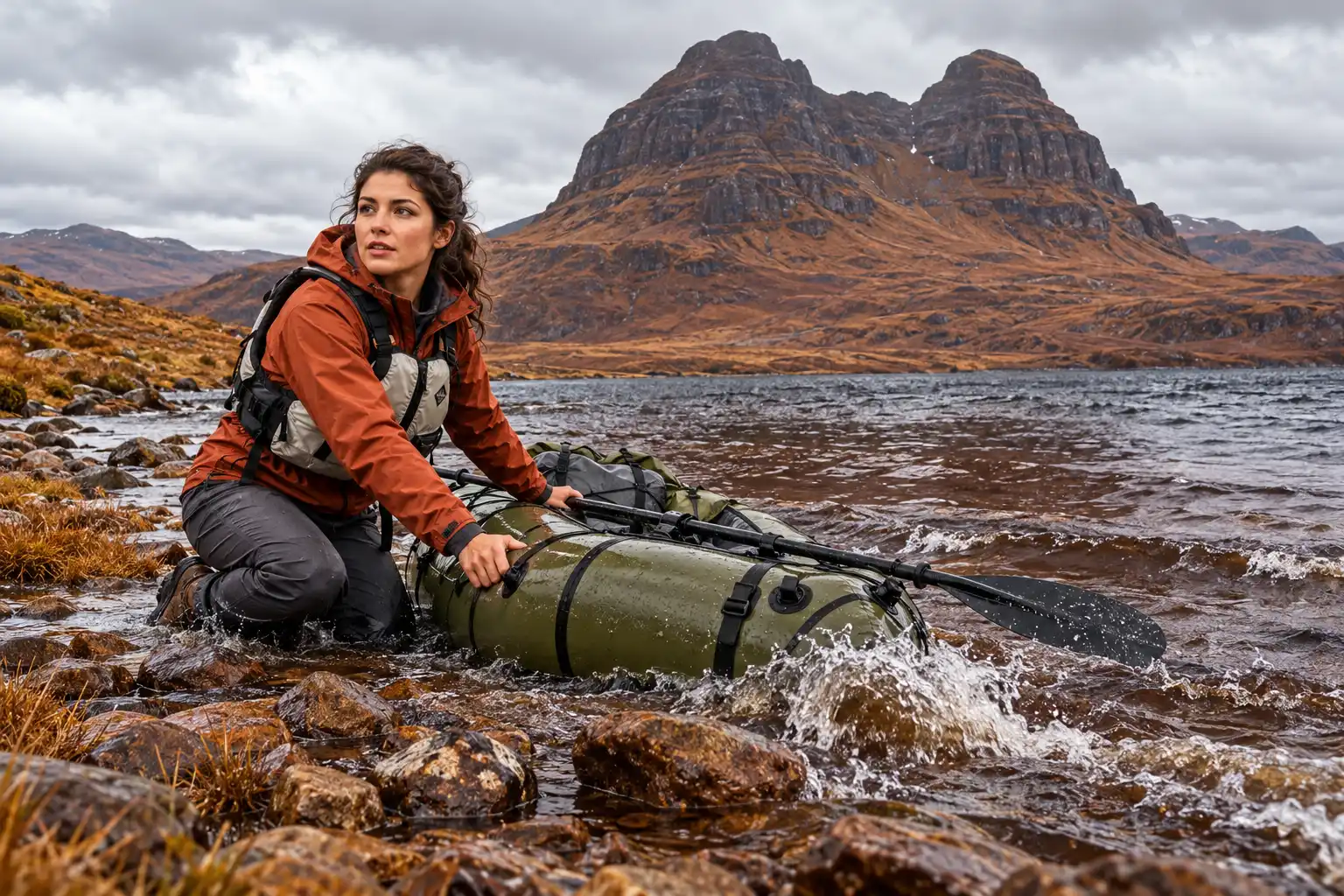
The Lochs Under Suilven
Once the boat is something you can carry, the next question is whether this water is the right place to put it down. Suilven stands at 731 m, modest beside many Scottish hills, and it still owns every shore around it. Cul Mor, Cul Beag, Stac Pollaidh and Canisp do the same work, steep tops jumping out of wet low ground rather than a long high ridge.
The chain on the south side of Suilven is the one a first solo trip can hold. Leave the car in the hamlet of Elphin and walk down to Loch Veyatie. The line runs on toward Fionn Loch, then a carry reaches the broader Loch Sionascaig. Cam Loch sits close enough to keep Suilven in view for much of a paddle, and its outflow is a reminder that a blue line on the map can be too thin to float.
Deer are more common than walkers here, and in the autumn rut stags call across the glens at night. That sound belongs to sleeping on these shores. It should not shape the route. The risk that should is a long open loch, a shore that turns to cliff, and a wind you did not mean to fight. Keep a public road inside a hard day’s walk on a first trip. Ullapool, to the south, is the place to buy food and to read the forecast before you leave the tarmac.
Why Does the Wind Decide the Day?
The lochs look like the easy half of the map. Wind is what takes that ease away. A short, light boat has little grip on the surface, so a breeze that would only slow a longer kayak can stop a packraft dead.
In late September 2025, Ash Routen started a first packraft trip on these lochs, alone, after practice on smaller water closer to home. He chose to leash the paddle to the raft so a capsize could not split him from the boat, and he tied his camping pack into the bow. The opening hundred metres on Loch Veyatie were already side-on waves. He found a rhythm anyway. Late in that September the heather was fading and the bracken on the hillsides had turned red, with the sea only a few hills off and a hint of salt in the air.
The distances from that week are easier to compare in one place.
| Stretch | What the September 2025 trip did |
|---|---|
| First afternoon on Loch Veyatie | 3.5 km to a stone beach, Cul Mor on one side and Suilven on the other |
| The next day | 8 km by 3 pm, after a bog walk off the wind, then a camp on Fionn Loch |
| Fionn Loch to Loch Sionascaig | A 3 km carry, empty boat dragged across bog and grass |
| Length of the trip | 6 days, with Suilven watched from the water and not climbed |
On that second morning one kilometre took more than half an hour. Walking was faster, and it kept him off rock that could cliff him out. He cut inland over tussock, picked up a faint path near Fionn Loch, and camped on stones with Cul Mor across the water. The boat had not failed. The wind had changed the job.
THE WIND TEST
- The pace: If the boat is slower than your boots, land and walk.
- The shore: Paddle only where you can step out. A rock wall is not a rest stop.
- The inland line: Mark the bog route on the map before you inflate, so leaving the loch is a path.
- The reload: On foot the boat goes back on your body with the camping pack.
A later morning on Loch Sionascaig was mirror calm, and he paddled the inlets because the surface allowed it. Same hull, different wind. Use the quiet days for the long crossings, and use the rough ones for the carries you were going to walk anyway.
Which Water Near Suilven Matches Your Plan?
With that wind test in mind, sort the usual shores before you leave Elphin. None of these is a rapid. The hard part is open water and a bad landing.
| Water | What the boat is for | When you walk instead |
|---|---|---|
| Loch Veyatie | The usual start from Elphin, and long enough for a headwind to stall a loaded packraft | Leave a cliffed shore and cut inland toward Suilven |
| Fionn Loch | The next link, with stone beaches that work as camps | A faint bog path beside the water gives you a line on foot |
| Loch Sionascaig | Broader water with islands, reached by a carry from Fionn Loch | Drag the empty boat on soft ground, or deflate if the rocks are sharp |
| Cam Loch | Open water with Suilven in view for much of the paddle | A 2026 trip walked off when the wind rose and the outflow was too low to paddle |
Islands on Sionascaig look like ready-made camps and often are not. Low bushes leave little flat ground for a tent, so a mainland beach of stones is the simpler pitch. A longer journey can join more inland lochs and even sea lochs over several weeks. That is a later trip, for someone who already self-rescues and who has a walk-off on every exposed crossing.
What to Pack for Cold Water and a Bog Carry
The shore you pick only works if the kit matches cold water and a carry through bog. Separate the hull, the safety clothing and the week’s food in your head before you try to separate them on a wet bank.
THE KIT THAT EARNS ITS CARRY
- The hull: The flatwater boat on the September 2025 trip weighed 2 kg and cost about $300.
- The usual range: Many packrafts weigh less than 4 kg, while sturdier boats, often the whitewater models, are priced above $1,000.
- The cold-water list: One listed setup, with the boat, thigh straps, spray deck, safety lines, paddle, dry clothing, inflation bag, helmet, backpack and dry bag, weighs 7 kg (15 lb).
- The camping pack: The loaded pack in the bow on that trip weighed 15 kg, and it was strapped down so a swim could not take the tent.
- The leash and the aid: Clip the paddle to the boat, and wear the buoyancy aid on your body for the whole time you are afloat.
- The clothes: Dry layers or a drysuit you can actually paddle in. Cotton stays wet and pulls heat off you.
The 2 kg figure is the hull alone, the 7 kg figure is a full cold-water boat kit that already includes a hull, and the 15 kg figure is the camping pack from the September 2025 trip. Add food and a tent on top of the hull, not on top of all three. A helmet earns its space on a rocky burn. On an open loch the leash and the aid do more for you.
How to Start a Solo Packraft Adventure From Elphin
Kit on the floor at home is not a launch at Elphin. Move through the morning in this order, and stop at the first step that fails.
- Read the wind for the loch the night before, not only the forecast for the summits. A light boat feels a breeze that a hill path ignores.
- Tell someone your lochs, your likely camps and the evening you will call. Solo should be a plan, not a disappearance.
- Park at Elphin and walk to a shore clear of sharp rock. If a public slipway is close, use it, which also spares the bank.
- Inflate fully, fit a deck if chop is likely, strap the pack into the bow and clip the paddle leash before you push off.
- Keep a beach within a short paddle. If the first short stretch is all side-on waves you cannot correct, go back.
- When the boat is slower than walking, land and take the inland line you marked that morning.
- On a short, soft carry, drag the empty boat and wear the pack. Deflate when the carry is long or the ground can cut the floor.
Practise the inflate and a climb back into the boat on a calm, shallow loch before you drive north. Assynt is a poor classroom for a first capsize. The drag toward Sionascaig worked because the ground was bog and grass. The same drag on scree is how a floor gets a hole, and a hole far from Elphin is a wet walk with a useless boat.
Anglers, Camping and the Scottish Access Rules
You can be tidy on the water and still get the trip wrong on the bank. You do not need a special boat permit for an ordinary loch here. Access rights include non-motorised rafting where the water suits the trip, and they tell you to stay off spillways and water intakes. The practical wording sits in rafting on lochs under the Access Code.
How Close Can You Paddle to an Angler?
Veyatie and its neighbours are fished for brown trout. A boat that is legal can still wreck a cast, or collect a hook in the tubes.
- On the loch: Stay well off any angler and keep your noise down.
- On a narrow neck: Wait for a signal from the angler or the ghillie, then take the line they suggest if you can do it safely.
- Near tackle: Do not paddle across nets or lines.
- On a busy fishery: If many rods are working a small commercial water, speak to the land manager before you inflate.
Those habits are how a right of access stays a right. The code is written for shared water, not for an empty brochure wilderness. Passing wide of a fishing boat costs you a few minutes. Arguing from the middle of someone’s drift costs the afternoon.
A Tent on a Stony Shore
Camping under the same rights means a lightweight tent, small numbers, and two or three nights in any one place, kept far from houses and roads. That standard is set out for lightweight camping away from buildings and roads.
Stone beaches take a pitch better than a soft green bank, which may be grazed or used by nesting birds. Cook on a stove. Peat, old heather and scattered trees are the wrong place for an open fire, especially in a dry spell. Bury human waste, and urinate well away from the loch and from any burn you plan to drink. The next paddler should not be able to find your site.
Islands, Banks and Shore Wildlife
The bank takes its damage when you get in and out, not while you are paddling the middle. Spend the extra minute looking for a rock shelf or an existing landing instead of clawing up peat.
Islands look unused and often hold the birds and animals that left the mainland shore when you arrived. Pass them wide, and camp on one only if you can do it without crushing the plants. Thick low bushes also make a poor tent pitch, which is another reason a mainland stone beach was the bed on the September 2025 trip. Nothing from the boat goes into the water, including food scraps and wash water.
When to Get Off the Water
Access tells you where you may be. Cold water tells you when you should leave. In water below 15°C, cold shock can make you gasp and breathe so fast that you inhale water, which is set out in cold water shock in the first minutes. Highland lochs spend much of the year at or under that line. Warm stones on the beach do not tell you the temperature at your waist.
During the gasp, keep your airway clear and do not sprint for shore. The fast breathing eases after a short spell. Only then should you swim, climb or paddle. A buoyancy aid is what holds your mouth up while that happens. It does not put you back in the boat.
WHAT YOUR BODY DOES IN THE WATER
- The first 30 seconds: The gasp and the fast breathing peak, so hold the boat and wait them out.
- Up to 2 or 3 minutes: Shock can still be running, and a breath-hold may drop below 10 seconds, which is worse when waves wash the face.
- From 3 minutes to 30 minutes: Grip and swimming strength fade, so do any clip, zipper or call for help while your hands still work.
- After 30 minutes: Hypothermia becomes the risk, and hard swimming cools you faster, so tuck in and show less of yourself to the water.
Solo changes the sums, because nobody else will push the boat back to you. The leash, the strapped pack and a shore you can name from your seat are the whole rescue. If you cannot point at the landing, you are already too far out for this kind of trip. Lightning, a burn that only scrapes along the floor, or fading light on a bog you have not walked are exits too. Stopping while you are still grumpy, not scared, is what kept that September week a hard walk.
Frequently Asked Questions
Can You Fish From a Packraft on an Assynt Loch?
No, not on access rights alone. Those rights cover walking, swimming and a non-motorised boat, and they do not cover fishing. Trout in these lochs are taken under permission from an estate or an angling group, so a rod needs that permission even when the packraft does not.
Do You Need to Swim Before a Solo Loch Crossing?
You need enough ease in the water to keep your face clear and to reach the boat or a shallow shore after a capsize. Wear the buoyancy aid so you float. Practise climbing back in on a calm, waist-deep loch before you travel alone, because the aid will not do that climb for you.
What Should You Do If a Connecting Burn Is Dry?
Step out and walk the portage you already measured on the map. If the floor scrapes, or you are poling more than paddling, that burn is a path. Deflate where the stones are sharp, and do not promise yourself the next loch until you are standing beside it.
Is Winter a Fair Time for a First Solo Trip?
Winter is a poor choice for a first solo. Daylight is short, shore stones ice up, and a walk back to the road that felt easy in September can finish in the dark. Save the cold months for a time when you already self-rescue in a drysuit and someone expects your call before dusk.
How Do You Tell a Commercial Fishery Loch?
Count the hire boats, look for a lodge and for permit boards, and ask in Elphin or Ullapool before you drive to the shore. A loch used hard as a commercial fishery is one you should clear with the land manager, because many rods in a small space are a safety problem as well as a business one.
If the loch at Elphin is already covered in small breaking waves when you shut the car door, the inland bog is the route for that morning. Keep the boat in the pack until you find a shore with the wind behind you, or with no wind at all.
Disclaimer: This is an educational guide to planning a solo packraft trip around Assynt, and it is information only. It is not personal coaching, a safety certificate, or a reason to launch on water you cannot leave. Speak to a qualified paddling coach or a local guide before you travel alone, and check the weather, the water level and the access advice for your own dates. Weights, prices and access rules reflect the sources used here and can change.

Gold Prices Fall to a 14-Month Low Despite Strikes

SpiceJet Clears a Rs 5,500 Crore Raise After Mumbai Stalled

Honda Activa’s Record Month Came With a Share Loss

Sony Turns the GTA 6 Launch Into a Firmware Gate

Xiaomi 18 Leak Skips the Rear Screen for Battery

Volkswagen Sells the Osnabruck Plant to Clear a Board Fight

Apple’s Foldable iPhone Hinges on Samsung Display Supply

Saksham Gaur Finds He Is His Own Company’s Client

Tata Motors’ Iveco Tender Opens as Holders Still Decide

What Is SD on Amazon Prime?
-
 AUTO2 months ago
Volkswagen Sells the Osnabruck Plant to Clear a Board Fight
-
 NEWS3 months ago
Apple’s Foldable iPhone Hinges on Samsung Display Supply
-
 BUSINESS3 months ago
Saksham Gaur Finds He Is His Own Company’s Client
-
 AUTO3 months ago
Tata Motors’ Iveco Tender Opens as Holders Still Decide
-
 TECHNOLOGY3 years ago
What Is SD on Amazon Prime?
-

 BUSINESS3 months ago
Hyderabad 22-Carat Gold Jumps After a False Bargain
-

 GAMING3 months ago
Onimusha Way of the Sword Preload Hits a Windows 11 Wall
-

 ENTERTAINMENT2 years ago
Andy Scott’s Steel Loon Repeats the Kelpies Regeneration Bet