
BUSINESS
Scotland’s Stranded Wind Lures Bitcoin Miners, Not Bill Cuts
Bitcoin miners want Scotland’s spare wind, but bill payers only gain if the load sits north of B4 and can switch off.

Bitcoin mining has been pitched as a buyer for Scotland’s stranded wind, the power turbines make when the wires south are full. The Bitcoin Policy Institute published that case in mid-November 2026. It is a think-tank argument, not a government programme.
The overlooked party is the household and business customer who already funds both sides of the trade. NESO paid just under £500 million in 2025/26 to turn wind down, while about 75% of the thermal constraint bill bought replacement energy, mostly from gas plants that a Highland mine does not replace.
Britain’s Biggest Opportunity Puts Miners Behind the Wires
The report, titled Britain’s Biggest Opportunity, is by Conner Brown, executive director of the Bitcoin Policy Institute, and Joey Garcia, head of regulatory affairs at Xapo Bank. They asked the Department for Energy Security and Net Zero and NESO to test mining sites behind transmission bottlenecks, especially along the Scotland-England boundary.
Their 2024 baseline is 8.3 TWh of wind turned off at a cost of £393 million, with 98% of that output in Scotland. They put the wider switch-off bill at more than £1 billion ($1.32 billion). That headline is the hook. It is not NESO’s paid-to-wind line, and it is not a sum miners can pocket.
The technical claim is narrower, and it is the part that stands up. ASICs can drop load in seconds. They have no customer workload to protect. A sample of ten mining firms, cited in the report, already cut power between 5% and 31% of the time when the grid asked.
Traditional data centers can contribute, but most require firm, uninterrupted power near metropolitan fibre hubs and cannot profitably shut down whenever the wind stops blowing.
Conner Brown and Joey Garcia, Britain’s Biggest Opportunity, Bitcoin Policy Institute
The report says mining is modular, quick to deploy, and able to run at partial use on cheap or unused power. That is the product. The bill-payer question is whether those boxes sit on the right side of the constraint, and who keeps the saving if they do.
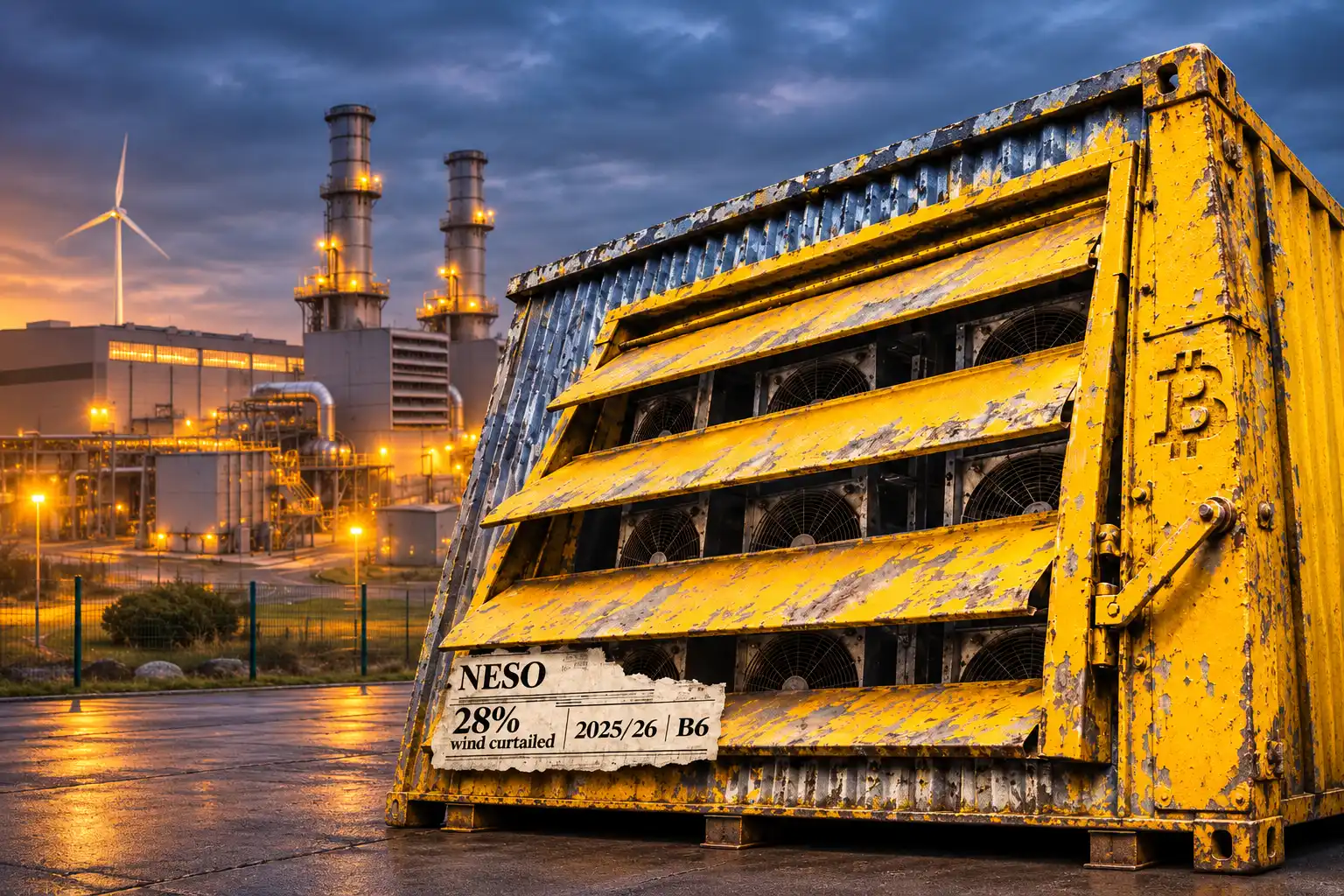
Almost £500 Million Went to Switching Wind Off
Mike Thompson, NESO’s chief economist, set out the 2025/26 outturn in mid-November 2026. Balancing costs rose 16% to £3.1 billion. Of that, just under £500 million paid to wind farms was for turning down. Constraints forced 13% of Great Britain wind offline, and 28% of wind north of the B6 boundary. NESO counted £891 million of quantified savings from using the existing network harder, managing outages, and flexing demand and supply.
THE 2025/26 BALANCING BILL
| Item | Figure |
|---|---|
| Total balancing costs | £3.1 billion, up 16% |
| Paid to wind farms to turn down | Just under £500 million |
| GB wind turned off for constraints | 13% |
| Wind north of B6 turned off | 28% |
| NESO quantified operational savings | £891 million |
Those switch-off payments are real. They are also the smaller cheque. Thermal constraints, the bottlenecks where lines cannot safely carry more power, remain the largest slice of the balancing bill. NESO’s November 2026 thermal constraints update puts that slice on course for £3.9 billion in 2027, and says the 2027 figure would be 16% lower without planned network outages. The outages are how the upgrades get built.
The Expensive Side of the Trade Is Gas
Thompson was blunt about where the money goes. Gas is the biggest part of the cost. About 75% of thermal constraint costs paid for replacement energy, predominantly from gas units. The average cost of Balancing Mechanism actions rose from about £90/MWh in April 2026 to £126 in September, and balancing costs hit record levels in October.
That split is why a new industrial load in Scotland does not automatically shrink the bill. When NESO turns a Scottish wind farm down, it often has to buy extra power south of the constraint to keep the lights on. A mine that sits beside the unused turbines can eat surplus wind. It does not ship extra megawatts to England, so the gas units that currently fill the gap still get paid unless demand in the south falls for some other reason.
October and December 2025 make the same point from the wires. December had more unconstrained wind (9.2 TWh against 7.9 TWh) and higher wholesale prices (£64/MWh against £53/MWh). October still had 34% higher balancing costs, because available capacity across the B4/B5 boundary in central Scotland was 52%, against 67% in December. The bill moved with the outages, not only with the wind.
Scotland’s Pinch Point Sits North of the Central Belt
BPI pointed DESNZ and NESO at the Scotland-England boundary. The first pinch is further north. Action to Protect Rural Scotland, drawing on NESO maps and Montel, puts the B4 boundary at 4 GW on the Tealing-Westfield 275 kV circuit, north of the central belt. B6, the border with England, is 6.7 GW on the Harker-Moffat 400 kV circuit.
Dr Callum MacIver, a research fellow at the University of Strathclyde who gave evidence to Holyrood’s Economy, Tourism and Energy Committee on 15 September 2026, said the Scotland-England boundary is not the first constraint. It is B4. Locating north of B4, he said, is likely to be more impactful in managing constraints.
Montel’s 2025 figures, carried in that briefing, show 10.14 TWh of energy was curtailed across the UK, including 10.06 TWh in Scotland. Of the Scottish total, 8.8 TWh sat in North Scotland, 87.5% of the Scottish figure, leaving 12.5% further south.
WHERE THE WASTED WIND SAT IN 2025
| Zone | Curtailed energy | Share |
|---|---|---|
| UK total | 10.14 TWh | Full Montel total |
| Scotland | 10.06 TWh | Almost all of the UK total |
| North Scotland | 8.8 TWh | 87.5% of the Scottish figure |
| South of that northern zone | Remainder | 12.5% of the Scottish figure |
A 20 MW container camp in the central belt is then hunting the thin end of the unused power. APRS also finds that all proposed hyperscale sites sit south of B4. Those projects total 7.2 GW in Scotland’s planning system. They are already making the same unused-wind claim miners now want. They are making it from the wrong side of the line.
Data Centres Already Queue for the Same Power
NESO is not waiting for Bitcoin. On 13 May 2026 in Glasgow, chief executive Fintan Slye said large users, including AI data centres, could cut the need to pay wind farms to turn down and other plants to turn up. NESO analysis in its Beyond 2030 National Blueprint says an extra 5 GW of flexible demand behind Scottish bottlenecks could save consumers up to £5 billion. With strong locational signals, up to 20% of future data-centre demand could sit in Scotland.
Scotland produces significant amounts of clean, home-grown electricity that is vital for Britain’s energy security.
Fintan Slye, Chief Executive, NESO, Glasgow, 13 May 2026
Holyrood heard the same month that about 80 GW of data-centre demand sits in the grid queue, while NESO is looking at around 6 GW connected by 2030 and 9-10 GW by 2035 across Great Britain. Miners would join that fight for connections, not walk onto an empty hillside.
WHO ALREADY WANTS THE SAME ELECTRONS
- NESO’s 5 GW case: Flexible demand behind Scottish bottlenecks is already modelled as a bill-saving tool, with data centres named first.
- 7.2 GW of hyperscale plans: Every site now in the planning system sits south of B4, so most unused northern wind still has no local buyer.
- Local Constraint Market: NESO has already paid Scottish households and firms to turn up heat pumps, EVs and electric heating when B6 is full, but the contracted trial volume was 3 MW across ten days.
- The wires themselves: Six subsea links totalling 12 GW are the official long-run answer to the export cap.
The 3 MW trial matters as a proof of method, not as scale. A single modest mine is already several times larger. The political order of battle is still data centres, heat, and cables. Mining is asking to be let into a queue that does not yet have its name on it.
THE SUBSEA LINKS ALREADY FUNDED
- 2029: Eastern Green Link 1 (East Lothian to County Durham) and Eastern Green Link 2 (Aberdeenshire to North Yorkshire) add 4 GW.
- 2033: Eastern Green Link 3 and Eastern Green Link 4 add 2 GW each.
- Early 2030s: Western Link 2 adds 2 GW from Ayrshire to Wales.
- 2035: Eastern Green Link 5 adds 2 GW from Aberdeenshire to Lincolnshire, taking the six-link total to 12 GW.
APRS notes that the first two links, due in 2029, would remove much of today’s unused-wind problem if generation build does not outrun them again. A mining camp that takes three years to connect is then racing a cable that was always the main plan.
Would a Scottish Mine Even Pay for Itself?
The modelling advocates keep citing is not a Highland site. Researchers at the Technological University of the Shannon, writing in Energy Economics, paired a 20 MW mine with a hypothetical 100 MW Irish wind farm on 2024 hourly data. The mine captured 83.1% of the farm’s annual dispatch-down energy, lifted combined system revenue from €22.2 million to €29.2 million (the paper’s 32%), and moved the farm’s effective capacity factor from 29% to 32%. Scaling to 30 MW absorbed 93.4% and raised system revenue to €31.1 million, with diminishing returns after that.
Payback is a Bitcoin-price story. At €100,000 per coin, the 20 MW project repaid in 2.13 to 3.56 years across the curtailment cases they ran. At €80,000, payback was 3.44 years at 25% curtailment and 4.07 years at 20% curtailment, and every lower-curtailment case missed the six-year equipment life. At €60,000, none of the tested cases paid back inside six years.
That is the commercial hole in the Scottish pitch. Unused power is irregular. Machines, buildings, cooling, and staff are not. A site that only runs when B4 is binding may not cover its kit, even if the electricity looks free on a windy Tuesday. The missing test is not another white paper. It is an hourly match between the miner’s draw, the wind farm’s output, and the export limit on that boundary. Without that log, nobody can say how many hours of usable power exist, or what the delivered cost is after grid charges.
Bill Payers Win Only If the Load Can Stop
Britain’s legal footing for Bitcoin as property is not the same as a path for industrial mining. BPI flags banking and tax drag. Research by the UK Cryptoasset Business Council, cited in the report, says about 40% of retail transfers to crypto exchanges are blocked or delayed by British banks. The FCA had already lifted its ban on retail crypto exchange-traded notes, then tax changes in April 2026 kept those notes out of Stocks and Shares ISAs. Brown said a regulated market needs to work for the people using it.
HMRC’s own VAT manual still helps on one narrow point. Bitcoin received by miners for mining is generally outside the scope of VAT, because the activity is not treated as a VAT economic activity. That does not fix connection queues, TNUoS, or a bank that will not hold the operator’s cash.
A trial that was serious about bills would publish curtailment hours at the chosen node, the tariff after grid charges, the emissions change against leaving the turbines off, and a contract that lets NESO dump the load as fast as it dumps a wind farm. It would also say who keeps the saving: the miner, the generator, the system operator, or the people who pay BSUoS.
WHAT WE KNOW
- The pitch: Britain’s Biggest Opportunity asks DESNZ and NESO to test mining behind Scottish bottlenecks. It is not an approved scheme.
- The 2025/26 bill: Balancing costs were £3.1 billion, with just under £500 million paid to wind farms to turn down.
- The map: 8.8 TWh of 2025’s unused Scottish wind sat in North Scotland, and B4 is the first thermal pinch.
- The queue: 7.2 GW of hyperscale data-centre plans in Scotland’s planning system sit south of that pinch.
WHAT IS UNCONFIRMED
- Consumer savings: No location-specific model shows what a Scottish mine would take off bills after gas replacement and grid charges.
- Usable hours: Nobody has published the hour-by-hour overlap between a named northern node and a miner’s break-even price.
- The off switch: It is untested whether a commercial miner would accept NESO interruption often enough to stay a flexibility asset rather than a firm load.
Eastern Green Link 1 and 2 are due in 2029 and add 4 GW of export capacity. That is the scale NESO is already building. A mining trial that wants to claim a slice of the unused wind has to plug in north of B4, take NESO’s off switch, and show the saving on the gas side of the bill, not only on the turbines that were paid to stop.
Disclaimer: This article is news reporting and analysis of a policy proposal and of published grid figures. It is for information only and is not investment, trading, tax, or energy-procurement advice, and it is not a recommendation to mine Bitcoin, buy cryptoassets, or site industrial load. Readers considering mining hardware, power contracts, or crypto exposure should consult a qualified financial adviser, tax adviser, and, for grid connections, a licensed energy professional before acting. Figures and project statuses are those given by NESO, BPI, Montel, APRS, HMRC, and the named researchers at the dates in their documents, and they can change with gas prices, outages, Bitcoin price, and planning decisions.

Gold Prices Fall to a 14-Month Low Despite Strikes

SpiceJet Clears a Rs 5,500 Crore Raise After Mumbai Stalled

Honda Activa’s Record Month Came With a Share Loss

Sony Turns the GTA 6 Launch Into a Firmware Gate

Xiaomi 18 Leak Skips the Rear Screen for Battery

Volkswagen Sells the Osnabruck Plant to Clear a Board Fight

Apple’s Foldable iPhone Hinges on Samsung Display Supply

Saksham Gaur Finds He Is His Own Company’s Client

Tata Motors’ Iveco Tender Opens as Holders Still Decide

What Is SD on Amazon Prime?
-
 AUTO2 months ago
Volkswagen Sells the Osnabruck Plant to Clear a Board Fight
-
 NEWS3 months ago
Apple’s Foldable iPhone Hinges on Samsung Display Supply
-
 BUSINESS3 months ago
Saksham Gaur Finds He Is His Own Company’s Client
-
 AUTO3 months ago
Tata Motors’ Iveco Tender Opens as Holders Still Decide
-
 TECHNOLOGY3 years ago
What Is SD on Amazon Prime?
-

 BUSINESS3 months ago
Hyderabad 22-Carat Gold Jumps After a False Bargain
-

 GAMING3 months ago
Onimusha Way of the Sword Preload Hits a Windows 11 Wall
-
 BUSINESS3 months ago
UltraTech Ultravolt Launch Splits Friday Stocks to Watch