
NEWS
AMD Zen 6 Packs 12 Cores as the PC Market Shrinks
Zen 6 puts 12 cores on each chiplet in EPYC Venice, but AMD is a data-center-first company planning for a smaller PC market in 2027.

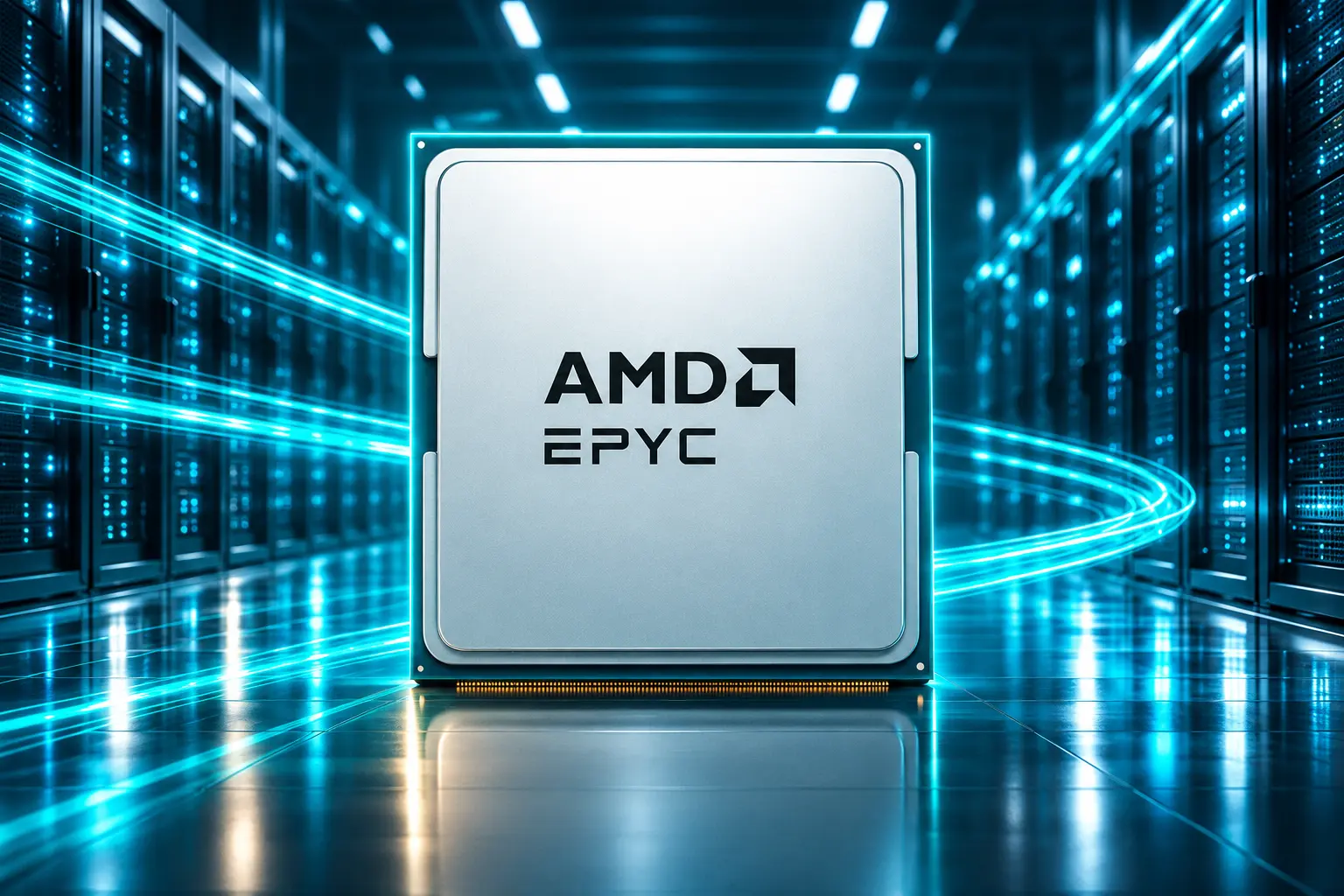
AMD’s Zen 6 core design, now shipping in EPYC 9006 server chips, puts 12 cores on each chiplet and claims a 27 percent jump in work per clock. Those are data-center parts. Desktop Ryzen chips that use the same core have no date, and the company that would sell them is planning for a smaller PC market.
The server boom paid for the 2-nanometer dies. It is also the reason a new gaming PC is getting harder to buy.
Venice Ships First, and Ryzen Gets the Leftovers
AMD said on November 10, 2026, that EPYC 9006 SP7 platforms are shipping, the first of four planned Venice families. The parts use Zen 6 and denser Zen 6c cores, PCIe 6.0, and JEDEC-standard MRDIMM-12800 memory. High-frequency host chips reach frequencies up to 5.3 GHz, and AMD puts per-socket memory bandwidth at up to 1.6 TB/s.
Lisa Su, AMD chair and CEO, had already tied the ramp to the data center. In the company’s November 3 earnings release she said demand for Instinct and EPYC kept strengthening, and that AMD expected growth to accelerate in the fourth quarter as it scaled Helios and Venice production.
VENICE ON THE LOADING DOCK
- Top SKU: The EPYC 9996 is listed at 256 cores and 512 threads, 1,024 MB of L3 cache, a 4.1 GHz boost, 600 W default power, and $14,904 in 1,000-unit pricing.
- Floor SKU: The lineup also includes an eight-core EPYC 9016 at $700, so the same family spans a bargain edge chip and a rack flagship.
- Standard Zen 6: Up to eight 12-core chiplets give 96 cores, 384 MB of L3, and the 5.3 GHz peak on frequency-tuned models.
- Dense Zen 6c: Up to eight 32-core chiplets give 256 cores and 1,024 MB of L3, with boosts up to 4.1 GHz.
That is not a desktop chip. AMD has not confirmed core counts, clocks, socket plans, or a launch window for Ryzen using Zen 6. The useful read for PC builders is the chiplet, because that tile is what later X3D parts would reuse.
Twelve Cores on One Die Cut the Old Penalty
Zen 5 put eight full cores on a chiplet and shared 32 MB of L3 among them. Zen 6 puts 12 cores on that tile and shares 48 MB. Cache per core stays at 4 MB, and each core still has a private 1 MB of L2. The extra cores are a 50 percent increase on the same kind of die, and the extra last-level cache is 50 percent as well.
That change is the part that maps to games. A 16-core Ryzen 9 today splits work across two eight-core chiplets, so some threads pay a hop when they miss local L3. A 12-core Ryzen 7 built as a single Zen 6 chiplet would keep every core on one 48 MB pool. AMD has not said it will ship that SKU. The server die makes it possible without adding a second compute tile.
ZEN 5 TO ZEN 6, ONE CHIPLET
| Feature | Zen 5 | Zen 6 | Zen 6c |
|---|---|---|---|
| Cores per chiplet | 8 | 12 | 32 |
| L3 per chiplet | 32 MB | 48 MB | 128 MB |
| L3 per core | 4 MB | 4 MB | 4 MB |
| L2 per core | 1 MB | 1 MB | 1 MB |
| Peak clock in EPYC | 5.0 GHz | 5.3 GHz | 4.1 GHz |
Zen 6c is the density sibling, doubling Zen 5c’s 16 cores and lifting L3 per core from 2 MB to 4 MB, which is why a full 32-core tile holds 128 MB. Desktop rumors that imagine 24-core Ryzen 9 parts assume two 12-core chiplets. That layout is a guess until AMD prints a stack-up.
The compute tiles sit on TSMC’s 2-nanometer-class N2 family. TSMC’s own N2 paper says the node uses gate-all-around nanosheet transistors and offers 15% more speed or 30% less power than 3-nanometer, with more than 1.15 times the chip density. N2P is the speed add-on, about 5 percent faster than base N2 and scheduled for volume in 2026. Last year’s Ryzen compute tiles were 4-nanometer-class parts. The process jump is real. It is also the expensive wafer that data-center customers are already buying in bulk.
What the 27 Percent IPC Claim Measures
AMD’s 27 percent instructions-per-clock figure is an average across selected server workloads, not a single-core gaming score and not a promise for Ryzen. The company compared 16 active Zen 6c cores on one chiplet with 16 Zen 5 cores spread across two chiplets, both running at the same frequency. It reports about 20 percent in enterprise and cloud work and about 31 percent in AI work. The 27 percent average mixes those, and it already includes the gain from keeping the cores on one die.
That method is why the number travels badly into a Steam library. A game that cares about one fast core and a fat L3 will not see a 27 percent lift just because a 256-core EPYC did. The fair takeaway is narrower: AMD is spending transistor budget on the core, and it is also spending it on putting more of those cores in one cache domain, which is the same trick that made X3D chips hard to catch in games.
WHAT GREW INSIDE THE CORE
- Reorder buffer: Entries rise from 448 to 640, so the core can keep more in-flight work in play.
- Integer registers: The physical file grows from 240 to 352 entries, matching the wider window.
- Op cache and feed: The operation cache goes from 6K to 6.75K entries, and delivery bandwidth rises from 12 to 18 operations per cycle.
- Memory queues: Load queues expand from 64 to 80 entries and store queues from 96 to 128.
- AI math: Full AVX-512 FP16, new bit-matrix multiply instructions, and four VNNI-INT8 pipes instead of two.
SMT stays at two threads per core. Zen 6 still aims at clocks; Zen 6c still aims at density. Both share the instruction set. Branch prediction and integer scheduling were revised as well, which is the unglamorous work that shows up in game codes that stall on poorly predicted branches.
People treating the 27 percent slide as a Ryzen preview are reading a server test as a frame-rate forecast. AMD has not published a desktop figure. The chiplet math is the part that actually carries.
Lisa Su Put the Data Center Ahead of the PC
On November 3, AMD reported third-quarter revenue of $13.4 billion, up 45 percent from a year earlier, for the quarter ended September 26, 2026. Data-center revenue was a record $8.5 billion, up 97 percent, about 63 percent of the company. In the release, Su said Data Center segment sales nearly doubled year over year.
AMD’S THIRD QUARTER, IN FOUR LINES
- $8.5 billion: Data-center sales, up 97 percent, on EPYC and the Instinct MI450 series.
- $2.9 billion: Client PC-chip sales, up 7 percent, led by Ryzen mobile.
- $773 million: Gaming sales, down 40 percent, on lower semi-custom and graphics revenue.
- $3.7 billion: Client and gaming together, down 8 percent, against a company that just printed a record quarter.
A few days later Su told Yahoo Finance’s Brian Sozzi where the company’s weight now sits.
We are a data center first company, that is our profile and you know, people need more computing to power all these applications.
Lisa Su, AMD chair and CEO, to Yahoo Finance
On the earnings call she was just as blunt about PCs. “PC sell-through slowed late in the quarter as higher memory and component costs weighed on demand,” she said. Then she gave the planning number that should sit next to every Zen 6 gaming mock-up: “In 2027, we are planning for PC market unit shipments to decline by a double-digit percentage.” AMD still says it expects to beat that market on the Ryzen roadmap and commercial PCs. It is not planning for the market to grow.
THE SQUEEZE ON THE PC BUILDER
- September 26, 2026: AMD’s third quarter closes with data center at $8.5 billion and gaming at $773 million.
- October 29, 2026: Intel’s quarter shows the same memory bind on the client side, even as its server group climbs.
- November 3, 2026: Su confirms PC sell-through slowed on higher memory and component costs, and sets a 2027 plan for a double-digit drop in PC units.
- November 10, 2026: EPYC 9006 SP7 platforms ship and AMD publishes the Zen 6 chiplet details PC owners are now reading as a Ryzen preview.
- January 2027: Intel is due to say more about Nova Lake at CES, still inside the memory crunch both companies described this fall.
Last year’s halo chips did not rewrite that mix. The Ryzen 7 9850X3D was a clock bump on the 9800X3D. The Ryzen 9 9950X3D2 Dual Edition stacked cache in a jack-of-all-trades package. Both were still client products inside a company whose growth is now Instinct racks and Venice sockets.
Higher Memory Costs Hit the Whole Box
Su’s explanation for weak PC sell-through was not a soft quarter for Ryzen as a brand. It was the bill of materials. “Our view is this is one of those times when component prices go up, it affects overall system pricing,” she said on the call. “One would expect the consumer markets to be more sensitive to that. And so we have seen a bit of slowdown in the sell-through.”
The same memory that feeds HBM in AI racks is the DRAM and NAND in a gaming build. When data-center buyers clear the shelves, a 32 GB kit and a GPU become the expensive parts of the box, and the CPU, even a fast one, is not the line item that kills the purchase. AMD’s own gaming line, the semi-custom console silicon and Radeon cards, fell 40 percent to $773 million in the quarter for that reason among others.
Intel is living in the same aisle. Its third-quarter deck, released October 29, 2026, lists a PC market challenged by memory shortages. Revenue was $16.5 billion, up 21 percent, but that lift was the server side. Data Center and AI rose 78 percent to $7.3 billion. The client group was $8.1 billion, down 5 percent. David Zinsner, Intel’s CFO, said the PC slowdown should last at least through the first half of 2027.
A 12-core Zen 6 Ryzen 7 with a stacked-cache sibling would still need a board, memory, and a GPU. If those three keep rising, the chip that looks unbeatable on a slide is a chip that sits in a build fewer people complete.
What Intel Has Confirmed About Nova Lake
Intel has confirmed that Nova Lake is its high-end desktop answer, that it is the first client family tied to the 18A-P process, and that more detail is due at CES in January 2027. Lip-Bu Tan, Intel’s CEO, said on the October 29 call that Nova Lake is tracking ahead of schedule, with design wins expected to be twice those of Panther Lake at launch. Zinsner said the company has had a hole in high-end desktop and that Nova Lake fills it.
That is the confirmed set. It is also the set that matters, because it means Intel is aiming at the same X3D-shaped hole AMD has owned, and it is doing so in a year both companies already described as ugly for PC units.
WHAT WE KNOW
- The brief: Nova Lake is a Core Ultra Series 4 desktop family aimed at the high-end gap, with extra detail promised at CES in January 2027.
- The node: Intel calls it the first client product on 18A-P, an enhanced 18A with backside power; some compute tiles have been described as TSMC N2P in partner materials, which Intel has not put in the earnings script.
- The bet: Intel has talked about a larger last-level cache, often labeled bLLC, as the reply to 3D V-Cache, without publishing a retail SKU list.
WHAT IS UNCONFIRMED
- Core maps: Leaked tables that put a Core Ultra 9 4970K BFC at 8 P-cores, 16 E-cores, and 4 low-power E-cores, 125 W, with a big-cache badge, have not been issued by Intel.
- Dual-tile parts: Partner slides that show 28-core single-tile chips first and 52-core dual-tile chips later in 2027 remain unconfirmed.
- Cache sizes: Figures of 144 MB on a single tile and 288 MB on two tiles are in the leak pile, not on an Intel product page.
Tan also said Intel is taking some Panther Lake capacity off the line to build more Granite Rapids server CPUs. That is the same allocation logic as AMD’s, just from the other side of the aisle: when the rack pays, the desktop waits.
The Cache Stack on Venice-X Looks Familiar
AMD has already shown that Zen 6 can take stacked cache. The shipping note for SP7 lists a 9006X follow-on, Venice-X, after the first wave. Briefings on AMD’s figures put a top 9006X at 1,152 MB of L3. On eight 12-core chiplets that is 144 MB per tile, which splits as 48 MB of on-die L3 plus 96 MB of stacked cache, the same 4 MB native plus 8 MB stacked per core that current X3D chips use, scaled from eight cores to 12.
If a desktop X3D part inherits that tile, a 12-core gaming chip would hold 144 MB of L3 on one die. That is the configuration enthusiasts keep drawing on whiteboards, and it is the one AMD has not confirmed. It is also the one that would arrive, if it arrives, into Su’s double-digit PC-unit plan and into Intel’s memory-shortage year.
A fatter chiplet on a 2-nanometer wafer, with stacked cache on top, is not a cheap object. More cores on more complicated chips will cost more. That was true before Venice shipped. It is more true when the foundry’s 2-nanometer line is already spoken for by server and phone customers.
AMD has not set a date for the first Zen 6 Ryzen chip. The server parts are already on sale.

Gold Prices Fall to a 14-Month Low Despite Strikes

SpiceJet Clears a Rs 5,500 Crore Raise After Mumbai Stalled

Honda Activa’s Record Month Came With a Share Loss

Sony Turns the GTA 6 Launch Into a Firmware Gate

Xiaomi 18 Leak Skips the Rear Screen for Battery

Volkswagen Sells the Osnabruck Plant to Clear a Board Fight

Apple’s Foldable iPhone Hinges on Samsung Display Supply

Saksham Gaur Finds He Is His Own Company’s Client

Tata Motors’ Iveco Tender Opens as Holders Still Decide

What Is SD on Amazon Prime?
-
 AUTO2 months ago
Volkswagen Sells the Osnabruck Plant to Clear a Board Fight
-
 NEWS3 months ago
Apple’s Foldable iPhone Hinges on Samsung Display Supply
-
 BUSINESS3 months ago
Saksham Gaur Finds He Is His Own Company’s Client
-
 AUTO3 months ago
Tata Motors’ Iveco Tender Opens as Holders Still Decide
-
 TECHNOLOGY3 years ago
What Is SD on Amazon Prime?
-

 BUSINESS3 months ago
Hyderabad 22-Carat Gold Jumps After a False Bargain
-

 GAMING3 months ago
Onimusha Way of the Sword Preload Hits a Windows 11 Wall
-

 BUSINESS3 months ago
UltraTech Ultravolt Launch Splits Friday Stocks to Watch