
NEWS
Scotland’s Tea Gardens Carry a Long Climate Food Bet
Scotland is restating a 2009 bread-basket wager even as its flagship estate tea still totals two to three kilograms a year.

Scotland’s best-known estate tea still totals two to three kilograms a year, 19 years after the first bushes went in near Forfar. In mid-October 2026, as the picking season closed, that crop was being poured as Kinnettles Gold, at about £40 a packet.
The same week, Prof Wayne Powell, principal and chief executive of Scotland’s Rural College, restated a claim his institution has carried since 2009: that a warming climate could make Scotland a bread basket for Europe.
The Flagship Tea Still Comes by the Kilogram
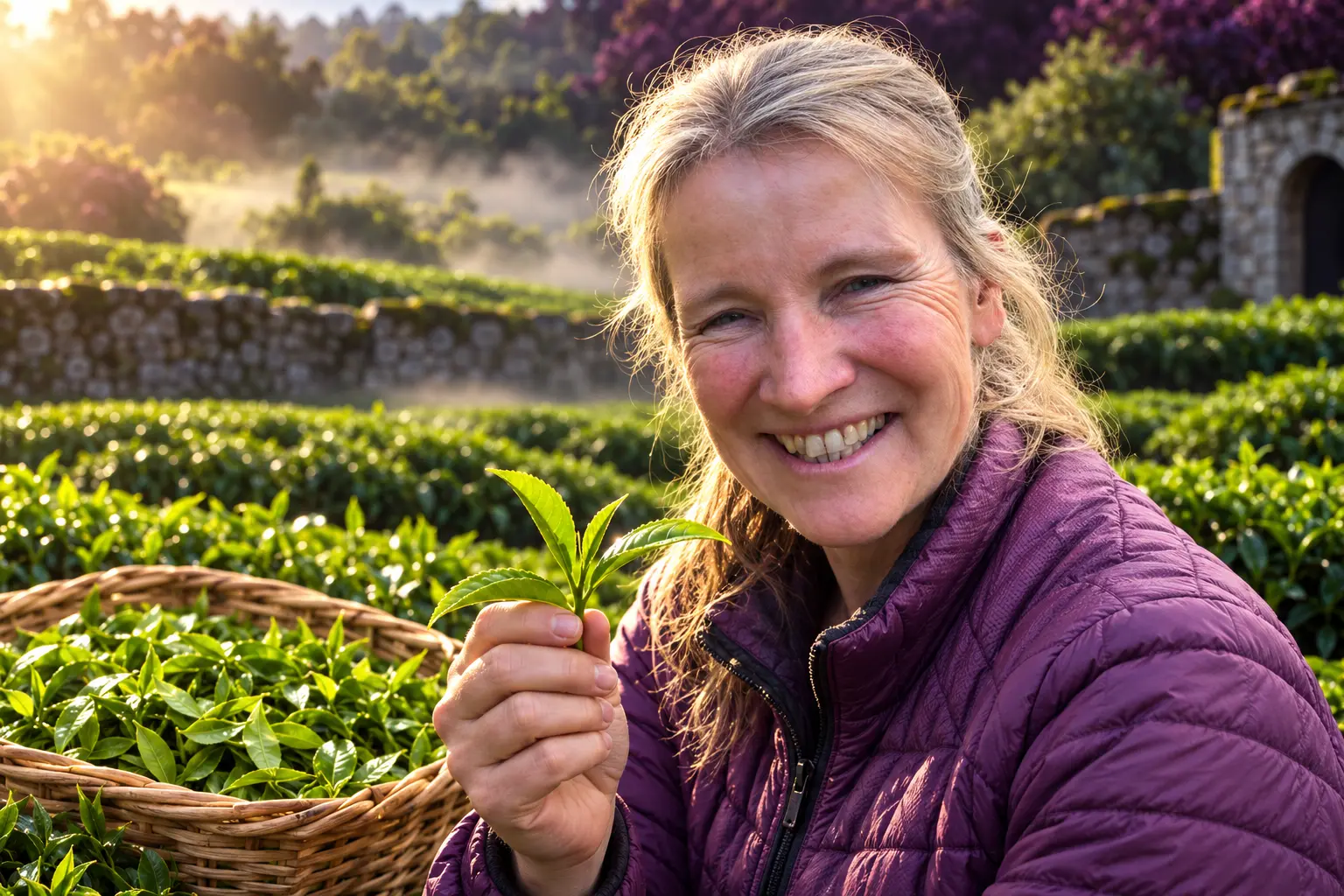
Susie Walker-Munro grows the tea on the family farm at Kinnettles, in a walled garden on the edge of Strathmore, at 57 degrees north. She is one of a handful of Scottish tea growers. The soil is acidic, the bushes are plucked for only the top few leaves, and she is already clear that this will never be a supermarket crop.
“Our yields are never, never going to be high,” she said as she finished the season. Latitude, she argues, will always block a year-round harvest of the sort seen near the equator. Wetter weather might lift output a little. “Maybe with climate change they might come up a bit, it depends if we get enough rain. Scotland could be absolutely ideal.”
Ideal, in her mouth, still means artisan. The farm also grows wheat, barley and oats, with oilseed rape in some years. Tea was a diversification, not a replacement. Cuttings of Camellia sinensis var. sinensis came from Cornwall in 2007. Shallow roots and wind taught a hard lesson: the plants survived only under tunnels.
FROM CUTTINGS TO A COLLECTIVE
- 2007: Kinnettles takes Cornish cuttings onto an Angus family farm as a slow diversification.
- 2015: Three hundred mature bushes yield 2 kg of hand-rolled black tea, launched as Kinnettles Gold through Pekoe Tea in Edinburgh.
- 2016: Nine women form Tea Gardens of Scotland and import cold-tolerant seed from Nepal and Georgia.
- 2020: Combined leaf becomes Nine Ladies Dancing, sold on Fortnum & Mason’s rare tea counter.
- 2024: Five gardens on the east coast blend a black tea called Five Gold Rings.
- 2025: Kinnettles launches Ivan Chai, a caffeine-free rosebay willowherb tisane, beside the estate black tea.
The original cultivar still produces two to three kilograms a year. Cuttings are expected to live about 45 years; seed-grown plants can last 100 or more, which is the point of the Nepali and Georgian stock. Walker-Munro has said Scotland will never be a major tea country. The gardens in Angus, Fife, Perthshire and Kincardineshire are a proof of flavour under stress, not a plan to crowd Darjeeling off the shelf.
Even the group treated scale as a problem to be designed around. They commissioned a 104-page feasibility study with Community Food Fund support, then pooled leaf because no single plot could fill a tin on its own. Droughts, hard rain and disease are already hitting tea regions closer to the equator. Scotland’s cooler, wetter habit looks, from a distance, like shelter. On the hill above the Kerbet, rainfall that used to sit around 600 mm can now arrive as a year’s worth in a month, and the plants still dislike wet feet.
3.14 Million Tonnes Is Still a Familiar Harvest
If tea is the photograph, cereals are the wager. In 2009 the Scottish Agricultural College, now folded into SRUC, was already arguing that warming would make Scotland the bread basket of Europe. The college put that year’s previous cereal harvest at almost 3 million tonnes. Powell’s 2026 version of the line is that climate change is redrawing Europe’s farming map, and that cheap renewable power could change the sums on irrigation, cold storage and processing.
Climate change is redrawing the farming map of Europe and Scotland could become one of Europe’s most important climate resilient food regions.
Prof Wayne Powell, Principal and Chief Executive, SRUC
The harvest that actually came in before this latest restatement is on the public record. Final estimates from the Scottish Government put 2025 at around 3.14 million tonnes of cereals, a ten-year high and about 5% above 2024’s 3.0 million tonnes. That is a strong year. It is also, still, the same three-million-tonne neighbourhood the college was citing before the bread-basket slogan took hold.
THE 2025 CEREAL HARVEST
| Crop | 2025 production | Change on 2024 |
|---|---|---|
| Total cereals | 3.14 million tonnes | +5% |
| Wheat | 1,030 thousand tonnes | +25% |
| Spring barley | 1,566 thousand tonnes | -6% |
| Winter barley | 363 thousand tonnes | +11% |
| Oats | 185 thousand tonnes | +2% |
| Oilseed rape | 153 thousand tonnes | +15% |
Wheat had a 20-year record for yield and production, lifted by a 10% larger area and a 13% better yield. Oilseed rape yield hit a 20-year high at 4.7 tonnes per hectare, which is why output rose even as planted area fell 11%. Spring barley, the crop that still dominates Scottish fields, went the other way after the sunniest spring and hottest summer on record. Winter crops had been helped by a kinder autumn in 2024. The pattern is a good year with a hole in it, not a new geography of food.
Barley remains the crop that pays the drinks bill. The James Hutton Institute notes that whisky accounts for 75% of Scotland’s food and drinks exports, which is why an International Barley Hub now sits beside the climate rooms at Invergowrie. A bread-basket story that only counts wheat misses the malt.
Deluge and Drought in the Same Season
The climate that was supposed to gift extra yield has already arrived in a less tidy form. Dr Mike Rivington, land use system modeller at the James Hutton Institute, has been comparing records since 1960 with what the models had pencilled in for mid-century. Temperatures are up by more than 1C, and by nearly 2C in some parts. In a 2023 analysis for the Scottish Government, Hutton found February already 2.5C warmer in some parts than the 1960 baseline, at the low end of what had been projected for 2020 to 2050.
Winter rain has jumped ahead of the forecast. Between 1990 and 2019, February and, to a lesser extent, April became up to 60% wetter in the west, above the 45-55% rise that had been projected by 2050. Hutton’s work points to Scotland exceeding a 2C rise by the 2050s, with May to November seeing up to 4C of extra warmth across 2020 to 2049. Consecutive dry days are expected to increase in months such as September.
THE THREE TRENDS ALREADY IN THE FIELDS
- A shifted baseline: Warmer air, odd rainfall timing and a thinner climatic water balance mean more water scarcity even as the growing season lengthens and frosts ease.
- Swings past memory: Year-to-year weather is moving outside the range farmers used to plan against, which makes sowing dates and cashflow harder to read.
- Deluge and drought: Hard winter rain and summer water deficit are more likely in the same year, and even in the same season; Rivington’s worry is back-to-back poor years.
Winter 2023-24 brought 13 named storms, including Storm Babet, which left soils saturated from October into late spring, hurt winter sowings and delayed spring planting. Those conditions, Rivington wrote, are likely to get more severe and more frequent. Some future years will still be kind. The 2025 wheat record is what a kind year looks like. The spring barley drop in a record-hot summer is the other half of the same climate.
Walker-Munro’s own hill already behaves like that split personality. Free-draining soils save the tea from puddles when a month dumps a year’s rain. Temperature spikes to 26C, including in April, are now part of the year. Only May to August are safely frost-free, and the met record still allows nights as low as minus 18C, if only for a night or two. That is a terroir, and it is also a warning about treating “milder Scotland” as a simple upgrade.
The Invergowrie Centre Rehearses a Harder Climate
The institutional answer is to stop arguing with the weather in the abstract and grow it indoors. On 25 October 2024, First Minister John Swinney and Ian Murray, then UK secretary of state for Scotland, opened the Crop Innovation Centre in Invergowrie. The 8000 sq m complex houses the Advanced Plant Growth Centre and the International Barley Hub, built with the University of Dundee’s plant sciences division.
The money is a £62 million Tay Cities Region Deal: £45 million from the UK government and £17 million from the Scottish government. Over ten years the centre is projected to support more than 900 industry projects and 2,600 extra jobs in the UK, 1,760 of them in Scotland and 470 in Tayside, with more than £900 million of GVA, over half of it in Scotland. A high-throughput phenotyping hall, using sensors and lasers to map plants, drew a further £3 million from Scottish Enterprise in 2025.
The Advanced Plant Growth Centre is five rooms in one: a molecular phenotyping lab, a high-throughput phenotyping platform, a vertical growth tower, post-harvest storage, and controlled environments that can copy present and future growing conditions. For three months before the BBC visit, staff had been running fava beans, photographing them every day, under the sort of light, water and nutrient stress that models suggest for 75 years ahead. The job is to pick plants that fail less when the weather refuses to stay in one category.
We need to start breeding those crops now and start understanding what Scottish farming’s going to look like. Farmers need time to plan, we need to get those crops out to the farmers and registered. Ultimately it’s about what those guys do in the fields that matters, not what we do inside a climate simulator.
Dr Robert Hancock, Deputy Director, Advanced Plant Growth Centre
Hancock’s shift is from breeding for a single stress, hot or dry, toward plants that cope with several. That is the scientific version of Rivington’s deluge-and-drought year. It is also a timeline warning. Varieties have to be bred, tested and listed before a farmer can buy the seed. The simulator is a rehearsal room. The bill still lands in the field.
Why Glasshouses Matter More Than Warmer Fields
Walker-Munro thinks glasshouses would be a better way to grow more tea than waiting for the open hill to turn tropical. Pete Ritchie, of the campaign group Nourish Scotland, pushes the same kit for a different shopping list: tomatoes, cucumbers, aubergines, even melons. His bet is not on gentler winters in Angus. It is on wind power later in the century making heat cheap enough to run Dutch-style houses on brownfield land, on islands, and in places that currently import salad.
“We’re going to be able to produce those plants with a lower carbon footprint and provide secure all-round jobs for people on brownfield sites in the cities and also on the islands and remote parts of Scotland,” Ritchie said. The Netherlands already lives in that model. Scotland’s version has a working farm attached.
A Farm Advisory Service case study of Standhill Farm, near Hawick, describes a four-acre glasshouse built in 2016 with about 55,000 tomato plants. Cow slurry, manure and silage feed an anaerobic digester. Electricity goes to the farm and the grid; captured heat and carbon dioxide go to the tomatoes, with two woodchip boilers in support and most irrigation taken off the roof. Output is about 700 tonnes of tomatoes a year, picked from early April to mid-November. Cool Scottish nights, the farm argues, help the crop even when the light is poorer than in Spain.
That is already more tomato than Kinnettles will ever pack tea. It also points to why Powell keeps pairing climate with power. A warmer field does not, by itself, grow a melon in Aberdeenshire. A glasshouse with spare heat does. Clyde Valley once had acres of tomato glass under coal heat; supermarkets and energy costs emptied them. Standhill’s trick is to treat a dairy herd’s waste as the boiler. If later decades really do bring cheap wind, the same logic extends to sites that never had a herd.
Indoor growing is not free of climate. Hutton’s own earlier work on vertical farms found that electricity can dominate the carbon bill, which is why the renewable mix matters. The 2025 harvest already showed what a record-hot summer does to spring barley in open ground. Glass and LEDs are the hedge against that, not a slogan about Scotland turning into Kent.
Young Farmers Inherit the Long Bet
David Murdoch, who chairs the Scottish Association of Young Farmers and dairies with his father at Beith in North Ayrshire, talks less about tea and more about headcount. GPS steering is already in the cab. Autonomous harvesting is a shorter leap than it was when his father started. “There’s no point in doing it if you don’t know your cattle, but embracing the technology is what keeps us competitive,” he said. Larger herds, larger machines, more output from fewer people: “that’s the way the world’s going.”
Rural Scotland has spent 75 years learning that sentence. The next generation is being asked to add nature recovery, carbon offsets and on-farm renewables to the same profit-and-price squeeze. Powell also flags health as a demand signal: obesity drugs are already shifting interest toward proteins and denser food, which would favour soya, flax and legumes if the climate and the market both play along. Those crops are still a prospect. Barley, wheat and a few kilograms of tea are the present.
The farmers of the 22nd century, the BBC piece noted, are about one generation from the people entering the industry now. That is the length of the bet. Seed-grown tea bushes are being planted as a children’s inheritance. Fava beans are being photographed in a box that copies 75-year weather. A rural college principal is using Ukraine’s old title, bread basket of Europe, as a destination for a country whose cereal harvest is still a 3.14 million tonne year in a 3 million tonne band.
Walker-Munro will keep pouring small glasses of Kinnettles Gold when the top leaves allow it. Hancock’s reminder sits over the rest of the map. The simulator can pick a tougher bean. The harvest still has to come in from fields that already know deluge and drought in the same season.

Edinburgh Opens a 2027 Tour Built for Time Trials

Korda Maps Auður From Meðalland to Irvine Bay

Apple Music Films Its New Logo in Mineral Oil

Oppo Prices the Pad Mini Above India’s iPad Mini

Austen Soaks Scotland Before Boelo Brings Weekend Gales

Volkswagen Sells the Osnabruck Plant to Clear a Board Fight

Apple’s Foldable iPhone Hinges on Samsung Display Supply

Tata Motors’ Iveco Tender Opens as Holders Still Decide

Saksham Gaur Finds He Is His Own Company’s Client

Onimusha Way of the Sword Preload Hits a Windows 11 Wall
-
 AUTO2 months ago
Volkswagen Sells the Osnabruck Plant to Clear a Board Fight
-
 NEWS2 months ago
Apple’s Foldable iPhone Hinges on Samsung Display Supply
-
 AUTO2 months ago
Tata Motors’ Iveco Tender Opens as Holders Still Decide
-
 BUSINESS2 months ago
Saksham Gaur Finds He Is His Own Company’s Client
-
 GAMING2 months ago
Onimusha Way of the Sword Preload Hits a Windows 11 Wall
-

 BUSINESS2 months ago
Hyderabad 22-Carat Gold Jumps After a False Bargain
-

 ENTERTAINMENT3 years ago
What is SD on Amazon Prime? – All You Need to Know
-

 NEWS2 months ago
iQOO 16 Locks 8,400 mAh While 100W Charging Holds