
BUSINESS
Festive EMIs Pull Hero, TVs and Kitchen Kit Into Towns
Hero two-wheelers hit 30 times a regular day as more than one in three Amazon shoppers used EMIs, pulling big-ticket festive buying into smaller Indian towns.

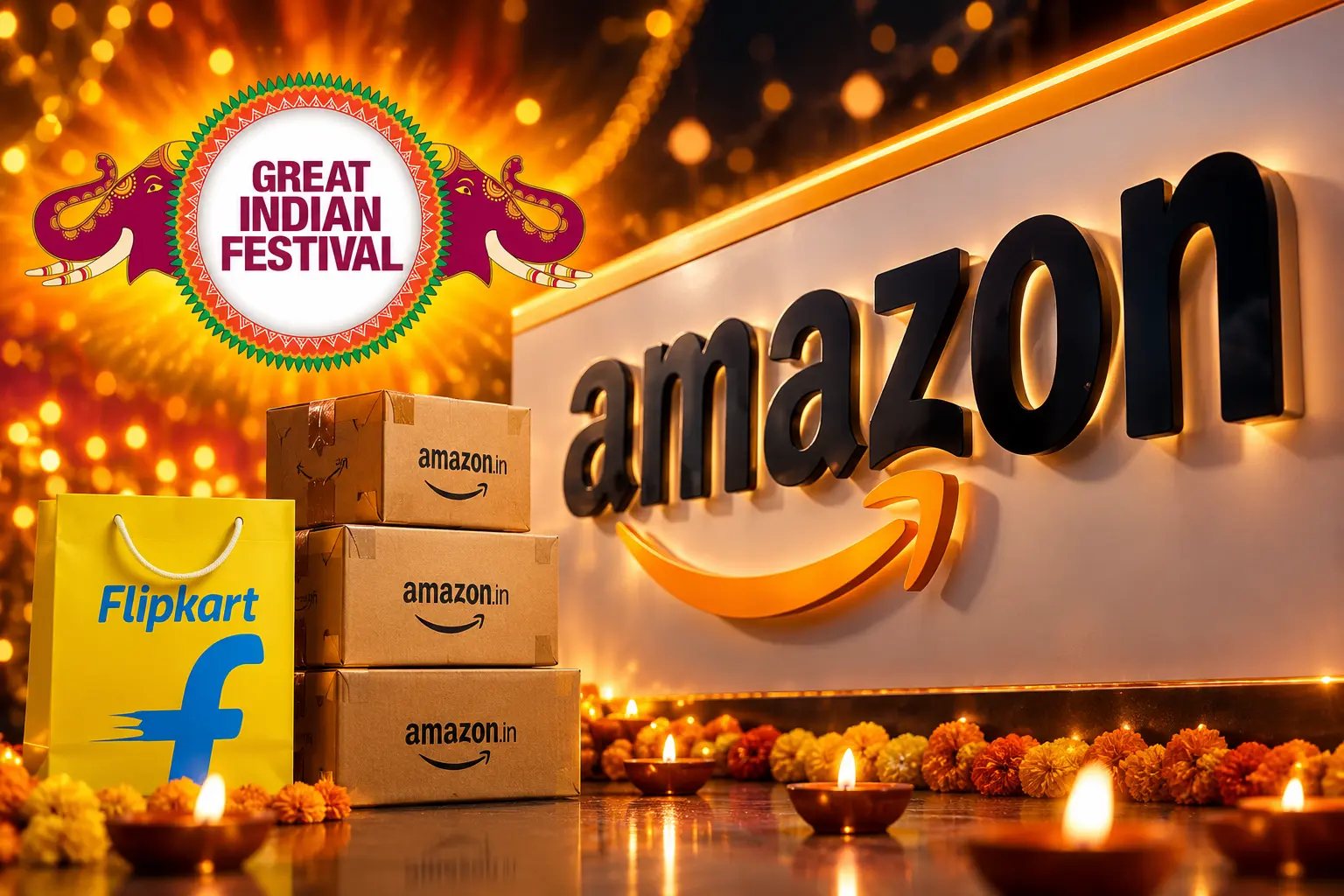
Hero MotoCorp sold two-wheelers at 30 times a regular day in 48 hours as Amazon and Flipkart opened India’s festive sales on credit. More than one in three Amazon customers chose EMIs, and Flipkart said one in three mobile buyers took no-cost EMIs.
The Great Indian Festival went live at midnight on 8 October 2026. Flipkart’s Big Billion Days opened to everyone the next day. The first tickets that moved were scooters, 55-inch TVs, heavy washers and kitchen machines, paid for in months, not at the till.
More Than One in Three Amazon Shoppers Chose EMI
Amazon said customers ordered 100 per cent more products ordered than a year earlier, the strongest opening in the event’s history, with orders from every pin code. Visits in the early phase crossed 440 million, and more than 72 per cent of them came from outside the nine largest metros. First-time shoppers on Amazon.in nearly doubled.
The checkout did as much work as the discount strip. Amazon said more than one in three customers chose EMI. Amazon Pay Later EMI transactions doubled, and that user base expanded 80 per cent year on year. One in four customers used Amazon Pay to split a bill interest-free.
THE OPENING CREDIT MIX
- Amazon EMI share: More than one in three customers chose equated monthly instalments at the start of the Great Indian Festival.
- Pay Later tenure: EMI transactions on Amazon Pay Later doubled, and the product’s user base grew 80 per cent year on year.
- Interest-free split: One in four customers used Amazon Pay to break a purchase into interest-free parts.
- Card and UPI: The Amazon Pay ICICI Bank Credit Card user base rose 15 per cent year on year, and one in four customers paid with UPI.
Saurabh Srivastava, Vice President at Amazon India, tied the opening to that stack of Prime extras, bank discounts, exchange, no-cost EMI and Pay Later, not to list prices alone.
We’ve seen a record 100% increase in products ordered and are humbled to see aspirations becoming affordable with extra savings for Prime members, instant bank discounts, exchange, no-cost EMI, Amazon Pay Later and a host of value-driving programs.
Saurabh Srivastava, Vice President, Amazon India
Shoppers already talk in “net effective” prices, the figure left after a bank cut, an exchange credit and an EMI tenure are stacked on the same cart. That is the number people screenshot, not the sticker.
Hero’s 30-Times Weekend Came From Smaller Towns
Two-wheelers were the loudest line in the opening books. Ashutosh Varma, Chief Business Officer for Hero MotoCorp’s India business, said sales hit 30 times regular-day levels in the first 48 hours, led by the Destini 125 scooter and the Xtreme 125R motorcycle.
Over 70 per cent of those buyers came from Tier 2 and Tier 3 markets, across more than 400 PIN codes. The upgrade was not a metro toy run. It was a small-town scooter and commuter-bike rush paid out over months.
Hero’s own festive page on the Destini 125 XTEC lists the scooter at ₹80,048 ex-showroom in Delhi, with a down payment starting at ₹1,999, 0 per cent interest and a cash discount of up to ₹1,000. The factory is selling the same idea the marketplaces are: a small cheque now, a machine at the gate, and a year of instalments.
Aman Deep Lohan, Amazon India’s director for home, kitchen and outdoors, said before the festival that the firm’s automotive business was growing about 70 per cent year on year. The shop lists petrol and electric two-wheelers from nearly 20 brands, including TVS Motor, Ather Energy, Hero and Bajaj Chetak. Lohan said no-cost EMIs running three to 12 months were pushing buyers toward higher-spec models.
A Destini at that Delhi tag, bought on a ₹1,999 down payment, is not a cash-and-carry festive gift. It is a household credit line that happens to have a headlamp.
Samsonite, Philips and the Kitchen Upgrade Wave
The same pattern showed up in luggage, mixers and the wet wall of the house. Samsonite India CEO Jai Krishnan said the premium line grew 200 per cent year on year in the first 24 hours, against 60 per cent for American Tourister. Gulbahar Taurani, MD and CEO of Versuni India, which sells Philips domestic appliances, reported tenfold regular-day demand, led by cooking appliances and mixers.
Solara founder Gopal Kolli reported 35 times regular-day sales, driven by air fryers and cold-press juicers, a multiple Amazon’s newsroom also logged. Eureka Forbes Chief Growth Officer Anurag Kumar called it the company’s biggest festival opening day, with premium water purifiers and robotic vacuums in front.
On Amazon, televisions of 55 inches and above made up 65 per cent of TV units sold. Front-load washing machines of 9 kg and above ran at 80 times a regular day. Home entertainment sold at 77 times a regular day, and large appliances at 50 times. MacBook Neo sales were 65 times a regular day, and premium wearables 80 times, led by Garmin, Apple, Samsung and Amazfit.
BRAND MULTIPLES IN THE FIRST FESTIVE WINDOW
| Brand or line | Opening multiple | Compared with |
|---|---|---|
| Hero MotoCorp two-wheelers | 30 times | Regular day, first 48 hours |
| Samsonite premium luggage | 200 per cent | Year on year, first 24 hours |
| American Tourister | 60 per cent | Year on year, first 24 hours |
| Philips domestic appliances | 10 times | Regular-day demand |
| Solara kitchen kit | 35 times | Regular-day sales |
| 9 kg+ front-load washers | 80 times | Regular day on Amazon |
Fashion did not sit out. Reebok India Brand Head Arjun Ramamoorthy said sales more than doubled year on year. WROGN co-founder Anjana Reddy said the brand recorded tenfold regular-day sales. RENÉE Cosmetics e-commerce head Jitendra Rawal said opening-day sales doubled year on year. Penguin Random House India CEO Gaurav Shrinagesh reported nearly 50 per cent growth over two days.
Those lines are easier to pay in cash than a scooter. The durables are not. A 55-inch panel and a 9 kg washer are the purchases that need a three-to-12-month schedule, which is why the EMI share matters more in those aisles than in a kurta cart.
Where Did Flipkart’s 6.3 Million Users Come From?
Flipkart recorded 6.3 million concurrent users in a minute during the opening hour of the 13th Big Billion Days, with more than six times as many shoppers as a regular hour and new customers up 34 per cent. Nearly one in two first-hour visits came from Tier 3 towns and beyond, and non-metro markets accounted for about 60 per cent of demand.
Early Access for Plus, Black and co-brand card members began at midnight on 8 October and logged more than 287 million sessions before the doors opened to everyone on 9 October. Flipkart said every 15th Indian online shopper visited in that first hour. The fastest-growing names on the board were Sardulgarh, Panskura, Sheikhpura and Kishanganj, not the usual metro list.
On mobiles, the affordability levers were explicit. One in four customers used a product exchange. One in three took no-cost EMI. Entry-level 5G models held at last year’s prices filled the rest of the basket.
FLIPKART’S FIRST-HOUR CATEGORY BOARD
- Large appliances: Sales grew 30 per cent year on year in the opening hour, across air conditioners, refrigerators and washing machines.
- Tablets: Sales grew 73 per cent year on year, a personal-tech upgrade sitting beside the phone cart.
- Beauty: Sales grew 42 per cent year on year, with more than 1,600 units of men’s perfume moving every minute at peak.
- Minutes: Orders ran at 3.5 times a regular day and new customers at 11 times, including an iPhone 17 handed over in New Delhi in 3.4 minutes.
On Early Access day, 51 per cent of transacting sellers recorded twice their regular-day growth. Sellers in Tier 2-plus India, including MSMEs, grew 2.9 times, with Bhiwandi, Panipat, Tirupur and Hisar in front. The seller-side surge matches the buyer-side map: the extra volume is not only landing in the big cities.
The same rush is already producing delivery fights and complaints about damaged stock. That is the cost of opening at this scale, and it sits beside the conversion story rather than cancelling it.
SBI Cards and Pay Later Do the Heavy Lifting
Amazon put State Bank of India at the centre of the price. Customers get a 10 per cent instant discount on SBI credit and debit cards and on SBI credit-card EMI, with Prime members offered up to 10 per cent extra savings. The Amazon Pay ICICI Bank Credit Card, a separate track, pays unlimited 5 per cent cashback for Prime members and 3 per cent for everyone else, with no joining or annual fee.
Amazon Pay Later is the in-house tenure. Eligible customers get welcome rewards of ₹600. Pay-in-3 interest-free EMIs apply on carts of ₹1,500 and above, with zero processing fee. Shoppers also get 10 per cent cashback on Amazon Pay Later EMIs across categories, again at zero interest and zero processing fees, according to Amazon’s own festive payments note.
A tool Amazon calls Savings Maximiser now pre-selects the highest cashback or the lowest-cost EMI in one tap, with biometric login in place of an OTP. The platform is not waiting for the customer to discover credit. It is choosing the cheapest-looking tenure at the button.
Sellers felt it in rupees. Amazon said units ordered in the first 24 hours were more than twice the same window last year, and the number of sellers who crossed ₹1 crore (10 million rupees) in that day grew over 80 per cent year on year. Beauty sellers saw nearly 7 times growth in units, kitchen 4.2 times, wireless 3.4 times, apparel 3.1 times and home 2.7 times. App downloads hit 5 times a regular business day. In more than 120 cities on Amazon Now, one in two products arrived in minutes.
Flipkart’s bank partners sit on a different pair of cards, Axis and ICICI, which is why a household’s wallet can decide the website before the product does. The two festivals are not only competing on TVs. They are competing on whose credit line is attached to the buy button.
Household Borrowing Was Already Tilted Toward Retail Loans
The opening numbers land on a household book that was already leaning into non-housing credit. The Reserve Bank of India’s June 2026 Financial Stability Report put household debt at 45.5 per cent of GDP by the end of September 2025. Non-housing retail loans were 58.4 per cent of household borrowings as of March 2026.
Fintech firms had 56.8 per cent of the small-ticket personal loan segment below ₹50,000 by March 2026, after 41.6 per cent credit growth against 20.1 per cent for the wider segment. Unsecured loans were about 70.5 per cent of those books, and around half of them went to borrowers under 35. Delinquencies on that fintech slice sat at 6.4 per cent. That figure is not an Amazon default rate. It is a reminder that cheap tenure on small tickets already leaves a mark at the unsecured end of the market.
HOW THE TWO SALES OPENED
- 8 October 2026: Amazon Great Indian Festival opens at midnight to all customers; Flipkart Early Access opens at midnight for Plus, Black and co-brand card members.
- 9 October 2026: Flipkart opens The Big Billion Days to everyone and logs 6.3 million concurrent users in a minute in the first hour.
- 9 October 2026: Amazon updates its opening note: more than 440 million visits, more than one in three customers on EMI, Pay Later EMI transactions doubled.
- 11 October 2026: Hero, Samsonite, Versuni, Solara and Eureka Forbes put 48-hour and opening-day multiples on the record, with Varma citing 30 times regular-day two-wheeler sales.
The festivals that opened on 8 and 9 October are still running. The scooters, washers and 55-inch screens are already in homes in towns that barely featured in older festive decks. The instalments on those carts will not be due in the opening hour. They will be due after the lights come down, on the same household books that already carry more non-housing retail debt than they did a few years ago.

Edinburgh Opens a 2027 Tour Built for Time Trials

Korda Maps Auður From Meðalland to Irvine Bay

Apple Music Films Its New Logo in Mineral Oil

Oppo Prices the Pad Mini Above India’s iPad Mini

Austen Soaks Scotland Before Boelo Brings Weekend Gales

Volkswagen Sells the Osnabruck Plant to Clear a Board Fight

Apple’s Foldable iPhone Hinges on Samsung Display Supply

Tata Motors’ Iveco Tender Opens as Holders Still Decide

Saksham Gaur Finds He Is His Own Company’s Client

Onimusha Way of the Sword Preload Hits a Windows 11 Wall
-
 AUTO2 months ago
Volkswagen Sells the Osnabruck Plant to Clear a Board Fight
-
 NEWS2 months ago
Apple’s Foldable iPhone Hinges on Samsung Display Supply
-
 AUTO2 months ago
Tata Motors’ Iveco Tender Opens as Holders Still Decide
-
 BUSINESS2 months ago
Saksham Gaur Finds He Is His Own Company’s Client
-
 GAMING2 months ago
Onimusha Way of the Sword Preload Hits a Windows 11 Wall
-

 BUSINESS2 months ago
Hyderabad 22-Carat Gold Jumps After a False Bargain
-

 ENTERTAINMENT3 years ago
What is SD on Amazon Prime? – All You Need to Know
-

 NEWS2 months ago
iQOO 16 Locks 8,400 mAh While 100W Charging Holds