HISTORY
Napoleon Bonaparte Scotland Connection: What the Records Show
The Napoleon Bonaparte Scotland connection is a Hebridean marshal, the Scots Greys’ eagle, and Ossian, and the Perthshire grandfather story fails a 1746 birth date.

Stories about Napoleon and Scotland usually arrive as family romance: Scottish blood, a Jacobite welcome, a queen’s portrait on a watch chain. The papers, the regimental returns, and the exile letters tell a narrower story, and it is the one you can check.
The Napoleon Bonaparte Scotland connection that holds up runs through a Hebridean family in French service, Scottish cavalry on the British side, a book of Celtic poems he would not travel without, and a castle on the Clyde that London considered as a prison and then refused. This page takes those strands in that order, then shows you how to test a claim that does not come with a date.
Where the Bonaparte Family Came From
Napoleon was born in Ajaccio in 1769, the year after Genoa’s cession of Corsica to France took effect in law. His people were Corsican notables of Italian descent, lawyers on his father’s side and soldiers on his mother’s, already settled on the island for generations.
His father, Carlo Buonaparte, was born in Ajaccio on 27 March 1746 and studied law at Pisa before coming home to marry. On 2 June 1764 he married Maria Letizia Ramolino, then in her mid-teens, whose father commanded troops at Ajaccio. Letizia Ramolino’s documented family line puts the Ramolinos among Lombard nobility long resident in Corsica, with Letizia’s mother recorded as Angela Maria Pietrasanta. The Buonapartes traced themselves to Tuscany. Neither house is a Scottish one.
A Perthshire historian, Robert Torrens, set out a different tale in 1999, drawn from an old book. In that account a labourer named William Bayne left Balloch, near Crieff, after the 1745 rising collapsed, was shipwrecked on Corsica, and watched his sons’ name drift from Bayne into Buonaparte. The dates will not carry it. Carlo was already born in Ajaccio on 27 March 1746, while the rising was still ending, so the man who supposedly arrived after the collapse cannot be Napoleon’s grandfather.
Claims of Stuart cousins, and of a cameo of Mary, Queen of Scots, on Napoleon’s watch chain, do not turn up in the family papers, the exile diaries, or a museum catalogue entry you can follow. If a story cannot name the record that holds it, keep it as later romance and go back to Ajaccio.
The Hebridean Family in Napoleon’s Army
The Scot closest to Napoleon’s power was not a secret kinsman. He was Étienne Jacques Joseph Alexandre Macdonald, born at Sedan in 1765, a marshal of France whose father had fled the Hebrides after Culloden.
That father, Neil MacEachen of Howbeg on South Uist, had guided Charles Edward Stuart while the prince was hunted through the islands, crossing with Flora MacDonald on the flight toward Skye. In France he took the name MacDonald, served as a lieutenant, and died in exile and poverty in 1788. His son grew up French, joined the army, and was in the ranks that backed the coup of November 1799, the seizure of power Napoleon agreed to lead after other generals had refused.
At Wagram in 1809 Napoleon made Macdonald a Marshal of France on the field, and soon after Duke of Taranto. A joke later told of the emperor was that he dared not let Macdonald hear bagpipes, in case the son of a Jacobite remembered which cause his father had served. The friendship was real enough to survive defeat. In 1814, at Fontainebleau, Macdonald found Napoleon seated before the fire in a plain dressing gown, head in his hands. Napoleon gave him the sword he had worn in the Egyptian campaign and told him to keep it in remembrance of the emperor and of his friendship.
Macdonald then helped negotiate the abdication. When Napoleon returned from Elba and asked him to come back, Macdonald refused, because he had sworn allegiance to Louis XVIII. He lived on as a minister, a peer, and arch-chancellor of the Legion of Honour, with his name cut on the Arc de Triomphe. On 29 June 1825 his diary notes that he was under sail for the Hebrides, to see the house where his father was born and the cave where his father had hidden with the prince. He died in 1840 and was buried at Père Lachaise in Paris, with soil he had brought from that house on South Uist.
Scottish Soldiers on the British Side
Sir Ralph Abercromby in Egypt
Napoleon did not meet a Scottish general in a personal duel. The army he had left in Egypt did. Sir Ralph Abercromby, born at Tullibody in Clackmannanshire on 7 October 1734, was sent in 1800 to destroy or drive out that army, and Sir Ralph Abercromby’s Egyptian command is the record of how the landing went.
The fleet came into Aboukir Bay in March 1801 and put the troops ashore on the 8th under fire. From camp before Alexandria on 16 March, Abercromby wrote to the Earl of Elgin at Constantinople, then British ambassador to the Ottoman court, and closed with a line that still sounds like a man writing between orders: “Excuse this Scrawl, written on my Knee.” Elgin forwarded the news. He was not, in this episode, a peace negotiator in Paris. He was the man the dispatch went through.
Before dawn on 21 March the French attacked and were beaten back. A musket ball struck Abercromby in the thigh. He stayed on the field until the attack had failed, then was carried to the flagship Foudroyant, where he died on 28 March. His body was buried at Malta. The battle did not cancel every French ambition in the east at a stroke. It did break the army Bonaparte had left behind, under a Scottish commander who never came home.
The Scots Greys at Waterloo
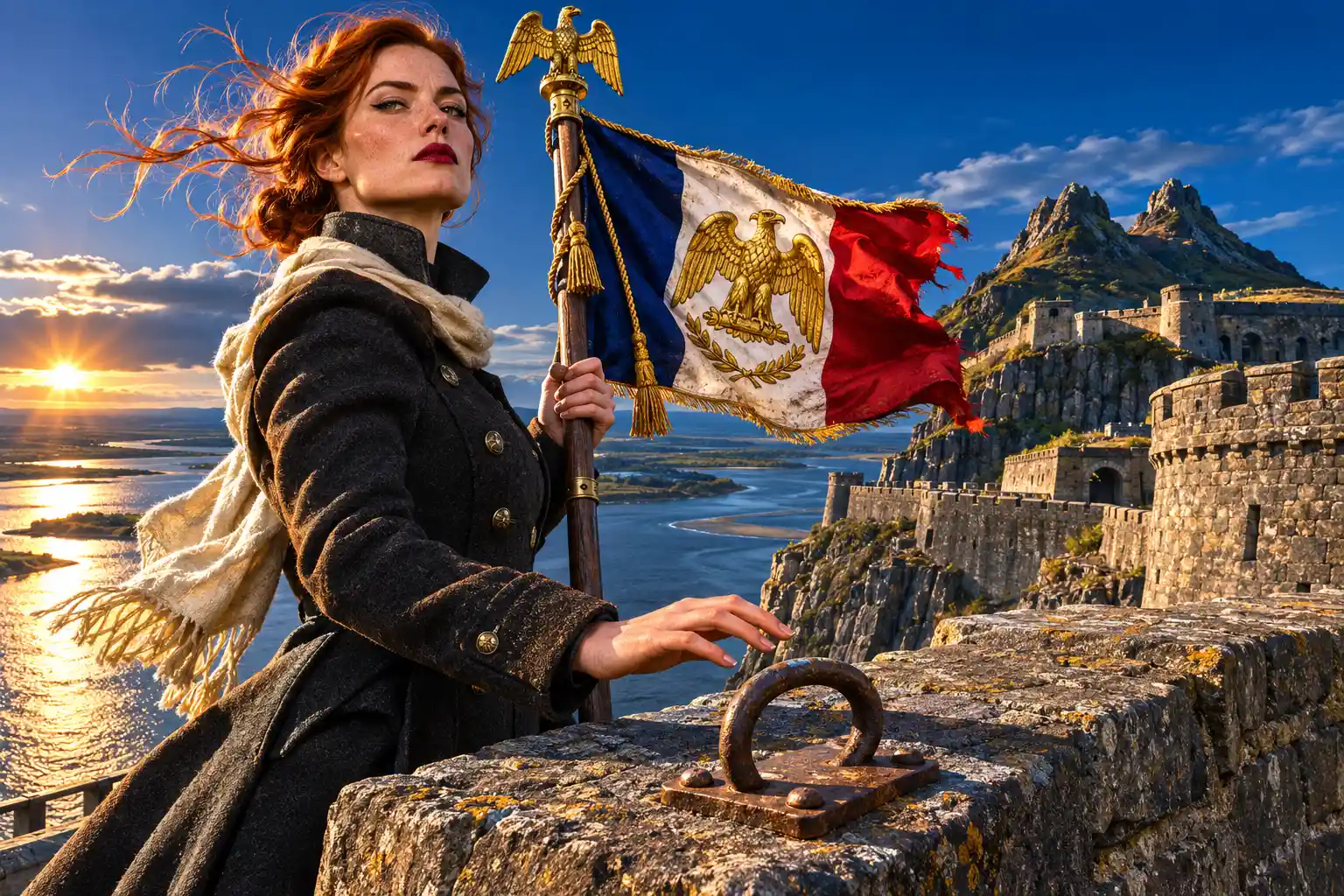
The regiment people mean by the Scots Greys was already being called the Scots Grey Dragoons after a 1693 inspection in London, when the men paraded on grey horses. Waterloo, on 18 June 1815, was its only Napoleonic battle honour. In the Union Brigade, with the Royal Dragoons and the Inniskillings, the Greys charged the French infantry of d’Erlon’s corps and broke a column of the 45th Regiment of the Line.
Sergeant Charles Ewart, a fencing master of the regiment, took the eagle that regiment carried. His own account is the closest thing to a script of those minutes:
I had a hard contest for it. The bearer thrust for my groin; I parried it off and cut him through the head. After which I was attacked by one of their lancers, who threw his lance at me, but missed the mark by my throwing it off with my sword. Then I cut him from the chin upwards, which went through his teeth. Next I was attacked by a foot soldier, who after firing at me charged me with his bayonet; but he very soon lost the combat, for I parried it and cut him down through the head, so that finished the contest for the eagle.
Sergeant Charles Ewart, account of the capture at Waterloo
He got the trophy into Brussels through crowds, and he was later made an ensign. The National Army Museum account of the Greys puts the cost of that attack at 201 men and 228 horses killed. The eagle entered the regiment’s cap badge, which is why a small French bird still sits on a Scottish cavalry badge long after the horses have gone.
The Eagle Now at Edinburgh Castle
Once the eagle was off the field, the argument became where a captured standard ought to live. It did not stay in a private house, and it did not stay in France.
WHERE THE EAGLE WENT
- 18 June 1815: Ewart takes the eagle of the 45th Regiment of the Line during the charge.
- The days after: He carries it into Brussels, where spectators crowd to see it.
- The long stay: The eagle and its colour are deposited at the Royal Hospital Chelsea in London.
- Waterloo Day, 1956: The trophy is handed back to the Royal Scots Greys and escorted to Edinburgh Castle.
- The museum now: It is shown with a sword said to be the one Ewart carried at Waterloo.
You can stand in front of that object today. The eagle and standard at Edinburgh Castle are in the Royal Scots Dragoon Guards Museum, the successor collection of the Greys, who amalgamated with the 3rd Carabiniers in 1971. Ewart’s own body was reburied on the castle esplanade in 1938, so the man and the bird are a short walk apart. Lady Butler’s 1881 painting Scotland Forever! is the picture most people carry of the charge, though the canvas and the ground are not the same thing, which is worth a question further down.
Ossian, a Burns Air, and Walter Scott
Napoleon kept a campaign library, and a personal librarian to manage it, running to 3,370 volumes. Histories, novels, Plutarch, and Homer were all in the chests. The book he talked about with the most heat was not a Scottish novel. It was James Macpherson’s Ossian, the poems of a supposed third-century Gaelic bard that had swept Europe after Fragments of Ancient Poetry in 1760, Fingal in 1762, and Temora in 1763.
He bought his first copy in 1786, aged 17, in the Italian translation by Melchiorre Cesarotti, which suited a Corsican who spoke Italian before he spoke French as a court language. About eleven years later the French writer Louis de Fontanes told the young general that people said he kept a copy of Ossian in his pocket even in the middle of a battle. He was never much moved by the argument, already loud in his lifetime, that Macpherson had composed a great deal of the verse himself.
On St Helena the taste was still there, and it met a real Scottish song. In October 1815, on the second day after HMS Northumberland had landed him, the daughter of his hosts, Betsy Balcombe, played and sang “Ye banks and braes.” She later wrote that when she finished he called it the prettiest English air he had ever heard. She told him it was a Scottish ballad, not an English one, and he answered that he had thought it too pretty to be English.
To a Scottish hostess on the island he claimed the fashion as his own work: “It was I. I made Ossian the fashion. I have been even accused of having my head filled with Ossian’s clouds.” He also said he liked Ossian for the same reason he liked the whisper of the wind and the waves of the sea. In 1813 Jean-Auguste-Dominique Ingres had already painted The Dream of Ossian for the ceiling over the imperial bed in the Quirinal, in Rome, so the enthusiasm was not a story invented after his death. A copy of Ossian was among the books noticed on HMS Bellerophon, the ship on which he surrendered in 1815.
Walter Scott belongs in this story as a visitor and a biographer, not as Napoleon’s correspondent. In 1815 Scott rode over the field of Waterloo and wrote to the Duke of Buccleuch that the ground was still torn with shot, and that the villages had already opened a trade in cuirasses, caps, and eagles. He bought two cuirasses, one of them intended for Abbotsford. What the National Library of Scotland holds among Scott’s working papers on Napoleon is the material for his own Life of Napoleon Buonaparte, including excerpts he copied from Colonel Sir Neil Campbell’s letters about Elba. A fan letter from the emperor praising Waverley is not in that file.
Dumbarton Castle and the Exile Letters
Colonel Sir Neil Campbell, a son of the Campbells of Duntroon in Argyll, was the British officer sent with Napoleon to Elba in 1814. Lord Castlereagh’s orders were that Campbell was not to act as a gaoler. He was to put the former emperor in possession of the island, of which Napoleon was to be sovereign. At Napoleon’s request, Campbell made Elba his base while the Congress of Vienna sat. Napoleon left the island in 1815 while Campbell was away on the mainland, and the royal navy captains nearby had been easier to slip past because they believed the British colonel was still there.
After Waterloo, Napoleon surrendered to Captain Frederick Maitland of HMS Bellerophon on 15 July 1815, hoping Britain would let him live quietly in England. He was not allowed to land. Ministers did discuss a Scottish fortress. Castlereagh raised Dumbarton Castle, on the rock above the Clyde and the Leven, as a place to hold him. On 21 July 1815 Lord Liverpool wrote back to Castlereagh that very nice legal questions might arise, and that they would be particularly embarrassing.
Liverpool went on to the political risk, not the thickness of the walls. People in Britain, he wrote, would make Napoleon an object of curiosity at once, and possibly of compassion within a few months, and his mere presence anywhere in Europe would help keep a ferment going in France. John Barrow of the Admiralty, asked by Liverpool and Lord Melville, recommended St Helena instead: far enough that intrigues would be impossible, and far enough that the prisoner would soon be forgotten. The castle stayed a garrison. Napoleon died on St Helena on 5 May 1821 without having seen Scotland.
How to Test a Napoleon and Scotland Story
New versions of this tale still surface, often with a village, a watch, or a boat in them. You do not need a university library to give most of them a first look. Four questions cover the ones that fail.
HOW TO TEST A SCOTTISH CLAIM
- The date: Put the story next to a birth, a battle, or a letter you can date, the way the Balloch tale fails against 27 March 1746.
- The person: Ask which Scot is actually named, and whether that person served France, served Britain, or only met Napoleon in a book.
- The object: An eagle, a sword, a grave, or a manuscript should have a museum, a cemetery, or a shelfmark, as the 45th’s eagle does at Edinburgh Castle.
- The paper: Exile plans that were serious left letters between ministers, as Dumbarton did in July 1815, rather than a secret agent revealed decades later with no file behind him.
If the story you heard was a flight to Orkney, a safe house in Kirkwall, and a welcome from Jacobite dukes, it does not survive those questions. The Scottish place in the exile correspondence is Dumbarton, and the ministers who raised it also buried it. Macdonald’s voyage to South Uist happened in 1825, under a Bourbon peerage, with Napoleon already dead.
Frequently Asked Questions
Does a DNA Match Make Napoleon Scottish?
A shared marker does not move Napoleon into a Scottish parish. An ancestry project matched the actor Tom Conti to a Y-chromosome marker, M34, taken from hairs linked to Napoleon and to a Bonaparte descendant, and described that marker as Saracen in origin, running through Italy into Corsica. Conti’s father was Italian and his mother Scottish, so the match sits on the Italian side of his family, which fits the Tuscan line and does nothing for Balloch.
Did a Second French Eagle Fall at Waterloo?
Ewart’s trophy was not the only eagle British cavalry took that day. The eagle of the 105th Regiment of the Line was also captured, by men of the Royal Dragoons, and accounts still dispute which soldier in that regiment got it clear of the fight. Museum labels are firmer about the 45th, because Ewart wrote the struggle down and the bird itself is on display, than they are about the second standard.
Did Napoleon Ever Set Foot in Scotland?
He did not. Dumbarton was a prison the cabinet discussed and Liverpool refused in the same July, and the Bellerophon never put him ashore in Britain on the way to his second exile. The Scot in this story who did go home was Marshal Macdonald, who sailed for the Hebrides in June 1825 to see his father’s house on South Uist, four years after Napoleon had died.
Did Napoleon Write to Walter Scott About Waverley?
No such letter sits in the papers Scott gathered for his biography. Those papers show him as Napoleon’s biographer, copying Campbell’s Elba notes into his own hand and working from memoirs such as Las Cases, not as the emperor’s pen friend. His ride over the battlefield was a visitor’s ride, with cuirasses bought for home, and the life he published grew out of that labour rather than out of a compliment from St Helena.
Why Does the Charge Painting Look So Fast?
Lady Butler painted Scotland Forever! in 1881 without having seen a battle. She was allowed to watch cavalry at training, and she set herself in front of horses to study the rush. The canvas shows a gallop and uncovered bearskins. On the day, the broken ground kept the Greys to a quicker walk than a gallop at the start, and the bearskin caps were worn under black oilskin covers, so the picture is a memory of courage rather than a diagram of the charge.
Barrow told Liverpool that distance would do what a castle on the Clyde could not, and that a man withdrawn from Europe would soon be forgotten. Scotland kept the parts of the story that left something you can still visit: the gilded eagle in the castle museum, the grave on the esplanade, and Uist soil in a grave at Père Lachaise.


Edinburgh Opens a 2027 Tour Built for Time Trials

Korda Maps Auður From Meðalland to Irvine Bay

Apple Music Films Its New Logo in Mineral Oil

Oppo Prices the Pad Mini Above India’s iPad Mini

Austen Soaks Scotland Before Boelo Brings Weekend Gales

Volkswagen Sells the Osnabruck Plant to Clear a Board Fight

Apple’s Foldable iPhone Hinges on Samsung Display Supply

Saksham Gaur Finds He Is His Own Company’s Client

Tata Motors’ Iveco Tender Opens as Holders Still Decide

What Is SD on Amazon Prime?
-
 AUTO2 months ago
Volkswagen Sells the Osnabruck Plant to Clear a Board Fight
-
 NEWS2 months ago
Apple’s Foldable iPhone Hinges on Samsung Display Supply
-
 BUSINESS2 months ago
Saksham Gaur Finds He Is His Own Company’s Client
-
 AUTO2 months ago
Tata Motors’ Iveco Tender Opens as Holders Still Decide
-
 TECHNOLOGY3 years ago
What Is SD on Amazon Prime?
-

 BUSINESS2 months ago
Hyderabad 22-Carat Gold Jumps After a False Bargain
-

 GAMING2 months ago
Onimusha Way of the Sword Preload Hits a Windows 11 Wall
-

 NEWS2 months ago
The Frame Pro’s $1,200 Labor Day Cut Needs a Soundbar