
BUSINESS
Kentucky Air Guard Turns Prestwick Into a Working Allied Hub
Four Kentucky C-130Js trained at Prestwick in August, proving a civilian Scottish airport can hot-pit Super Hercules with Canada and the Royal Navy.

Four C-130J Super Hercules and 60 Kentucky Air Guard Airmen trained at Glasgow Prestwick Airport between Aug. 14 and 22, 2026. They brought 62,000 pounds of gear from Louisville and spent the window flying with the British Royal Navy and the Royal Canadian Air Force.
Lt. Col. Nick Reinke, the mission commander and a C-130 pilot with the 165th Airlift Squadron, said the trip was built to pile continuation and tactical training onto an unfamiliar overseas field. The public release that followed, written by Dale Greer of the 123rd Airlift Wing, framed dozens of multinational training events on a civilian Scottish runway that already earns its keep as a NATO stop.
Four Super Hercules, 60 Airmen, One Scottish Week
The 123rd Airlift Wing, Kentucky’s C-130 unit at the Air National Guard base in Louisville, put four Super Hercules on the Prestwick ramp. Senior Master Sgt. Bethany Begley, a loadmaster with the 165th Airlift Squadron, was photographed on Aug. 19 walking a pre-flight inspection along one of those fuselages.
Reinke said crews ran specialized fueling, low-level formation flying and rapid-reaction launches to keep combat mission certifications current. They also dropped maritime gear and people, including two open-ocean rescue drills with a Royal Navy helicopter unit.
THE WORK ON THE PRESTWICK RAMP
- Hot-pit fuel: A C-130J took on fuel with its engines still running, a drill Reinke said Prestwick’s civilian fuel staff had to learn in real time.
- Low-level formation: Kentucky crews needed United Kingdom approval to fly low and then joined a Canadian Super Hercules in the same formation.
- Rapid launches: Crews practiced getting airborne fast from a field whose air traffic control, airspace and support agencies were not the ones they use in Louisville.
- Maritime drops: Loadmasters put equipment and people into the water for rescue work miles off the Scottish coast.
- Open-ocean rescue: Two full scenarios tied a Kentucky C-130, Special Tactics jumpers and a Royal Navy Merlin into one chain.
Reinke put the point in plain terms. At home, crews already know the airspace, the tower, the airfields and the local habits. In Scotland, even a proficiency circuit meant working a different air traffic control system, and specialized fueling meant working host-nation agencies.
“Worldwide capability is more than simply being able to fly across the Atlantic,” Reinke said. “It means arriving with the people and equipment needed to operate, understanding an unfamiliar airspace and support structure, integrating with Allied forces, adapting when weather or circumstances change the plan, and continuing to accomplish the mission.”
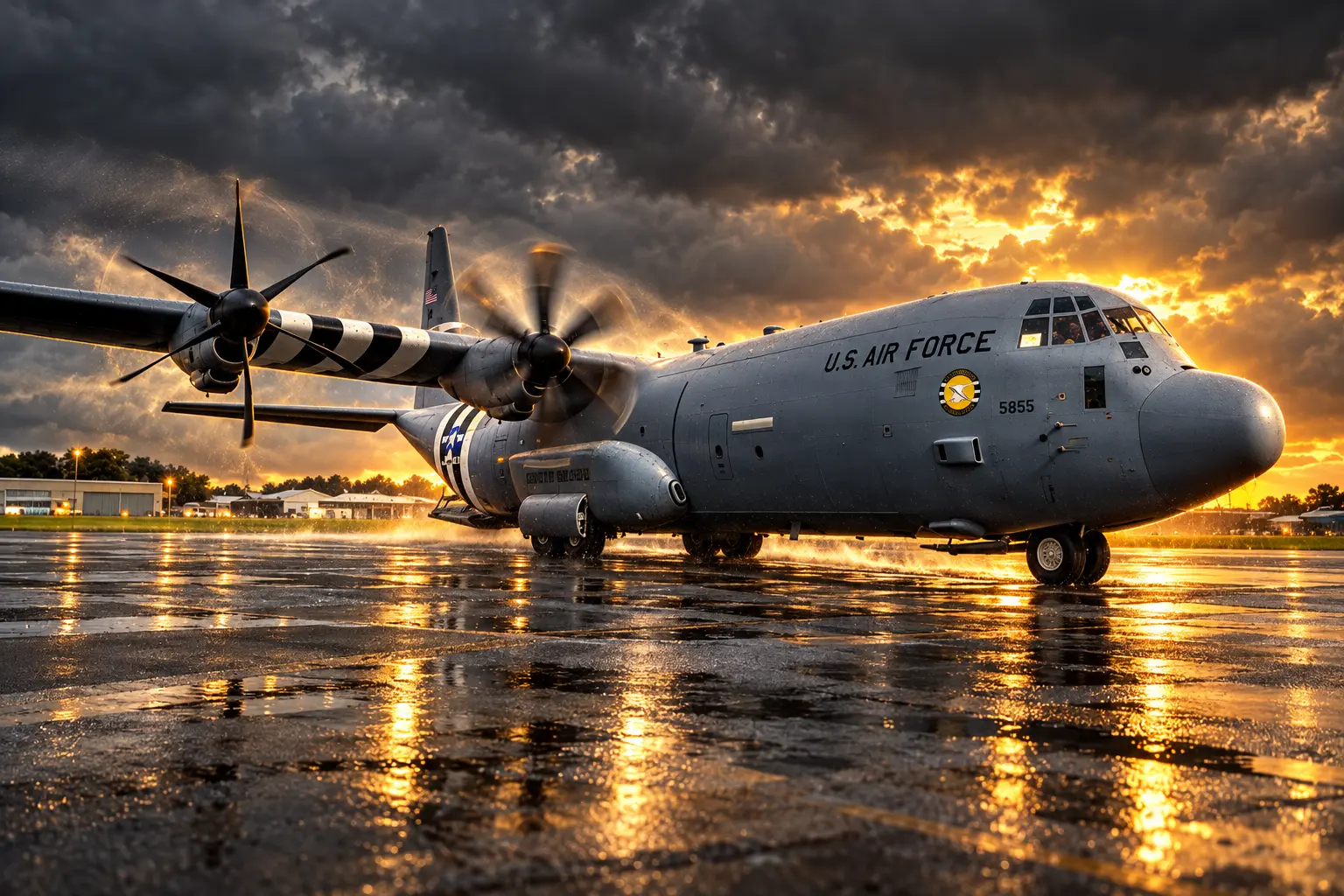
Prestwick Already Runs Like a NATO Airfield
Prestwick is a civilian international airport on the Ayrshire coast, owned by the Scottish Government, with a long runway, 24-hour opening and relatively light airline traffic. Ryanair is the main passenger carrier. Cargo and military fuel pay a large share of the bills.
Canada has treated the field as a forward airlift hub since late March 2022, when a tactical airlift detachment arrived with CC-130J Hercules to move aid toward Ukraine. By September 2022 that presence had a new name, Air Task Force Prestwick, and a year-round rhythm of crews, parts and cargo. The airport’s own July 2026 results still list the Royal Air Force, the U.S. Air Force and the Royal Canadian Air Force as regular military customers.
Kentucky did not invent that pattern. It plugged four Super Hercules into a ramp that already knew the type. Canadian Hercules were still launching from Prestwick on live European legs in late September, weeks after the Kentuckians packed up, including flights tracked into Rzeszow, Poland. The Guard’s week sat on top of a working hub, not an empty training strip.
Reinke said the fuel work was meant to last after the deployment ended. Civilian agencies at Prestwick helped complete the hot-pit, and he said that left the field more able to support follow-on and allied aircraft.
That partnership leaves behind a more capable location for follow-on and Allied forces in the future, rather than the benefit ending when our deployment ended.
Lt. Col. Nick Reinke, mission commander, 165th Airlift Squadron
That is the part a photo of a loadmaster on a Scottish ramp does not show. The product of the week was not only Kentucky’s training folder. It was a civilian airport that had now run a Super Hercules hot-pit with U.S. crews and host-nation fuelers standing on the same concrete.
A Five-Ship With a Marine in a Canadian Cockpit
One of the week’s set pieces was a five-ship formation: Kentucky’s four C-130Js plus one Royal Canadian Air Force Super Hercules. Reinke said the Canadian aircraft commander was a U.S. Marine Corps exchange pilot, which meant the briefing had to line up Air Force, RCAF and Marine procedures and words before anyone started engines.
“That meant our mission planning and briefing had to reconcile U.S. Air Force, Royal Canadian Air Force and U.S. Marine Corps procedures and terminology to make sure everyone had the same understanding before execution,” Reinke said. “That is exactly the kind of interoperability that is difficult to simulate.”
Formation flying also needed United Kingdom low-level approval and a second nation’s C-130J in the same package. Those are small frictions on paper and large ones in a cockpit, because a missed call-sign habit or a different checklist order is how a five-ship becomes four plus one stray. The Marine in the Canadian seat made the point sharper. Allied airlift is already mixed at the crew level, not only at the alliance-communiqué level.
Prestwick’s lighter commercial schedule gave them room to do that work without fighting a packed passenger bank. The same geography that makes the airport a first stop after a transatlantic crossing, on Scotland’s west coast, also puts crews over water and into UK low-level routes that Louisville cannot copy.
The Atlantic Rescue That Needed a Merlin
The other main effort was open-ocean rescue. The scenario put a stranded Airman in a life raft on the Atlantic, miles from shore. A C-130 crew had to find the raft. Loadmasters then dropped an inflatable motorboat nearby, and three Special Tactics Airmen parachuted in, got the boat working and gave first aid. They then worked a hoist with the Royal Navy’s 814 Naval Air Squadron while the C-130 stayed overhead.
Sixteen Airmen from Kentucky’s 123rd Special Tactics Squadron were part of that package. A pararescue flight chief on the team, speaking in the wing’s account of the trip, said Scotland was a different classroom from the places they usually train in the United States.
“It’s a lot colder here, and the salt water is an unusual factor for us,” he said. “The Royal Navy also uses different geolocation methods, and they have different tactics and techniques than we typically employ.”
He said the Navy’s Merlin Mk2 throws substantially more rotor wash than the UH-60 Black Hawks Kentucky crews are used to standing under. Those are the details that do not show up in a home-station syllabus: cold salt water, a heavier downwash, and a partner that finds a raft with different kit. He said they had to be flexible on the spot to finish the job.
Exercises such as this, conducted alongside our United States Air Force partners, enable our crews to maintain and enhance critical search and rescue skills while strengthening the interoperability that underpins NATO’s collective security.
Capt. James Hall, Royal Navy
Lt. S. Cass, a flight commander with 814 Naval Air Squadron, said the squadron hoped to keep working with “our friends across the pond in the years to come.” Hall, in the same release, tied the week to search and rescue skills his Merlin force does not get if it only flies its usual anti-submarine tasking. The C-130 found the raft, the jumpers got wet, and the Merlin pulled the casualty. That chain is the reason the Royal Navy was on the tasking in the first place.
Kentucky’s Second European Airlift Trip of 2026
Prestwick was not the wing’s first European lift of 2026. In June the 123rd closed out a larger job in Denmark for NATO’s Ramstein Flag 2026, an Allied Air Command drill that spanned 18 nations and more than 200 aircraft. More than 50 Kentucky Airmen arrived in late May on three C-130Js, a second rotation followed, and total unit participation rose to more than 100 people.
Col. Nicholas Miles, a C-130J pilot and detachment commander for the 123rd Operations Group, said those crews flew 24 airlift missions through June 19, moving 228 people and 62.5 tons of cargo and equipment through Denmark, Belgium, Finland, Germany, Norway and Sweden. “It’s important that we practice with the partners we are going to fight with in the future,” Miles said. “Exercises like this give us the opportunity to practice operating in a contested environment, which we can’t do back at our home station.”
KENTUCKY’S TWO EUROPE TRIPS IN 2026
| Trip | Dates | Aircraft | People | What they flew |
|---|---|---|---|---|
| Ramstein Flag, Denmark | Late May to June 19 | 3 C-130Js | More than 100 | 24 missions, 228 people, 62.5 tons |
| Prestwick, Scotland | Aug. 14-22 | 4 C-130Js | 60 | Hot-pit fuel, formation, ocean rescue |
The Denmark trip was a distributed airlift test across six countries. The Scotland trip was smaller and sharper: fewer people, one extra aircraft, and a civilian field that demanded host-nation fuelers, UK low-level paperwork and a Navy helicopter. Together they show how an Air National Guard J-model wing now spends a calendar year. Louisville still owns the airplanes. The North Atlantic owns a growing share of the flying.
The wing finished moving from the older C-130H to the Super Hercules when its eighth J-model reached Louisville on Aug. 25, 2022, after the first of the new aircraft arrived in November 2021. Ramstein Flag and Prestwick were not debuts for the type. They were the point at which a Guard unit a few years into the J-model was being used as NATO’s spare airlift, first from a Danish fighter base and then from a Scottish commercial airport.
Who Pays for the Fuel on a Scottish Government Runway?
Glasgow Prestwick Airport is a Scottish Government asset that sells fuel, parking and handling to allied militaries while running cargo and a Ryanair passenger base. U.S. federal procurement records show the Department of Defence has spent $141.21 million (£104 million) with Glasgow Prestwick Airport Ltd since a 2016 contract, an arrangement later extended through March 31, 2030. In the airport’s 2024-25 accounts, fuel brought in £24,340,000 of £49,495,000 in revenue, almost half, while passenger services were 10 percent.
A Scottish Government economic impact assessment for the year to March 31, 2023, put £26.6 million of core GVA against 524 full-time equivalent jobs from the airport’s own aviation work. On July 13, 2026, the airport posted an operating profit of £3.9 million for the year ended March 31, 2026, up 11 percent, its seventh straight profitable year. Freight rose to more than 46,000 tonnes. Passenger numbers rose 11 percent to more than 600,000. Chief executive Jules Matteoni said cargo growth alone created over 200 jobs in the past year and that the airport now directly employs more than 600 people.
PRESTWICK IN THE LEDGER
- DoD fuel money: $141.21 million since 2016, with the current contract running to March 31, 2030.
- Airport profit: £3.9 million for the year to March 31, 2026, the seventh year in a row in the black.
- Fuel share: £24.34 million of £49.50 million in 2024-25 revenue, against a 10 percent passenger-services slice.
- People: More than 600 direct staff after a year in which cargo added over 200 jobs.
Matteoni also said the Ministry of Defence had moved its Voyager tanker fleet to Prestwick for five months while RAF Brize Norton’s runway is resurfaced. That is the same airfield Kentucky used for hot-pit practice. Scottish ministers have faced calls to restrict U.S. military flights from the government-owned field, and they have answered that defence is reserved to London. The Guard’s week did not settle that argument. It did show what the runway is already used for: Canadian Hercules on standing duty, Royal Navy Merlins over the water, RAF tankers on dispersal, and a Kentucky four-ship that left the fuel team able to hot-pit a J-model.
Reinke called the deployment an unqualified success, not for any single event but for how much readiness training the wing layered into one exercise. The Super Hercules went home. The ramp they used is still selling fuel to the next allied tail.
Frequently Asked Questions
When Did Kentucky Finish Switching to the C-130J Super Hercules?
The 123rd Airlift Wing completed the move from the older C-130H on Aug. 25, 2022, when its eighth Super Hercules arrived in Louisville, after the first J-models showed up in November 2021. Prestwick and Ramstein Flag were later tests of a fleet that had already been on the new type for several years.
Who Owns Glasgow Prestwick Airport?
The Scottish Government has owned the airport since 2013. Defence remains a UK government power, which is why a field owned in Edinburgh still handles NATO military traffic under rules set in London.
What Does Hot-Pit Refueling Change in a Real Fight?
Crews keep the engines running while fuel goes in, so the airplane can launch again without a full shutdown, a restart and a long wait on a ramp that may be under threat. Reinke said the Prestwick drill also trained civilian host-nation fuelers on the method, which is the difference between a one-off Guard visit and a field that can turn a Super Hercules for the next user.
What Is 814 Naval Air Squadron’s Usual Job?
Capt. James Hall said the Merlin Mk2 force’s normal role is anti-submarine warfare. The Prestwick week pulled those crews into search and rescue with a U.S. C-130, a hoist, and jumpers in cold salt water, which is why he treated the exercise as extra SAR practice rather than a repeat of their day job.
How Large Is Canada’s Standing Presence at Prestwick?
Canada stood up a tactical airlift detachment there in late March 2022 and renamed it Air Task Force Prestwick in September 2022, with three CC-130J Hercules and roughly 55 to 60 Canadian Armed Forces members. That standing force is why a Kentucky five-ship could add a Canadian jet without building a Canadian presence from scratch.

Edinburgh Opens a 2027 Tour Built for Time Trials

Korda Maps Auður From Meðalland to Irvine Bay

Apple Music Films Its New Logo in Mineral Oil

Oppo Prices the Pad Mini Above India’s iPad Mini

Austen Soaks Scotland Before Boelo Brings Weekend Gales

Volkswagen Sells the Osnabruck Plant to Clear a Board Fight

Apple’s Foldable iPhone Hinges on Samsung Display Supply

Saksham Gaur Finds He Is His Own Company’s Client

Tata Motors’ Iveco Tender Opens as Holders Still Decide

Onimusha Way of the Sword Preload Hits a Windows 11 Wall
-
 AUTO2 months ago
Volkswagen Sells the Osnabruck Plant to Clear a Board Fight
-
 NEWS2 months ago
Apple’s Foldable iPhone Hinges on Samsung Display Supply
-
 BUSINESS2 months ago
Saksham Gaur Finds He Is His Own Company’s Client
-
 AUTO2 months ago
Tata Motors’ Iveco Tender Opens as Holders Still Decide
-
 GAMING2 months ago
Onimusha Way of the Sword Preload Hits a Windows 11 Wall
-

 ENTERTAINMENT3 years ago
What is SD on Amazon Prime? – All You Need to Know
-

 BUSINESS2 months ago
Hyderabad 22-Carat Gold Jumps After a False Bargain
-

 NEWS2 months ago
iQOO 16 Locks 8,400 mAh While 100W Charging Holds