
GAMING
GTA VI Weather Goes Local, and the Puddles Stay
Rockstar rebuilt GTA VI weather so storms sit on one stretch of Leonida while another stays dry. Hurricanes are in. Mission rules are not.

Rockstar has rebuilt Grand Theft Auto VI weather so a storm can soak one stretch of Leonida while the next stay dry. Owen Shepherd, vice president of art for lighting and rendering, said the studio re-engineered the system to be localized and persistent, with cloudscapes that roll across the Florida-inspired state. Tropical storms and hurricanes are in the game. How often they hit, and whether they change a mission, is still unsaid.
Those lines landed on September 29, 2026, in a 14-page cover package built from interviews with senior Rockstar staff. The studio also sent 12 new screenshots. Several show weather as a place, not a filter: lightning over the Leonida Keys, a seaplane aimed at a storm front, a shoreline under thunder.
Leonida Can Be Sunny and Soaked at Once
Older Grand Theft Auto maps ran one sky. If it rained on you, it rained on the county. Shepherd is describing a different machine. Clouds move. Rain has an address. You can stand in sun and watch a cell dump water on a piece of the map you are not in.
We have re-engineered our weather system to make everything much more localized and persistent, and really wanted the world to feel dynamically solid and achieve a sense of scale we haven’t felt before. The world features new fully dynamic cloudscapes that roll across the map; these give us a broad spectrum of weather, from the clear blue skies of a Miami winter to the vertiginous cumulonimbus clouds with sporadic lightning that you see most afternoons in the Floridian summer and autumn.
Owen Shepherd, vice president of art for lighting and rendering, Rockstar Games
That is the sleeper in the interviews. Hurricanes will sell the screenshot. Local rain is the rule that changes how the state is used. If a cell is actually pouring two bridges over, the play is to go there, not to wait for a global weather flag to flip.
Aaron Garbut, Rockstar North’s co-studio head and head of development, told the same sessions that Leonida is the studio’s biggest world by some distance, around twice the size of Grand Theft Auto V. He split it into six regions: Vice City, the Leonida Keys, Grassrivers, Port Gellhorn, Ambrosia, and Mount Kalaga National Park. A map that large only feels large if the sky can disagree with itself.
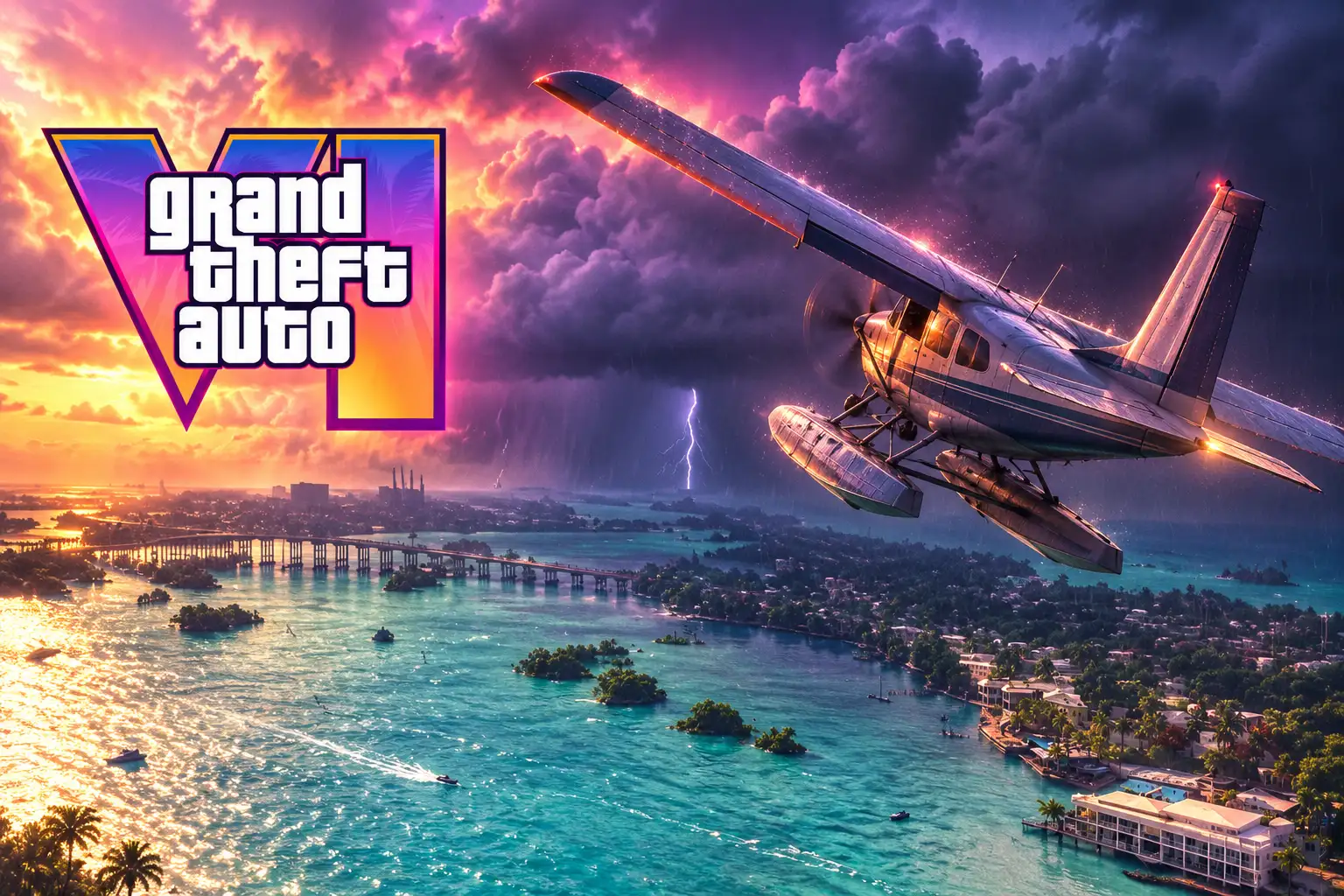
What a Localized Storm Leaves Behind
The second half of Shepherd’s brief is the unglamorous part, and it is the part that makes the first half honest. Rain is not a particle layer that dies when the cloud moves on. The ground keeps the argument.
WHAT STAYS AFTER THE CELL MOVES
- Wet asphalt: Recently showered ground stays wet, so a dry driver can still read where the rain just was.
- Persistent puddles: Standing water remains in the same spots after the cloud has gone, a leftover the player can drive into later.
- Rainbows: After a shower, rainbows can form when the light is right, a by-product of the same lighting pass rather than a separate trick.
- A storm you can chase: Because rain is local, a distant downpour is a destination, not a skybox painting.
- A storm you can miss: The reverse is also true. You can occupy sun and never feel the cell that is hammering the next county.
That leftover wetness is how the world proves it has a memory. It also gives photographers and video makers a new job: hunt the light behind a cell instead of waiting for a menu to spawn dusk. People already reading the new stills keep pointing at lightning on the horizon as if it were a pin on the map, because in this system it is.
Wind That Stops at the Roofline
Weather in Leonida is not only rain. Shepherd described a separate wind pass that includes offshore breezes after sunset, convectional updrafts, and occlusion from buildings. In plain terms, a tower blocks air the way a tower should. Gusts do not blow through concrete.
He said hair and debris will swirl around on rooftops, gusts will throw ripples across water, and grass will bend in the swamps. Those are small motions, and they are how a tropical state stops looking like a painted backdrop. They also tie the weather brief to the rest of the cover package. Leonida holds 170+ animal species, including more than 60 bird types and more than 30 land mammals. Fur in that roster reacts to dirt, clumping, and wet coats. A local shower does not only darken a road. It changes the animals standing in it.
Senior vice president of narrative Rupert Humphries said the studio’s Florida trips were built to take the state in at ground level, from night rides with ex-cops to time in the Everglades and the Keys. The weather work sits in that same research habit. Leonida is not a permanent beach postcard. It is a place that has afternoons.
A Hurricane Looks Like This on the Ground
Tropical storms and seasonal hurricanes are confirmed for Leonida. That is the line that moved around fastest on September 29. Shepherd did not talk about category ratings or a disaster meter. He talked about what the street does when the sky closes.
Heavy clouds, strong winds, dense atmospherics, and a lot of rain combine so that everything is dripping wet, water is gushing off roof edges and lampposts, thunder rumbles, and flashes of lightning light up the clouds dramatically.
Owen Shepherd, vice president of art for lighting and rendering, Rockstar Games
That is a look. Water off lampposts, thunder, lightning in the cloud mass. It matches the stills of a Keys sky going dark. It does not answer the questions players immediately ask once a hurricane is on the record: whether traffic thins, whether shops shutter, whether a wanted level gets easier in the rain, whether a story beat can force you into a cell, whether you can trigger one.
WHAT WE KNOW
- Local cells: Sun and rain can occupy different parts of Leonida at the same time.
- Leftover water: Puddles and wet ground remain after a shower passes.
- Full storms: Tropical storms and hurricanes are in the world, with heavy rain, wind, thunder and lightning.
- Physical wind: Breezes, updrafts and buildings that block air all move hair, debris, water and swamp grass.
WHAT IS UNCONFIRMED
- How often: Nobody on the record has said how frequently the larger storms arrive.
- Story use: There is no confirmation that a hurricane is a mission, a cutscene, or a random world event.
- Police and traffic: No designer has said cops, civilians or shops change behaviour in a storm.
- Player control: There is no word on a weather command, a skip, or an on-demand trigger.
Treat clips that already promise a hurricane as a getaway tool as guesswork. Presence is on the record. The rules are not.
How Florida’s Real Season Fits the Map
Rockstar’s brief is not a fantasy climate. It is Florida’s, compressed into a playable state. The National Hurricane Center’s climatology page puts the Atlantic season on a hard calendar: June 1 to November 30. Based on the 1991 to 2020 window, an average Atlantic season of 14 named storms also brings 7 hurricanes and 3 major hurricanes, meaning Category 3 or higher. The peak date on that record is September 10, and most of the activity sits between mid-August and mid-October.
THE ATLANTIC NUMBERS LEONIDA IS SAMPLING
- Season window: June 1 to November 30, with a peak around September 10.
- Named storm: Maximum sustained winds of 39 to 73 mph.
- Hurricane: 74 mph or higher; a major hurricane starts at 111 mph.
- Normals: 14 named storms, 7 hurricanes, 3 major hurricanes in the 1991 to 2020 average.
Grand Theft Auto VI is now set to launch November 19, 2026, a Thursday, on PlayStation 5 and Xbox Series X|S. That date sits 11 days before the official Atlantic season ends. Players who walk into Leonida in late November are walking into the calendar Florida actually uses, even if Rockstar never maps one in-game month onto one real month.
Shepherd’s own cloud list already follows that calendar in spirit. He set clear winter light against the tall summer and autumn thunderheads that stack most afternoons in Florida. The hurricane line is the same idea taken to the violent end of the scale. The studio is not inventing a new kind of sky. It is refusing to leave the ugly half of the state on the cutting-room floor.
Red Dead’s Clouds Were the Test Run
None of this arrives from nowhere. Red Dead Redemption 2 already ran a living sky: volumetric clouds that darkened in storms, wind that picked up as a front moved in, rainbows in the right light, mud and snow that held a trail. Grand Theft Auto V’s clouds sat on a large dome wrapped in a noise pattern. They varied. They did not occupy space the same way.
Shepherd did not call Leonida a port of that Western. He said the weather system had been re-engineered, and that the team wanted a sense of scale it had not felt before. The honest read is a step, not a copy. RDR2 proved Rockstar could let a storm arrive. GTA VI is trying to let a storm occupy one county of a modern city-state and then leave evidence on the tarmac.
THREE SKIES, THREE SETS OF RULES
| Game | Sky | After the rain | Violent weather |
|---|---|---|---|
| Grand Theft Auto V | Clouds on a world-wrapping dome | Surfaces dampen while weather is up | No tropical storms or hurricanes |
| Red Dead Redemption 2 | Volumetric clouds, storms that darken the world | Mud and snow hold trails; rainbows possible | Frontier storms, not Atlantic cyclones |
| Grand Theft Auto VI | Fully dynamic cloudscapes that roll across Leonida | Persistent puddles and wet ground after a cell passes | Tropical storms and hurricanes confirmed |
The hardware worry sitting under that table is obvious, and it is already in the air around the new stills. A map Garbut puts at around twice Grand Theft Auto V, packed with interiors he says the team obsessed over, now also carries local rain, leftover water, and a wind pass that cares about rooftops. That is a heavier world to keep in memory. It is also the bet the interviews keep making: density and weather at the same time, not one traded for the other.
November 19 Still Has No Storm Rules
Rockstar’s own launch note, posted November 6, 2025, moved the game to Thursday, November 19, 2026, and apologised for the extra wait. Pre-load for digital copies is dated November 12. Store pages list it for PlayStation 5 consoles on November 19 and for Xbox Series X|S the same day. No PC date sits on those pages.
THE WEATHER FILE, IN ORDER
- November 6, 2025: Rockstar sets the launch for Thursday, November 19, 2026, citing polish on Leonida and a return to modern Vice City.
- September 29, 2026: Shepherd and other leads describe localized, persistent weather; Rockstar issues 12 new screenshots, including storm light over the Keys.
- November 12, 2026: Digital pre-load window opens.
- November 19, 2026: Grand Theft Auto VI launches on PlayStation 5 and Xbox Series X|S, 11 days before the Atlantic hurricane season’s listed end date.
Between the interview day and that Thursday sits the blank the cover package left in plain sight. A player will be able to see rain that is not falling on them. They will be able to drive into leftover puddles. They will, at some unknown interval, sit under the kind of sky Shepherd described, with water coming off the lampposts. What that does to a chase, a drop-off, a fishing trip in the Grassrivers, or a night in Vice City is a question Rockstar has not answered yet.
The local storm is already a system. The hurricane is still a picture.

Edinburgh Opens a 2027 Tour Built for Time Trials

Korda Maps Auður From Meðalland to Irvine Bay

Apple Music Films Its New Logo in Mineral Oil

Oppo Prices the Pad Mini Above India’s iPad Mini

Austen Soaks Scotland Before Boelo Brings Weekend Gales

Volkswagen Sells the Osnabruck Plant to Clear a Board Fight

Apple’s Foldable iPhone Hinges on Samsung Display Supply

Saksham Gaur Finds He Is His Own Company’s Client

Tata Motors’ Iveco Tender Opens as Holders Still Decide

Onimusha Way of the Sword Preload Hits a Windows 11 Wall
-
 AUTO2 months ago
Volkswagen Sells the Osnabruck Plant to Clear a Board Fight
-
 NEWS2 months ago
Apple’s Foldable iPhone Hinges on Samsung Display Supply
-
 AUTO2 months ago
Tata Motors’ Iveco Tender Opens as Holders Still Decide
-
 BUSINESS2 months ago
Saksham Gaur Finds He Is His Own Company’s Client
-
 GAMING2 months ago
Onimusha Way of the Sword Preload Hits a Windows 11 Wall
-

 ENTERTAINMENT3 years ago
What is SD on Amazon Prime? – All You Need to Know
-

 BUSINESS2 months ago
Hyderabad 22-Carat Gold Jumps After a False Bargain
-

 NEWS2 months ago
iQOO 16 Locks 8,400 mAh While 100W Charging Holds