
NEWS
Starship’s First Orbit Attempt Starts Falcon 9’s Sunset
SpaceX will try to put Starship in orbit on September 28, 2026, a step that also starts the wind-down of Falcon 9 for commercial customers.

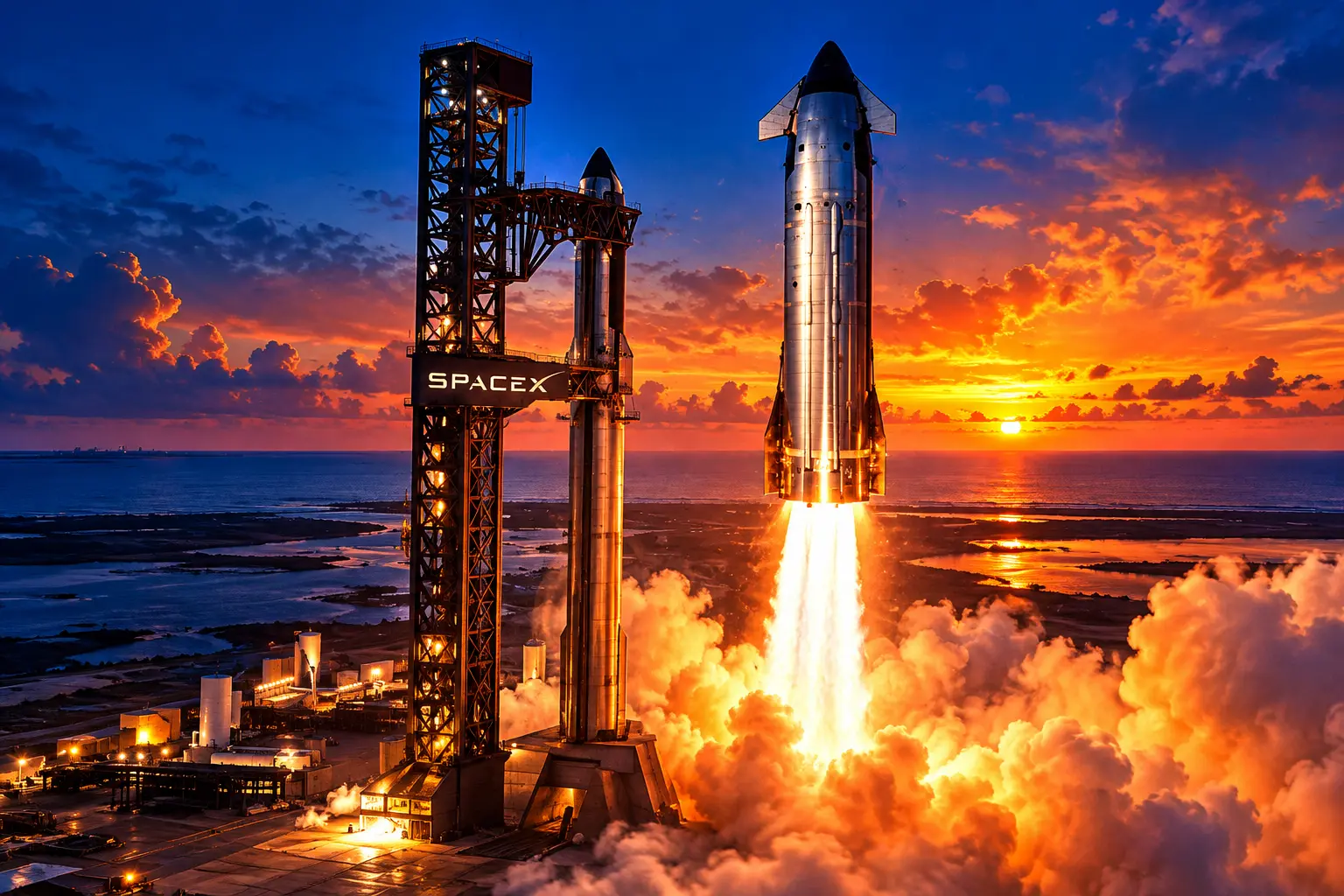
SpaceX is aiming to put Starship into Earth orbit for the first time on September 28, 2026, on a nearly 10-hour flight from Starbase, Texas, with 26 next-generation Starlink satellites in the nose. The 75-minute launch window on September 28 opens at 7:15 a.m. CT (8:15 a.m. ET), after the FAA licensed the launch and reentry on September 26.
If Ship 41 looks healthy after a coast check, a 19-second engine burn will lock it in orbit. That is the step that turns a test article into the rocket SpaceX wants to replace Falcon 9 with, even though the company has not promised commercial customers a ride on the new machine.
Flight 14 Leaves the Safety Net Behind
Every one of the 13 full-scale Starship flights since 2023 flew a path SpaceX calls a passively safe suborbital trajectory. Lose control, and the ship was already falling toward a planned splash zone. Flight 14, with Super Heavy Booster 21 under Ship 41 at Pad 2, is built to drop that net.
After staging, the ship first stays on the old Indian Ocean path. Controllers then get a window of about 17 minutes after engine cutoff at T+8 minutes 11 seconds to decide whether backup hardware for a later deorbit burn is sound. Only then does a single sea-level Raptor fire at T+25 minutes 17 seconds to circularize at about 275 km, for roughly six laps, with splashdown west of Chile.
The Federal Aviation Administration said on September 27 that it had issued license authorization the day before for Flight 14 launch and reentry operations. SpaceX finished a wet dress rehearsal on September 24. Neither stage will be caught by the tower. The booster is aimed at a controlled splash in the Gulf of Mexico, and the ship at the Pacific.
THE FLIGHT 14 CLOCK
| Mission time | Event |
|---|---|
| T+00:00:00 | Liftoff from Pad 2 |
| T+00:02:22 | Hot-staging and stage separation |
| T+00:06:36 | Super Heavy landing burn (Gulf) |
| T+00:08:11 | Starship engine cutoff, coast check begins |
| T+00:25:17 | 19-second orbital insertion burn |
| T+00:34:07 to T+01:04:39 | Starlink deploy |
| T+08:52:37 | 11-second deorbit burn |
| T+09:50:11 | Landing burn and flip off Chile |
Those times are approximate and come from SpaceX’s own mission page. If the coast check fails, the insertion burn is skipped and the ship falls back into the Indian Ocean, still a test, still suborbital.
26 Satellites and a Pair of Used Tiles
SpaceX says this is the first time it plans to send Starlink Version 3 satellites into the constellation. Flight 13, on July 24, 2026, released 20 working V3 spacecraft, but they were on a suborbital arc and burned up about 20 minutes after release. The Flight 14 batch is meant to stay up, raise itself on onboard thrusters, and start serving customers a few weeks after launch.
THE V3 PAYLOAD ON FLIGHT 14
- The stack: 26 production Starlink V3 satellites, listed as Starlink Group 31-1.
- Capacity: Each satellite adds 1 Tbps, for 26 Tbps on this flight, about 10 times a Falcon 9 launch of V2 Mini spacecraft.
- Cameras: Three of the 26 carry a camera suite aimed at Ship 41’s heat shield.
- Reused tiles: Two tiles recovered from Ship 40 after the July splashdown are flying again on Ship 41, the first tile reuse on Starship.
The rest of the heat-shield work is quieter and more anxious. SpaceX added extra tile retainers in zones that shed hardware on the way up, closed newly found plasma leak paths behind tiles, and is flying patches of a curved tile that cuts heating in the gaps. Those changes came from photos of Ship 40 while it still floated intact in the Indian Ocean, a first for the program.
Why SpaceX Will Abort Orbit If the Ship Looks Sick
Orbit is a different legal and physical object from a high arc. A dead Starship at 275 km is not on a path that brings it down in a known patch of sea. Joseph Gonzalez, an associate professor of practice in aerospace engineering at the University of Illinois, put the failure modes in plain order.
There’s so many things that can go wrong. With your propellant systems, maybe you have a leak, you might have a freeze over of one of your bows, so maybe your engines are not igniting. Then you essentially just have a dead object that’s in orbit that can pose a risk.
Joseph Gonzalez, associate professor of practice in aerospace engineering, University of Illinois
SpaceX has said the ship will fly below crewed stations and that it will skip the orbit burn if early minutes show trouble. Elon Musk, speaking at the All-In Summit this month, named the fear that still sits over every recovery plan: a breakup over land. “What we’re most concerned about is if the ship were to break up over land and rain debris on people,” he said. “Our popularity would diminish very rapidly.” Debris from two 2025 flights fell over and near Turks and Caicos and the Bahamas, and some residents were furious.
The booster has its own unfinished business. On Flight 13, all 33 Raptor 3 engines ran on the way up, and Super Heavy used all 33 on the high-thrust stretch of the boostback burn for the first time on a V3 booster. Ice clog in the three center engines then cut the burn short. Only 8 of 13 engines relit for landing, and the booster hit the Gulf hard. SpaceX says Flight 14’s booster has new engine filters and software meant to make relight more reliable. It is still an ocean practice landing, not a tower catch. Catching both stages, the step SpaceX engineers call the holy grail of rocketry, waits. Musk has said the V3 design is capable of a fully and rapidly reusable Starship. “Of that I am certain,” he said this month.
After 2028, Falcon 9 Stops Taking New Work
The orbit attempt is also a business deadline. SpaceX has stopped taking new dedicated Falcon 9 bookings for missions beyond 2028 and has closed new reservations on its Falcon rideshare program. Gwynne Shotwell, SpaceX’s president, said the company would fly “maybe 140, 145-ish” Falcon missions in 2026, down from 165 in 2025, then “tail off our launches as Starship is coming online.” Musk has said Falcon 9 goes away once Starship can fly “reliably several times per week.”
Starlink already occupies most of the Falcon pad time that other companies used to buy. Launch data compiled by astrophysicist Jonathan McDowell show Starlink’s share of Falcon 9 missions rising from 54% in 2020 to about 79% so far in 2026. SpaceX’s second-quarter 2026 results put that in money: Starlink brought in $4.3 billion of $7.8 billion in revenue, while space services, the bucket that includes commercial launch, were less than 12%.
FALCON 9 AT THE TURN
| Measure | Figure | Period |
|---|---|---|
| Falcon 9 flights | 165 | 2025 |
| Planned Falcon flights | 140 to 145 | 2026 |
| Starlink share of Falcon 9 | 54% | 2020 |
| Starlink share of Falcon 9 | about 79% | 2026 |
| Starlink share of company revenue | $4.3B of $7.8B | Q2 2026 |
SpaceX’s IPO prospectus is blunt about who wins the remaining slots. The company “may prioritize our own launch payloads over additional U.S. government contracts or third-party customers.” Akhil Rao, chief economist at Rational Futures and a former NASA employee, said the scarce resource is launch capacity itself: flying an outside customer means giving up the profit from flying another Starlink or, later, an orbital data-center satellite.
A Launch Crunch With No Replacement Rocket
At least seven spacecraft companies have been told Falcon 9 is fully booked for all types of missions until 2028 or 2029. SpaceX has booked some commercial cargo on Starship, but people who watch the manifest say NASA tanker flights and Starlink V3 will eat the early operational years. Caleb Henry, director of research at Quilty Space, has been hearing the same line from operators for months.
What we have is an industry in panic.
Caleb Henry, director of research, Quilty Space
The Western market has no spare heavy rocket sitting idle. Russia’s commercial fleet dropped out for Western customers after 2022. The next large American vehicles have stumbled in the same window that SpaceX is closing its book.
ROCKETS THAT CANNOT FILL THE GAP
- New Glenn: Exploded during a May 2026 static-fire test and wrecked its only Florida pad; Blue Origin is out at least through the end of 2026.
- Vulcan: Grounded since February over booster trouble, with only two military missions flown years after a Space Force award.
- Ariane 6: Flying, with a production goal of about 10 vehicles a year, too few to replace Falcon’s cadence.
- Neutron, Nova, Terran R: Medium-lift designs that, even on their own calendars, are aimed at 2027 debuts and a slow climb after that.
Telesat has been asked whether it would share any of the 11 Falcon 9 launches it already holds. It would not. Amazon’s LEO constellation has had to slow satellite production because launch slots it bought years ago are not ready. AST SpaceMobile has told investors that launch availability is now the pacing item for its network. Falcon 9’s published price has risen from around $54 million in 2013 to roughly $74 million. Robert Sproles, chief executive of Exolaunch, has said demand is outrunning supply and that he does not see prices falling in the foreseeable future. Six orbits on Flight 14 would also make Starship a worldwide tracking object rather than a local Texas roar, which is a public-relations fact, not extra pad time for anyone else.
The Moon Landing Still Needs a Fuel Depot
NASA is already in the queue that commercial operators cannot see. The agency’s $2.89 billion lunar lander contract under NextSTEP-2 Appendix H Option A pays SpaceX to land astronauts with a Starship derivative. A later option added more work. Before a lander can leave low Earth orbit for the moon, SpaceX has to park a depot on orbit and fill it with more than 10 tanker flights, moving propellant that has to stay colder than minus 260 degrees Fahrenheit.
That transfer has never been done in space. A July 2026 GAO assessment of NASA’s major projects said SpaceX’s cryogenic propellant transfer remains a top risk for the human landing program, alongside Raptor development. NASA’s own inspector general has described a storage depot followed by more than 10 tankers, each of which must rendezvous, dock, and pump. Flight 14 does not attempt any of that. It only asks whether Version 3 can stay up for ten hours, drop a working payload, and come back in one piece. The moon stack still sits on the far side of that answer.
Musk has talked about launching Starship once or twice a month, then as often as once an hour. In August he pitched a $100 billion complex in southern Louisiana, a state that has never hosted an orbital launch, and said Starbase Louisiana would have over a dozen towers.
Starbase Louisiana will ultimately have over a dozen launch towers, enabling more than 30 Starship flights per day and making it the biggest launch site on Earth!
SpaceX makes sci-fi real. https://t.co/C7Ht0U12ba
— Elon Musk (@elonmusk) August 25, 2026
He wrote that the site would enable more than 30 Starship flights per day and would be the biggest launch site on Earth. Those numbers are a goal, not a license, and they sit next to a vehicle that has not yet completed a single orbit.
South Texas Already Lives With the Noise
People around Starbase already take the blast as a fact of the calendar. Sonic booms land like gunshots. Gonzalez, who has family in Brownsville, said walls shake with each flight. “I love it,” he said of the launches, “but they’re not as big of fans.” A group of residents filed a lawsuit in April alleging property damage from Starship flights. SpaceX has argued that even if the harm is proved, it was not intentional.
A fully and rapidly reusable cadence, if it ever arrives, multiplies that local load long before it opens a commercial ticket window. The company still has to relight a Super Heavy without ice in the center engines, bring a ship through orbital heating, and prove it can deorbit on command. Controllers get 17 minutes after cutoff to decide whether Ship 41 is allowed to stay up. The 19-second burn at T+25:17 is the whole argument, compressed into one engine.

Edinburgh Opens a 2027 Tour Built for Time Trials

Korda Maps Auður From Meðalland to Irvine Bay

Apple Music Films Its New Logo in Mineral Oil

Oppo Prices the Pad Mini Above India’s iPad Mini

Austen Soaks Scotland Before Boelo Brings Weekend Gales

Volkswagen Sells the Osnabruck Plant to Clear a Board Fight

Apple’s Foldable iPhone Hinges on Samsung Display Supply

Saksham Gaur Finds He Is His Own Company’s Client

Tata Motors’ Iveco Tender Opens as Holders Still Decide

Onimusha Way of the Sword Preload Hits a Windows 11 Wall
-
 AUTO2 months ago
Volkswagen Sells the Osnabruck Plant to Clear a Board Fight
-
 NEWS2 months ago
Apple’s Foldable iPhone Hinges on Samsung Display Supply
-
 AUTO2 months ago
Tata Motors’ Iveco Tender Opens as Holders Still Decide
-
 BUSINESS2 months ago
Saksham Gaur Finds He Is His Own Company’s Client
-
 GAMING2 months ago
Onimusha Way of the Sword Preload Hits a Windows 11 Wall
-

 ENTERTAINMENT3 years ago
What is SD on Amazon Prime? – All You Need to Know
-

 BUSINESS2 months ago
Hyderabad 22-Carat Gold Jumps After a False Bargain
-

 NEWS2 months ago
iQOO 16 Locks 8,400 mAh While 100W Charging Holds