
NEWS
Earth Vent Microbes Grew in Enceladus Ocean Brine
Japan vent microbes grew at pH 11 in Enceladus brine, and plume ice grains sort ocean salts a 2042 lander could sample.

A methane-making microbe from a Japanese deep-sea vent grew in a laboratory brine built to match the ocean under Saturn’s moon Enceladus. The cells kept dividing at pH 11, well past their published limit, in tests run for 48 hours at 65°C.
The work appeared on 25 September in Science Advances, beside a second study of ice grains from the moon’s plumes. Those grains freeze slowly, then smash in the vents, sorting ocean salts into chemically distinct specks a lander could actually read.
A Vent Microbe Grew at pH 11
William Orsi, a professor of geomicrobiology at Ludwig-Maximilian University in Munich, and colleagues mixed water with salts and carbonates, then added powdered rock to stand in for Enceladus’s core. Rock and water began making hydrogen, the same class of reaction thought to run on the moon’s seafloor.
They added Methanothermococcus okinawensis, a microbe that lives on hydrogen and carbon dioxide and gives off methane. It was first taken from hydrothermal vents in the Okinawa Trough, between Japan and Taiwan. Cultures were prepared at the Institute of Microbiology and the German Archaea Centre at the University of Regensburg.
In ordinary methanogen medium the cells failed at pH 11. In the Enceladus mix they grew until pH 11 in the simulant, and they shifted their chemistry to scrape up scarce carbon dioxide by turning up the reductive acetyl-CoA pathway. Frank Postberg and Nozair Khawaja of the Free University of Berlin contributed to that study.
GROWTH AFTER 48 HOURS AT 65°C
| pH | Enceladus simulant | Standard MMC medium |
|---|---|---|
| pH 10 | 2.4 x 10⁵ cells per ml | about 100 times fewer cells |
| pH 11 | 1.4 x 10⁵ cells per ml | no growth |
Abiotic hydrogen in the flasks sat between 166 and 281 micromoles per litre, enough to feed cytochrome-poor methanogens. The carbon and energy budget of the cells was fuelled by that rock-made hydrogen, not by a gas mix piped in from a cylinder.
“If we use the cellular definition of life that we understand on Earth today, the experiments tell us that if this organism, or something similar to it, was on Enceladus, there’s a good chance it could survive,” Orsi said. He also called the attempt “a long shot.”
Ice Grains That Split the Ocean Apart
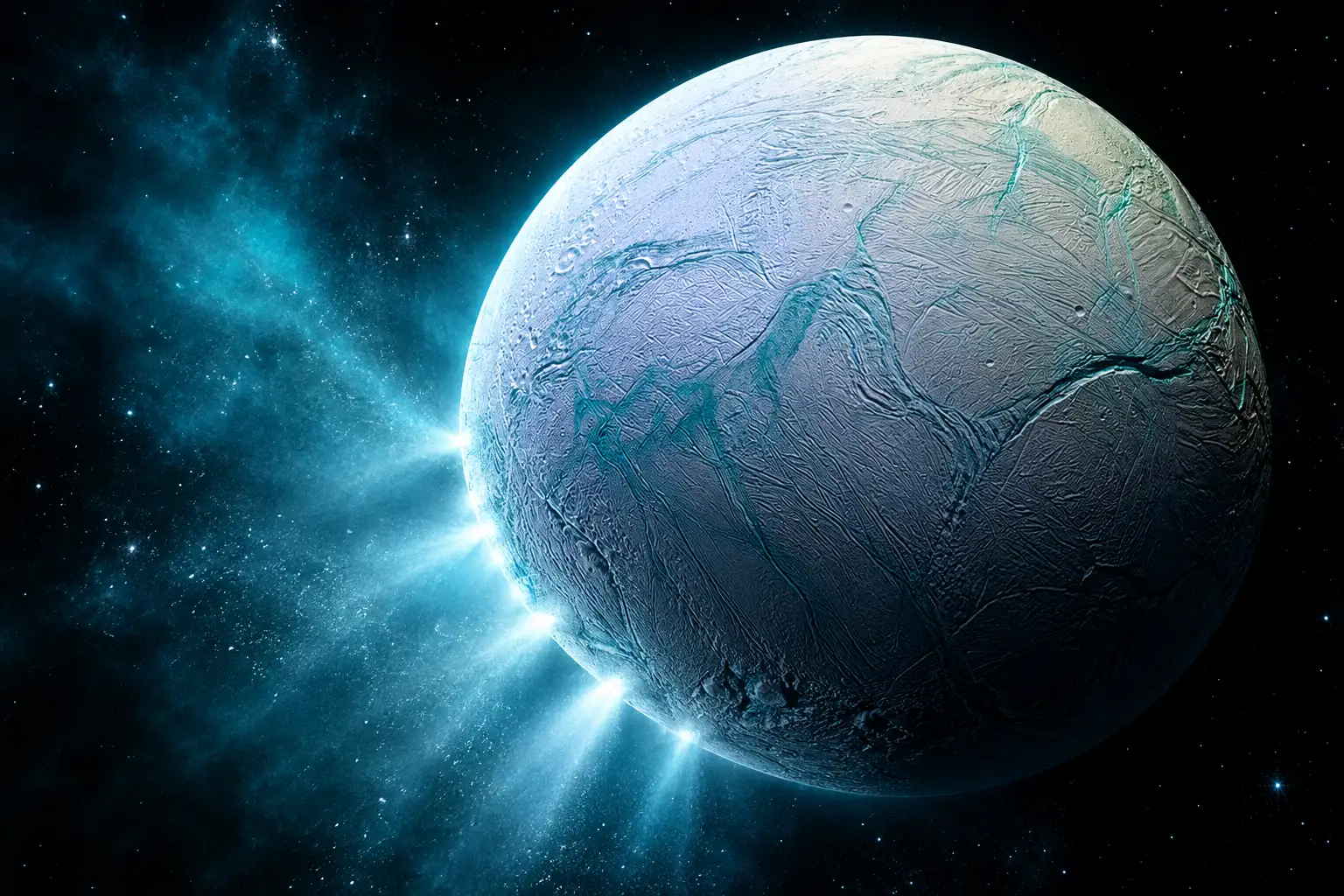
The companion paper, also dated 25 September, goes after a different problem: how a probe would ever see such cells if they existed. Cassini’s Cosmic Dust Analyzer recorded about 1,000 mass spectra of individual salt-rich Type 3 ice grains in Saturn’s E ring, the ring fed by Enceladus’s spray.
Those grains are frozen droplets of ocean water. They are not a uniform brine. Postberg’s team found five basic compositional subtypes of salt, each usually dominated by one mineral family.
SALT FAMILIES IN TYPE 3 ICE GRAINS
| Subtype | Dominant chemistry |
|---|---|
| Chloride | sodium chloride (NaCl) |
| Carbonate | sodium bicarbonate / sodium carbonate |
| Phosphate | disodium and trisodium phosphate |
| Hydroxide | sodium hydroxide |
| Potassium salts | potassium chloride or potassium hydroxide |
Laboratory freezes and thermodynamic calculations show that this split happens only in droplets larger than 10 micrometres, cooling slower than 20 kelvins per minute. A flash-frozen micrometre speck would stay mixed. The vents do something else.
Slow Freezing, Then a Smash in the Vents
HOW THE PLUME SORTS AN OCEAN
- Large spray: Ocean droplets form at hundreds of micrometres and ride a slow gas flow, so they freeze slowly enough for salts to crystallise apart.
- Vent smash: The ice is then accelerated to more than 100 metres per second in narrow cracks, where wall hits shatter it into tiny fragments that each carry mostly one salt.
- Organic split: The same freeze-and-break sequence also separates organic ocean constituents into differently composed grains, rather than smearing them through the whole plume.
That last point is the design note hiding under the microbe headline. If bits of cells rode the spray, they would not be diluted across every particle. They would turn up in a small fraction of grains, at high concentration inside those grains, which is the geometry impact-ionization mass spectrometers already know how to read.
Postberg, a professor of planetary sciences at the Free University of Berlin, said that outcome would be “great news” for the search for life, and that signs of life would be relatively easy to identify with today’s instruments. Earlier Cassini work had already shown that only a small share of plume ice, on the order of 1 to 4 percent, carries organic material in high amounts.
What a 48-Hour Test Cannot Prove
David Rothery, a professor of planetary geosciences at the Open University, said the methanogenesis result “removes another barrier to the viability of microbial life there.” It does not say the barrier of time has fallen.
Could they survive for a year? Could they survive for a million years? We don’t know.
William Orsi, professor of geomicrobiology, Ludwig-Maximilian University in Munich
Orsi also stressed that life on Enceladus, if it ever started, could be unlike anything in an Earth flask. The simulant was anoxic, carbonate-rich and very alkaline, with pH values of 10 or 11. It was still a 48-hour run at 65°C, a temperature chosen because this strain is a thermophile, not because anyone has measured 65°C at the moon’s seafloor.
The cells adapted to low carbon dioxide in that window. Adaptation over days is not a population that holds a vent field through ice-age cycles of a small moon. The paper closes a chemistry argument. It leaves the duration argument open.
Cassini Already Sampled the Spray
Enceladus is 313 miles across, about 504 km, a figure NASA and ESA both use. Saturn had 293 confirmed moons as of June 2026, more than any other planet. For more than two centuries this particular ice ball looked ordinary. That ended when Cassini arrived.
NASA’s Cassini team found jets of icy particles from that ocean blasting from four south-polar fractures, informally called tiger stripes, each about 135 km long. The spray leaves at about 400 metres per second. Some of it falls back. Some of it builds Saturn’s E ring.
Gravity and a slight orbital wobble showed a global saltwater ocean under the ice. Under the south polar region that ocean is about 10 km deep. The ice shell is about 30 to 40 km thick over much of that terrain and as thin as 1 to 5 km at the south pole. Silica nanoparticles 2 to 8 nanometres across, sampled in the plume, point to water that was at least 90°C when those grains formed at the rock-water interface.
The James Webb Space Telescope later mapped a water vapour plume spanning more than 6,000 miles, more than 20 times the width of the moon, gushing at about 79 gallons per second. In 2025, a re-analysis of a fast Cassini flyby found a wider set of organic fragments in freshly ejected ice grains, including esters, ethers and nitrogen- and oxygen-bearing species.
FROM FLYBY TO FLASK
- February 2005: Cassini’s first close Enceladus pass hints at a south-polar plume.
- 2005 to 2015: Repeat flybys map the tiger stripes, salts, silica and a global ocean.
- October 2015: Cassini makes its last pass through the spray.
- 2018: Laboratory work shows M. okinawensis can make methane in high-pressure Enceladus-like gas mixes.
- May 2023: Webb maps the giant water-vapour plume.
- 25 September 2026: The two Science Advances papers land on the same day.
Phosphates in ice grains, reported from Cassini’s dust analyzer in 2023, already completed the set of CHNOPS elements in the plume. One of the new grain subtypes is a phosphate grain. The vents are handing a future probe the same salts, pre-sorted.
The Same Microbe, Eight Years Earlier
This is not the first time M. okinawensis has been asked to impersonate an Enceladus bug. A 2018 Nature Communications study put the same species under high pressure, up to 50 bar, with gases Cassini had seen in the plume, including inhibitors. It still converted as much as 72 percent of the carbon dioxide into methane.
That work used defined gas mixtures in steel vessels. It did not rebuild a soda ocean sitting on powdered chondritic rock, and it did not push the published pH limit. The 2026 flasks do both. They also show the cells turning on extra carbon-fixation genes when free CO2 almost vanishes at pH 11, which is the condition that killed them in standard medium.
The overlap is the point of using this strain at all. It is a strict anaerobe. It can live on hydrogen and carbon dioxide alone. Cassini already measured both gases in the plume, plus methane whose origin is still argued. A Bayesian reading of those escape rates in 2021 found that abiotic serpentinization alone was a poor fit and that methanogenesis scored well if the chance of life arising was assumed to be high. If that chance is low, the same numbers fit a habitable ocean that is empty, with leftover methane from some other source.
The new growth data do not break that tie. They say a known Earth metabolism can run in the water chemistry. They do not say it does.
Two Ariane Rockets and a South Pole Landing
ESA’s L4 mission is the first flagship of the Voyage 2050 programme and the agency’s fourth Large-class flight. It is still under study. The plan is a fully European orbiter and a lander, with a launch in 2042 and arrival at Saturn in the 2050s, after a cruise of about ten years.
Two Ariane 6 rockets would lift the stack, which would then be assembled in orbit near Earth. At Enceladus the orbiter is meant to sample the plumes bursting through the ice and reconnoitre the south pole. The lander would touch down there for several weeks and analyse icy particles that have fallen from the ocean, the same class of grains Postberg’s team has now shown come pre-sorted.
L4 IN BRIEF
- The launch: 2042, on two Ariane 6 rockets, with in-orbit assembly near Earth.
- The wait: Arrival in the 2050s, about ten years after launch and 80 minutes of one-way light time from Earth.
- The work: Plume sampling from orbit, then a south-pole landing for several weeks of surface chemistry, plus flybys of other Saturn moons.
- The cold: Mean surface temperature near -198°C, with south-polar terrain unlike any landing ESA has flown since Huygens dropped onto Titan in 2005.
Dr Rachael Hamp, also at the Open University, who has worked on Enceladus’s plumes, said the new papers make the proposed European mission “even more exciting.” The science traceability matrix already lists a hunt for chemical biosignatures, from monomers to polymers, and a test of whether methanogenesis or serpentinization made the organics. The ice-grain paper tells that payload where the signal would sit: not in a well-stirred average of the plume, but in rare, rich particles.
The flask ran for 48 hours. The lander is due on the south pole in the 2050s, after a 2042 launch, to sample ice the vents have already sorted.
Frequently Asked Questions
Where was Methanothermococcus okinawensis first isolated?
Ken Takai and colleagues isolated it in 2002 from a hydrothermal vent chimney on the Iheya Ridge in the Okinawa Trough, at 972 metres depth, during a dive by the submersible Shinkai 2000. The cells are highly motile irregular cocci with a polar bundle of flagella, and they were described as strict anaerobes that can live on hydrogen and carbon dioxide alone, with formate as an alternative energy source.
How fast does the microbe divide in its original lab tests?
The 2002 species description reported growth between 40 and 75°C, with an optimum of 60 to 65°C and a doubling time of 30 minutes at that optimum. The Enceladus simulant runs were set at 65°C to sit on that peak, not to copy a measured seafloor temperature on the moon.
What pH range did the 2002 species description allow?
Takai’s paper listed growth between pH 4.5 and 8.5, with an optimum of pH 6.7. That 8.5 ceiling is the limit the 2026 team beat in the Enceladus mix; the same cells still failed at pH 11 in standard methanogen medium, so the soda-ocean chemistry, not a hidden general alkaliphily, is what carried them.
Which culture collection strain was used in the Enceladus simulant?
The tests used the type strain IH1, held as DSM 14208 at the German Collection of Microorganisms and Cell Cultures and as JCM 11175 in Japan. It is the same lineage isolated from the Iheya chimney and the same species used in the 2018 high-pressure methane work.

Edinburgh Opens a 2027 Tour Built for Time Trials

Korda Maps Auður From Meðalland to Irvine Bay

Apple Music Films Its New Logo in Mineral Oil

Oppo Prices the Pad Mini Above India’s iPad Mini

Austen Soaks Scotland Before Boelo Brings Weekend Gales

Volkswagen Sells the Osnabruck Plant to Clear a Board Fight

Apple’s Foldable iPhone Hinges on Samsung Display Supply

Saksham Gaur Finds He Is His Own Company’s Client

Tata Motors’ Iveco Tender Opens as Holders Still Decide

Onimusha Way of the Sword Preload Hits a Windows 11 Wall
-
 AUTO2 months ago
Volkswagen Sells the Osnabruck Plant to Clear a Board Fight
-
 NEWS2 months ago
Apple’s Foldable iPhone Hinges on Samsung Display Supply
-
 AUTO2 months ago
Tata Motors’ Iveco Tender Opens as Holders Still Decide
-
 BUSINESS2 months ago
Saksham Gaur Finds He Is His Own Company’s Client
-
 GAMING2 months ago
Onimusha Way of the Sword Preload Hits a Windows 11 Wall
-

 ENTERTAINMENT3 years ago
What is SD on Amazon Prime? – All You Need to Know
-

 BUSINESS2 months ago
Hyderabad 22-Carat Gold Jumps After a False Bargain
-

 NEWS2 months ago
iQOO 16 Locks 8,400 mAh While 100W Charging Holds