
NEWS
Meta Built Muse to Take a Cut of Shopping
Muse topped the U.S. App Store as a shopping agent Meta wants to tax with a take-rate, then Amazon blocked it from checkout.

Muse, Meta’s personal AI assistant, hit No. 1 on Apple’s U.S. App Store on Sept. 18. Sensor Tower counted about 730,000 U.S. downloads in those first 10 days after the Sept. 8 launch.
The app is not a chat box that waits for a prompt. It runs on a cloud computer Meta issues to each user, and it is built to shop, book, and pay. Mark Zuckerberg’s plan is to take a small fee on those transactions. Amazon cut the agent off its store on Sept. 20.
Meta Wants a Cut of Every Cart
Zuckerberg told Alex Heath on the Sources podcast the week Muse launched that he does not expect billions of people to buy a Mac Studio, wire it up, and run an agent at home. Muse is the version you hand to a relative. It is free to start, with up to 100 million tokens a week, plus paid plans at $20 and $100 a month for heavier use.
The long-term bill is not the subscription. On Sept. 23 at Connect he called the model novel and said Meta would keep a huge token allowance free, then profit later by taking a small fee from purchases, bookings, and bill talks. He had already put the same idea in plainer words for Heath: the agent should make you money and save you money, and that is how it pays for itself. The cut may be charged to the businesses on the other side of the cart. Meta has not said how large the fee will be, which jobs it will cover, or when it starts.
MUSE ON THE METER
- Free cap: Up to 100 million tokens a week, plus a cloud computer that keeps working when you close the phone.
- Paid plans: $20 and $100 a month for people who burn through the free pool.
- Take-rate: A small, still undisclosed fee on transactions the agent completes.
- No Muse ads: Zuckerberg is not planning to sell ads inside the assistant.
That last point matters because Meta still lives on ads everywhere else. Muse is the first consumer product under AI chief Alexandr Wang, 29, that tries to get paid at the moment of a decision rather than in the feed that precedes it. Lloyd Walmsley at Mizuho Americas wrote that the bull case for Meta is starting to play out. Truist Securities has sketched extra annual revenue of at least $28.5 billion by fiscal 2030 if the agent sticks.
We believe that Muse will make you money. We’re standing behind this by making Muse free for a huge number of tokens with the expectation that over time we will profit by taking a small fee from transactions.
Mark Zuckerberg, CEO, Meta Connect 2026
The rails are already in. Muse is among the first consumer agents to use the Link by Stripe digital wallet, which can mint a single-use virtual card scoped to one purchase when a merchant does not take Stripe. Shop Pay and PayPal sit beside it. Meta says the agent cannot see the card numbers in a Stripe account, and it is not supposed to buy without a final yes from the user.
Day 12, Amazon Shut the Door
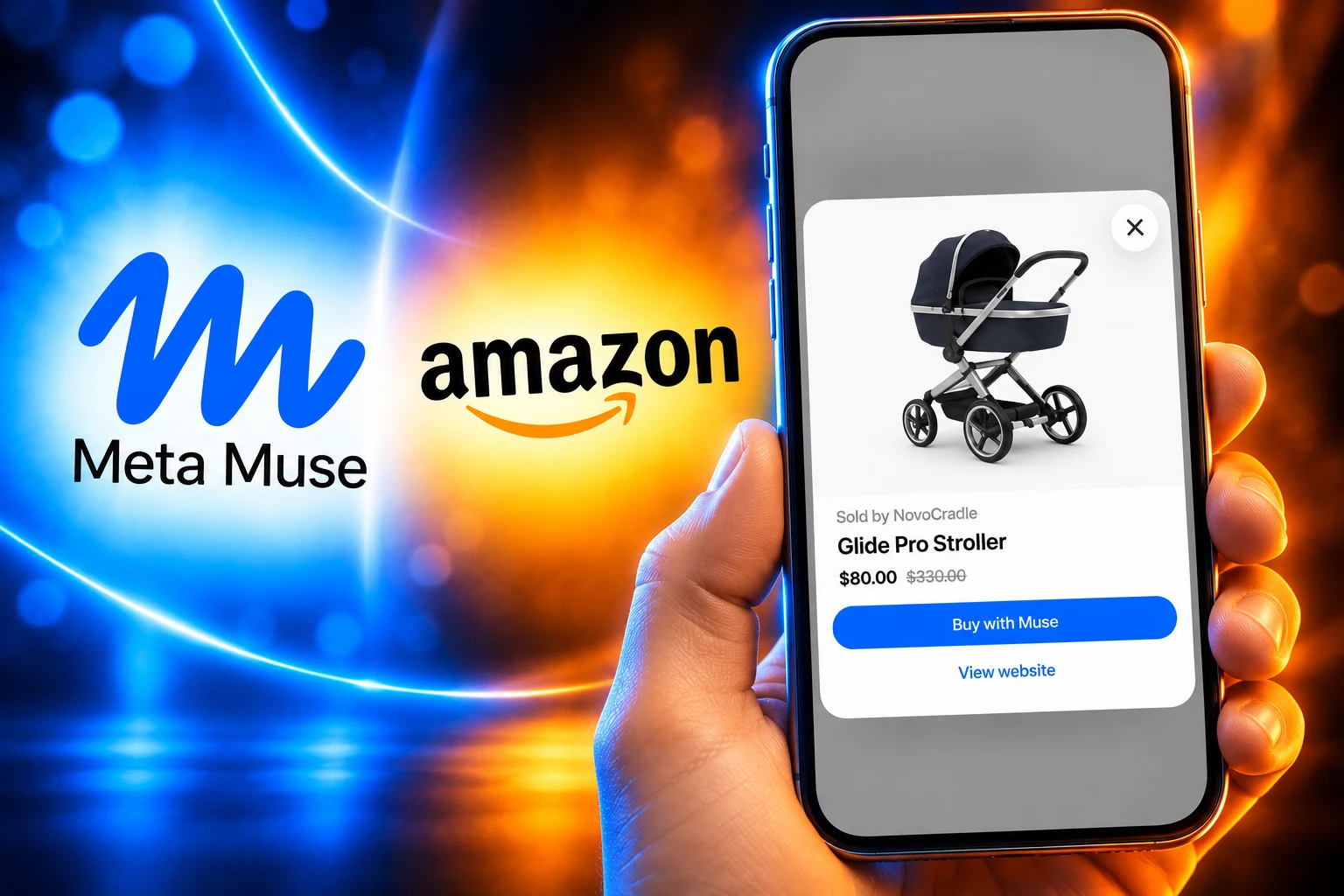
Twelve days after launch, people who pointed Muse at Amazon.com got a popup instead of a product page. “Continued access by an unauthorized AI agent violates Amazon’s Conditions of Use, to which our customers have agreed.”
Amazon says it had asked Meta to keep the store out of the experience and was ignored. It says Meta never disclosed that Muse would shop there, that the agent does not identify itself while it browses, and that it appears to capture and store customer logins. Because the bot does not announce itself, Amazon argues an undisclosed third party is walking through account pages and order history.
An Amazon spokesperson said third-party apps that offer to buy from other businesses on a customer’s behalf “should operate openly and respect service provider decisions about whether or not to participate.” The company compared Muse to food-delivery apps and online travel agencies, which book only with the merchant’s say-so. Amazon ads brought in more than $68 billion last year, a business that depends on people lingering on search pages and seeing sponsored listings. An agent that types “paper towels” and buys the cheapest result never sees those ads.
Amazon has spent a year pushing outside agents off the store, including a suit against Perplexity over its Comet browser. A federal appeals court in August undercut the hacking theory. The Ninth Circuit said the shopper accesses Amazon’s computers, not the AI firm, which left Amazon one clean path: the customer contract. The Muse popup cites the Conditions of Use, not a criminal statute. Amazon declined to say whether it would sue Meta. The two companies still do business; Amazon goods have been buyable inside Facebook and Instagram since 2023, and Meta signed a multibillion-dollar deal in April to run agent workloads on Amazon’s Graviton chips.
The block is leaky in theory. If the agent uses a person’s own IP address and cookies, a store cannot always tell a human from a bot acting for them. In practice Amazon did tell Muse sessions apart and served them a different page. Meta’s line, published at launch, is that Muse has no visibility into passwords or payment methods, and that shared credentials go into secure storage so the agent can use them without seeing them.
Walmart, Shopify and the Checkout Club
Connect was Meta’s answer to the empty Amazon slot. Wang said Muse can reach the full Shopify catalog and check out with Link and Shop Pay, and that PayPal now covers more of the globe. Developers filed more than 1,500 connector applications in under a week after Meta opened the platform.
WHO LET THE AGENT IN
| Partner | Job in Muse | Status |
|---|---|---|
| Shopify | Catalog and Shop Pay checkout | Live |
| Stripe Link | Wallet and scoped virtual cards | Live |
| PayPal | Global payments | Live |
| Walmart, Best Buy, Gap, Sephora | In-app shopping | Integrating |
| Wayfair, Ulta, Fanatics, Dick’s, Michael Kors, American Eagle | In-app shopping | Integrating |
| Expedia | Travel | Coming soon |
| Instacart | Groceries | Coming soon |
| Notion, Granola, GitHub, Box | Work apps | Live or adding |
| Amazon | Shopping | Blocked Sept. 20 |
Meta’s own recap lists Walmart, Best Buy, Sephora and Wayfair among the stores joining the agent, with Instacart for the kitchen and Expedia for trips. Early Muse users had already sent it after groceries and discount codes. Some of that traffic now has a sanctioned door. Some of it does not.
Shopify shares jumped after the Shop Pay news. The pattern is the old platform trick: if enough people ask Muse to buy, merchants will want a seat on the results. Meta has not said whether it will sell placement inside those answers. Until it does, the announced fee is a small cut of the cart, and the unannounced option is a new shelf.
How Friedman Turned OpenClaw Into Muse
Nat Friedman, the former GitHub chief who now runs products and applied research in Meta’s superintelligence unit, did not hide the template. After he used OpenClaw in January, he bought hundreds of Mac minis for the lab. On Sept. 21 he wrote that Muse was built from scratch and still “definitely heavily inspired as a product by openclaw,” with a goal of making something like it safe, simple, and big enough for billions of people.
we built muse from scratch, but it is definitely heavily inspired as a product by openclaw. After I used openclaw in january I bought hundreds of mac minis for the MSL team and lots of us fell in love with using openclaw (and other personal agents). @steipete is a genius and his…
— Nat Friedman (@natfriedman) September 21, 2026
OpenClaw, created by Austrian developer Peter Steinberger, is a desktop agent that developers loved and ordinary users found opaque. Friedman’s internal memo was titled “The Claw Is The Law.” His personal site puts the working rule in four words: slow is fake. He has pushed staff off sluggish internal tools toward faster outside ones such as Vercel. Early Muse users found the same file names OpenClaw uses, including SOUL.md, and similar lines about being genuinely helpful. Friedman said the team thought Steinberger had gotten those pieces exactly right. OpenAI hired Steinberger earlier this year to lead personal agents, and Meta’s own staff had watched the calendar for a giant rival that did not show up before launch.
The product plan is older than the Mac mini run. In September 2025, Wang and Friedman wrote a board memo on a “superintelligent personal sidekick” that would learn a person’s goals and chase them all day, part chatbot and part to-do list. Inside Meta the project was codenamed Hatch. Zuckerberg had brought Friedman in as part of a deal to take a stake in NFDG, the fund Friedman ran with Daniel Gross, after a bid for Safe Superintelligence went nowhere.
FROM HATCH TO CONNECT
- September 2025: Wang and Friedman circulate the sidekick memo; Hatch work starts in earnest.
- January 2026: Friedman uses OpenClaw and stocks the lab with Mac minis.
- March 2026: David Singleton of Dreamer joins and starts on Muse’s vault for sensitive data.
- September 8, 2026: Muse launches on iOS, Android, the web, and WhatsApp.
- September 17, 2026: The Mac app ships.
- September 18, 2026: Muse is the top free iPhone app in the United States.
- September 20, 2026: Amazon blocks the agent from its store.
- September 23, 2026: Connect adds retail connectors, glasses access, and a pocket gadget called Muse Charm.
Wang later said the wait was a “long ass time,” and that the result is something a grandma can use. He called the launch a “banger” and spent the week posting memes of the mascot.
Thousands of Staff Taught It Errands
The grandma test was not free. Two weeks before launch the bot still struggled with English, a person familiar with the work said, and the room exhaled when coherence scores finally moved. Earlier in 2026, some of Meta’s strongest AI staff tried Hatch and came away cold. It felt like another chatbot with a weaker model and extra steps.
Friedman’s group pulled tens of thousands of Meta employees into months of testing. They invented jobs for the agent, then scored whether it could finish them. Silicon Valley calls that loop hill-climbing. The painful part was not a clever reply. It was booking a meeting, canceling a flight, picking the right tool, and staying quiet about why someone missed a standup.
WHAT THE HILL-CLIMB TRAINED
- Errands: Book meetings and cancel plane tickets without dropping the thread.
- Tools: Choose the right site or API for a job, including ones the model had not used.
- Checkout: Compare goods, hold a cart, and wait for a human yes before paying.
Manners: Do not explain a no-show by saying the person was hungover.
Meta also bought agent talent. It hired Dreamer cofounders Singleton and Hugo Barra and the rest of their team. Singleton has said he helped design how Muse stores sensitive information. Instinct, an invite-only agent that lives in iMessage, still draws the crowd that wants a phone-number interface and a spend-capped card. Muse’s edge is the audience Meta already has, including people who had never used an agent and found the app in a Facebook feed. Hadi Javeed, cofounder of healthcare startup RevelAi, said his father saw a Muse ad, downloaded it, and bought shoes the same day. “They completely deleted all the setup that was required,” Javeed said.
A Meta spokesperson said Muse is busy working for millions of people because of that grind, and that the kitchen is still cooking. The millions claim sits beside the 730,000 U.S. iPhone downloads in the first 10 days; the app also runs on Android, the web at muse.ai, WhatsApp, and Mac, which is a wider net than the App Store chart.
A Cloud PC Meta Says It Cannot See
Javeed praised the setup and, like a lot of people who have tried the app, worried about what it has to read to work. Muse needs broad access to mail, calendars, and store accounts. By design it can reach a checkout page through a browser when a service has no public API, the same way a person would. Bank of America analysts have called privacy and trust the main brakes on wider use. Zuckerberg has said Meta delayed the launch over safety and product liability.
The technical pitch is a locked room. Muse runs in its own Linux virtual machine in Meta’s cloud, with a browser inside. Zuckerberg says he and Friedman personally recruited Signal founder Moxie Marlinspike to help design that box so that even Meta cannot see what is in it. Separate sentinel agents watch what comes in and what goes out, flag prompt-injection attempts, and demand a tap before sensitive steps such as sending mail or paying. Meta’s write-up of the secure virtual machine and Sentinel monitor is the document Amazon’s credential complaint now sits against.
Friedman is not gentle with critics. Communications chief Andy Stone nicknamed him “Nat the Truthteller” after he waved off a Muse security write-up as the work of “dummies.” Internally he is known for moving fast and colliding with other teams. The product still asks users to hand an ad company the keys to a computer that can spend money. That bargain is the adoption ceiling, no matter how pretty the grandma demo looks.
Connect pushed the agent off the phone. In the coming months Muse is due on Meta’s AI glasses, woken by name, able to act on what you are looking at, including a product on a shelf. It is getting its own email address. Computer use on the Mac app can drive any program once you allow it. Muse Charm, a pocket gadget for voice and a live avatar, is promised later this year. Each of those surfaces is another place the agent can see a thing and buy it.
The Rally Is Ahead of the Fee
Meta shares jumped 11% on Sept. 21 as Muse sat on top of the free chart and knocked ChatGPT down a peg. JPMorgan moved the stock from Neutral to Overweight and lifted its target from $640 to $820. Wang has said Meta has other ideas as big as Muse, and the company has talked up a new model, Watermelon, that it claims has already caught up with OpenAI. Employees who lived through a year of layoffs, monitoring, and low morale have treated the chart and the stock as a lift.
Downloads are not retention, and a No. 1 badge is not a take-rate. Muse is U.S.-first. Amazon, the store many shoppers still mean when they say they need to buy something, is dark. The fee that is supposed to pay for 100 million free tokens a week has no published size, no start date, and no list of which checkouts will carry it. Until those show up, Muse is a hit assistant that knows how to spend, sitting on a business model that has not started charging.
Disclaimer: This article is news reporting and analysis of Meta’s Muse product, related partnerships, and market reaction, and it is for information only. It is not investment advice, a recommendation to buy or sell Meta or any other security, and not a judgment on whether anyone should connect bank, mail, or store accounts to an AI agent. Readers who are weighing shares, spend through the app, or data permissions should consult a licensed financial adviser or a qualified privacy lawyer before acting. Figures, app rankings, partnerships, and the Amazon block reflect the sources available on the dates named in the piece and can change.

Edinburgh Opens a 2027 Tour Built for Time Trials

Korda Maps Auður From Meðalland to Irvine Bay

Apple Music Films Its New Logo in Mineral Oil

Oppo Prices the Pad Mini Above India’s iPad Mini

Austen Soaks Scotland Before Boelo Brings Weekend Gales

Volkswagen Sells the Osnabruck Plant to Clear a Board Fight

Apple’s Foldable iPhone Hinges on Samsung Display Supply

Tata Motors’ Iveco Tender Opens as Holders Still Decide

Saksham Gaur Finds He Is His Own Company’s Client

Onimusha Way of the Sword Preload Hits a Windows 11 Wall
-
 AUTO2 months ago
Volkswagen Sells the Osnabruck Plant to Clear a Board Fight
-
 NEWS2 months ago
Apple’s Foldable iPhone Hinges on Samsung Display Supply
-
 AUTO2 months ago
Tata Motors’ Iveco Tender Opens as Holders Still Decide
-
 BUSINESS2 months ago
Saksham Gaur Finds He Is His Own Company’s Client
-
 GAMING2 months ago
Onimusha Way of the Sword Preload Hits a Windows 11 Wall
-

 BUSINESS2 months ago
Hyderabad 22-Carat Gold Jumps After a False Bargain
-

 ENTERTAINMENT3 years ago
What is SD on Amazon Prime? – All You Need to Know
-

 NEWS2 months ago
iQOO 16 Locks 8,400 mAh While 100W Charging Holds