
NEWS
Cerebionics Tests Brain Commands Where Hands and Radios Fail
Cerebionics is testing portable EEG commands with Ukrainian operators, betting a cheap decoder beats implants while Europe still lacks a brain-data law.

Cerebionics is a four-person London firm whose founder, 24-year-old Agnessa Pedersen, is testing a portable EEG headset with Ukrainian soldiers. The kit reads broad patterns of intent and turns them into high-level machine commands. She described the work at TechBBQ in September 2026.
The months in Ukraine are doing more than proving a demo. They are training a decoder for rooms where hands are gone and radios fail, and they are producing brain recordings that European law has not yet named as their own class of data.
The Software Gap Behind the EEG Headset
Pedersen grew up in Norway building robot arms that could lay down drawings while she was at school. Flex-sensor gloves came next, then a turn toward brain-computer interfaces in 2024, while she was still a full-time student in cybernetics and robotics. Project Europe’s cheque, about a year before the TechBBQ conversation, was the point she moved to London and hired a team.
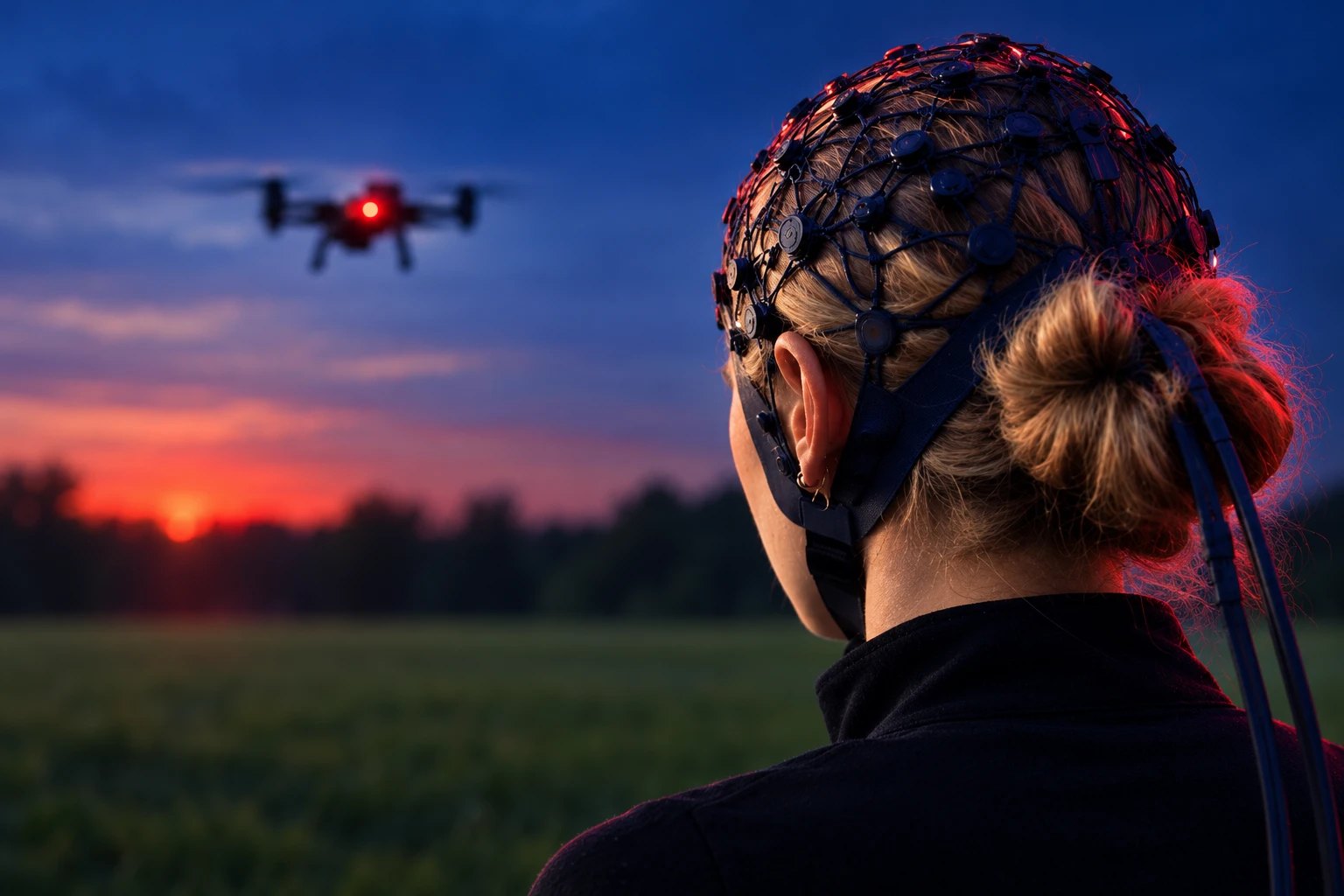
Cerebionics sells the idea of a modular, non-invasive link that can talk to a drone, an unmanned ground vehicle, or a command-and-control API. “We’re essentially creating a highway between the brain and the end system, but doing it non-invasively,” Pedersen said. The hardware is EEG electrodes, light enough to wear while walking.
She is blunt about where the work actually sits. “The hardest part is the software: the decoder, and making the platform generalisable and transferable.” Hardware, she said, is already “good enough right now.” The company has described that decoder as able to run fully offline, with no external network in the loop, which matters once the other end of the highway is a radio that can be jammed.
In a hiring post it said Ashritha Sai Mani Chundru had joined as founding machine learning engineer while finishing an MSc in human and biological robotics at Imperial College London. That hire matches the founder’s own ranking of the problem. A headset without a model that works on a new head is a lab toy.
Ukrainian Operators Are Training the Software
Pedersen has spent months with Ukrainian soldiers across different parts of the military. Detail of that work stays off the record, which is the point of it. “You can’t build something for defence and only sit inside a lab in London,” she said. “Those environments are so different. Even within Ukraine, the eastern frontline is vastly different from the southern front.”
You can’t build something for defence and only sit inside a lab in London.
Agnessa Pedersen, founder, Cerebionics, at TechBBQ
By 20 May 2026 she had already spent six months in Ukraine building the product. In September she was still describing ongoing work with users there. One encounter she would talk about was a veteran FPV drone operator who lost most of his right hand on a combat mission. Acro-mode flying wants both hands on throttle, pitch, and roll at once. He told her he felt he had lost his purpose.
That is a customer, not a metaphor. The World Health Organization has put amputations in Ukraine over four years of war above 100,000. Units have already pulled wounded infantry back onto drone screens rather than discharge them. An extra command channel is useful when a remaining hand is on a stick, a voice is on a net, and eyes are in a goggle feed.
WHAT WE KNOW
- Field loop: Cerebionics has spent months with Ukrainian military users and says that feedback changed what the kit must survive.
- The injured operator: Pedersen describes an FPV veteran who lost most of his right hand and could no longer fly acro mode as he had.
- Her method: She went to events, found soldiers, and asked them, rather than trying to run the work on video calls from London.
WHAT IS UNCONFIRMED
- Units and sites: Which formations, which front, and which end systems were in the tests remain off the record.
- Hit rates: No public figure has been given for command accuracy, false positives, or time-to-abort in the field.
- Procurement: Several letters of intent exist. No announced defence contract sits on the record.
She said she was surprised that nobody told her to take the deep tech away. Early kits were not robust against things the users already knew. That gap is the training set. A London lab cannot invent the dirt, the motion, or the day-to-day change in how the war looks.
What Scalp EEG Can Command?
Implant systems put thousands of electrodes into brain tissue and chase fine motor traces, and in some work, speech. Cerebionics reads scalp EEG. “That’s simply a fact because of the skull and the way the technology works today,” Pedersen said. For her use cases she does not need a single finger. She needs the intended command, passed to the machine.
The UK information regulator defines neurodata as first-order neural recordings plus inferences drawn straight from them. That is the class of signal on the headset: electrical activity at the scalp, then a model that has to decide whether a pattern is a command or noise. Pedersen’s scientific version is event-related desynchronisation, watching which areas activate. “The cool thing about the brain is that the signals you get from doing an action versus thinking about doing that action are very similar.”
HOW THE COMMAND CHANNEL COMPARES
| System | How it reads the brain | What it tries to send | Where it is being tried |
|---|---|---|---|
| Cerebionics | Portable EEG on the scalp | High-level commands such as direction, confirm, abort | Ukrainian military users, with operational detail off the record |
| Implant platforms | Thousands of electrodes in brain tissue | Fine motor movement and, in some work, speech | Clinical patients with severe paralysis |
| Other European EEG software | Device-agnostic decoding of EEG | Rehab, communication, operator monitoring | Clinics and labs |
Europe already has other non-invasive bets. Cogitat in the UK decodes EEG into digital commands for robotic rehab. BirgerMind in Latvia aims at people with ALS and paralysis. InnoBrain in Sweden folds EEG together with eye tracking. Cerebionics is trying to be the command highway into robots and unmanned systems, including defence, rather than a clinic communicator.
THE INTENT DICTIONARY
- Yes and no: A direct confirm or reject without a spoken call.
- Confirm, dismiss, execute, abort: Safety-shaped verbs for a system that should freeze when it is unsure.
- Change direction: Movement in different directions, the first block of vehicle and drone control.
- Switch systems: Jumping an operator between platforms when hands and eyes are already busy.
That dictionary is still being built. Everyone has a pattern, and it drifts day to day, which is why the headset still needs calibration. The models, Pedersen said, are trained to separate genuine intent from the brain’s background chatter. If confidence is low, the system is supposed to do nothing.
Jamming Still Sets How Fast a Thought Becomes Action
Voice, eye tracking, and muscle sensors already control machines. Pedersen’s case for adding a brain channel is occupancy. When those other paths are full, intent still has somewhere to go. The wounded FPV operator is the clean version of that argument. So is a two-handed pilot who needs a silent abort.
Scalp EEG is a weak, noisy signal. It lives in the microvolt range. A blink, a jaw clench, or a shift of dry electrodes in thick hair is far louder, and walking around makes the contacts move. That is why a confidence gate that refuses to fire is not a nice-to-have. It is the difference between a command and a twitch.
Latency is not only the decoder. The chain is acquire, classify, transmit, then have the drone or vehicle actually do the thing. In a jammed pocket the headset can be healthy and the command still dies on the radio. Cerebionics can tighten signal grab and classification. It cannot legislate the link budget, the protocol, or the air.
Hands remain the better fine controller. Even implant work has not retired them. The product that can survive that fact is an extra channel, used when a hand is missing or already busy, and ignored when a joystick is faster. Pedersen said as much when she talked about a collection of command paths, each with strengths and holes.
Brain Recordings Sit Outside a Dedicated Law
Put a headset on a soldier and the next question is where the trace goes. Pedersen said any neural data Cerebionics collects is anonymised, stripped of location and other identifying metadata, and stored locally rather than in the cloud. GDPR can still apply. Europe does not yet have a dedicated statute for BCI recordings as their own class.
UNESCO’s member states adopted the first global ethics standard on neurotechnology on 5 November 2025 in Samarkand, and it entered into force on 12 November 2025. A UNESCO report cited in that announcement found a 700% increase in investment in neurotechnology companies between 2014 and 2021. The text is a recommendation, not a statute. It still names the thing London is now building.
Neurotechnology has the potential to define the next frontier of human progress, but it is not without risks. With the adoption of this new normative tool, UNESCO is setting clear boundaries, enshrining the inviolability of the human mind.
Audrey Azoulay, Director-General, UNESCO press announcement, 5 November 2025
The expert group behind that text, chaired by Hervé Chneiweiss and Nita Farahany, drew on more than 8,000 contributions. The recommendation warns against workplace monitoring and against non-therapeutic use on children, and it wants explicit consent. It also tells governments to keep the tools inclusive and affordable, which is the same price problem Pedersen set for herself.
In March 2026 the UK Information Commissioner’s Office had Nesta run a citizens’ jury on neurotechnology and neurodata. Twenty members of the UK public met for three online sessions over two weeks. They liked medical and safety uses. They opposed using brain data to watch worker focus or student output. They wanted a new legal category for brain data, and they did not want a blanket ban. The ICO has said formal guidance for the sector is still to come.
That jury was about consumer and workplace kit in the UK, not about Ukrainian operational traces. The two piles should not be mashed together. They do share a clock. A London company collecting neural recordings, even locally and stripped of names, is building into a market whose rules are being written in public while the field tests are already running.
Watch the May Demo, Then Discount the Magic
On 20 May 2026, Kitty Mayo, chief executive of Project Europe, posted video of Pedersen flying a drone with the headset. “Two weeks ago, watching Agnessa Pedersen mind control a drone in real time, was one of the most moving moments in my career,” Mayo wrote.
Two weeks ago, watching Agnessa Pedersen mind control a drone in real time, was one of the most moving moments in my career. Agnessa is a rare and wondrous human working towards a wild future. pic.twitter.com/W0wafYD2Zs
— kitty mayo (@Kitty_Mayo_) May 20, 2026
The clip did what clips do. It also invited a fair objection. EEG-controlled drone races were already a campus spectacle in 2016. A toy that took off on brain-wave headsets was on sale a few years after that. A clean indoor hover, on a calibrated founder who has used the platform a lot, is not the same object as a command that survives dust, motion, hair, and a jammed downlink on a new operator.
Pedersen has used the kit enough that she “thinks in a way that suits the platform’s functionality.” A first-time user, she said, may find the mental move hard to get hold of. Onboarding, in an optimistic case where someone understands it quickly, still took about an hour when she spoke in September 2026. A finished generalisable model, the one that would shrink that hour, had not been locked.
Price has the same unfinished shape. “It can’t cost $100,000 or $20,000 for the whole system and then require you to record huge amounts of data,” she said. For mass use the bill has to fall toward ordinary controllers. She called that tough, and not impossible. Defence is the harsh classroom. Gaming is the sentence she grins at. “Imagine going to a gamer, say, a Call of Duty fan, and saying, ‘This technology has been tested in a genuinely demanding environment; now have a go at it.’”
An Hour of Calibration After a €200,000 Cheque
Project Europe, the under-25 programme built by Harry Stebbings of 20VC and run by Mayo, named Cerebionics in its first cohort of six startups in July 2025. The published terms are €200,000 for 6.66% equity. Pedersen was the only woman founder in that first group. She has said she wants, over five years, to be the main non-invasive BCI company, and that in the future everything will be mind controlled.
CEREBIONICS LTD, company 16782510, was incorporated in London on 14 October 2025. The registered office is 16 Berkeley Mews, W1H 7AY. Pedersen is the sole director. The file lists her nationality as Norwegian and her country of residence as Norway. Nature of business is other engineering activities. First accounts, made up to 31 October 2026, are due by 14 July 2027.
THE COMPANY CLOCK
- 2024: Pedersen starts BCI work as a student and the firm dates its founding to this year.
- July 2025: Project Europe names Cerebionics in its first cohort and invests €200,000 for 6.66%.
- 14 October 2025: CEREBIONICS LTD is incorporated in London, with Pedersen as director.
- 20 May 2026: Mayo posts the live drone demo; Pedersen has by then spent six months in Ukraine.
- September 2026: At TechBBQ she says the transferable model is still unfinished and calibration still takes about an hour.
THE BENCH IN ONE GLANCE
- Headcount: A four-person team, with a founding machine learning engineer added in 2026.
- Money: €200,000 on Project Europe’s standard first-cheque terms, plus several letters of intent and no named contract.
- Onboarding: About an hour in a good case, until a model that transfers across users exists.
- Data stance: Local storage, anonymised traces, no cloud, under GDPR and ahead of any dedicated BCI statute.
Pedersen still wants the headset in smart glasses and goggles, and as its own piece of headwear. She still wants a dictionary of commands wide enough for a drone, a ground vehicle, and a C2 API. The September interview left the transferable model unbuilt and the price unsolved. The Ukraine loop is the part that is already running, and the brain recordings it creates will be judged by rules that are still being written in London and Paris, not in the dugout where the decoder is learning what a real command feels like.

Edinburgh Opens a 2027 Tour Built for Time Trials

Korda Maps Auður From Meðalland to Irvine Bay

Apple Music Films Its New Logo in Mineral Oil

Oppo Prices the Pad Mini Above India’s iPad Mini

Austen Soaks Scotland Before Boelo Brings Weekend Gales

Volkswagen Sells the Osnabruck Plant to Clear a Board Fight

Apple’s Foldable iPhone Hinges on Samsung Display Supply

Saksham Gaur Finds He Is His Own Company’s Client

Tata Motors’ Iveco Tender Opens as Holders Still Decide

Onimusha Way of the Sword Preload Hits a Windows 11 Wall
-
 AUTO2 months ago
Volkswagen Sells the Osnabruck Plant to Clear a Board Fight
-
 NEWS2 months ago
Apple’s Foldable iPhone Hinges on Samsung Display Supply
-
 AUTO2 months ago
Tata Motors’ Iveco Tender Opens as Holders Still Decide
-
 BUSINESS2 months ago
Saksham Gaur Finds He Is His Own Company’s Client
-
 GAMING2 months ago
Onimusha Way of the Sword Preload Hits a Windows 11 Wall
-

 ENTERTAINMENT3 years ago
What is SD on Amazon Prime? – All You Need to Know
-

 BUSINESS2 months ago
Hyderabad 22-Carat Gold Jumps After a False Bargain
-

 NEWS2 months ago
iQOO 16 Locks 8,400 mAh While 100W Charging Holds