SCIENCE
Difference Between Lobster and Crayfish: How to Tell Each One
The difference between lobster and crayfish is the water and the claws, but a clawless saltwater animal sold as crayfish in Australia is a rock lobster.

You are holding a crustacean or reading a menu, and the word in front of you is lobster or crayfish. Those words are used for three different animals, and the easy one to miss is the rock lobster, which has no big claws.
The difference between lobster and crayfish comes down to water and claws when the label matches the animal. True lobsters and crayfish both grow claws. True lobsters live in salt water, and crayfish live in rivers, lakes, and ponds.
Below, you get the family split, three checks you can use on a catch or a photo, and the countries where crayfish means a rock lobster. Lookalikes such as bugs and squat lobsters come after that, along with the giant freshwater crayfish that makes size a poor test.
Lobsters, Rock Lobsters, and Freshwater Crayfish
The menu name is a poor guide to family, which is where the mix-up starts. Lobsters, rock lobsters, and crayfish are all crustaceans with a hard outer shell and a segmented body, and they share the ranks from kingdom down through the order Decapoda. The split that matters starts at the next rank.
| Trait | True lobster | Rock lobster | Crayfish |
|---|---|---|---|
| Infraorder | Astacidea | Achelata | Astacidea |
| Family | Nephropidae | Palinuridae | Cambaridae, Astacidae, and Parastacidae |
| Water | Cold salt water | Salt water, reefs and rocky coast | Fresh water |
| Claws on the first legs | Large and unequal | Absent | A large pair |
| Shell | Hard shell, colour used as camouflage | Thorns on the body, horns on the head | Smooth shell |
True lobsters belong to Nephropidae, rock lobsters to Palinuridae, and crayfish to Cambaridae, Astacidae, and Parastacidae, which you can match in the museum guide to these three crustaceans. True lobsters and crayfish share the infraorder Astacidea. Rock lobsters sit in Achelata, so the clawed lobster is nearer to a crayfish than to the spiny animal that shares its menu name.
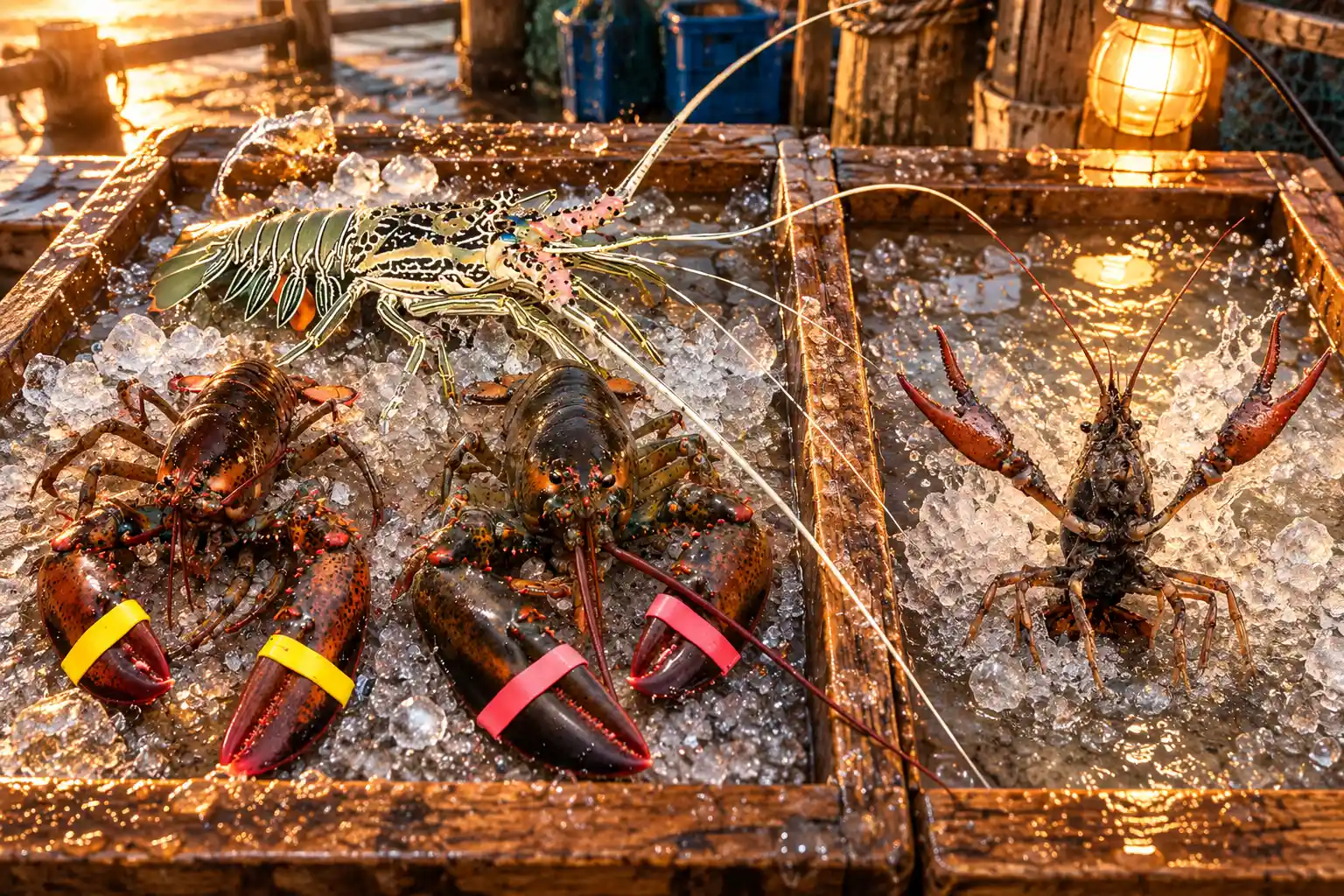
The Difference Between Lobster and Crayfish in Three Checks
Once you know the three groups, you can name the animal in front of you with the checks in this order.
- Translate the local name before you trust it.
- Find out whether the animal came from salt water or fresh water.
- Look at the first pair of legs for a large claw, and at the shell for thorns or a smooth surface.
Salt water with no large claws is a rock lobster, also called a spiny lobster, salt water with large unequal claws is a true lobster, and fresh water with claws is a crayfish. A freshwater setting and a set of heavy claws can point at different names, so you want both the water and the claws before you decide.
In a photo you may not see the water, so start with the claws and the shell, then use the setting if it is visible. A creek bed, a muddy bank, or a burrow points to a crayfish, and a reef or a sea floor with thorns and long antennae points to a rock lobster.
On a plate, the same checks explain the meat you paid for. A true lobster is sold for the claws and the tail, and a rock lobster is sold for the tail because there is no crusher claw to crack.
Why Does the Word Crayfish Change by Country?
The checks work after you translate the local word, because crayfish does not mean the same animal in every country. Rock lobsters are sometimes called crayfish in Australia, New Zealand, and South Africa, and that animal is a spiny lobster in a different family from both the clawed lobster and the freshwater crayfish.
In Western Australia the short name cray points at the same animal. People there often call Panulirus cygnus a crayfish, and the western rock lobster fact sheet still places it among the spiny lobsters. In New Zealand the spiny red rock lobster is what the word crayfish refers to in ordinary speech.
WHAT THE LOCAL WORD MEANS
- Western Australia: A board that says crayfish, over a spiny animal with long antennae and no claws, is a western rock lobster.
- United States: Crawfish or crawdad, on a clawed animal from fresh water, means a crayfish.
- Europe: One heavy crusher claw and one slimmer cutter claw, from salt water, means a true lobster.
Freshwater crayfish in Australia also go by local names, including yabby. The marron is a freshwater crayfish found only in Australia, and it is the third largest freshwater crayfish in the world, so a big clawed animal from a river is still not a rock lobster.
Where Do Lobsters and Crayfish Live?
With the name translated, the water the animal came from is the next check, so the real ranges matter. The genus Homarus has only two species. The European lobster, Homarus gammarus, lives around Europe, and the American lobster, Homarus americanus, lives on the Atlantic coast of North America from Canada to North Carolina. There are no true lobsters of this genus on the Australian coastline.
Shell colour on these lobsters works as camouflage and follows the place they live. In deep European water the shell is blue, and American lobsters are brown or green.
Rock lobsters, also called spiny lobsters, live on coral reefs and in crevices in rock. They occur in the Pacific, Atlantic, and Indian oceans, and in the Red Sea and the Mediterranean, in colours from brown and red to very bright patterns. In Australia the commercial species are the southern rock lobster, from the south-east, and the western rock lobster, from southern Western Australia. The western species is a temperate animal of the continental shelf, with most of them living between Perth and Geraldton.
Crayfish live in rivers, lakes, dams, streams, and ponds. North America holds a wide mix of species, and further species occur around the world. They do not live in the sea, which is why a saltwater catch with claws is not a crayfish.
Claws, Spines, and What Each Animal Eats
Water gets you close, and the shell and the claws confirm that you have read the water correctly. These animals share the decapod body plan, with walking legs along the body and a row of swimmerets under the tail. On true lobsters and crayfish the legs nearest the head form the big claws, and the next legs end in smaller pincers, while the last legs are plain walking legs.
- True lobster: The cutter claw tears food and the larger, dented crusher claw breaks it, so the animal can take small fish, sea urchins, crabs, and sea stars.
- Rock lobster: Without a cutting claw, it eats snails, clams, crabs, small shells, and sea urchins, and it scavenges.
- Crayfish: The claws crush and tear, and the animal eats aquatic plants, insects, worms, and molluscs, and it scavenges as well.
The western rock lobster is an opportunist on top of that menu, and it also takes coralline algae and detritus along with molluscs and other crustaceans. The claws on a true lobster are for defence and for catching prey as well as for feeding. If it loses the crusher, the cutter transforms into a crusher, and a new cutter grows at the next moult.
Sharp thorns cover a rock lobster, two horns sit on the head, and a threatened animal makes a loud screech by rubbing a long antenna against a soft part of the shell. In a cave it backs in so the thorns and the antennae face outward. A crayfish, by contrast with that armour, has a smooth shell and still carries the large claws.
Slipper Lobsters, Bugs, and Squat Lobsters
The three checks still leave a few crustaceans that carry a lobster name and do not match the animal you expect. Blind lobsters live in deep water with no daylight, have no eyes, and carry long slim claws. Reef lobsters are bright animals of shallow rocky and coral reefs in the Indo-Pacific, the Caribbean, and warmer parts of the Atlantic, they are prized in the aquarium trade, and catch data are still missing for most species, so the effect of collecting them is unknown.
Slipper Lobsters and Australian Bugs
Slipper lobsters are easy to separate once you look at the head, where a broad flat plate sits in front of the eyes. A rock lobster carries long spiny antennae in that same spot, and a true lobster carries claws instead.
They live in warm oceans and sit closer to rock lobsters than to true lobsters. Slipper lobster is the common name for the family Scyllaridae, not for a single species, which is why one animal picks up so many labels. In Australia they are called bugs.
- Shovel-nosed lobster: One of the plate-fronted names for this family.
- Spanish lobster: Another market name for the same flat-headed animal.
- Mitten lobster and fan lobster: Further names you may see on a label for Scyllaridae.
Scampi and the Norwegian Lobster
Scampi, also called the Norwegian lobster or the Dublin Bay prawn, sit in Nephropidae with true lobsters, so the saltwater-and-claws check is meant to catch them. They are abundant in the north-eastern Atlantic and the North Sea, and they are relatively rare and expensive in Australia. Small animals often live on the shell without harming the scampi.
- Same family: Nephropidae, with the clawed lobsters, not with rock lobsters.
- Where you meet them: Common in Europe, scarce and costly in Australia.
- What to look for: Claws, plus a saltwater origin, which keeps them out of the crayfish box.
Squat Lobsters and Their Long Claws
Squat lobsters belong with hermit crabs, not with true lobsters, even though the name says lobster. They hide in crevices or under rocks on the sea floor, and they do not carry a shell on the back the way a hermit crab does.
THE CLAW LENGTH
Some squat lobsters grow claws more than six times as long as the body, and they use them to scoop and sift sand. Others feed on wood, including timber from shipwrecks.
A rock lobster beside one of these would show thorns and long antennae, and no claw of that length. The body stays small, which is another reason a quick size guess fails.
Size, Age, and the Tasmanian Giant Crayfish
After those lookalikes, size is the last clue to test, and two Australian animals show why bulk will not settle the name. The Tasmanian giant freshwater crayfish is the largest freshwater crustacean in the world, and its top weight sits in the same band as a very heavy western rock lobster.
| Animal | Where it lives | Weight | Lifespan |
|---|---|---|---|
| Western rock lobster (Panulirus cygnus) | Continental shelf off Western Australia, most of them between Perth and Geraldton | Over 5 kg, and animals over 3 kg are rare | Over 20 years |
| Tasmanian giant freshwater crayfish (Astacopsis gouldi) | Rivers and streams of northern Tasmania only | Up to 6 kg, and most of the larger animals weigh 2 to 3 kg | Up to 60 years |
Those weights and ages belong to these two species, not to every crayfish in a pond and not to every lobster in a tank. A heavy animal in a photo is still unnamed until you have the water and the claws.
LEAVE A GIANT CRAYFISH IN THE RIVER
- The species: Astacopsis gouldi lives only in the rivers and streams of northern Tasmania.
- The listing: It is listed as Vulnerable, it is protected, and illegal fishing is an ongoing pressure.
- Back in the water: A large clawed animal in those rivers goes back in the water.
Males grow the larger pincers, and the shiny shell runs from dark brown-green to black or blue. Habitat that suits it includes shade, flowing and still water, deep pools, logs, and undercut banks, which the giant freshwater crayfish species profile pairs with the protected status.
It usually stays within a small home site in the stream. A shift to a new home site happens only on occasion, so you are likely to find the animal near the logs and undercut banks it already uses.
Frequently Asked Questions
Are Crawfish and Crawdads the Same as Crayfish?
Yes. Crawfish and crawdad are other names for the freshwater crayfish, the clawed animal of rivers, lakes, and ponds. They are not names for the clawless rock lobster that markets in Australia, New Zealand, and South Africa sell as crayfish.
What Is a White Western Rock Lobster?
A white is a western rock lobster just after a group moult. In late spring, sub-adults shed together, the red shell turns creamy white to pale pink, and the animals walk at night toward deeper spawning ground. The red colour returns a few months later.
Can a Rock Lobster Regrow a Lost Antenna?
Yes. Western rock lobsters grow back legs and antennae they have lost, and the replacement comes in when they moult. Octopus, which take lobsters from holes in the reef, are one of the predators that cost them those parts.
Is There a Clawed Lobster on the Australian Coast?
No. An Australian shop that says lobster or crayfish is selling a rock lobster, and the meat you take home is the tail rather than a crusher claw to crack. Clawed Homarus lobsters are a European and North Atlantic animal, which is why a local pot does not hold one.
Marron, the big freshwater crayfish found only in Australia, still has claws and still comes from fresh water, which keeps it distinct from the western rock lobster on a coastal menu.


Edinburgh Opens a 2027 Tour Built for Time Trials

Korda Maps Auður From Meðalland to Irvine Bay

Apple Music Films Its New Logo in Mineral Oil

Oppo Prices the Pad Mini Above India’s iPad Mini

Austen Soaks Scotland Before Boelo Brings Weekend Gales

Volkswagen Sells the Osnabruck Plant to Clear a Board Fight

Apple’s Foldable iPhone Hinges on Samsung Display Supply

Saksham Gaur Finds He Is His Own Company’s Client

Tata Motors’ Iveco Tender Opens as Holders Still Decide

Hyderabad 22-Carat Gold Jumps After a False Bargain
-
 AUTO2 months ago
Volkswagen Sells the Osnabruck Plant to Clear a Board Fight
-
 NEWS2 months ago
Apple’s Foldable iPhone Hinges on Samsung Display Supply
-
 BUSINESS2 months ago
Saksham Gaur Finds He Is His Own Company’s Client
-
 AUTO2 months ago
Tata Motors’ Iveco Tender Opens as Holders Still Decide
-
 BUSINESS2 months ago
Hyderabad 22-Carat Gold Jumps After a False Bargain
-

 TECHNOLOGY3 years ago
What Is SD on Amazon Prime?
-

 GAMING2 months ago
Onimusha Way of the Sword Preload Hits a Windows 11 Wall
-

 NEWS2 months ago
The Frame Pro’s $1,200 Labor Day Cut Needs a Soundbar