
NEWS
Apple’s M5 Ultra Mac Studio Leaves a $4,000 Memory Gap
The M5 Ultra Mac Studio can hold 256GB at 1.2TB/s, yet Apple skipped 128GB, charges $4,000 for the next step, and still has no 512GB price.

$5,499 buys the base M5 Ultra Mac Studio with 96GB of unified memory. The next memory step is 256GB, and that step costs $4,000. Units begin arriving on September 22; the 512GB option is still held for late October, with no price on Apple’s shop page.
Apple announced the M5 Max and M5 Ultra machines on August 25. The chassis is the same 3.7 by 7.7 by 7.7 inch silver box from 2022. The argument inside it has changed. This cube is now sold as a local-model box, and the checkout ladder is built around that, not around a video editor who needed one more Thunderbolt port.
The $4,000 Jump From 96GB to 256GB
The M5 Max Studio starts at $2,499 with 36GB of memory, a 32-core GPU, and 460GB/s of bandwidth. You cannot add RAM on that chip. A $600 bump to the 18-core CPU and 40-core GPU, which raises bandwidth to 614GB/s, is the gate to 48GB, 64GB, or 128GB. The 128GB option is $2,000 over the $2,499 starting price, or $1,600 over the 64GB model. There is still no 96GB Max.
The M5 Ultra starts at $5,499 with 96GB, a 1TB SSD, and 1.2TB/s of memory bandwidth, which Apple puts 50 percent above M3 Ultra. Apple’s spec sheet lists 256GB and 512GB only as configure-to-order memory, and it ties 512GB to the 36-core CPU and 80-core GPU. Hands-on notes on the new Ultra put the 96GB-to-256GB bump at $4,000. A Max with 128GB and 1TB storage is $100 less than that base Ultra.
MAC STUDIO MEMORY LADDER
| Configuration | Unified memory | Bandwidth | Price |
|---|---|---|---|
| M5 Max, base | 36GB | 460GB/s | $2,499 |
| M5 Max, 40-core GPU | up to 128GB | 614GB/s | $2,000 over the Max starting price for 128GB |
| M5 Ultra, base | 96GB | 1.2TB/s | $5,499 |
| M5 Ultra, 256GB step | 256GB | 1.2TB/s | $4,000 above the 96GB Ultra |
| NVIDIA DGX Spark | 128GB | 273GB/s | $4,699 |
That $4,000 line is the product. Unified memory sits on the package with the CPU and GPU, so none of these figures can be raised after you buy. A tester’s M5 Ultra with 256GB and a 4TB SSD ran about $12,300. Configurator listings for a 36-core, 80-core GPU machine with 256GB and a 16TB SSD reach $18,299. The 36-core, 80-core GPU chip itself starts at $6,799 with 96GB and 1TB. Education pricing is $2,299 for the Max and $5,099 for the Ultra. Apple Upgrade lease figures are $48.99 a month for the Max and $110.10 for the Ultra on a 36-month term.
HOW THE HIGH-MEMORY SKUS DISAPPEARED
- March 6, 2026: Apple removes the 512GB option on the M3 Ultra Mac Studio and raises the 96GB-to-256GB upgrade from $1,600 to $2,000.
- May 2026: The 256GB M3 Ultra configuration leaves the store, leaving 96GB as the only Ultra memory on sale.
- June 2026: Starting prices move to $2,499 on the Max Studio, from $1,999, and to $5,299 on the Ultra, from $3,999, after Apple said AI data-center demand had driven memory and storage costs to a point it would no longer absorb.
- August 25, 2026: Apple announces M5 Max and M5 Ultra Studios. The Ultra list price is $5,499, $200 above the June Ultra figure, and 512GB is dated for late October.
- September 22, 2026: Customer units begin arriving. Apple’s shop page still flags 512GB as a late-October option.
In June Apple said the consumer electronics industry was facing a surge in demand for memory and storage from AI data centers, and that it had “never seen a component price increase this much, this quickly.” Tim Cook had already called higher memory costs unsustainable. The new Ultra restores 256GB at checkout and promises 512GB later. It still will not sell you 128GB on that chip.
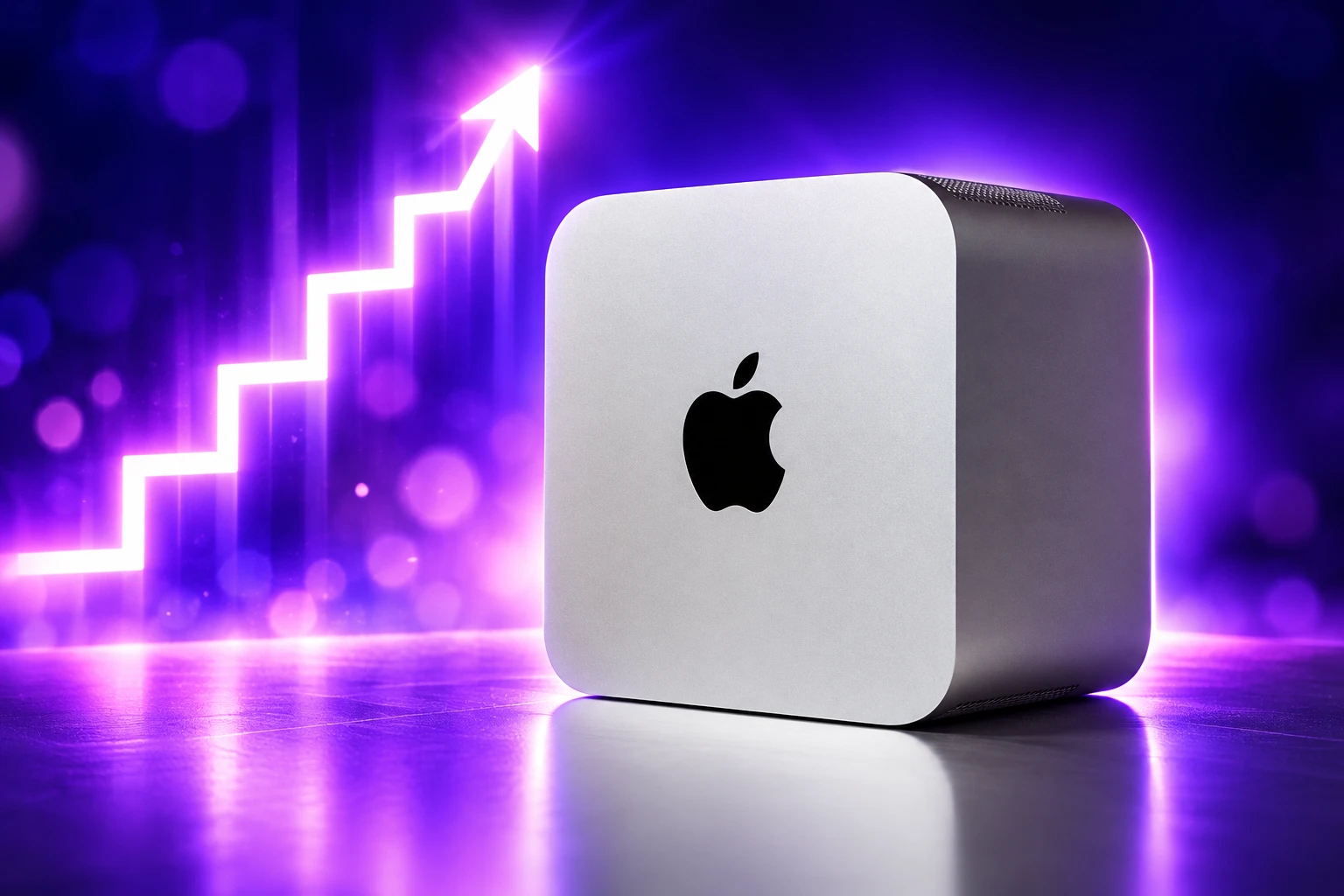
Apple Now Pitches the Cube for Local Models
Johny Srouji, Apple’s chief hardware officer, called Mac Studio the desktop for on-device AI and for the hardest pro jobs, in a quiet box that sits on a desk. The newsroom copy is blunt about the point of 512GB: users can run enormous language models entirely on the machine. Neural Accelerators now sit in each GPU core on the Ultra, which Apple did not do on M3 Ultra. Peak AI compute is listed at up to 4.3 times M3 Ultra and 9.8 times M1 Ultra. LM Studio prompt processing is listed at up to 4 times M3 Ultra and 9.8 times M1 Ultra.
Marques Brownlee spent a week with an M5 Ultra and said the extra memory is no longer aimed at people like him.
There’s nothing I can make Final Cut do with 256GB of unified memory that it couldn’t do with 128GB
Marques Brownlee, @MKBHD
He also wrote that you do not need to spend the $10K-plus this Mac costs if you are a video creator who is not doing 3D work, and that the machine rips if you pay it anyway. That split is the honest read of the new product page. The box is still named Studio. The demos are local models, agents, and on-device research. If the weights you want already fit in 128GB, Final Cut is not the reason to clear $4,000.
Buy the memory that holds the model. The chip name tells you how fast tokens move once the weights are resident. macOS and the display stack take their own bite, so a 96GB Ultra is not a 96GB model budget. People running local stacks treat roughly the high 80s as the practical ceiling on that SKU before the system starts to swap. A 70B-class checkpoint that needs headroom for context sits more comfortably on a 128GB Max than on a 96GB Ultra, even though the Ultra’s pipe is wider.
The 128GB Max That Costs Less
At the money most people actually compare, three compact boxes now sit on top of each other, and only one of them is the Ultra.
THREE DESKSIDE BOXES AROUND THE ULTRA’S STARTING PRICE
- M5 Max, 128GB: $100 less than the $5,499 Ultra when you take 128GB and 1TB, with an 18-core CPU, a 40-core GPU, and 614GB/s, which is the highest memory Apple will sell in this chassis without going Ultra.
- M5 Ultra, 96GB: $5,499 with a 30-core CPU, a 64-core GPU, a 32-core Neural Engine, and 1.2TB/s, plus two Thunderbolt 5 ports on the front instead of 10Gb/s USB-C, and no 128GB option on the way up.
- DGX Spark, 128GB: NVIDIA’s GB10 Grace Blackwell box, listed at $4,699, with a fixed 128GB pool, 4TB of storage in the configuration NVIDIA is selling, and CUDA rather than Metal.
If 36GB is enough for three-plus years, this is the wrong Mac. A kitted Mac mini or an M5 Pro MacBook Pro will do the same jobs without the Studio tax. The Max and Ultra CPUs and GPUs are faster, but a short memory ceiling will throttle that lead. Front ports are the other quiet surcharge. The Max still puts two 10Gb/s USB-C ports on the face. You pay $5,499 for the base Ultra before those become Thunderbolt 5.
The lower Ultra is a 30-core CPU (10 super cores and 20 performance cores) and a 64-core GPU. The top Ultra is a 36-core CPU (12 super and 24 performance) and an 80-core GPU. Apple describes M5 Ultra as two M5 Max chips fused into one SoC, a quad-die package, with UltraFusion carrying more than 4.4TB/s between dies. The 32-core Neural Engine matches the last Ultra’s core count and is a newer generation. A newer M6 in the Mac mini still wins single-core by about 6 to 8 percent in Geekbench 7 and Cinebench 2026, and its Neural Engine leads the Ultra’s by about 10 percent in Procyon Computer Vision 2. Those gaps are not why anyone buys this box.
Four Mac Studios Can Share One Memory Pool
Apple’s other answer to a 96GB ceiling is more boxes. Thunderbolt 5, at up to 120Gb/s, can cluster four Mac Studio systems with RDMA so they share a memory pool. Apple says four machines deliver up to 3 times faster distributed AI inference than one. That is a throughput claim, not a promise that four cubes behave like one 384GB or 1TB computer with linear speed.
Mac Studio is the ultimate desktop for on-device AI and the world’s most demanding pro workflows, relied on by users for its tremendous performance and extensive pro connectivity, all in a quiet, compact design that sits right on your desk
Johny Srouji, chief hardware officer, Apple
The machines ship with macOS 27 Golden Gate. RDMA over Thunderbolt first showed up as a Tahoe 26.2 feature on earlier Studios, which is why four-node pools were already a known trick before this chip landed. The new part is Apple putting the four-unit, 3-times figure in the launch itself. NVIDIA’s competing small box can also gang up to four units, over ConnectX-7, and NVIDIA rates that pack for models up to 700 billion parameters. The Studio cluster is the Mac-side version of the same idea: if one machine cannot hold the weights, buy more of the same machine.
Genlock over USB-C is the other new I/O trick, for locking a display to a camera, including iPhone 17 Pro. It is limited to the latest M5-family desktops, the M5 Pro mini and the M5 Max and M5 Ultra Studios, and it is a video-desk feature on a product whose marketing has otherwise moved on. Wi-Fi 7 and Bluetooth 6 arrive with Apple’s N1 radio. Storage uses a next-generation SSD architecture Apple rates at up to twice the prior read and write speeds, which matters when a multi-gigabyte checkpoint has to land on disk before it lands in memory. The Ultra’s Media Engine doubles the Max’s encode and decode blocks and is rated to play up to 33 streams of 8K ProRes 422 at 30 fps.
What a DGX Spark Offers That This Mac Does Not
NVIDIA’s Spark is the compact CUDA machine this Ultra is being stood next to, and it is the reason 128GB keeps coming up. The GB10 Grace Blackwell superchip is specified at up to 1 petaFLOP of FP4 AI, with 128GB of coherent unified memory at 273GB/s. NVIDIA rates it for local inference up to 200 billion parameters and fine-tunes up to 70 billion. It is 150 by 150 by 50.5 mm, weighs 1.2 kg, and uses a 240W brick around a 140W chip. The Mac Studio Ultra weighs 8.0 pounds and lists 480W as maximum continuous power. It is still a small silver square, just not a paperback.
ONE BOX, TWO MEMORY BETS
| Spec | Mac Studio M5 Ultra | NVIDIA DGX Spark |
|---|---|---|
| Memory options | 96GB, 256GB, 512GB (512GB in late October) | 128GB, fixed |
| Memory bandwidth | 1.2TB/s | 273GB/s |
| Starting price | $5,499 | $4,699 |
| Local model pitch | Enormous LLMs on device; 512GB for the largest open weights | Inference to 200B, fine-tune to 70B |
| Scale-out | Up to four Studios, Thunderbolt 5 RDMA, up to 3x inference | Up to four Sparks, ConnectX-7, up to 700B |
| Software | macOS 27, MLX, Core AI, Metal | DGX OS, CUDA, NVIDIA AI stack |
1.2TB/s against 273GB/s is about 4.4 times the pipe. That gap is why a single Studio can feel faster on token generation even when Spark looks cheaper on a 128GB label. Spark’s bet is CUDA, FP4 tensor cores, and a software stack that most open-weight models still meet first. The Mac bet is a wider bus and, at 256GB and 512GB, a larger single pool than Spark will sell at any price. AMD Ryzen Halo-class mini PCs and the coming RTX Spark Windows boxes also top out at 128GB, which is why they read as Max and low Ultra rivals, not as 256GB machines.
A 256GB Ultra is the first compact Mac that can hold checkpoints a 128GB Spark has to quantize harder or split. A 96GB Ultra is not that machine. It is a faster pipe with less room than the cheaper Spark and less room than Apple’s own 128GB Max. People who already live on CUDA will keep buying Spark for that reason, then network a second unit when 128GB runs out. People who want one quiet box and a 235B-class model at a usable quant are the reason 256GB exists.
Path Tracing Hits 60 fps With Ugly Upscaling
Hands-on numbers on an M5 Ultra with 256GB follow the core counts. On Procyon Stable Diffusion XL, the 80-core Ultra scored 72 percent higher than the 40-core Max. On Cinebench 2026 GPU rendering, the Ultra scored about 46 percent higher than the Max. In that same GPU test, the closest non-Mac in a small sample was a GeForce RTX 5090 at full power in an Alienware 18 Area-51 laptop, and the Ultra scored 30 percent higher. Multicore CPU speed sits at the top of Apple’s current stack, as you would expect from 36 cores against 18.
HANDS-ON FIGURES ON THE 256GB ULTRA
- Stable Diffusion XL: 72 percent higher than the 40-core M5 Max on Procyon.
- Cinebench 2026 GPU: about 46 percent higher than the Max, and 30 percent higher than a full-power RTX 5090 in that sample.
- Shadow of the Tomb Raider: about 20 percent more frames than the Max, 150 fps on the Max at 1,920 by 1,200, 158 fps on the Ultra at 2,560 by 1,440, and 118 fps at 4K on the Ultra.
- Cyberpunk 2077: about 60 fps with path tracing at 1080p with MetalFX upscaling, 177 fps at 1080p and 128 fps at 1440p with MetalFX off.
That path-tracing result is the first time a Mac in this testing has looked passable with the effect on, and it still depends on MetalFX, which looks poor here. Ray tracing and upscaling still mix badly. Gaming is beside the point in any case. Only a handful of Mac titles can use this GPU, and that list is not about to grow. The machine is quiet under load, which is the other reason people keep putting it next to a 5090 tower.
Displays scale with the chip. The Max drives up to five external screens. The Ultra drives eight, or four Studio Display XDR units at 5K and 120Hz. Rear I/O is four Thunderbolt 5 ports, 10Gb Ethernet, two USB-A ports, HDMI 2.1, and a headphone jack, on both models. The enclosure uses 100 percent recycled aluminum and is rated at 35 percent recycled content overall. That does not change the checkout problem. If you need 256GB or more, this is the only Mac that will sell it to you, and it will not sell you the step in between.
Until late October, 256GB is the only way past 96GB on the Ultra, and Apple has not said what 512GB will cost. The people who already know their local models need that pool will pay it. Everyone else is being asked to fund a gap the Max and a $4,699 Spark already occupy.

Edinburgh Opens a 2027 Tour Built for Time Trials

Korda Maps Auður From Meðalland to Irvine Bay

Apple Music Films Its New Logo in Mineral Oil

Oppo Prices the Pad Mini Above India’s iPad Mini

Austen Soaks Scotland Before Boelo Brings Weekend Gales

Volkswagen Sells the Osnabruck Plant to Clear a Board Fight

Apple’s Foldable iPhone Hinges on Samsung Display Supply

Saksham Gaur Finds He Is His Own Company’s Client

Tata Motors’ Iveco Tender Opens as Holders Still Decide

Onimusha Way of the Sword Preload Hits a Windows 11 Wall
-
 AUTO2 months ago
Volkswagen Sells the Osnabruck Plant to Clear a Board Fight
-
 NEWS2 months ago
Apple’s Foldable iPhone Hinges on Samsung Display Supply
-
 AUTO2 months ago
Tata Motors’ Iveco Tender Opens as Holders Still Decide
-
 BUSINESS2 months ago
Saksham Gaur Finds He Is His Own Company’s Client
-
 GAMING2 months ago
Onimusha Way of the Sword Preload Hits a Windows 11 Wall
-

 ENTERTAINMENT3 years ago
What is SD on Amazon Prime? – All You Need to Know
-

 BUSINESS2 months ago
Hyderabad 22-Carat Gold Jumps After a False Bargain
-

 NEWS2 months ago
iQOO 16 Locks 8,400 mAh While 100W Charging Holds