
ENTERTAINMENT
Earl Spencer’s Farewell Book Relitigates Diana’s Funeral Fight
Earl Spencer billed Swan Song as his last word on Diana. The launch restages a 1997 funeral call the Palace says grief may have coloured.

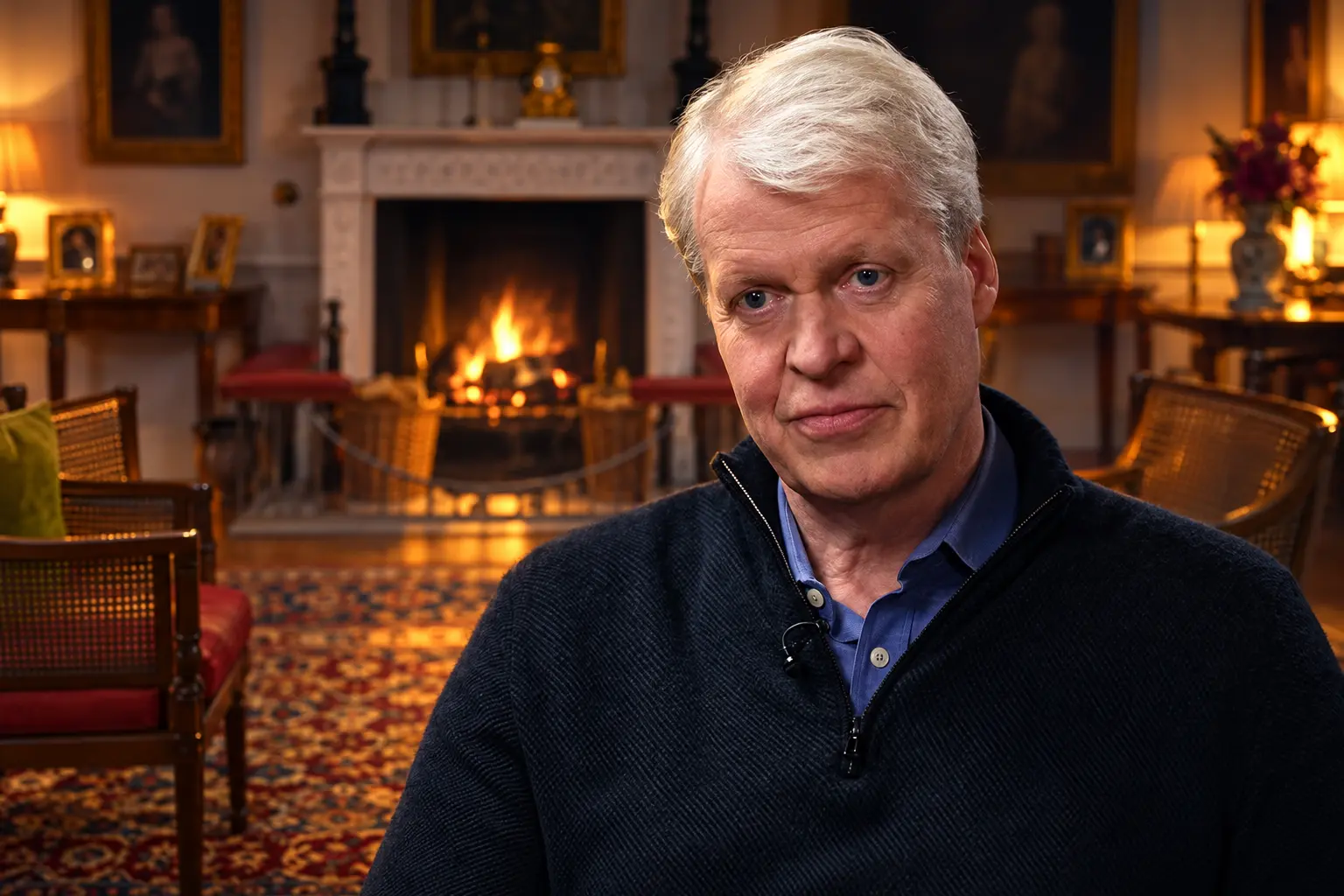
Earl Spencer told Laura Kuenssberg that Swan Song is his last word on his sister Diana, a duty as an eyewitness, and a walk into the sunset. The memoir comes out on 22 September.
Buckingham Palace has already tried to puncture that memory, pointing to a brother’s grief rather than denying the 1997 call outright.
A Farewell Built Around One Phone Call
Spencer, 62, sat for the interview at Althorp, the Northamptonshire estate where Diana is buried. He is a historian as well as the ninth earl, and he framed the book as a correction of “untruths that have become accepted over time,” timed for the 30th anniversary of her death in August 2027. In the publisher’s own announcement he said he wanted to the truth about Diana from her brother’s perspective, as he had tried to do in Westminster Abbey.
Penguin Michael Joseph publishes in the UK. Penguin Press handles North America. The book is set to appear in 12 languages on the same date. Penguin describes it as the first time he has spoken at length about his sister, and as the most intimate, loving and honest portrait yet of her. He also called it a “sign off.”
The launch has not behaved like a sign-off. The first extract landed on 16 September. The Palace answered the same day. Kuenssberg’s sit-down was shown on 20 September. A few copies were stolen from a lorry in the Netherlands before release. King Charles, 77, kept his public diary moving through it.
FROM THE CRASH TO PUBLICATION DAY
- 31 August 1997: Diana dies in a Paris car crash at 36. Spencer is in Cape Town. His sister Lady Jane Fellowes rings in the night, first to say the smash is “not too serious,” then, after a run of worse calls, to say she has died.
- Early September 1997: Spencer fights a plan for Princes William, then 15, and Harry, then 12, to walk behind the coffin. He says the then Prince of Wales rang him, went “ballistic,” and told him they would forget her soon enough.
- 6 September 1997: The two princes, their father, Prince Philip and Spencer walk behind the gun carriage. In the abbey, Spencer delivers the eulogy he now calls a direct answer to that call.
- 16 September 2026: The first extract is published. Buckingham Palace, which usually stays silent on books, issues its grief-and-memory statement.
- 20 September 2026: Spencer, at Althorp, tells Kuenssberg those were “exactly the words he said.”
- 22 September 2026: Swan Song: Diana, My Sister is published.
Six days separated the crash from the funeral. Nearly 30 years separate that week from the hardback.
He Hung Up, Then He Wrote It Down
Penguin has confirmed the passages quoted from the book. In the memoir Spencer writes that Charles poured a “stream of anger” down the phone after Spencer said Diana would not have wanted her sons on that walk. Charles, he writes, compared it to his own walk behind Lord Mountbatten’s coffin. Spencer says he replied that Charles had been 30, and Mountbatten had not been his mother.
Then comes the sentence the Palace chose to fight. Spencer writes that Charles paused, then “unleashed down the phone what I have always taken to be his pent-up contempt for Diana, and his horror that the world was so bowled over by her death.”
Rest assured, he hissed, we’ll forget her soon enough. I can’t believe you just said that, I said flatly, before hanging up.
Earl Spencer, Swan Song: Diana, My Sister
In the Althorp interview he stood on that wording. He said he has had only two phone calls with Charles in his life, so he was “hyper-alert.” He told close friends and family at the time because the remark was “monstrous.” Asked who a reader should believe, he said he was telling the truth, and asked what else would have made him hang up on the future king that day.
He does not claim a recording. He claims a memory, a hang-up, and a handful of people he told in 1997. Julian Payne, a former communications secretary to the King, said it was “just not language that I recognise.” That is the whole evidential fight: one man’s ear against a palace that will not quote a denial of the sentence itself.
A second call, on the night she died, is the other live wire. Spencer writes that Charles sounded “giddily elated, like a lottery winner,” while other callers could barely speak. He suspects the prince was already thinking of Camilla, now Queen. Kuenssberg asked if he could be sure. “I cannot be sure,” he said. “I’m saying that’s what I assume from the tone is a possibility.”
William and Harry Have Already Told This Walk
The argument under the alleged line was never only about Charles. It was about two boys on a London street. They have both, as adults, described that walk. Their uncle is now publishing the fight that put them there.
WHO HAS SPOKEN ABOUT THE FUNERAL WALK
| Person | What they have said |
|---|---|
| Earl Spencer | Fought the plan; says Diana would not have wanted it; later called it barbaric; says some courtiers wanted the boys there to shield Charles from abuse. |
| Prince Harry | Wrote in Spare that “Uncle Charles raised hell” and called the idea “barbaric.” He has said no child should be asked to do it, and that he walked so William would not go alone. |
| Prince William | Has called the procession one of the hardest things he has ever done. |
| Buckingham Palace | Has not addressed the walk in this row. It has challenged Spencer’s memory of the phone call around it. |
Harry also wrote that an alternative plan would have sent only William, then 15, and “spare the Spare.” That plan died. Both brothers walked, with Philip, their father and their uncle in the line. On the train to Althorp afterwards, Spencer writes, he watched Harry and saw “a lack of obvious care.” The boy “needed Diana’s hugs,” he says, and was “allowed to spin out of control.” William, “the image of his mother then,” was his “secondary concern” because he looked more composed.
Spencer told Kuenssberg he does not like to discuss what he has said to the brothers, “but this will not be a surprise to them.” He has not published a warning letter to the Palace. William has not spoken. Harry has not spoken. The people who actually walked behind that coffin are being asked, again, to absorb a family argument as public history.
Grief Is the Word the Palace Used
Royal houses often ignore books. They ignored large parts of Spare. They did not ignore this. A spokesperson spoke on 16 September, after the first extract, and has not added a line since the Althorp interview.
While we do not comment on books as a matter of principle, His Majesty is mindful that the pain of fraternal grief can cloud reason, affect judgement and colour memory in ways others do not recognise, even many years after such a loss.
Buckingham Palace spokesperson, 16 September 2026
The statement does not say Charles never spoke those words. It says a brother’s grief can colour a memory, even decades on. Spencer heard a smear. In later remarks he called it a “rather poor imitation” of Queen Elizabeth II’s “recollections may vary,” and said it was “not every day you wake up to find you’ve been gaslit by the King.” He called the reply “astonishingly provocative and below the belt,” because it tried to brand him a liar without a straight denial.
In the Kuenssberg interview he asked whether the King was furious or embarrassed. “I don’t hear him saying he didn’t say that,” he added. Jennie Bond, a former palace correspondent, said the household was right to go quiet after that first statement. Silence now does the same job the statement did: it leaves Spencer’s sentence in the air, and invites the public to treat it as grief talking.
Two arguments are running at once, and they are easy to mash together. One is whether Charles said the line. The other is whether Spencer should be the man selling it. The Palace answered the first with memory and grief. The second is the one that will not die. A peer who once attacked the press for hunting his sister is now the one putting the funeral argument on the stall. That charge does not prove the call never happened. It does explain why a palace that stayed quiet on Spare chose to speak this time.
The Abbey Heard This Fight in 1997
Spencer told Kuenssberg his funeral address was already a “direct rebuttal” of the prince’s alleged comment. That is the part of this row that is not new. On 6 September 1997, with Charles sitting in the abbey, he promised that Diana’s “blood family” would keep her sons from being “simply immersed by duty and tradition.” He called her “the most hunted person of the modern age.” He closed on a line he is now, in effect, putting back into circulation.
Above all, we give thanks for the life of a woman I am so proud to be able to call my sister: the unique, the complex, the extraordinary and irreplaceable Diana, whose beauty, both internal and external, will never be extinguished from our minds.
Earl Spencer, funeral oration, Westminster Abbey, 6 September 1997
The full text of that oration still sits in the public record, including the pledge that her qualities will never be extinguished from our minds. Applause rolled in from the street. The new book is a second version of the same job, written when Charles is King and Camilla is Queen, and when the two boys in that sentence are 44 and 42 and barely on speaking terms.
He still says he wants “a modern monarchy.” Asked if he supports this one, after the book he has written, he said, “I do.” Then he drew a line under the crown: he is not dealing with King Charles as monarch in these pages. “This is all 30-odd years ago.” The institution gets a pass. The man on the 1997 phone does not.
What He Left Out of the Book
Kuenssberg put the sales question to him directly. Why include Diana telling him Charles was in love with his valet, a claim Spencer himself calls improbable, if not to make a book move? He said it sat inside a conversation in which she told him the marriage was over. “It’s a brother’s tribute, a loving tribute to a sister. And I think she deserves honesty so that’s what I’ve delivered.”
He also said something that does not sit easily with a swan song. “This is not a threat, it’s a fact, I know lots of things about the King which I chose not to include in the book because they were not relevant.” Pressed on the sound of that, he said it was “just the reality.”
CLAIMS BEYOND THE FUNERAL CALL
- The engagement: Spencer writes that Diana tried to call the wedding off after Charles showed “next to no interest in her” at his brother Andrew’s 21st birthday party, soon after she found a bracelet bought for Camilla. Their father, he says, would not let her break it.
- The night before the wedding: He repeats a story Diana told a close friend, that Charles said he was “very happy to marry her, but he was not actually in love with her.”
- The waist: Days after the engagement, he writes, Charles squeezed her waist and said, “Oh, a bit chubby here, aren’t we?” Her waist, she later told her brother, shrank from 29 to 23½ inches before the marriage.
- The valet: Diana, he writes, told him “my husband is in love with his valet.” He did not ask a name. He still calls the idea improbable, and kept it in.
- The title: On the funeral day, he writes, Queen Elizabeth II offered to restore the HRH style Diana lost in the divorce. Spencer declined, asking what the point was now she was dead.
- The Panorama wound: He still ties Martin Bashir’s 1995 deceit, and the fake bank statements shown to him, to Diana’s later isolation. “She wasn’t paranoid,” he said. “She was convinced that she couldn’t trust people because the evidence was there.”
Each of those items is his account, or his account of hers. None has the Palace statement hanging off it. The forget-her line does, which is why it is doing the commercial work whether he likes the question or not.
He Says He Stands With Both Nephews
The public habit is to slot Spencer into Harry’s camp. He rejects it. “I’m on my deceased sister’s sons’ side, both of them.” If either wanted something, he said, he would be there. He will not pick a camp. He hopes the rift is “resolved” one day, and he will not pretend he knows the finer detail. “A mother would want her two sons to be happy together and love each other.”
On Harry he would talk about protection. As “an uncle who’s seen his sister die in very, very preventable circumstances,” he said he worries about “the fifth-in-line to the throne who’s served in the military not having any police protection.” He is “not here to speak for Harry and Meghan,” but he sees “echoes” of the coverage that “brought low” their mother, and called that daily destruction a “cancerous influence.”
That is the part of the interview that is not about Charles at all. It is about whether the man who pledged, in 1997, to keep those boys from his sister’s anguish is still doing that job, or doing a different one: locking their father’s worst alleged sentence into print, then stepping “into the sunset” with more material still in his pocket.
At the end, Kuenssberg asked if he would ever get over the death. He was visibly shaken. He misses her “every day.” “That’s the thing with sibling loss, you never get over it.” The hardback that comes out on 22 September is, he said, a celebration, and his final take. He has been Diana’s brother. He would like that to be the last word. The Palace, the princes and the 1997 call are now in the shops with him.

Edinburgh Opens a 2027 Tour Built for Time Trials

Korda Maps Auður From Meðalland to Irvine Bay

Apple Music Films Its New Logo in Mineral Oil

Oppo Prices the Pad Mini Above India’s iPad Mini

Austen Soaks Scotland Before Boelo Brings Weekend Gales

Volkswagen Sells the Osnabruck Plant to Clear a Board Fight

Apple’s Foldable iPhone Hinges on Samsung Display Supply

Saksham Gaur Finds He Is His Own Company’s Client

Tata Motors’ Iveco Tender Opens as Holders Still Decide

Onimusha Way of the Sword Preload Hits a Windows 11 Wall
-
 AUTO2 months ago
Volkswagen Sells the Osnabruck Plant to Clear a Board Fight
-
 NEWS2 months ago
Apple’s Foldable iPhone Hinges on Samsung Display Supply
-
 AUTO2 months ago
Tata Motors’ Iveco Tender Opens as Holders Still Decide
-
 BUSINESS2 months ago
Saksham Gaur Finds He Is His Own Company’s Client
-
 GAMING2 months ago
Onimusha Way of the Sword Preload Hits a Windows 11 Wall
-

 ENTERTAINMENT3 years ago
What is SD on Amazon Prime? – All You Need to Know
-

 BUSINESS2 months ago
Hyderabad 22-Carat Gold Jumps After a False Bargain
-

 NEWS2 months ago
iQOO 16 Locks 8,400 mAh While 100W Charging Holds