
BUSINESS
HAL Shares Rise as Brokers Price a Backlog Conversion
Citi kept a Rs 6,175 HAL target after Friday’s deliveries, betting the defence PSU can convert a Rs 2.54 lakh crore order book.

Hindustan Aeronautics Ltd shares rose 1.33 percent to Rs 4,864 in Monday’s early session after Citi retained a Buy rating and a Rs 6,175 target, nearly 29 percent above Friday’s close of Rs 4,800.30. Goldman Sachs kept Buy at Rs 5,870, about 22 percent above that close, and both banks treated the Bengaluru handovers as a wider factory test rather than a one-day tape story.
The harder question underneath those targets is whether HAL can turn a Rs 2.54 lakh crore order book into billed aircraft while the 180-jet Tejas Mk-1A line still waits on engines, software tests and Indian Air Force acceptance.
Citi and Goldman Keep Buy as Deliveries Widen
Citi held Buy at Rs 6,175 after HAL, on September 18, handed over the last two LCA Tejas Final Operational Clearance twin-seat trainers and three HTT-40 basic trainers to the IAF, plus four Dhruv Next Generation helicopters to Pawan Hans Ltd. Goldman Sachs held Buy at Rs 5,870 and said supply limits are easing as airframes move through production and testing. CLSA kept Outperform at Rs 5,481 and framed the next stretch as a delivery problem, not an order-book problem.
BROKER TARGETS FROM FRIDAY’S CLOSE
| Brokerage | Rating | Target (Rs) | Upside from Rs 4,800.30 |
|---|---|---|---|
| Citi | Buy | 6,175 | Nearly 29% |
| Goldman Sachs | Buy | 5,870 | About 22% |
| CLSA | Outperform | 5,481 | About 14% |
Goldman Sachs had already lifted HAL from Neutral to Buy in August, raising its target to Rs 5,870 from Rs 5,545, the first upgrade since it began coverage in October 2025. Monday’s notes were a retain after a fresh data point, not a new conversion to bullish. HAL is up 9.2 percent in 2026, while the Nifty 50 is down 10.7 percent, and the stock’s market capitalisation was about Rs 3.21 lakh crore.
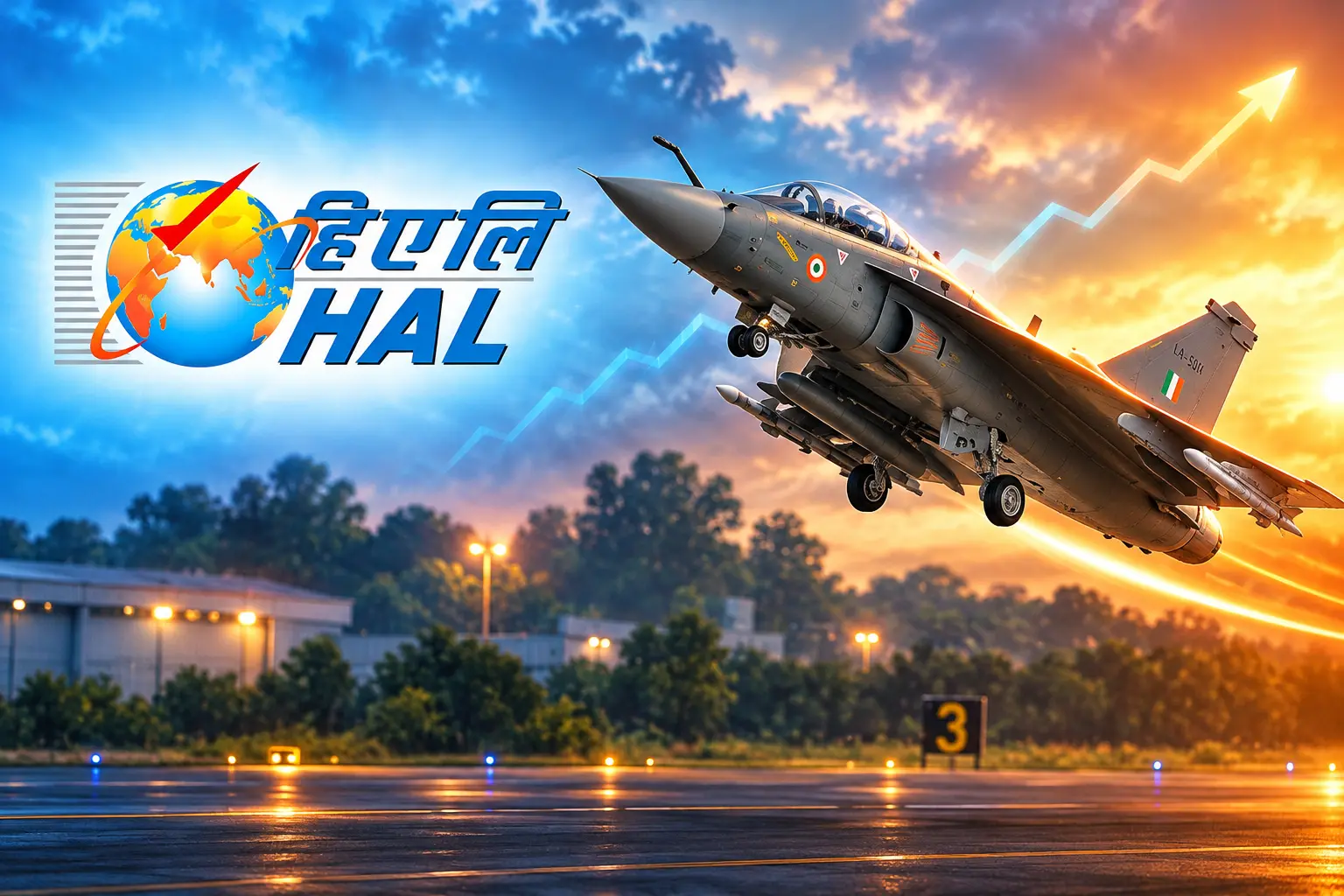
The 40-Jet Tejas Order Finally Closes
The ceremony in Bengaluru closed a much older book. The Defence Ministry said HAL two Tejas FOC twin-seater trainers were the last aircraft under the FOC contract, and that they keep the core systems of the front-line jet so pilots can train on the type they will fly.
That pair finishes the original 40-aircraft Mk1 programme, which the IAF bought in two 20-jet slices. Defence Minister Rajnath Singh and Civil Aviation Minister K Rammohan Naidu attended, with Air Chief Marshal AP Singh also present. HAL chairman and managing director Ravi K, who took charge on May 1, said the mix of fighter trainers, basic trainers and civil helicopters showed the company can deliver across civil and defence work.
HOW THE ORIGINAL TEJAS MK1 ORDER RAN
- March 31, 2006: IAF orders 20 Mk1 jets in Initial Operational Clearance form, 16 fighters and four trainers, with deliveries due by December 2011.
- December 23, 2010: IAF orders another 20 in FOC form, again 16 fighters and four trainers, with a contractual deadline of December 2016.
- December 2013: IOC is achieved, years after the original 2008 aim, and the first IOC-standard fighter reaches the IAF in 2016-17.
- March 2024: The first Mk-1A, LA-5033, makes its maiden flight from HAL’s Bengaluru line, still with no accepted handover behind it.
- September 18, 2026: HAL hands over the last two FOC trainers and closes both 2006 and 2010 Mk1 orders, 40 aircraft in all.
The FOC tranche is about a decade past its 2016 deadline. Air-to-air refuelling, structural changes and flight-control software all ran long, and the IAF would not take the last trainers until safety and performance points were closed. Finishing that 40-jet book is factory proof. It is not Mk-1A proof.
Ten Engines for a 180-Aircraft Line
The line that dominates the growth case is still pre-delivery. The IAF ordered 83 Mk-1A jets in February 2021, 73 fighters and 10 trainers, for about Rs 48,000 crore, with the first aircraft due within three years, by February 2024. A second order for 97 jets followed in September 2025 for Rs 62,370 crore. Together that is 180 aircraft, about Rs 1.1 lakh crore. Two and a half years after the first Mk-1A flight, HAL has still not handed one jet to the IAF.
THE MK-1A LINE IN SEPTEMBER
- Engines in hand: HAL has received 10 GE Aerospace F404 engines, and Goldman Sachs noted that GE had delivered another three in the latest batch.
- More promised: GE has told HAL it will send 12 additional engines by December 2026.
- Airframes waiting: Ravi K said 27 Mk-1A airframes are ready, built ahead of engines so jets can roll out as powerplants arrive.
- This year’s target: Management is aiming for 10 Mk-1A aircraft by March 2027, against a stated capacity of 24 a year if engines keep coming.
On November 7, 2025, HAL announced a deal with GE for 113 F404-GE-IN20 engines to support the 97-jet programme, with those units scheduled from 2027 to 2032, on top of the 99 engines ordered in 2021 for the first Mk-1A contract. A third Tejas production line at Nashik was opened on October 17, 2025. Metal is not the scarce item. Accepted, flown, billed aircraft are.
I have received 10 engines, and I will be able to deliver these 10 LCA Mk-1As by March. They have promised 12 additional engines by December this year.
Ravi K, Chairman and Managing Director, HAL, in an interview
Ten jets against 180 on order is a start, not a rate that clears a multi-year fighter backlog on its own. Defence watchers on X treated that March 2027 number as a drip, and the arithmetic is blunt: even a full 24-a-year clip would need several clean years of engines, tests and IAF signatures.
A Rs 2.54 Lakh Crore Book Still Needs Cash
HAL’s own year-end update put the order book at about Rs 2.54 lakh crore on March 31, 2026, against Rs 1.89 lakh crore at the start of the year. The lift came mainly from the 97-jet Mk-1A contract at Rs 62,370 crore, six ALH helicopters for Rs 2,704 crore and eight Dornier aircraft for Rs 2,186 crore. The company said that manufacturing book gives seven to eight years of work.
HAL’s order book remained healthy at around Rs 2.54 lakh crores as on 31st March 2026, against the opening order book position of Rs 1.89 lakh crores, after adjusting current-year liquidation. The increase is mainly due to the signing of major orders with the MoD for the supply…
— HAL (@HALHQBLR) March 31, 2026
Provisional, unaudited revenue for the year ended March 31, 2026 was Rs 32,250 crore, against Rs 30,981 crore the year before. HAL said Tejas Mk-1A and HTT-40 delays, tied to supply-chain and technical snags, held the top line back, while ALH helicopters and AL-31FP and RD-33 engine work filled some of the gap. The May earnings call listed manufacturing orders of Rs 69,668 crore and repair-and-overhaul orders of Rs 26,539 crore among the year’s inflows.
Ravi K put the conversion task in plain terms. LCA, the Light Combat Helicopter and the Advanced Light Helicopter programmes, he said, should support revenue over the next two to three years, with repair, overhaul and spares adding to the mix, and Pawan Hans work a bonus that was not visible a year earlier. Goldman Sachs made the same pivot in its note: as constraints ease, attention should move to HAL’s ability to convert that book into revenue.
Why the Mk-1A Overhang Has Not Cleared
Citi still treats the start of Mk-1A deliveries as the remaining execution overhang on the fighter line. Engine arrivals help, and Citi said better F404 availability plus testing progress should narrow that gap. They do not close it. Ravi K said a few radar issues remain, weapon integration is done, and the open work is software confirmation plus the live missile profiles that have to be flown, because “when you put a missile, you need to go, bang, go up and come down.” He has put the programme at about 90 to 95 percent complete. The last slice is the part the IAF signs for.
GATES STILL OPEN ON MK-1A
- Radar and software: Final radar fixes and software changes still need confirmatory tests before a jet is offered as complete.
- Weapons flight work: Missile carriage and firing profiles have to show how the airframe behaves, even after ground firing tests.
- IAF acceptance: No Mk-1A has been taken on charge; the force has already waited through several missed start dates since the February 2024 contract mark.
- Engine cadence: Ten engines cover the near-term 10-jet goal, but the 97-jet engine stream is scheduled from 2027 to 2032, so any slip hits output immediately.
Rajnath Singh used the same podium to ask for realistic timelines on technical projects, warning that delay opens gaps in defence needs, lifts cost and risks making kit obsolete. That is the ministerial version of the overhang the banks are trying to price through. HAL has said it can finish the 83-jet order in three to four years if engines keep arriving, at 24 Mk-1A aircraft a year, and that it will keep building airframes whether or not the next GE batch is on the dock.
Trainers and Civil Helicopters Carry the Proof
Citi’s comfort is that execution is no longer a single-programme story. The HTT-40 basic trainer aircraft, named Ankur at the handover, starts deliveries under a 70-aircraft Ministry of Defence contract. It is a tandem-seat turboprop with a glass cockpit, powered by a Honeywell TPE331-12B, and it is meant to cover aerobatics, instrument flying, navigation, night flying and close formation. India has long bought basic trainers abroad; Rajnath Singh said HAL is now building that role at home and that the type could find export buyers.
The four Dhruv NG helicopters mark HAL’s civil-certified rotary step. The 5.5-tonne twin is meant for passenger lift, emergency medical work and offshore logistics. Ravi K said dual civil-military certification is the commercial point, Pawan Hans will fly the type for ONGC, and the operator’s book is eight flying helicopters plus two on standby, 10 in all. Four went over on September 18. The rest, he said, should follow by December or toward March, with pilot training already under way. Citi called Dhruv NG a civil reference that is still on schedule. Goldman Sachs read the same mix of fighter trainers, basic trainers and helicopters as the manufacturing portfolio beginning to move.
There can be no sudden ‘big bang’ in the development of aerospace systems. It is a vast and gradual process involving a wide range of components.
Rajnath Singh, Defence Minister, Bengaluru handover ceremony
That line fits the stock better than the ceremony photos. Friday showed HAL can close old trainer work and open a civil helicopter stream. The fighter programme that holds most of the growth math is still in the gradual part.
What the Street Is Pricing Into HAL
Nearly 29 percent of upside at Citi, and about 22 percent at Goldman Sachs, is a claim that HAL becomes a delivery company over the next several quarters, not that it already is one. CLSA’s “best is yet to come” line points at the second half of the year in the same way. The 9.2 percent gain in a down Nifty year suggests some of that conversion bet is already in the price. The first accepted Mk-1A will test it more honestly than another trainer handover, because that is when engines, software and IAF signatures have to show up on the same jet.
Until then the tape will keep treating every F404 arrival and every test point as a proxy for cash. Ten engines and 27 airframes are a better place than a frozen line. They are still a long way from 180 billed fighters.
Disclaimer: This article is news reporting and analysis of HAL share-price moves, brokerage notes and aircraft-programme updates, and it is for information only. It is not investment advice, a recommendation to buy or sell Hindustan Aeronautics shares, or an offer to deal in any security. Readers should consult a SEBI-registered investment adviser or another qualified financial professional before acting on any rating or price target. Figures, ratings and delivery timelines reflect the company statements and brokerage notes cited for the dates given, and they can change with engine supply, flight testing and official handovers.

Edinburgh Opens a 2027 Tour Built for Time Trials

Korda Maps Auður From Meðalland to Irvine Bay

Apple Music Films Its New Logo in Mineral Oil

Oppo Prices the Pad Mini Above India’s iPad Mini

Austen Soaks Scotland Before Boelo Brings Weekend Gales

Volkswagen Sells the Osnabruck Plant to Clear a Board Fight

Apple’s Foldable iPhone Hinges on Samsung Display Supply

Saksham Gaur Finds He Is His Own Company’s Client

Tata Motors’ Iveco Tender Opens as Holders Still Decide

Onimusha Way of the Sword Preload Hits a Windows 11 Wall
-
 AUTO2 months ago
Volkswagen Sells the Osnabruck Plant to Clear a Board Fight
-
 NEWS2 months ago
Apple’s Foldable iPhone Hinges on Samsung Display Supply
-
 AUTO2 months ago
Tata Motors’ Iveco Tender Opens as Holders Still Decide
-
 BUSINESS2 months ago
Saksham Gaur Finds He Is His Own Company’s Client
-
 GAMING2 months ago
Onimusha Way of the Sword Preload Hits a Windows 11 Wall
-

 ENTERTAINMENT3 years ago
What is SD on Amazon Prime? – All You Need to Know
-

 BUSINESS2 months ago
Hyderabad 22-Carat Gold Jumps After a False Bargain
-

 NEWS2 months ago
iQOO 16 Locks 8,400 mAh While 100W Charging Holds