
BUSINESS
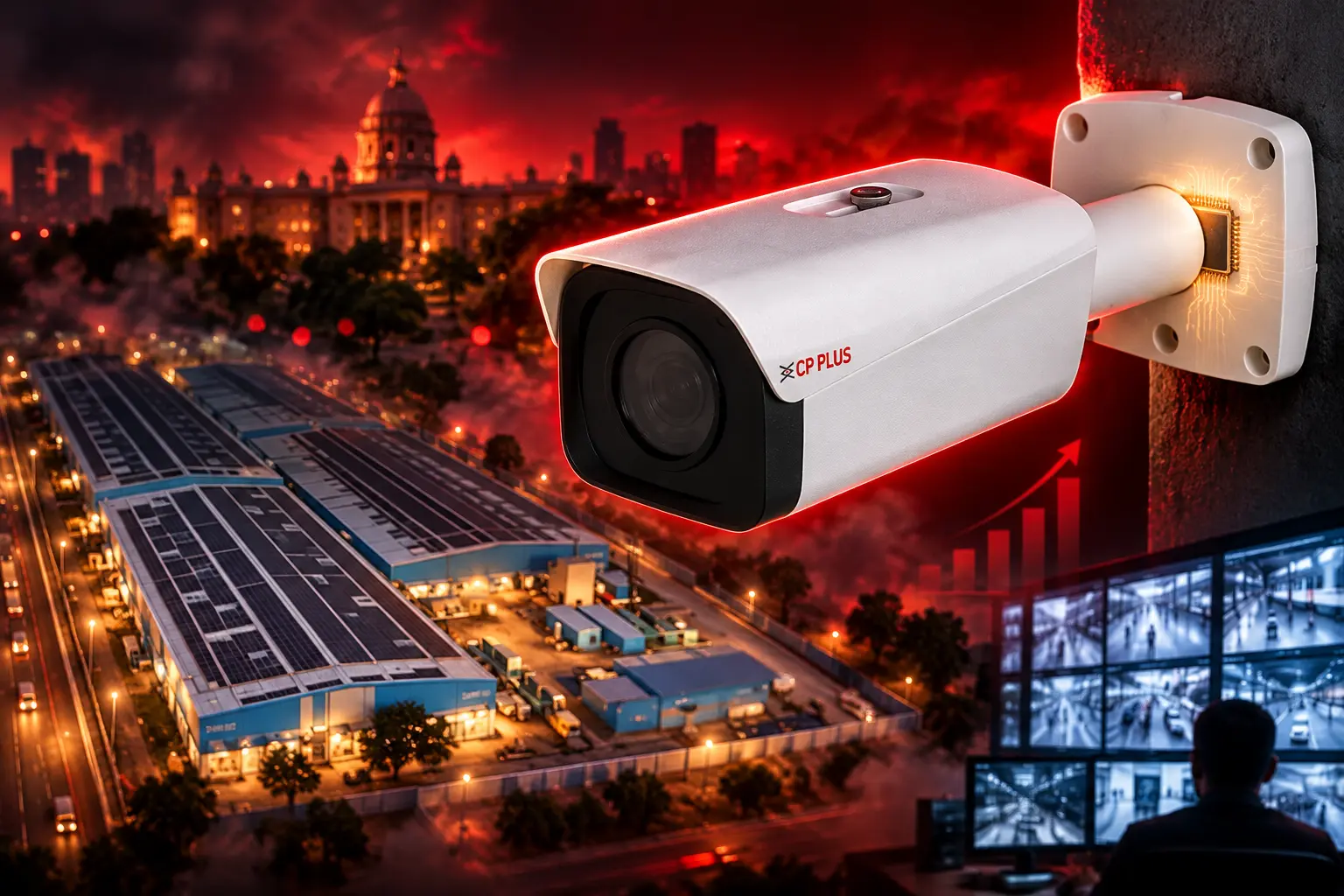
India’s New CCTV Rules Still Import the Camera’s Brain
STQC rules pulled Chinese CCTV cameras off Indian shelves in 2026. Local listed brands filled the gap, but the processors still come from Taiwan.

India’s CCTV market is forecast to grow from USD 5.75 billion in 2026 to USD 14.25 billion by 2031, about ₹1.3 lakh crore, at a 19.88% CAGR. The new security tests have already decided who can sell into that demand.
From April 1, 2026, internet-connected cameras need a Standardisation Testing and Quality Certification Directorate clearance before they can be sold. Chinese brands that once held about a third of the trade were pushed off the shelf. The Indian listed names taking that volume still buy the processor from Taiwan.
The Chip Inside the Camera Is the Test
The Ministry of Electronics and Information Technology put CCTV cameras under Essential Requirements for security in a gazette dated March 6, 2024, and added them to the Compulsory Registration Order on April 9, 2024. Public-procurement preference for Make in India cameras took effect on June 7, 2024. The registration security tests followed on April 9, 2025. The April 1, 2026 date then applied the same bar to connected cameras sold in the open market.
STQC, a MeitY directorate, issues the security test report. That report is valid for three years. Labs do not only check whether the camera records video. They inspect the System-on-Chip, the firmware, the printed circuit board, the network port, and debug interfaces such as USB, UART, and JTAG. Vendors must table a bill of materials for those parts, plus invoices that show where the chip and the firmware were bought.
THE TESTS STQC LABS RUN
- Trusted parts: Labs check that security-critical pieces, above all the SoC and firmware, come through a managed bill of materials.
- Border filter: Guidance tells labs to confirm SoCs not sourced from land-border countries, using invoices and technical papers.
- Board proof: Vendors must hand over design files, layout drawings, and X-ray images of the circuit board.
- Malware scan: Firmware has to be checked with current malware tools before the camera is packed.
- Disruption file: Firms also file supply-chain risk notes and playbooks for a parts shock.
That land-border line is the hinge. India shares a land border with China, so a camera built around a Chinese chipset cannot clear the test even if the plastic shell is moulded in Noida or Gandhinagar. Taiwan, Singapore, the United States, and South Korea sit outside that filter. Assembly in India is no longer enough. The origin of the silicon is.
Chinese Brands Lost the Legal Right to Sell
Hikvision, Dahua Technology, and TP-Link had been the cheap default in shops, housing societies, and a large slice of public work. Industry executives said the government then refused to certify products that used Chinese chipsets. Without the STQC stamp, those models cannot be sold as connected cameras.
Varun Gupta, a research analyst at Counterpoint Research, said a factory built to produce two million Hikvision cameras a month was denied certification because it made Chinese products. Counterpoint also put Indian brands at over 80% of the market as of February 2026, with Bosch and Honeywell holding the high end. Chinese names had accounted for about one-third of sales the year before.
THE DATES THAT CLOSED THE MARKET
- March 6, 2024: MeitY notifies Essential Requirements for CCTV security and public procurement.
- April 9, 2024: CCTV cameras are added to the Compulsory Registration Order for the same security tests.
- April 26, 2024: The Ministry of Home Affairs tells government agencies to buy under the procurement order and the MeitY threat advisory.
- June 7, 2024: Make in India procurement rules for cameras take effect.
- April 9, 2025: New BIS licences without the security tests stop being issued.
- April 1, 2026: Uncertified internet-connected CCTV cameras cannot be sold.
Government departments were already told, in March 2026, not to buy cameras that miss the security bar. Maharashtra ordered a halt on Chinese CCTV buying and a security audit of cameras already on state sites. BIS followed with warehouse raids. Existing cameras in homes and offices were not ordered ripped off the wall. New stock is the constraint.
A camera that passes STQC can still ship with a Taiwanese processor the Indian buyer never sees. That is what the rule allows. The political fight was about Chinese hardware. The industrial fight is about who designs the silicon. Only the first fight is over.
How CP Plus Took 43.3% of India’s CCTV Market
Aditya Infotech Limited, listed as CPPLUS after an IPO on August 5, 2025, sells under the CP PLUS brand and a second line, Nexivue. Frost & Sullivan put its share of organised Indian video surveillance at 43.3% in FY26, effectively double the 20.8% it held in FY25. Internet Protocol products are 79% of the CP PLUS mix. CP PLUS itself was 87% of company revenue in the June quarter.
The same company had been Dahua’s national distributor in India for 16 years. That book is being wound down on purpose.
We have let the brand die a slow death in India. Our business with Dahua has contracted by 80%.
Anup Nair, director of strategy and operations, Aditya Infotech
The June quarter shows what filled the hole. Revenue from operations was ₹1,402.4 crore, up 89.5% from ₹740.0 crore a year earlier. EBITDA was ₹207.8 crore, up 220.0% from ₹64.9 crore, and the margin went to 14.8% from 8.7%. Net profit was ₹142.2 crore, up 332.5% from ₹32.9 crore. Gross margin was 30.8%, up from 22.7%. Management has guided FY27 revenue of ₹6,000 to ₹6,500 crore, against FY26 revenue of ₹4,220.8 crore.
Q1 FY27 AT ADITYA INFOTECH
| Item | Q1 FY27 | Q1 FY26 | Change |
|---|---|---|---|
| Revenue | ₹1,402.4 crore | ₹740.0 crore | 89.5% |
| EBITDA | ₹207.8 crore | ₹64.9 crore | 220.0% |
| EBITDA margin | 14.8% | 8.7% | 6.1 points |
| Net profit | ₹142.2 crore | ₹32.9 crore | 332.5% |
| Gross margin | 30.8% | 22.7% | 8.1 points |
The plant already runs at 25 lakh units a month, at 85 to 90% utilisation. A Kadapa greenfield and a second cluster in Greater Noida are meant to double that capacity over three years. An in-house housing and enclosure line is due by the end of Q3 FY27, with lenses, cables, and bare boards being pulled closer to home. Debt-to-equity fell to 0.07x from 0.44x in Q1 FY26. The cash conversion cycle shortened by 7 days to 64 days.
The chip is the part that did not move to India. Aditya Infotech sources 100% of its semiconductor SoCs, about 35% of the bill of materials, from fabrication partners in Taiwan. Management is lifting list prices 15 to 20% in the first half of FY27 and aiming for 25% across the year, in part to cover those global parts. The security file is cleaner than a HiSilicon board. The processor is still foreign.
Thirty EMS Partners Keep D-Link India’s Shelves Full
D-Link (India) Limited is not a camera specialist. Almost all of its revenue is networking: switches, wireless, racks, and cabling. IP cameras sit inside that catalogue, sold into homes, small firms, and enterprise nets, with CCTV cable and power supplies sold beside them. The listed Indian unit holds the parent trademark for goods made here.
The FY26 annual report says two-thirds of D-Link India’s product supply is now sourced locally, through contracts with more than 30 electronics manufacturing and original-design partners that build to D-Link’s designs. The channel is three national distributors, more than 100 business distributors, and more than 15,000 resellers. That is a Make in India story about factories on contract, not about an Indian chip.
For the quarter ended June 30, 2026, revenue from operations was ₹456.96 crore, up 30.5% from ₹350.16 crore. Net profit was ₹27.61 crore, up 13.3% from ₹24.38 crore. Profit before tax was ₹37.17 crore. The company is adding 10G, 25G, and 100G data-centre switches, which is where the networking parent wants growth. Cameras are a compliance product in a broader kit, which is why a STQC shock in surveillance still shows up in a networking P&L.
A Gandhinagar Plant and a Paper Chip
Prizor Viztech Limited, an SME-listed camera maker founded in 2017, is trying to climb from assembly to the board and then to the chip. It sells IP and analog cameras, 4G and solar units, and a display line of LED sets and panels that third parties make under the Prizor name. The dealer net runs past 11,000 outlets and 150 distributors across 21 to 22 states.
On July 29, 2026, the company told the exchange it had started a new assembly line that lifted total assembly line capacity to 24 lakh units a year, from 16 lakh, by adding 8 lakh units. A surface-mount line can make 50 lakh printed circuit boards a year. For the year ended March 31, 2026, revenue from operations was ₹152.99 crore and profit before tax was ₹28.21 crore. On September 9, 2026, it said it had BIS-ER 01 clearance for 10 more 4MP IP dome and bullet models from an STQC-certified lab.
The silicon plan is still a contract. On December 12, 2025, Prizor signed a memorandum with IndieSemic Private Limited on the ISC-S2-PZ, a CCTV SoC based on the VEGA processor. After validation, Prizor gets exclusive rights to the ISC-S2-PZ chipset in India and abroad for three years, and it has said it will buy about 50 lakh units a year for at least three years. IndieSemic stays the design and manufacturing lead. Prizor leads field tests.
By validating and bringing IndieSemic’s indigenous ISC-S2-PZ chipset to market, we are aligning cutting-edge semiconductor design with our extensive surveillance manufacturing capabilities. With this collaboration, Prizor takes one more step toward backward integration beyond our SMT line.
Mitali Gauswami, managing director, Prizor Viztech, December 12, 2025 press release
Those words are about a chip that still has to be validated. Until field tests close, Prizor’s cameras, like CP PLUS units, depend on imported processors. The plant can mould housings and stuff boards. It cannot yet print the part STQC cares about most.
Why Analog Cameras Still Outsell IP Models
The value of the market is moving toward IP and AI. The volume is not there yet. Mordor Intelligence’s 2026 India CCTV study still has analog cameras at 51.65% of 2025 sales, with IP at 40.55% and pan-tilt-zoom at 5.85%. AI-enabled cameras are the fast slice, at a 20.55% CAGR through 2031, because STQC and software analytics both favour devices that can take a signed firmware load and run detection on the edge.
INDIA CCTV MIX IN 2025
| Slice | Share or rate |
|---|---|
| Analog cameras | 51.65% of 2025 sales |
| IP cameras | 40.55% of 2025 sales |
| PTZ cameras | 5.85% of 2025 sales |
| Government buyers | 38.05% of 2025 revenue |
| Residential and smart home | 20.15% CAGR to 2031 |
| Wired systems | 67.95% of 2025 sales |
Government remains the largest end-user at 38.05% of 2025 revenue, which is why a procurement rule moves share so fast. Residential kits are the fastest private slice, at a 20.15% CAGR, helped by sub-USD 25 Wi-Fi cameras. Wired systems still hold 67.95% of sales. North India held 42.25% of 2025 revenue, with 76,000 cameras already counted across 100 smart cities. Cameras at village junctions in Bihar and elsewhere show the same shift below the metro tenders: a box on a pole, then a recorder, then a login on a phone.
Cheaper analog gear is harder to retire where coaxial cable is already in the wall. The new tests still push buyers toward IP, because a connected camera that cannot show a lab report cannot be sold. That mix is why CP PLUS keeps stressing the 79% IP share inside its own brand. The installed base will trail the rule for years.
The Scarcity Window Is Already Closing
The first year of the mandate rewarded whoever had certified models, factory hours, and a dealer book at the same time. Aditya Infotech had all three, which is how a 20.8% brand became a 43.3% brand in one fiscal year. D-Link had the EMS net and the shop-floor channel. Prizor had dealers in thousands of tehsils and a plant that could add a line in months.
That shortage is fading. More domestic names have now put models through STQC-accredited labs, so a buyer on GeM or in a district tender has a longer shortlist than they did in early 2026. DRAM and other parts have been dear, which is why Aditya Infotech is pushing through those 15 to 20% list-price increases. A certified camera costs more than the grey-market dome it replaced. The bill shows up in housing-society minutes and in small-shop invoices.
Backward work is underway in housings, lenses, cables, and boards. The SoC, about a third of the camera’s materials cost at Aditya Infotech, is still a Taiwan foundry part. Prizor’s IndieSemic paper, and any similar design tie-up, will matter only after a chip clears validation and lands on a production board that then clears STQC as its own series. Until that happens, India has local brands, local assembly, and an imported brain.
The rule did what it set out to do on Chinese hardware. Hikvision and Dahua no longer have a clean path to the connected-camera shelf. The listed Indian suppliers took the orders. The processor inside those orders still arrives in a reel from overseas, and the first Indian CCTV SoC is a purchase pledge dated after a test that has not yet been passed.
Disclaimer: This article is news reporting and analysis of company filings, government orders, and market data. It is for information only and is not investment advice, a research recommendation, or an offer to buy or sell any security. Readers who may act on any figure or company named here should consult a SEBI-registered investment adviser who can judge their own objectives, risk, and holding period. Revenue, share, capacity, and certification status reflect the cited filings and reports as dated in the piece and can change with later results, lab decisions, and guidance.

Edinburgh Opens a 2027 Tour Built for Time Trials

Korda Maps Auður From Meðalland to Irvine Bay

Apple Music Films Its New Logo in Mineral Oil

Oppo Prices the Pad Mini Above India’s iPad Mini

Austen Soaks Scotland Before Boelo Brings Weekend Gales

Volkswagen Sells the Osnabruck Plant to Clear a Board Fight

Apple’s Foldable iPhone Hinges on Samsung Display Supply

Saksham Gaur Finds He Is His Own Company’s Client

Tata Motors’ Iveco Tender Opens as Holders Still Decide

Onimusha Way of the Sword Preload Hits a Windows 11 Wall
-
 AUTO2 months ago
Volkswagen Sells the Osnabruck Plant to Clear a Board Fight
-
 NEWS2 months ago
Apple’s Foldable iPhone Hinges on Samsung Display Supply
-
 AUTO2 months ago
Tata Motors’ Iveco Tender Opens as Holders Still Decide
-
 BUSINESS2 months ago
Saksham Gaur Finds He Is His Own Company’s Client
-
 GAMING2 months ago
Onimusha Way of the Sword Preload Hits a Windows 11 Wall
-

 ENTERTAINMENT3 years ago
What is SD on Amazon Prime? – All You Need to Know
-

 BUSINESS2 months ago
Hyderabad 22-Carat Gold Jumps After a False Bargain
-

 NEWS2 months ago
iQOO 16 Locks 8,400 mAh While 100W Charging Holds