
BUSINESS
Hougan Calls Clarity’s Senate Failure a Speed Bump
Matt Hougan recast the Senate’s 49-50 CLARITY miss as a speed bump after Atkins and Selig began shipping crypto rules without a statute.

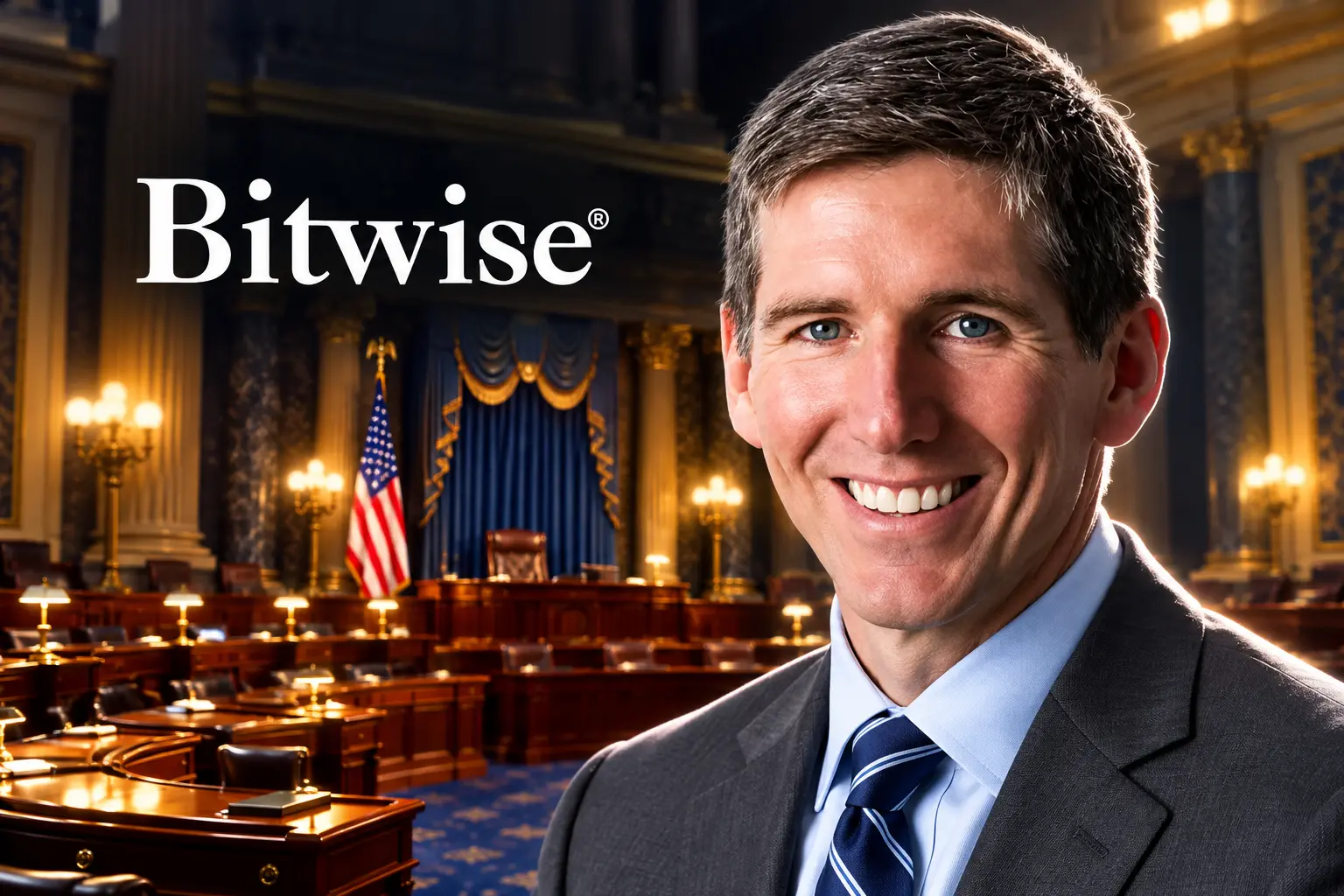
Bitwise CIO Matt Hougan called the Senate’s 49-50 CLARITY Act miss a speed bump, one day after the bill fell 11 votes short of cloture. The next fight is no longer a 60-vote count. It is a pair of agencies writing rules that do not need Democratic yeses, and that a later White House can unwind.
Hougan had spent January treating the bill as crypto’s groundhog. In a 16 September note he said that winter is no longer the base case, because prices, Wall Street, and the SEC and CFTC had already moved.
Cloture Failed 49-50 on H.R. 3633
The Digital Asset Market Clarity Act never reached debate. Senators voted on cloture on H.R. 3633, Record Vote 234, and the motion failed 49-50. Cloture needed 11 votes more than the 49 yeas. Senator Chris Coons did not vote, so 99 senators were recorded.
All 49 yeas were Republicans. Four Republicans voted no: Susan Collins of Maine, Josh Hawley of Missouri, Jerry Moran of Kansas, and Thom Tillis of North Carolina. Tillis voted no so he could enter a motion to reconsider, which he did a minute after the result. Holding the full GOP conference would still have left the bill seven short of 60, because no Democrat or independent voted to proceed.
THE AFTERNOON THE BILL STALLED
- September 14, 2026: SEC Chair Paul Atkins urges the Senate to send the bill to the president, and says the agency will keep writing crypto rules if the floor vote fails.
- September 15, 2026, 2:18 p.m.: The Senate starts voting on cloture on the motion to proceed, per the vote log for September 15.
- September 15, 2026, 3:00 p.m.: The motion fails 49-50. Coons is recorded as not voting; Collins, Hawley, Moran, and Tillis vote no.
- September 15, 2026, 3:01 p.m.: Tillis enters a motion to reconsider, keeping a narrow path to try cloture again in this Congress.
The House had already passed the measure 294-134 in July 2025. That margin never reached the Senate floor. Sen. Cynthia Lummis of Wyoming, who had led the Senate push, said that evening that the bill is dead. Majority Leader John Thune can still file another cloture motion, and Tillis’s reconsideration is on the record, but the chamber’s remaining days run into a 30 September funding fight and a House that is out until November.
Hougan Drops His Groundhog Warning
In January, Hougan called the Clarity Act crypto’s “Punxsutawney Phil” and said failure would mean six more weeks of winter, volatile trading into the midterms. On 16 September he published a client note titled as a speed bump, not a roadblock, and wrote that he no longer thinks that winter path is the most likely one.
He still calls the bill a good one. It would have tightened investor protections and, in his words, given crypto rules that would outlast this White House. He is candid that agency rules can be reversed, and that only Congress can give the Commodity Futures Trading Commission real power over spot markets. He has not dropped that problem. He has ranked it below the fact that builders and banks did not wait.
Rules can be reversed by the next administration, and only Congress can give the CFTC real authority over spot markets. But on everything else, Atkins’ and Selig’s rulemaking is likely to be more pro-crypto than the Clarity Act itself.
Matt Hougan, Chief Investment Officer, Bitwise CIO memo, 16 September 2026
That sentence is the trade. A statute would have locked in a split of SEC and CFTC turf and survived a change of party. A chair’s order, a staff no-action letter, and a proposed offering rule do not. Hougan now says the extra speed and the friendlier text are worth that risk through 2029, when the current SEC and CFTC lineup is in place.
Bitcoin Rose While Passage Odds Fell
The chart that changed his mind is a split between price and prediction markets. Bitwise plotted CoinGecko bitcoin prints against Polymarket’s contract on Clarity becoming law in 2026, from 1 July through 15 September.
PRICE VERSUS PASSAGE ODDS
| Date | Bitcoin (CoinGecko, via Bitwise) | Polymarket odds of 2026 passage |
|---|---|---|
| 1 July 2026 | $57,950 trough | 39% |
| 4 September 2026 | Peaked above $80,000 | Falling through the summer window |
| 15 September 2026 | Down about 4% on the vote day | 18% |
If the bull market had needed the statute, Hougan wrote, falling odds should have pulled prices down with them. They did not. Bitcoin bottomed at $57,950 on 1 July and ran through 4 September while the Polymarket share slid from 39% to 18% by 15 September. The vote day still hurt. He said bitcoin fell about 4%, and he allowed that rates and oil were in the mix. He did not treat that print as a new winter. He treated it as one more bump on a road that was already open.
Robinhood, Morgan Stanley, and DTCC Kept Building
Hougan’s second exhibit is not a poll. It is product. Large firms spent the summer shipping crypto rails while the Senate text was still in flux, which he reads as proof they already trusted the people in the chairs more than the people with the gavel.
WHAT SHIPPED WITHOUT A STATUTE
- Robinhood: Launched its own blockchain in the past quarter, a venue bet that did not wait on cloture.
- Morgan Stanley: Launched a Solana ETF, putting a major broker-dealer’s name on a product the bill was supposed to clarify.
- DTCC: Settled its first batch of tokenized stock trades, the same on-chain share rail the SEC later tried to house under a temporary order.
Those firms, he wrote, took comfort in an “extraordinarily pro-crypto SEC and CFTC” sitting through 2029. They did not need Clarity because they already had “clarity of conviction.” Crypto, in his phrase, had been in a heads-we-win-big, tails-we-still-win setup on regulation. The miss removes the heads. It does not remove the tails, as long as Paul Atkins and Mike Selig keep the pens.
The Agencies Wrote a Path in Two Days
Atkins had already told a Solana Policy Institute audience on 14 September that Congress should pass the bill, then added that the administration will deliver with or without that legislation. Project Crypto, he said, is the SEC’s answer, built rule by rule. Regulation Crypto Assets, proposed in August, is the offering piece. Transfer-agent rules last rewritten about 40 years ago are the plumbing piece. A custody proposal for advisers and funds is the third pillar, including a path for self-custody where a qualified third-party custodian does not yet exist.
CFTC Chair Mike Selig posted the morning after the vote that the agency is locked in and ready to ship its rules for the new frontier of finance. Hougan quoted that line in the memo the same day.
— Mike Selig (@ChairmanSelig) September 16, 2026
The chairs then used the tools they already had. On 17 September the SEC issued a temporary Innovation Exemption for tokenized stocks, press release 2026-90, File 4-927, Release 34-106402. The order lets Tokenized Securities Venues run permissioned automated market makers in tokenized NMS stock for five years, with a dealer exemption for certain liquidity providers, issuer opt-outs, and a request for comment. Atkins called it a bridge toward durable rulemaking. It is also, by design, a clock.
The same day, the CFTC’s Market Participants Division issued Staff Letter 26-25, signed by division director DJ Hennes. Staff said they will not recommend enforcement against qualifying passive software providers, or their people, for failing to register as introducing brokers, so long as the code only connects users to registered futures commission merchants, introducing brokers, and designated contract markets, and the provider does not hold customer funds or make the trades. The letter extends, on similar terms, relief first given to Phantom Technologies in Letter 26-09 on 17 March. It is a staff position, not a Commission rule.
STATUTE VERSUS WHAT THE AGENCIES CAN SIGN
| Track | What it is | How long it lasts |
|---|---|---|
| CLARITY Act | Senate cloture, 60 votes, then a statute | Outlasts a change of chairs |
| Regulation Crypto Assets | SEC offering proposal; comments due 20 October 2026 | A Commission rule a later SEC can reopen |
| Innovation Exemption | SEC order for tokenized NMS stock venues | Five years, then it expires |
| CFTC Letter 26-25 | Staff no-action for passive trading software | Staff can withdraw it; it is not spot-market law |
Hougan told clients the present funk should last until Atkins and Selig put out their next proposals. The destination, he said, is unchanged. Crypto spent its first 17 years without core market legislation and still became, in his figure, a $2.5 trillion asset class. The new calendar is a comment file, not a whip count.
Ethics Broke the Senate Floor Coalition
The industry read the miss as Democratic politics. Ripple CEO Brad Garlinghouse wrote that the vote stung, that consumers and U.S. competitiveness got left behind, and that “the politics of the democrats (the anti-crypto army) was elevated over good policy.” He still pointed to Atkins and Selig to fill the gap, and said Ripple’s business had not changed. Senate Banking Chair Tim Scott said nearly all Republicans had voted to advance the bill and that it was time for the two agencies to set rules until Congress legislates.
The Democrats who voted no did not describe it as a war on tokens. They described it as a fight over who profits while writing the rules. Sen. Elissa Slotkin of Michigan said the ethics language was too thin, that President Trump, his children, and his Cabinet are making billions of dollars in crypto, and that she would not vote to codify that for this White House or for a future Democratic one. She also wanted harder illicit-finance tools and said the CFTC still lacks the oversight and staffing to run the bill.
Today, I voted no on the Clarity Act, legislation meant to regulate cryptocurrency in America.
The ethics provisions in this bill are simply too thin. President Trump, his children, and his Cabinet are making billions of dollars in the crypto space, in part from bilking everyday…
— Sen. Elissa Slotkin (@SenatorSlotkin) September 15, 2026
That ethics fight sat on the same roll call as a bank fight over stablecoin yield, which Hawley and Moran cited, and as a CFTC staffing argument. The no column mixed those strands. A later attempt will have to unbundle them, or it will reprint 49-50.
Seven Democrats who had spent two years in the talks, Sens. Kirsten Gillibrand, Angela Alsobrooks, Cory Booker, Catherine Cortez Masto, Ruben Gallego, Mark Warner, and Raphael Warnock, said the night after the vote that the miss was a setback, not the end, and that they would keep working. None of them had voted yes. Alsobrooks had pinned the breakdown on ethics language she said Democrats needed to stop “the grift and the corruption” they see in this White House. The coalition that walked the bill through committee did not walk it onto the floor.
Rules That Can Be Unwound After 2028
Hougan’s January case for a statute was durability. His September case is that durability can wait, because Atkins and Selig hold the agenda until 2029 and because Wall Street already treated that as enough. The second move is the one the vote actually priced. Cloture is no longer the catalyst. Comment periods are. Regulation Crypto Assets is open through 20 October. The Innovation Exemption is a five-year experiment with a feedback file. Letter 26-25 can be pulled back by the same staff who signed it.
A later president can replace both chairs. Hougan said that out loud. He also said only Congress can hand the CFTC spot-market authority, so the deepest jurisdictional fix the industry wanted is still sitting in the failed motion. Tillis’s reconsideration and the seven Democrats’ statement keep a legislative ember alive. Lummis’s verdict is that the ember is already out. Either way, the people writing the next pages work at 100 F Street and at the CFTC, not at the cloakroom whip board, and the rules they sign are built to be rewritten.
Disclaimer: This article is news reporting and analysis of public statements, a Senate roll call, and agency actions. It is informational only and is not investment, trading, legal, or tax advice, and it is not a recommendation to buy, sell, or hold bitcoin or any other crypto asset or fund. Readers should consult a licensed financial adviser, attorney, or tax professional before making decisions based on market-structure bills or agency rules. Vote tallies, prices, prediction-market odds, and the status of proposed rules and staff letters reflect the cited documents as of the dates named above and can change as Congress, the SEC, or the CFTC act.

Edinburgh Opens a 2027 Tour Built for Time Trials

Korda Maps Auður From Meðalland to Irvine Bay

Apple Music Films Its New Logo in Mineral Oil

Oppo Prices the Pad Mini Above India’s iPad Mini

Austen Soaks Scotland Before Boelo Brings Weekend Gales

Volkswagen Sells the Osnabruck Plant to Clear a Board Fight

Apple’s Foldable iPhone Hinges on Samsung Display Supply

Saksham Gaur Finds He Is His Own Company’s Client

Tata Motors’ Iveco Tender Opens as Holders Still Decide

Onimusha Way of the Sword Preload Hits a Windows 11 Wall
-
 AUTO2 months ago
Volkswagen Sells the Osnabruck Plant to Clear a Board Fight
-
 NEWS2 months ago
Apple’s Foldable iPhone Hinges on Samsung Display Supply
-
 AUTO2 months ago
Tata Motors’ Iveco Tender Opens as Holders Still Decide
-
 BUSINESS2 months ago
Saksham Gaur Finds He Is His Own Company’s Client
-
 GAMING2 months ago
Onimusha Way of the Sword Preload Hits a Windows 11 Wall
-

 ENTERTAINMENT3 years ago
What is SD on Amazon Prime? – All You Need to Know
-

 BUSINESS2 months ago
Hyderabad 22-Carat Gold Jumps After a False Bargain
-

 NEWS2 months ago
iQOO 16 Locks 8,400 mAh While 100W Charging Holds