
LIFESTYLE
Recalled Italian Guanciale Is Sitting in Restaurant Coolers
A Class I Listeria recall of 1,513 pounds of Italian guanciale targets restaurant kitchens in eight states, with dated life running to May 2027.

Prime Line Distributors and Ferrarini USA are recalling 1,513 pounds of imported Italian guanciale after a U.S. lab sample tested positive for Listeria monocytogenes. The Department of Agriculture’s Food Safety and Inspection Service posted the Class I action on Sept. 6, 2026, and said no illnesses have been confirmed.
The meat is dry-cured pork jowl, the cut kitchens render for carbonara and amatriciana. Most of this lot went to food-service coolers, not the grocery meat case, and the dated life on the pack runs to May 16, 2027.
Recalled Guanciale Went Straight Into Kitchens
FSIS listed the two recalling firms in a single notice, recall 019-020-2026, covering 1,513 pounds of imported ready-to-eat pork produced as guanciale. Prime Line Distributors, a Fort Lauderdale, Fla., firm, sent its share to food-service and retail locations in Florida. Ferrarini USA, a Hoboken, N.J., firm, sent its share to distributors and food-service locations in California, Florida, Idaho, Illinois, Michigan, New Jersey, New York and Texas.
That split is the whole distribution map. Eight states. One Italian plant. One lot code. The agency’s own processing tag on the file is “Products with Secondary Inhibitors – Not Shelf Stable,” which is a refrigerated product, not a pantry ham.
WHERE THE TWO FIRMS SENT THE LOT
| Company | Based in | States named | Channel FSIS named |
|---|---|---|---|
| Prime Line Distributors, Inc. | Fort Lauderdale, Fla. | Florida | Food service and retail |
| Ferrarini USA, Inc. | Hoboken, N.J. | California, Florida, Idaho, Illinois, Michigan, New Jersey, New York, Texas | Distributors and food service |
A diner who orders carbonara never sees an establishment number. The cook who pulled a vacuum pack from a walk-in is the person who has to match LOT: 263311US to the notice. Online talk treated the story as a generic pork scare. It is a single Italian jowl lot sitting in restaurant and distributor coolers, not steaks and not pork already cooked into a dish.
🚨 Prime Line Distributors, Inc. and Ferrarini USA, Inc. Recall Imported Ready-To-Eat Pork Guanciale Products Due to Possible Listeria Contamination https://t.co/jVzgdkEYQj
— USDA Food Safety & Inspection Service (@USDAFoodSafety) September 7, 2026
What Lot Number and Date Mark the Recalled Pork?
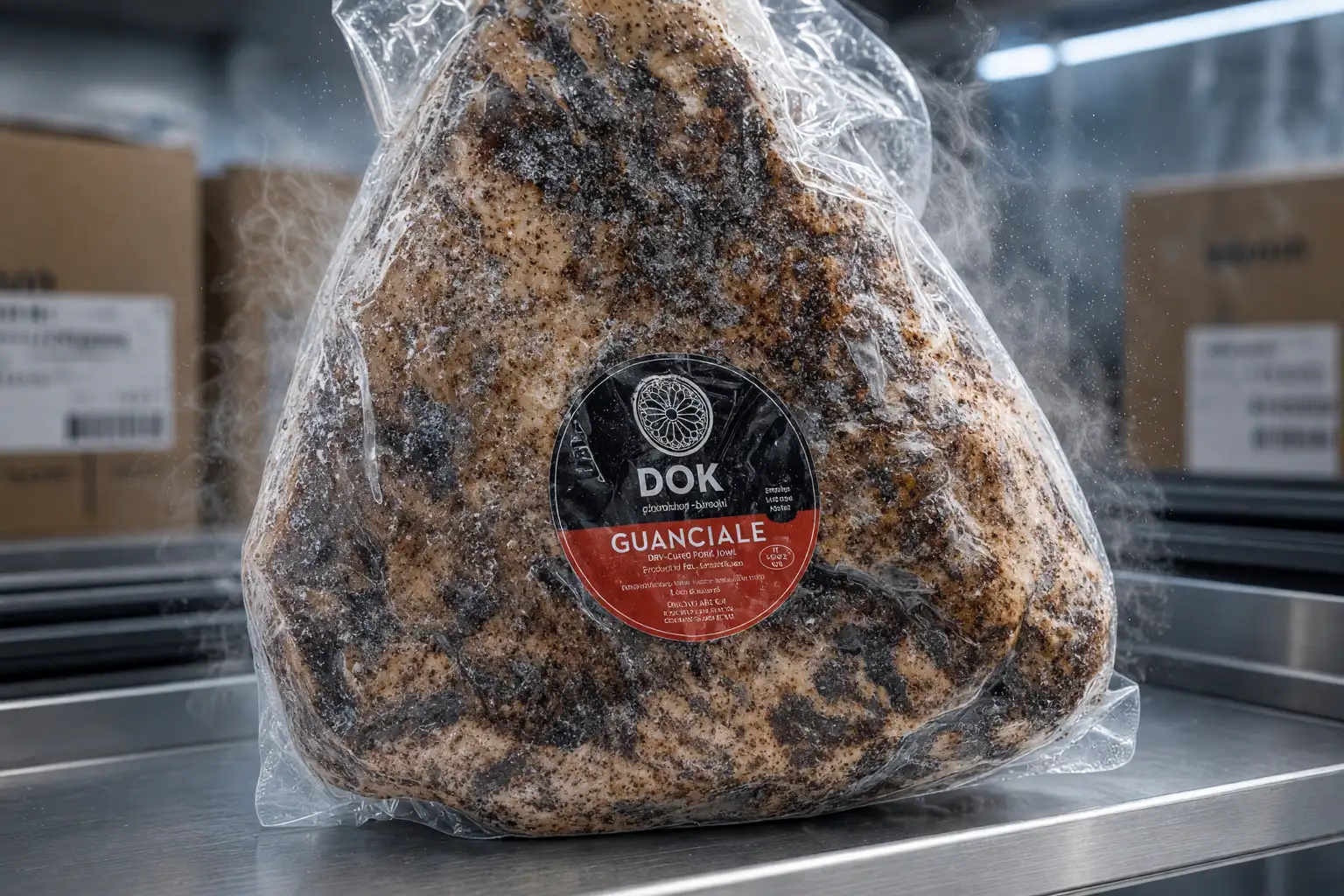
Every recalled pack carries the same lot and the same best-if-used-by line. FSIS also published the product labels. The extra “DOK GUANCIALE” sticker appears only on one Prime Line line.
LABEL LINES TO MATCH
- Prime Line cases: Cardboard cases of various weights holding two vacuum packs marked “PRIME LINE DISTRIBUTORS, INC. GUANCIALE PORK JOWL PRODUCT OF ITALY,” with LOT 263311US and BEST IF USE BY DATE 05.16.27.
- Prime Line singles: Various-weight vacuum packs marked “GUANCIALE PORK JOWL PRODUCT OF ITALY,” same lot and date, plus an extra “DOK GUANCIALE” label.
- Ferrarini cases: Cardboard cases of various weights holding two vacuum packs marked “GUANCIALE PORK JOWL PRODUCT OF ITALY,” same lot and date.
- Ferrarini singles: Various-weight vacuum packs marked “FERRARINI GUANCIALE DRY-CURED PORK JOWL,” same lot and date.
The Italian inspection mark reads IT 1937 L CE, printed inside the mark or on the case. Liliana Rojas, Prime Line’s QA/QC manager, is the company contact at 954-925-4500. Luca Infantino, Ferrarini USA’s chief financial officer, is the contact at 818-256-1622. Consumers can also call the USDA Meat and Poultry Hotline at 888-674-6854.
The July Import and the September Notice
Est. 1937L Bome SRL in Italy produced the jowl on May 21, 2026. The two U.S. firms imported it on various dates in July 2026. FSIS said a product sample confirmed positive for Listeria monocytogenes during routine import reinspection, then posted the recall on Sept. 6.
By then the same lot was already in kitchens and distributor coolers. Import reinspection is the port checkpoint, not a second plant audit in Italy. After Customs and Border Protection and APHIS clear a shipment, the meat is reinspected by FSIS at an import facility. The Public Health Information System assigns the checks from each country’s and each plant’s history. Better performers get fewer extra tests. Product that passes is stamped with the USDA mark and may move in commerce like domestic meat.
THE PATH OF LOT 263311US
- May 21, 2026: Bome SRL produces the dry-cured pork jowl at Est. 1937L in Italy.
- July 2026: Prime Line and Ferrarini USA import the lot on various dates.
- Sept. 6, 2026: FSIS posts Class I recall 019-020-2026 after a reinspection sample tests positive for Listeria monocytogenes.
A Class I recall, as FSIS defines it, is a health-hazard case with a reasonable probability that use of the product will cause serious adverse health consequences or death. All FSIS recalls are voluntary. The agency can detain product and ask the Justice Department to seize it if a firm refuses. FSIS said it will run recall effectiveness checks down the distribution chain and will post retail consignee lists when they are available.
Who Faces the Highest Risk From This Lot?
Listeria monocytogenes can cause listeriosis, an infection that hits older adults, people with weak immune systems, and pregnant women and their newborns hardest. Healthy young people rarely get the invasive form. FSIS said fever, muscle aches, headache, stiff neck, confusion, loss of balance and convulsions can follow, sometimes after diarrhea. In pregnancy the infection can cause miscarriage, stillbirth, premature delivery or a life-threatening infection of the newborn.
The Centers for Disease Control and Prevention puts laboratory-confirmed U.S. incidence at about 0.24 cases per 100,000 people, with about 800 confirmed cases reported each year and about 1,250 cases once undiagnosed illness is counted. CDC estimates listeriosis is the fourth leading cause of death from foodborne illness, with about 172 deaths per year. Nearly everyone with the infection is hospitalized. The case-fatality rate is about 20%. Nearly 25% of pregnancy-associated cases end in fetal loss or death of the newborn.
LISTERIA, IN THE CDC AND FDA FIGURES
- Estimated U.S. cases: About 1,250 a year once missed diagnoses are counted, against about 800 laboratory-confirmed reports.
- Deaths: About 172 a year, with a case-fatality rate of about 20%.
- Pregnancy: Pregnant women are about 10 times more likely to get listeriosis than other healthy adults, the Food and Drug Administration says.
- Timing: CDC says symptoms usually start within 2 weeks and can start as late as 10 weeks; FSIS told higher-risk people with flu-like symptoms within two months of eating the food to seek care.
No confirmed illness has been tied to this guanciale. That is the status on the notice, not a medical all-clear for anyone who already ate it. FSIS said people in the higher-risk groups should tell a doctor if they ate the product and then feel flu-like symptoms.
Italy Already Lost 6,126 Pounds of Pork at U.S. Ports
Italian pork is a large, watched trade. FSIS’s March 10, 2026, final report on an on-site audit of Italy, conducted July 15 to Aug. 6, 2025, reviewed three years of port data. From May 1, 2022, to April 30, 2025, the agency performed 100 percent reinspection for labeling and certification on 137,715,076 pounds of pork Italy sent to the United States.
Additional checks, including lab tests for Listeria monocytogenes and Salmonella in ready-to-eat product, covered 16,047,372 pounds. Those extra checks rejected 6,126 pounds for public-health problems such as Salmonella and Listeria in ready-to-eat pork. Another 879,184 pounds were refused for shipping damage, labeling and other issues that were not public-health findings.
Italy had 138 establishments certified to export pork to the United States. Auditors visited 11. Bome SRL’s 1937L plant was not on that visited list, and the report did not name this May lot. The systemic finding was different: Italy’s Ministry of Health had not conducted on-site supervisory reviews at certified plants at the frequency set in Ministerial Circular DGISAN 10140. Auditors said they found no deficiency that was an immediate threat to public health. The ministry said it would fix the review gap.
The 6,126 pounds stopped at the border never reached a U.S. kitchen. Lot 263311US did. The difference is the lag between a port sample and a recall posted after the same lot had already moved into food service.
A Smaller Ferrarini Recall in May 2025
Ferrarini USA is not a one-off importer. The parent lists Ferrarini USA as a New Jersey operating company, next to arms in Hong Kong, Switzerland, Spain and Poland. Lauro Ferrarini began industrial cooked-ham production in 1956 at Rivaltella, south of Reggio Emilia. The group later added Parma ham plants at Lesignano de’ Bagni, joined the Pini Group in 2023, and in 2024 landed on Italy’s register of Historical Trademarks of National Interest.
On May 2, 2025, FSIS posted a separate Ferrarini USA recall for about 70 pounds of ready-to-eat sliced “FERRARINI PROSCIUTTO DI PARMA PRODUCT OF ITALY.” That product, lot 2527642, establishment IT 713 L CE, was imported April 21, 2025, and shipped to retail locations in California without being presented for import reinspection. A federal establishment told FSIS the shipment had moved without the port check. FSIS later recorded 23 pounds recovered. No adverse reactions were confirmed.
The 2025 miss was a skipped inspection on 70 pounds of sliced ham. The 2026 action is a Listeria-positive sample on 1,513 pounds of jowl that did go through reinspection and then into kitchens. Same U.S. company, different plants in Italy, different failures, 16 months apart.
Coolers Can Still Hold the May Lot
FSIS is concerned that some products may be in food service and retail refrigerators and freezers. Food service and retail locations are urged not to serve or sell these products.
U.S. Department of Agriculture Food Safety and Inspection Service, recall 019-020-2026
The best-if-used-by date is May 16, 2027. From the Sept. 6 notice that is 252 days of dated life still printed on the pack. Dry-cured jowl is bought in vacuum bags and held cold. A case that arrived in July can still be in a walk-in in winter, long after the Sunday notice has left a news feed.
FSIS said affected items should be thrown away or returned to the place of purchase. Effectiveness checks will test whether Prime Line and Ferrarini notified their customers and whether those customers pulled the lot. Retail consignee lists will go on the FSIS recalls page when the agency has them. Until a kitchen matches LOT 263311US and IT 1937 L CE and pulls the bags, the leftover risk is in the cooler, not on a grocery shelf.
Disclaimer: This article is news reporting on a USDA Food Safety and Inspection Service recall and related public-health figures. It is informational only and is not medical advice, a diagnosis, or a substitute for care. It does not tell anyone whether they have listeriosis, whether they should take antibiotics, or whether a specific meal was safe. Readers who ate the recalled guanciale and feel ill, and anyone who is pregnant, older, or immunocompromised, should contact a licensed physician or other qualified clinician. Figures, distribution lists and illness counts reflect the agency notices and health-agency pages cited here and can change as FSIS completes effectiveness checks.

Fake IT Calls Steal Microsoft 365 Tokens Without Malware

Capcom Cashes Its Onimusha Bet at 1 Million Copies

Volkswagen Sells the Osnabruck Plant to Clear a Board Fight

Recalled Italian Guanciale Is Sitting in Restaurant Coolers

The Frame Pro’s $1,200 Labor Day Cut Needs a Soundbar

NSE Pre-Open Session Copies the August Closing Auction

Saksham Gaur Finds He Is His Own Company’s Client

Five Stocks to Buy Today Chase Thursday’s Market Highs

Kia Sorento Takes Aim at India’s Fortuner Class

The Rs 4.66 Lakh Crore IPO Queue Is Mostly Paper
-
 BUSINESS5 days ago
NSE Pre-Open Session Copies the August Closing Auction
-
 BUSINESS5 days ago
Saksham Gaur Finds He Is His Own Company’s Client
-
 BUSINESS5 days ago
Five Stocks to Buy Today Chase Thursday’s Market Highs
-
 AUTO5 days ago
Kia Sorento Takes Aim at India’s Fortuner Class
-
 BUSINESS5 days ago
The Rs 4.66 Lakh Crore IPO Queue Is Mostly Paper
-

 NEWS1 week ago
Apple’s Foldable iPhone Hinges on Samsung Display Supply
-

 BUSINESS5 days ago
Hyderabad 22-Carat Gold Jumps After a False Bargain
-

 GAMING1 week ago
Onimusha Way of the Sword Preload Hits a Windows 11 Wall