
NEWS
Storm Boelo Followed Austen Too Fast for Pole Crews
Boelo followed Austen so quickly that high winds locked repair crews off the poles, leaving 22,600 properties dark on Monday.

Storm Boelo still had 22,600 properties without power on Monday afternoon, after two named storms in two days and winds that kept repair crews off the poles. Two men were killed by falling trees on Sunday, 25 October, and a yellow wind warning covers much of Scotland, northern England and Northern Ireland from 03:00 to 23:59 on Tuesday, 27 October.
Most supplies came back through remote switching. The homes and firms still dark were waiting on physical repairs that gale-force winds would not allow, while a further blow was already on the north of Scotland’s chart.
Austen Cleared the South Before Boelo Hit the North
Boelo, pronounced Boo-loh, is the second named storm of the 2026-27 season. It followed Storm Austen, which ran through the south-west on Friday, 23 October, and logged 76mph at St Mary’s Airport on the Isles of Scilly, 74mph at Aberporth in west Wales and 71mph at Culdrose in Cornwall.
The Met Office then issued amber warnings for Saturday night and Sunday across mainland Scotland, parts of Northern Ireland and the far north of England, with widespread gusts of 60-70mph and 80mph on exposed coasts. Chief forecaster Jason Kelly said the strongest winds and the greatest disruption would sit in the north, with heavy rain adding a further hazard.
Lawrence Slade, chief executive of the Energy Networks Association, later put the operational problem in one line. The issue was not only the damage. It was the gap between the two systems.
It certainly was a tough one. One of the problems was how quickly Boelo followed after Austen.
Lawrence Slade, chief executive, Energy Networks Association, on BBC Radio 4’s Today
National Grid’s customer business for the Midlands, south-west England and south Wales, which took the brunt of Austen, said on Monday evening that every property it had lost was back on.
All 181,147 properties affected by Storm Austen and Storm Boelo have now had power restored. 💙
Huge thanks to our teams, customers and local businesses for your patience and support.
More wet and windy weather is on the way, get ready at: https://t.co/LtuqkDp6fr#StormBoelo… pic.twitter.com/PJZsypthk7
— National Grid UK Customers (@gridcustomersuk) October 26, 2026
The north did not get that clean ending. SSEN recorded gusts up to 85mph in parts of northern Scotland. St Bees in west Cumbria hit 78mph. The Energy Networks Association told operators’ remaining customers that sustained winds of 50-85mph across Scotland and northern England were still stopping pole work on Monday.
THE AUSTEN-TO-BOELO CLOCK
- Friday, 23 October: Storm Austen, the first named storm of the season, hits the south-west with gusts of 76mph on the Isles of Scilly.
- Saturday, 24 October: Storm Boelo arrives. An amber wind warning covers Scotland, the far north of England and parts of Northern Ireland from 21:00.
- Sunday, 25 October: Two men are killed by falling trees. The Energy Networks Association counts 161,400 properties still off. SSEN still has 38,000 customers off at 19:00.
- Monday, 26 October: About 22,600 properties remain off in the afternoon. A yellow warning runs from 18:00 to 03:00 on Tuesday along western coasts.
- Tuesday, 27 October: A further yellow warning runs from 03:00 to 23:59 across much of Scotland, northern England and Northern Ireland. SP Electricity North West quotes 18:00 as its worst-case restoration time.
Before the first warning even took effect, the political row was about tinned food and bottled water. The thing that then kept the last thousands dark was simpler. A pole is not a switch. You cannot climb it in a gale.
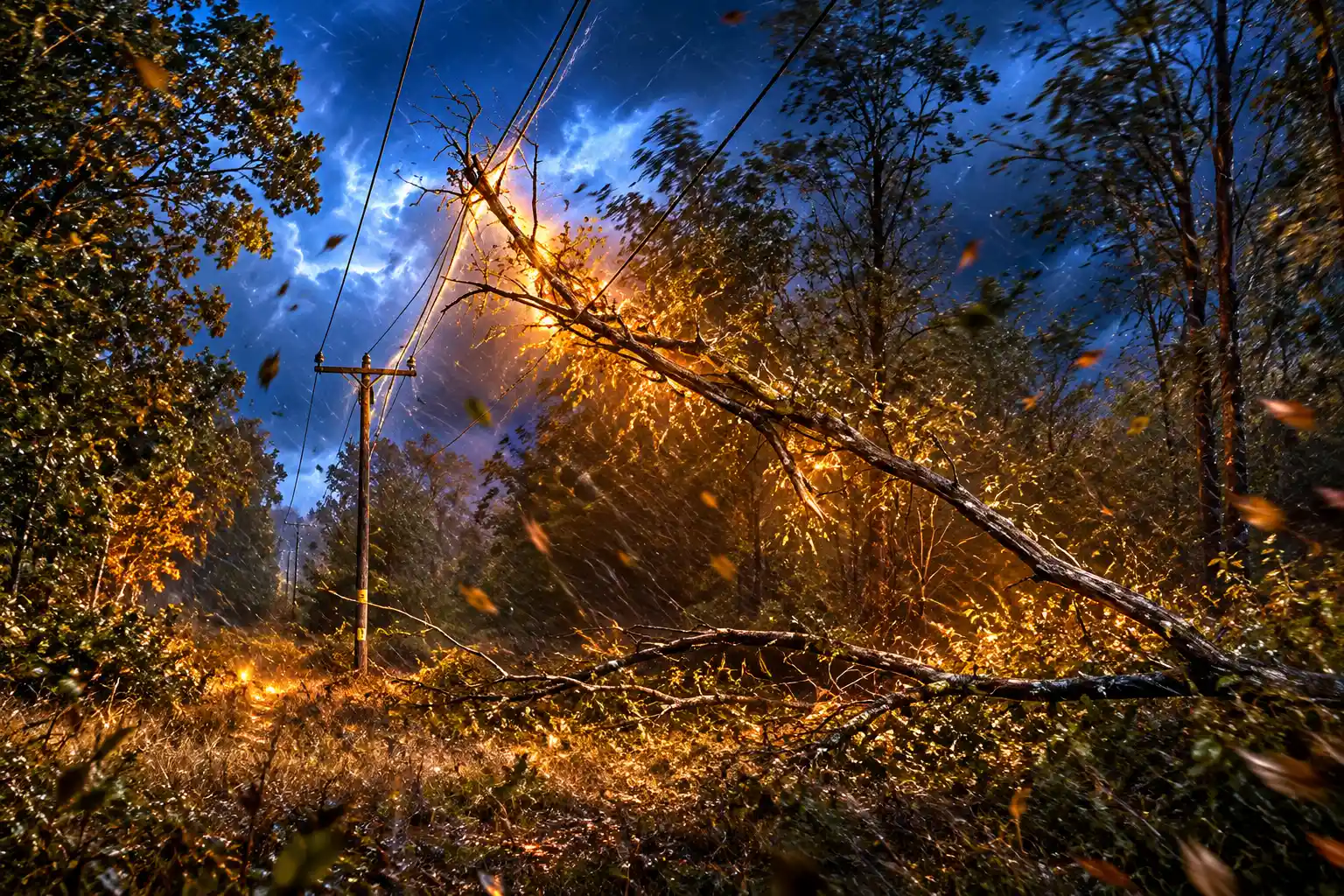
Engineers Could Not Climb Until the Wind Dropped
Slade said there had been no let-up, with winds widely 50-70mph and up to 85mph in northern Scotland. Until that system passed, crews could not safely replace poles or get wires back up.
SSEN’s Sunday evening update described the same bind in operational language. Gusts up to 85mph had torn through the north of Scotland. Control-room staff restored thousands of customers by remote switching, which reroutes power around damaged kit without anyone leaving the ground. The remaining faults sat behind fallen trees, flooded roads and overhead lines that could not be climbed until the wind dropped to a speed where work at height is allowed.
By 19:00 on Sunday, SSEN had restored more than 54,000 customers and still had 38,000 off. It expected the vast majority back on Monday, 26 October, and said it would be Tuesday before every customer hit by Boelo was restored. Extra tree-cutting teams were sent in to clear a path for the linesmen. A welfare operation was held back until Monday morning, when the wind had eased enough for vans to move.
SP Electricity North West told Cumbria and Lancashire the same story in a different accent. High winds made it unsafe for overhead teams to climb poles, so the first wave of restorations was remote switching. Around 100 individual sites still needed physical work on Monday, with extra crews drafted from less-hit networks. Full restoration was quoted at 18:00 on Tuesday, 27 October, described as a worst-case time after earlier storms, when customers asked to be told the late end of the range rather than an optimistic one.
Nik Wheeler, SSEN’s head of customer operations, said teams were trying to reconnect homes before Tuesday’s weather arrived, and that he could not guarantee they would beat it.
How Many Homes Lost Power in Storm Boelo?
The Energy Networks Association said 838,700 properties lost power across Austen and Boelo. That is a hit count, not a snapshot of who was dark at one hour. On Sunday the association still had 161,400 off. By Monday afternoon the remaining figure was 22,600.
Those three numbers are the national spine. Under them, each distributor was running its own clock, and several of them were still quoting Tuesday before the last overhead jobs would be done.
WHERE POWER STILL SAT ON MONDAY
| Network | What it counted | Still off | When |
|---|---|---|---|
| Energy Networks Association | 838,700 properties hit by both storms | 22,600 | Monday afternoon, 26 October |
| SSEN (north of Scotland) | More than 54,000 restored | 38,000 | 19:00 Sunday, 25 October |
| SP Electricity North West | More than 80,000 restored | About 3,000 | Monday, 26 October |
| Northern Powergrid | 138,000 customers hit | 4,400 | 10:44 Monday, 26 October |
| SP Energy Networks | More than 50,000 restored | 1,500, mainly Ayrshire and Dumfries and Galloway | Monday, 26 October |
| NIE Networks | 12,500 at peak | Under 1,000 | Sunday afternoon |
| National Grid (Midlands, south-west, south Wales) | 181,147 hit by both storms | 0 | Monday evening, 26 October |
Northern Powergrid’s remaining 4,400 sat in the North East, Yorkshire and northern Lincolnshire, after 138,000 customers had been hit. SP Energy Networks said the last 1,500 were mainly in Ayrshire and Dumfries and Galloway, and that a very small number would run into Tuesday. NIE Networks had already restored around 11,500 of its 12,500 peak by Sunday afternoon, with Andrew Cupples, head of system operations, hoping the rest would return that night.
The pattern is the same at every scale. Switching brought most people back. The tail was wood, wire, trees and wind.
A Cumbria Factory Lost Its Christmas Window
Marcus Reed, operations director at home fragrance maker Wax Lyrical, said the factory and shop in Lindal, Cumbria, would be without power until Tuesday evening. He had to turn away staff and customers in what he called the busiest stretch of the year before Christmas.
“To lose two days manufacturing and distribution is going to be really disruptive,” Reed said. He called it the worst situation he had seen there. Earlier weekend faults had stayed inside a 12-hour window. This one did not.
On the Ayrshire coast the problem was water, not only wires. Wendy McKinney, whose bathroom shop in Largs flooded on Sunday, said the storm had been devastating to local businesses. She said North Ayrshire Council only put sandbags out after the flooding had started, left on pallets in the street for people to help themselves, “too little too late.” The council said it had handed out almost 300 sandbags in Largs and Saltcoats, followed established resilience procedures, and would look at flooding reports for lessons.
WHAT THE WIND STOPPED
- Wax Lyrical, Lindal: The factory and shop stayed dark until Tuesday evening, with two days of making and dispatch lost in the Christmas run.
- Largs high street: Seawater entered shops on Sunday; sandbags arrived after the flood, not before it.
- Aberdeenshire schools: Five primary schools shut on Monday for lack of power, and Ellon Academy shut because of storm damage.
- Scottish classrooms: Other schools closed for missing heat or water as well as missing supply.
- Vulnerable customers: SSEN sent texts to more than 220,000 people on its priority list before Boelo arrived, then held welfare vans until the wind fell.
Travel stayed messy on Monday. Rail operators ran speed limits. Some Northern services were still warning of disruption into Tuesday, 27 October. The Met Office told coastal towns to expect spray and large waves under the Monday-night yellow warning, with gusts up to 65mph on exposed western coasts, then 50-60mph widely on Tuesday and up to 70mph in the far north of Scotland.
The Curator Walking Near Castle Douglas
Richard Baines, 60, the long-serving curator of Logan Botanic Garden near Stranraer, was struck by a falling tree at about 10:30 on Sunday while walking near his home in Mid Kelton, just outside Castle Douglas. Police Scotland said it was not treating the death as suspicious. A man in his 20s died the same day when a tree hit the car he was driving in north London. Two women were taken to hospital after another falling tree in Aberfeldy, Perth and Kinross.
Logan is one of four Scottish gardens run by the Royal Botanic Garden Edinburgh, warmed by the Gulf Stream and planted with species that would not survive a normal Scottish winter. Baines coined the line that it was “Scotland’s most exotic garden.” Under him it put in the first public conservatory in the UK powered by green energy, won Which?’s Best Garden in the UK in 2021, and took VisitScotland’s five-star visitor-attraction status.
He had a warmth, a genuine sense of humour, he always made time for individuals and that’s one of the tributes that has been said many times this morning. He always found time for his colleagues. And he was always very supportive in providing opportunities for the next generation of horticulturalists. He was a very genuine and warm human being.
David Knott, director of horticulture, Royal Botanic Garden Edinburgh
Knott said Baines led fieldwork in China, the Canary Islands and Vietnam, work from which seven plant species new to science are being published. Dumfries and Galloway MSP Finlay Carson, a former school friend, called him a remarkable gentleman whose work brought credit to Galloway as well as to his trade. The garden sits near Stranraer. The road where he died is on the other side of the region. The storm did not care about that map.
£90 After 48 Hours Does Not Cover a Lost Shift
Slade said the UK network is resilient and that money is already spent to prepare for storms of this kind, then added that a debate is needed on how much more investment is required as climate change brings further storms. That debate will not credit Reed’s two lost production days this week. The rules that do sit on the table are Ofgem’s Guaranteed Standards, and they run on storm categories that are not the Met Office’s amber and yellow warnings. They count how many high-voltage faults a day a storm causes against a normal day.
A category 1 storm is unusually bad weather that causes at least 8 to 13 times more faults than normal. A category 2 storm causes at least 13 times more. Operators then have 24 hours to restore supplies in category 1 and 48 hours in category 2, with the clock starting when the company knows the supply is off, not always when the customer’s lights go.
STORM PAYMENTS UNDER OFGEM RULES
- Category 1: £90 for the first 24 hours off, then £45 for every further 6 hours, capped at £2,235.
- Category 2: £90 for the first 48 hours, then £45 for every further 6 hours, also capped at £2,235.
- Ordinary weather: £100 for a home or £195 for a business after 12 hours if fewer than 5,000 properties are hit, or after 24 hours if 5,000 or more are hit, plus £45 per extra 12 hours, with a £400 cap when 5,000 or more are affected.
- How it is paid: The operator should pay automatically by cheque, cash, bank transfer or a credit through the supplier. You do not need to put a claim in for the standard storm sums.
SSEN added its own hardship layer on top. Customers off for more than 12 hours can claim £30 per person per day for food and drink if they keep receipts. People on the Priority Services Register can claim reasonable costs for other lodging after 24 hours, and if a cut is estimated to run beyond 48 hours that lodging help opens to all customers. None of that restarts a production line that has already missed two days of Christmas dispatch.
A factory that went dark on Saturday night and stays dark until Tuesday evening is living inside the category 2 clock. The first automatic £90 does not fall due until 48 hours have passed from the operator’s notification. Reed’s “worst situation” and Ofgem’s £90 are describing the same hours in different currencies.
A Third Storm Was Already on the Chart
The Met Office had already said unsettled weather would continue into the week, particularly in the north, as another area of low pressure approached, with a wind warning out for northern parts of the UK on Tuesday. SSEN, still working through Boelo’s broken poles, wrote on 25 October that it was already preparing for a third storm in less than a week aimed at the north of Scotland on Tuesday, with more high winds and heavy rain in western and northern regions.
A yellow warning covering western coasts ran from 18:00 on Monday, 26 October, to 03:00 on Tuesday. The next one covers much of Scotland, parts of northern England and Northern Ireland from 03:00 to 23:59 on Tuesday, 27 October. The Met Office has warned that further power cuts are likely in that area, and that people should have torches and batteries ready.
SP Electricity North West’s remaining jobs were still being quoted to 18:00 on Tuesday. SSEN had already told customers it would be Tuesday before every Boelo fault on its network was closed. National Grid’s southern patch was finished on Monday night. The north was being asked to wait through one more wind warning before anyone could swear the last pole was back in the ground.

Gold Prices Fall to a 14-Month Low Despite Strikes

SpiceJet Clears a Rs 5,500 Crore Raise After Mumbai Stalled

Honda Activa’s Record Month Came With a Share Loss

Sony Turns the GTA 6 Launch Into a Firmware Gate

Xiaomi 18 Leak Skips the Rear Screen for Battery

Volkswagen Sells the Osnabruck Plant to Clear a Board Fight

Apple’s Foldable iPhone Hinges on Samsung Display Supply

Saksham Gaur Finds He Is His Own Company’s Client

Tata Motors’ Iveco Tender Opens as Holders Still Decide

What Is SD on Amazon Prime?
-
 AUTO2 months ago
Volkswagen Sells the Osnabruck Plant to Clear a Board Fight
-
 NEWS3 months ago
Apple’s Foldable iPhone Hinges on Samsung Display Supply
-
 BUSINESS3 months ago
Saksham Gaur Finds He Is His Own Company’s Client
-
 AUTO3 months ago
Tata Motors’ Iveco Tender Opens as Holders Still Decide
-
 TECHNOLOGY3 years ago
What Is SD on Amazon Prime?
-

 BUSINESS3 months ago
Hyderabad 22-Carat Gold Jumps After a False Bargain
-

 GAMING3 months ago
Onimusha Way of the Sword Preload Hits a Windows 11 Wall
-

 BUSINESS3 months ago
UltraTech Ultravolt Launch Splits Friday Stocks to Watch