
BUSINESS
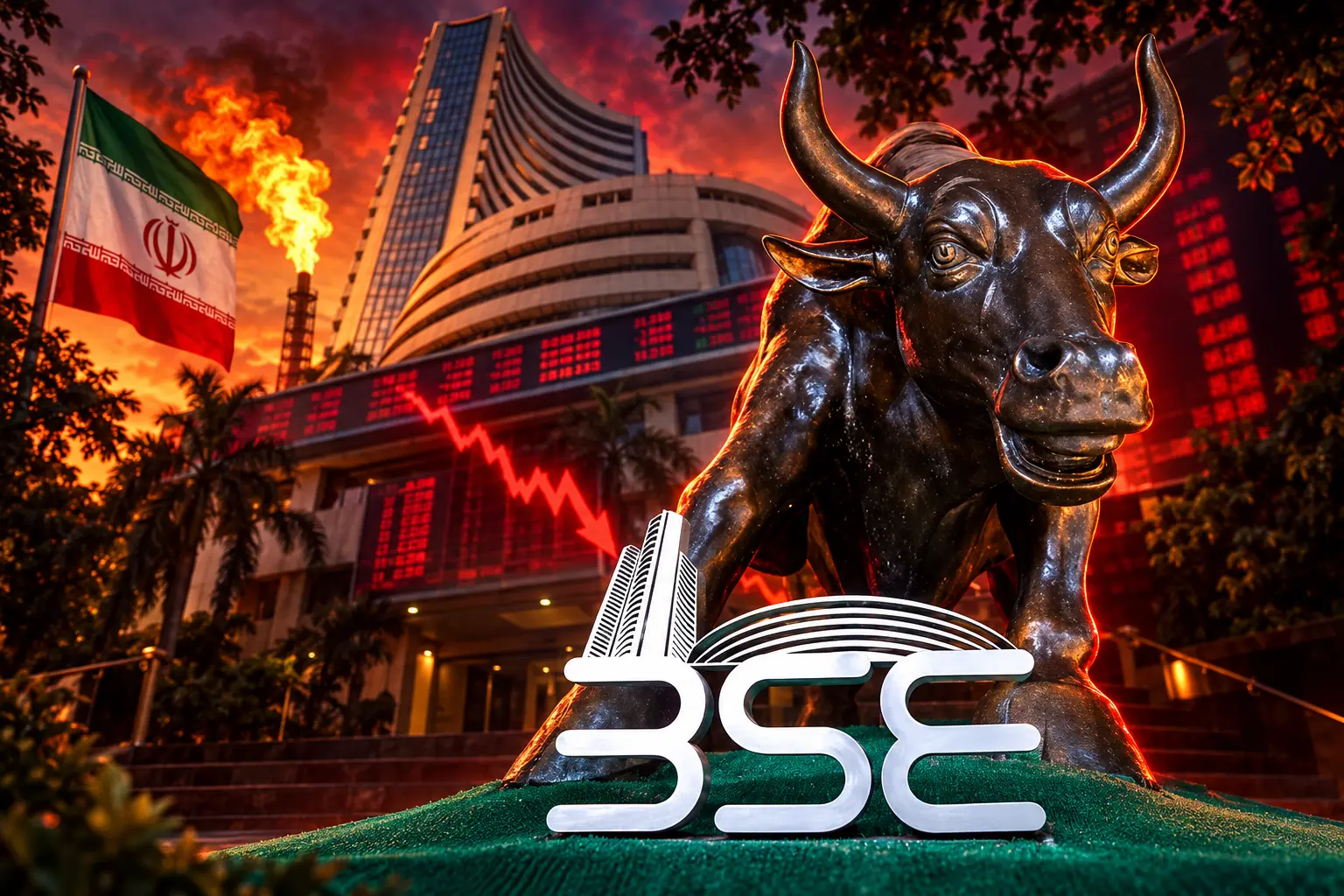
Banks Lead the Sensex 1,000-Point Drop on Oil
The Sensex fell 1,010 points on September 28 as Bank Nifty dropped 1.91%, a faster hit that shows $106 oil is tightening Indian financial conditions.

The BSE Sensex fell 1,009.71 points, or 1.37%, to 72,886.03 on September 28. NSE Nifty 50 traded at 22,823.95, down 316.55 points, also 1.37%.
Nifty Bank dropped faster, down 1,059.45 points, or 1.91%, to 54,520.95. Brent crude sat near $106 a barrel after US President Donald Trump rejected an Iranian plan to reopen the Strait of Hormuz.
Sensex Falls 1,010 Points With Banks in Front
GIFT Nifty futures had already pointed lower before the cash open, at 23,100, down 88.5 points, or 0.38%. The Sensex then opened at 73,734.83, printed a high of 73,740.85, and slid to an intraday low of 72,855.76, only 1,310 points above its 52-week low of 71,545.81.
Around 9:30 a.m., all 30 Sensex members were in the red. By 11:11 a.m. in Mumbai the benchmark was still more than 1,000 points below Friday’s close of 73,895.74. India VIX jumped 1.83 points, or 15.05%, to 13.99 as hedges were bid.
THE MORNING TAPE
| Index | Level | Change | % change |
|---|---|---|---|
| BSE Sensex | 72,886.03 | -1,009.71 | -1.37% |
| NSE Nifty 50 | 22,823.95 | -316.55 | -1.37% |
| Nifty Bank | 54,520.95 | -1,059.45 | -1.91% |
| India VIX | 13.99 | +1.83 | +15.05% |
Friday had closed with a rebound, the Sensex up 315.20 points, or 0.43%, and the Nifty up 77.40 points, or 0.34%, to 23,140.50. That bounce did not hold once oil turned higher again.
Why Bank Nifty Dropped Faster Than the Sensex
The oil headline is real. The leadership on the tape is not an oil stock. Early Sensex laggards were lenders and finance names, the same group that sets loan rates, credit growth and the cost of money when inflation risk rises.
EARLY SENSEX LAGGARDS
- Bajaj Finance: 979.20, down 1.59%.
- Kotak Mahindra Bank: 397.00, down 1.59%.
- HDFC Bank: 725.10, down 1.45%.
- Bajaj Finserv: 1,744.80, down 1.37%.
- Mahindra & Mahindra: 2,991.90, down 1.30%.
Hindustan Unilever, Larsen & Toubro, Bharat Electronics, Titan and Eternal also traded lower in that first half hour. Later in the session HDFC Bank was still the largest single drag on Nifty Bank, with ICICI Bank, State Bank of India, Kotak Mahindra Bank and Axis Bank close behind.
That mix is the oil shock working through the rupee and the rate path. Higher crude lifts India’s dollar bill, the rupee softens, foreign money leaves, and banks are marked down first because they sit on both credit risk and bond books. Traders already treat Bank Nifty as the oil lever: when crude cools, the bank index is the first place they look for a bounce, and when crude jumps they sell it harder than the Nifty 50.
Trump Rejected the Hormuz Reopening Plan
Brent rose about 1.5% to around $106 a barrel in the Monday session after Trump said on Saturday, September 26, that he had rejected Iran’s latest proposal. Iran had put a seven-day plan to reopen the Strait of Hormuz to the United States through Qatari mediators at the UN General Assembly. Trump told an interviewer on Sunday, September 27, that he still expected talks later in the week of September 28.
If certain conditions are met, the Strait of Hormuz will be open at the end of seven days, and talks will be restarted.
Abbas Araghchi, Iranian foreign minister, at the UN General Assembly
Trump said the United States already had “total control of the strait, with massive amounts of oil passing through it.” Iran’s conditions still included an end to what Tehran calls US acts of aggression, a lift of the naval blockade, and the release of Iranian assets.
SEVEN MONTHS FROM THE FIRST STRIKES
- February 28, 2026: The United States and Israel launch strikes on Iran, and routine traffic through Hormuz breaks down.
- June 17, 2026: Washington and Tehran sign a memorandum aimed at resuming shipping; prices ease, then military strikes resume.
- September 9, 2026: Brent crosses $100 a barrel again as talks stall.
- September 25, 2026: Indian benchmarks close a seventh straight down week, their longest such run since 2020.
- September 28, 2026: Trump’s rejection puts $106 oil back on the Indian open.
The US Energy Information Administration’s chokepoint note still puts pre-war traffic at 20.9 million barrels a day through Hormuz in the first half of 2025, about a fifth of world petroleum liquids use, with 89% of the crude and condensate bound for Asia. Kpler’s September reading had Hormuz flows recovering toward about 7.4 million barrels a day, and Middle East crude exports at 12.8 million barrels a day, the highest since the war began. That is a rebound from the worst weeks. It is still a long way from 20.9 million.
Foreign Funds Sold ₹11,490 Crore Last Week
The cash market did not wait for a new war headline. Foreign investors have been selling through the secondary market for weeks, and domestic institutions have been the bid. On Friday, September 25, they were net sellers of ₹3,693.93 crore across NSE, BSE and MSEI, against domestic net buying of ₹2,838.17 crore, so only about 77% of that day’s foreign sale was absorbed.
THE FLOW LEDGER
| Period | FII / FPI net | DII net |
|---|---|---|
| Friday, September 25 | -₹3,693.93 crore | +₹2,838.17 crore |
| Week of September 21-25 | -₹11,490 crore | +₹16,398 crore |
| September to September 25 | -₹18,531 crore | +₹52,617 crore |
Domestic funds bought almost three rupees for every rupee foreigners sold in September, and they more than covered the week’s foreign sale. The Nifty still fell 0.88% for the week, and the Sensex fell 0.54%, or 399.22 points, after a 205.9-point drop in the Nifty. Provisional data put foreign selling for 2026 at $25.86 billion.
That is the tell. When domestic buying outruns foreign selling and the index still drops for a seventh week, the tape is pricing something larger than a one-day order imbalance. It is pricing a weaker rupee, a fatter oil bill, and a Federal Reserve that has already raised rates, with the US 10-year yield near 5.2%.
The RBI Is Holding the Rupee Near 96
The rupee opened at 95.89 against the dollar on September 28 and slipped to 95.95, down 20 paise from Friday’s close of 95.75. The dollar index was at 101.11, up 0.15%.
THE RUPEE AND THE RESERVE BUFFER
- Spot print: 95.95 per dollar in early trade, 20 paise weaker than Friday’s 95.75 close.
- The 96 line: Anil Kumar Bhansali, head of treasury at Finrex Treasury Advisors, said the Reserve Bank of India is holding 96.00 and he saw a 95.50 to 96.00 range.
- Reserves: The RBI’s weekly statistical supplement showed reserves of $765.901 billion as on September 18, down $14.881 billion in a week.
- The 2026 slide: RBI Deputy Governor Poonam Gupta said the rupee was down nearly 7% against the dollar in 2026.
Foreign currency assets, the bulk of the reserve pile, fell $14.816 billion to $630.980 billion in that week. Gold rose $68 million to $111.292 billion. Reserves had touched a record $785.71 billion in the week ended September 5 after heavy inflows under the RBI’s FCNR(B) swap window, which Gupta put at nearly $133 billion of $143.5 billion in scheme inflows by September 18. The window was shut a month early. The later-September oil spike then reversed those rupee gains.
West Asia tensions and high crude oil prices caused the Indian rupee (INR) to depreciate for most of August. Strong FCNR(B) deposits led to brief recoveries in early September, but these gains reversed in the later part of the month on account of higher crude oil prices.
Poonam Gupta, Deputy Governor, Reserve Bank of India, in the RBI bulletin
Bhansali said Brent held above $100 and still posed a threat to the import bill and to reserves even with the central bank at the 96 line. A weaker rupee raises the rupee cost of every imported barrel, which is why bank stocks, not upstream oil names, led the Sensex lower.
India’s Crude Bill Is Already Up 48 Percent
India imports more than 88% of the crude it burns. The Oil Ministry’s Petroleum Planning and Analysis Cell put the April-August import bill of $74.8 billion, up 48.4% from a year earlier, even as volumes slipped 0.4% to 100.7 million metric tons from 101.1 million. That is an extra $24.4 billion for almost the same oil.
The Indian crude import price averaged $114.80 a barrel in September to the date of that PPAC print, against a basket average of $100.75 for the month so far, $90.19 in August and $82.04 in July. ICRA, earlier in September, estimated oil marketing companies were under-recovering about Rs 23 a litre on diesel, Rs 5 on petrol and Rs 200 on each domestic LPG cylinder while pump prices stayed frozen.
Those losses do not stay at the fuel retailer. They leak into the fiscal math, into inflation prints the monetary policy committee has to read, and into the credit cycle banks are being priced for. Sensex is 15.41% below its 52-week high of 86,159.02. For 2026 it is down 13.29%, with the Nifty down 11.44%, before Monday’s drop is counted in the year-to-date totals that closed Friday.
Ajit Mishra, senior vice president for research at Religare Broking, said the next swing still sits with diplomacy and crude, and that industrial production for August, the HSBC manufacturing PMI, foreign flows and monthly auto sales would set the domestic tone in the week of September 28.
Globally, developments around US-Iran diplomacy and crude oil prices will remain critical. Any progress on a framework for reopening the Strait of Hormuz could ease energy prices and provide some relief to India’s import bill and the rupee, while renewed geopolitical tensions could keep volatility elevated.
Ajit Mishra, SVP Research, Religare Broking
Nifty had been defending the 23,000 zone into Friday. Monday’s print put it at 22,823.95, with traders marking 22,800 as the next shelf. Bank Nifty, already down 1.91% on the day and 3.46% on the week, is where that oil-to-money transmission will show up first if $106 crude holds.
Disclaimer: This article is news reporting and analysis of market moves, oil prices and currency prints, and it is for information only. It is not investment advice, a recommendation to buy or sell any security, currency or commodity, or a forecast of returns. Readers should consult a SEBI-registered investment adviser or a qualified financial professional before acting on any market view. Index levels, flow figures and oil prices reflect the sources as dated in the piece and will change as sessions, revisions and talks move on.

Edinburgh Opens a 2027 Tour Built for Time Trials

Korda Maps Auður From Meðalland to Irvine Bay

Apple Music Films Its New Logo in Mineral Oil

Oppo Prices the Pad Mini Above India’s iPad Mini

Austen Soaks Scotland Before Boelo Brings Weekend Gales

Volkswagen Sells the Osnabruck Plant to Clear a Board Fight

Apple’s Foldable iPhone Hinges on Samsung Display Supply

Saksham Gaur Finds He Is His Own Company’s Client

Tata Motors’ Iveco Tender Opens as Holders Still Decide

Onimusha Way of the Sword Preload Hits a Windows 11 Wall
-
 AUTO2 months ago
Volkswagen Sells the Osnabruck Plant to Clear a Board Fight
-
 NEWS2 months ago
Apple’s Foldable iPhone Hinges on Samsung Display Supply
-
 AUTO2 months ago
Tata Motors’ Iveco Tender Opens as Holders Still Decide
-
 BUSINESS2 months ago
Saksham Gaur Finds He Is His Own Company’s Client
-
 GAMING2 months ago
Onimusha Way of the Sword Preload Hits a Windows 11 Wall
-

 ENTERTAINMENT3 years ago
What is SD on Amazon Prime? – All You Need to Know
-

 BUSINESS2 months ago
Hyderabad 22-Carat Gold Jumps After a False Bargain
-

 NEWS2 months ago
iQOO 16 Locks 8,400 mAh While 100W Charging Holds