
BUSINESS
Scotland’s Land Register Still Maps Only 62.4% of Land
After the missed 2024 deadline, only 62.4% of Scotland is on the Land Register. Higher plans-report fees now hit the titles still stuck in Sasines.

Registers of Scotland still has only 62.4% of the country’s land on the map-based Land Register, after missing a 2024 completion date set by ministers. The rest is not a rounding error. It is farms, estates, islands and older titles that rarely sell, still sitting in the deeds-based General Register of Sasines.
Plans-report fees rose on 19 August 2025, and that increase is now being used to nudge owners toward voluntary registration. The sharper problem is how “almost complete” is counted, and who pays when the leftover land finally moves.
Only 62.4% of Scotland Is on the Land Register
The Land Register plots each title on current Ordnance Survey mapping and gives the keeper’s warranty over what that title says. The General Register of Sasines, opened in 1617, records deeds in writing. You can still own land on that older register. You just cannot point to a single modern map polygon and call it finished.
Most titles reach the new register when a property is sold. Voluntary registration is the other door: the last recorded Sasines owner applies with no sale, so the plot is mapped before the next deal. Registers of Scotland says that step clarifies boundaries, carries a state-backed warranty, and makes later deals over scattered ground cheaper to run. It also asks owners to fund a public map that sales alone will not finish.
Jennifer Henderson, Keeper of the Registers of Scotland and chief executive, runs a body that is answerable to the Scottish Parliament, not to a minister in daily charge. That matters when the completion date slips, because the pressure lands on owners, solicitors and the keeper’s own case piles rather than on a single cabinet timetable.
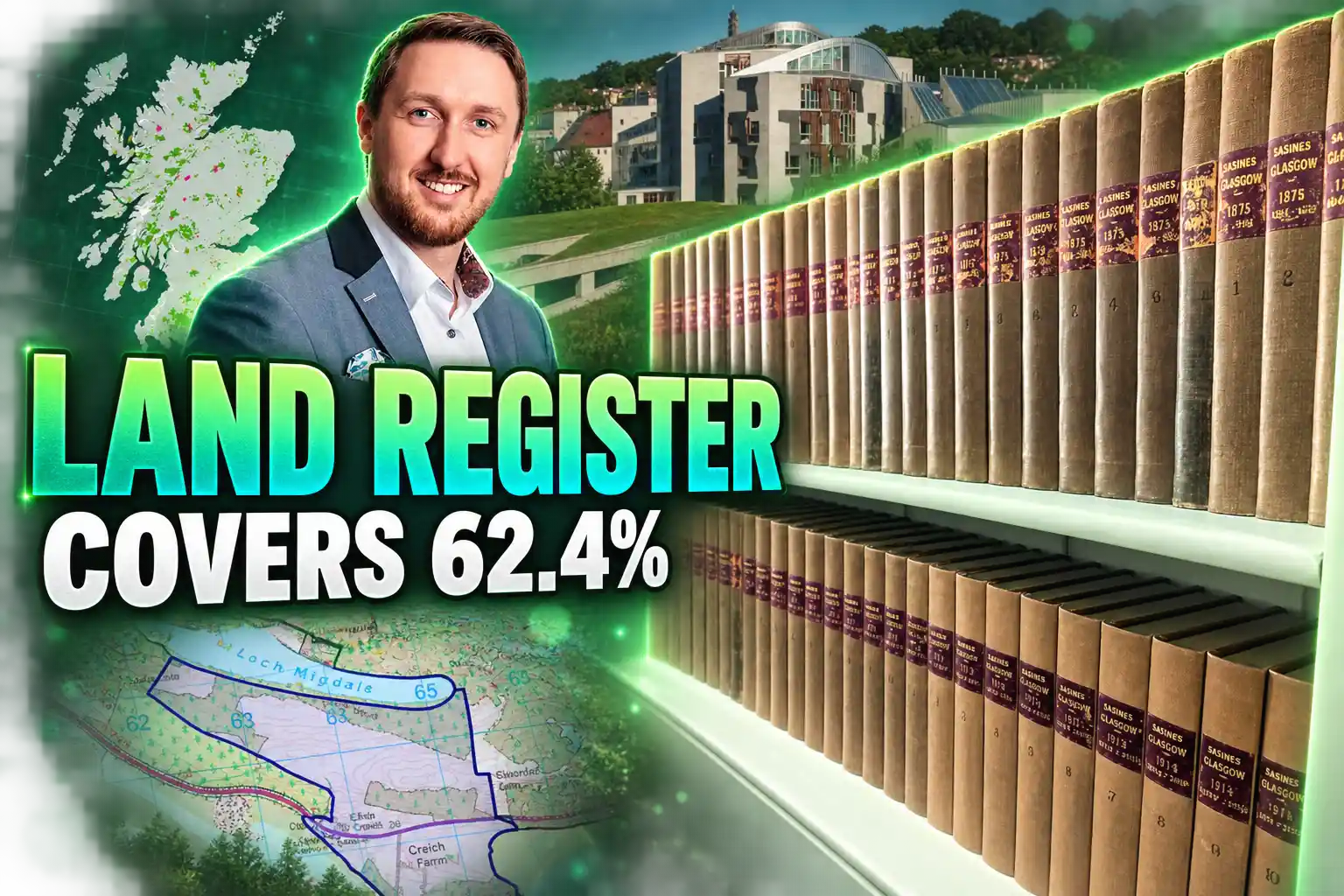
How Registers of Scotland Counts 96.1% Coverage
The figure people hear is 96.1%. The figure that describes a finished map is 62.4%. Registers of Scotland builds the larger number by stacking three different things and calling the stack total land coverage.
THE AUGUST 2026 COVERAGE STACK
- On the register: 62.4% of land mass on the Land Register, up from 62.1% in July 2026.
- In the queue: 2.9% is casework in progress at Registers of Scotland, unchanged on the month.
- On an indicative layer: 30.8% is Indicative Sasines, down from 31.1% in July 2026, which is a mapped guess at older deeds rather than a registered title.
- The headline total: those three layers add to 96.1% in both months.
Indicative Sasines is useful. It is not the Land Register. The Scottish Land Commission treats that product as the first spatial view of Sasines titles, a way to see likely ownership until a proper title sheet exists. Progress toward a “functionally complete” register, which is a different test based on addresses that regularly change hands, stood at 88.3% in August 2026.
Functional completion leaves out land that rarely or never sells, including social housing and some large estates. That is why a housing market can feel mapped while a huge share of the country, by area, is still a deeds problem.
Ministers Wanted the Map Finished by 2024
The Land Registration (Scotland) Act 1979 started the modern register. The Land Registration etc. (Scotland) Act 2012 added the tools meant to finish it, including voluntary registration and keeper-induced registration. In May 2014, ministers invited the keeper to complete the Land Register by 2024.
THE DATES BEHIND THE 62.4%
- 1617: The General Register of Sasines opens as a public deeds register.
- 1979: The Land Registration (Scotland) Act creates the map-based Land Register.
- May 2014: Ministers invite the keeper to finish the Land Register by 2024.
- January 2019: Keeper-induced registration is paused for privately owned properties.
- 2022: Registers of Scotland changes its strategic aim from completing the land register to delivering the benefits of a completed land register.
- 2024: The 100% completion date passes with the map still open.
- 19 August 2025: Plans-report fees rise and Level 2 reports are withdrawn.
- August 2026: 62.4% of land mass is on the Land Register.
Lorna Slater, MSP for Edinburgh Central, asked in June 2026 whether missing that date was holding up housing, infrastructure, community ownership and planning data. Hannah Mary Goodlad, answering for the Scottish Government on 29 June 2026, said full completion still needed the people whose land remains in Sasines.
Full completion of the Land Register remains an important objective requiring the input of the Registers of Scotland and, critically, those who own land which is still in the General Register of Sasines.
Hannah Mary Goodlad, Scottish Government, parliamentary answer, 29 June 2026
In 2022 Registers of Scotland had already moved the goalposts in public. Completing every last plot was no longer the stated aim. Delivering the benefits of a completed register was. Keeper-induced registration, which lets the keeper move a Sasines title onto the map without an owner’s application, had already been paused for private homes in January 2019 after a run at public stock and some urban streets. The leftover work is voluntary, or it waits for a sale.
Plans Report Fees Jumped in August 2025
A plans report is the pre-check before a first registration. It tests whether a deed plan meets the keeper’s rules and whether the plot collides with titles already on the cadastral map. On 4 August 2025, Henderson’s monthly update said the service was being repriced from 19 August 2025 “to ensure a sustainable, excellent service,” with Level 2 withdrawn and standard turnaround cut to three working days.
PLANS REPORT FEES FROM 19 AUGUST 2025
| Report | Before 19 August 2025 | From 19 August 2025 |
|---|---|---|
| Basic (old Level 1) | £65 plus VAT | £110 plus VAT |
| Standard (old Level 3) | £95 plus VAT | £160 plus VAT |
| Level 2 | Offered | Removed |
The current product list uses Basic and Standard, not the old Level 1 to Level 3 labels. A basic plans report at £110 plus VAT confirms whether the plan meets the keeper’s deed-plan rules and lists conflicting cadastral units, with no plan drawn. A standard report at £160 plus VAT adds illustrative prints of conflicts, shared areas and any mismatch with the Ordnance Survey map. If the evidence is too thin, Registers of Scotland still charges the basic fee.
A same-day fast-track service, trailed in that August 2025 note for early autumn, is now on the plans-reports page. Fast-track requests can be filed on a weekday after midnight and before 10am, and accepted jobs are meant to be done before 5pm. RoS lists a fast-track basic report at £195 plus VAT and a fast-track standard report at £295 plus VAT. Continuations are free. VAT is payable on the service fees.
Those sums are the public tariff. They are not the bill that decides whether a farm or a tenement stair actually gets mapped.
Shetland, Moray and the Land that Never Sells
Completion is not even across the map. Registers of Scotland says the register was rolled out in stages, that social housing and large rural estates change hands less often, and that local markets move at different speeds. July 2026 local figures show where the remaining Sasines land sits.
LAND REGISTER SHARE BY AREA, JULY 2026
| Local authority | On the Land Register | Still Indicative Sasines |
|---|---|---|
| Shetland Islands | 29.0% | 49.9% |
| Orkney Islands | 46.6% | 36.6% |
| Moray | 47.3% | 45.5% |
| Highland | 60.2% | 34.4% |
| Glasgow City | 69.0% | 13.3% |
| North Lanarkshire | 80.9% | 10.5% |
Shetland’s 29.0% land-register share is the lowest in that set. Moray still has 45.5% of its area on the indicative Sasines layer. Highland can look “done” on the 96.7% composite and still have only 60.2% on the real register. Glasgow is the other way round: 69.0% on the Land Register and a much thinner Sasines remainder, because the leftover problem in cities is smaller on the ground even when address gaps remain.
That split is why a voluntary-registration drive is not a suburban product pitch. The titles that would finish the map are the ones with old deed plans, shared access, utilities across a march fence, and neighbours who have already been plotted. Once those neighbours are on the cadastral map, a late first registration has more lines to hit and more conflicts to argue.
From 17 November 2026, National Records of Scotland says requests for sasine deeds after 1869 should go to Registers of Scotland, which already holds primary access. The old register is still a working system, not a museum shelf.
First Registrations Still Miss the 35-Day Mark
Registers of Scotland is faster on work that is already on the map. It is slow on the work that would finish the map. In August 2026 it completed 84.1% of land-register applications within 35 working days. Dealings of whole, which move an existing registered title, accounted for 24,267 of those quicker files and 2,308 of the slower ones.
First registrations went the other way. Of the 2,035 first registrations completed that month, 900 were done in 35 working days and 1,135 took 36 days or more. Transfers of part, another job that often needs a new cadastral unit, were slower still. Open land-register applications stood at 71,434 in August 2026. The oldest open case dated from January 2020.
RoS says a first registration needs a new entry, usually from a more experienced colleague, and that those files are processed in order. Land that has not been sold or remortgaged for a long time, or that was carved from a larger plot, takes longer. Voluntary registration is a first registration by another name. Paying extra for a plans report does not move the file to the front of that queue.
A 25% Discount Does Not Cover the Solicitor
Registers of Scotland still prices voluntary registration at a 25% discount for voluntary registration against the standard table, on the value of the plot. Up to £50,000 the keeper’s fee is £60, against £80 on a transfer. Over £5,000,000 it is £6,190, against £8,250. If a standard security over the whole plot is registered on the same day, the voluntary fee can fall to nil and the security is charged at £80. A solicitor’s fee sits on top, and RoS “strongly recommend[s]” using one, even though the law does not require it.
WHAT A VOLUNTARY FIRST REGISTRATION ACTUALLY COSTS
- Keeper’s tariff: the discounted voluntary band, from £60 to £6,190, set by the value of the land.
- Plans report: £110 or £160 plus VAT, or the fast-track rates if the plan has to be tested in a day.
- Solicitor time: the large line, because someone has to read the deeds, fix the plan and take on the 2012 Act duty to keep the register accurate.
- Deed copies: land researcher and former MSP Andy Wightman notes a Land Register search at £3.60, while a Sasines search at the same price can still mean ordering deeds at £30 each.
People who have had to get paper titles to Meadowbank-era registers already know which line hurts. One recent complaint put a solicitor’s charge at £460 simply to send deeds in electronically, after the firm said the file had to be read first. Replies pointed out that registered post is available, and that the invoice also covers letters and copies. The plans-report rise from £65 to £110 plus VAT is real. It is not the reason a hill farm stays off the map.
What voluntary registration still buys is time and sequence. You pick the moment to map a boundary instead of discovering a clash in a sale. Leasehold ground, a housing association’s stock, or a farm with rights running over a neighbour are the cases where a title sheet is worth the solicitor. The keeper’s discount is an incentive, not a price for the whole job.
The 2024 date is gone. The 96.1% coverage line is a composite, and 30.8% of Scotland by area is still an indicative drawing of older deeds. Fees for the pre-check went up on 19 August 2025, and first registrations in August 2026 still ran longer than the 35-day window more often than not. Anyone left in Sasines is mapping into a tighter cadastral map than the one that faced the first wave of urban titles, and the people who own that leftover ground are the ones the 2014 promise now depends on.
Disclaimer: This article is news reporting and analysis of Registers of Scotland fees, coverage figures and voluntary registration. It is informational only and is not legal advice, conveyancing advice or a recommendation to register or to delay registration of any property. Readers who are thinking about a first registration, a plans report or a title dispute should consult a solicitor qualified in Scots property law, and where a plan is in issue a chartered surveyor, before spending money or filing an application. Fees, turnaround times and coverage percentages are those published by the cited bodies for the dates given and can change.

TCS Opens Q2 as Mid-Cap IT Keeps the Growth

Bitcoin’s Jobs Rally Fails While December Hike Odds Hold

The Heat Turn a Bucks Rematch Into Vice City Night

The G7 Opens Diesel Tanks While Carriers Head East

Kia Bets Fortuner Money on a Made-in-India Sorento

Volkswagen Sells the Osnabruck Plant to Clear a Board Fight

Tata Motors’ Iveco Tender Opens as Holders Still Decide

Saksham Gaur Finds He Is His Own Company’s Client

Onimusha Way of the Sword Preload Hits a Windows 11 Wall

The Frame Pro’s $1,200 Labor Day Cut Needs a Soundbar
-
 AUTO4 weeks ago
Volkswagen Sells the Osnabruck Plant to Clear a Board Fight
-
 AUTO1 month ago
Tata Motors’ Iveco Tender Opens as Holders Still Decide
-
 BUSINESS1 month ago
Saksham Gaur Finds He Is His Own Company’s Client
-
 GAMING1 month ago
Onimusha Way of the Sword Preload Hits a Windows 11 Wall
-
 NEWS4 weeks ago
The Frame Pro’s $1,200 Labor Day Cut Needs a Soundbar
-

 NEWS1 month ago
Apple’s Foldable iPhone Hinges on Samsung Display Supply
-

 BUSINESS1 month ago
SEBI Reopens How F&O Settles After the Closing Auction
-

 BUSINESS1 month ago
The Rs 4.66 Lakh Crore IPO Queue Is Mostly Paper