
BUSINESS
Noel Tata Warns a Listing Would Reorder the Tata Way
Noel Tata says listing Tata Sons could put profit over philanthropy, three days after fellow trustees argued foundation-owned listed firms keep their character.

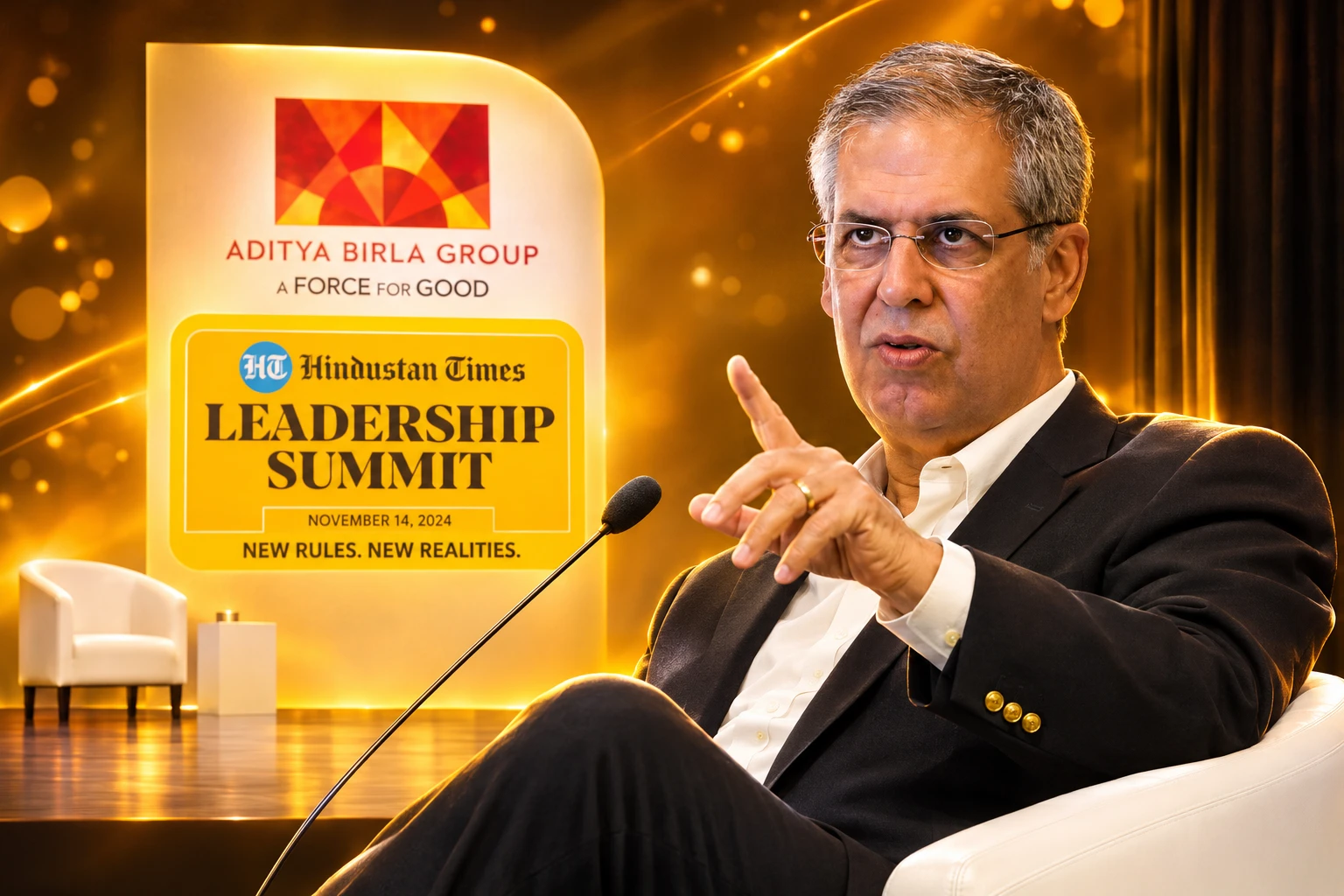
Noel Tata told a New Delhi audience on November 14 that listing Tata Sons could put profit ahead of philanthropy. The Tata Trusts chairman said 30,000 to 40,000 new shareholders might one day reverse a rule he treats as sacred: charity owns commerce.
Three days earlier, his own vice-chairmen had written that a listing would leave the Trusts’ shares, dividends and charitable spending untouched. The Tata Sons board meets on November 26 with both versions of that argument on the table.
Noel Tata Warns a Listing Would Reorder Tata Sons
Speaking at the 24th Hindustan Times Leadership Summit, in conversation with Suhel Seth, Noel framed Tata Sons as a holding company whose profits exist to be given away. “The whole essence of Tata Group today is that 66% of profits of Tata Sons are used for philanthropic causes. That is unique in the world,” he said. He added, “Charity precedes commerce. Charity owns commerce. It’s not the other way around.”
My worry is that listing, which is what some people are proposing, will change the Tata way. And one day, if we have 30,000-40,000 shareholders, profit may take precedence over philanthropy. And I think that will fundamentally change the Tata way of working.
Noel Tata, chairman, Tata Trusts, 24th Hindustan Times Leadership Summit, New Delhi
He reached for permanence. “The owner cannot die, the owner cannot be bought, and the owner cannot retire. So there is a continuity in what happens in the Tata way.” Dividends from listed Tata companies, he said, become hospitals, flood relief and schools, “year on year, by design.” He asked why anyone would tinker with a structure that had “delivered such value for 150 years.”
The public line matches a private one he took in September, when Tata Trusts said they had not agreed to a float and asked the Tata Sons board to explore options other than listing. Noel told that board a listing would “destroy its character and strike at the heart of this principle.” On November 14 he promised the Trusts would “play a constructive role with regulators and others to try and find a solution which keeps the Tata way the way it is.”
He also sketched a philanthropy programme meant to show what those dividends buy: a planned network of 40 to 50 not-for-profit general hospitals in underserved districts, sited near cities large enough to attract doctors. Direct grants, he said, sit beside a second Trusts job, backing Tata Sons on “projects of national importance,” including a first semiconductor plant and a first electric-vehicle battery factory.
The Five-Page Rebuttal Inside Tata Trusts
That is not the view of the whole house. On November 11, vice-chairmen Venu Srinivasan and Vijay Singh sent a five-page letter to senior advocate Darius Khambata, copied to every trustee, including Noel. Khambata, whose term at the Sir Dorabji Tata Trust and Sir Ratan Tata Trust ended on November 9, had written on November 2 that a listing would be “existential” for the Tata model and had described the September 17 Tata Sons board as “a day that will live in infamy.”
Srinivasan and Singh called his account “incomplete in several material respects.” They asked whether the worry was the Tata model or “the preservation of control over Tata Sons by the present leadership of Tata Trusts.” Where control becomes an end in itself, they wrote, questions arise about trustees’ fiduciary duties.
The Trusts would remain shareholders of Tata Sons before and after listing, and their shareholding, dividends and the philanthropy those dividends fund would be unaffected.
Venu Srinivasan and Vijay Singh, vice-chairmen, Tata Trusts, letter dated November 11, 2026
They pointed to Novo Nordisk, Hershey, Lundbeck and Demant, foundation-anchored companies that trade in public markets. Closer to Bombay House they named Tata Consultancy Services, Tata Steel, Tata Power and Tata Motors, listed firms that have still made long, nation-building bets. “An institution’s character is preserved by the quality of its governance and accountability, not by its listing status,” they wrote. The threat, in their closing, was “the weakening of collective governance, the concentration of authority in a few individuals, and the erosion of the institutional independence that Ratan Tata spent a lifetime building.”
The letter also reopened the chair. On July 28, 2025, trustees of the two main trusts unanimously recommended a fresh five-year term for N Chandrasekaran, Tata Sons executive chairman since 2017. Khambata, they said, drafted that resolution. The proposal was deferred in February 2026. After about seven months of silence, Chandrasekaran said he would not seek reappointment after February 2027. The nomination committee asked him to reverse that, and on September 17 the board did, by a 4:1 vote. Noel was the no. Srinivasan, the other Trusts nominee in the room, voted yes. Noel left the Bombay House meeting. The company announced the resolution within an hour.
Tata Sons has since refused Noel’s request for the audio-video file of that sitting. In a November 9 letter, company secretary Suprakash Mukhopadhyay said recordings of in-person meetings are an aid to minutes, not a record the company shares with directors. Draft minutes went up on October 1. The Registrar of Companies was told of the reappointment under Section 117 of the Companies Act.
Why the Reserve Bank Closed the Private Door
The listing fight is not a free philosophical choice. Tata Sons is a core investment company. In September 2022 the Reserve Bank of India placed it in the upper layer of non-banking financial companies, a tag that, under the bank’s governance directions, requires an NBFC-UL to be listed within three years of identification. The original deadline was September 30, 2025. Tata Sons is still private.
The group tried to step off the register. Talks with the central bank began in 2023. After paying down more than ₹21,000 crore of debt, Tata Sons applied in March 2024 to surrender its CIC registration, arguing it no longer used public funds. The application sat for two years. On June 24, 2026, the RBI simplified the upper-layer test to a flat asset floor of ₹1,00,000 crore and kept a listing exemption only for upper-layer NBFCs that are fully owned and controlled by government. Tata Sons is not one of those.
THE PATH THAT RAN OUT
- September 2022: The RBI places Tata Sons in the upper layer and starts a three-year listing clock.
- March 2024: After paying more than ₹21,000 crore of debt, Tata Sons applies to surrender its core investment company registration.
- September 30, 2025: The original listing deadline passes with the holding company still unlisted.
- August 6, 2026: The RBI names Tata Sons Private Limited ninth on the 2026-27 upper-layer list, as a core investment company, without prejudice then to the pending application.
- September 11, 2026: The RBI rejects the surrender bid and tells Tata Sons to comply with upper-layer rules, including listing.
- September 17, 2026: The Tata Sons board starts listing steps and, by a 4:1 vote, gives Chandrasekaran a new five-year term.
On August 6 the central bank published its 2026-27 upper-layer roster against March 31, 2026 financials. Tata Sons Private Limited sits ninth on the upper-layer NBFC list, among 17 names, with Tata Capital Limited one slot above it. Once in the layer, an NBFC stays under the enhanced rules for at least five years even if it later misses the size test. Srinivasan and Singh told Khambata the two-year review was a regulator’s verdict, not a failure of advocacy, and that “meaningful” lobbying for special treatment would not fit the Tata ethos.
An 18.37 Percent Stake Tied to Costly Debt
The public argument is philanthropy. The shareholder who has pushed hardest for a float needs cash. The Shapoorji Pallonji Group holds 18.37 percent of Tata Sons through Sterling Investments Corporation and Cyrus Investments, a stake it has pledged against borrowings. In July it refinanced ₹21,500 crore, including about ₹15,200 crore of three-year zero-coupon rupee bonds at a yield of 18.95 percent and a $650 million bond at 14.5 percent. Its borrowing cost sits around 18 to 19 percent. It wants that nearer 12 percent.
An investor note circulating in September put a look-through value of about ₹2.3 lakh crore on the holding. Paper value is not rupees in a bank. Before the RBI’s September 11 letter, Noel tabled a Shapoorji proposal for Tata Sons to buy enough of those shares to raise at least ₹25,000 crore in two tranches over 18 months, priced under Rule 11UA of the Income Tax Rules, as a way to stay private. After the RBI closed that hope, Shapoor Mistry, the SP Group chairman, called a listing a “social and moral imperative.”
THE MONEY UNDER THE PHILOSOPHY
| Item | Figure |
|---|---|
| SP Group stake in Tata Sons | 18.37 percent |
| Cash sought from a part-exit | ₹25,000 crore |
| July 2026 refinancing | ₹21,500 crore |
| Yield on the main rupee bonds | 18.95 percent |
| Dollar bond in the same package | $650 million at 14.5 percent |
A listing would give that stake a market price and a path to sell. A buyback would do the same job without 30,000 new names on the register. Either way, the Trusts’ dividend stream is not the item being refinanced. The pledged minority is. That is why the loudest objection to Noel’s philanthropy warning is arithmetic, not sentiment: charity funded by dividends does not require Tata Sons to stay unlisted. A private veto, and a locked 18.37 percent, do.
November 26 Puts Two Escape Plans on the Table
Noel has asked for both routes to come back on November 26. In late October he wrote to Mukhopadhyay, as any director may with 15 days’ notice, seeking a vote on a business reorganisation and a report on the Shapoorji cash plan. The two largest trusts had already sent the reorganisation note on September 26, after the RBI rejection.
The plan is to amalgamate Tata Electronic Systems and Tata Consulting Engineers into Tata Sons Private Limited. The bet is that an operating company, rather than a pure investment vehicle, might slip the core-investment-company box that pulled Tata Sons into the upper layer. Whether the RBI would accept that redesign is an open regulatory question, not a done deal. The September 17 board, with Chandrasekaran and directors Harish Manwani, Anita George, Saurabh Agrawal and Venu Srinivasan in support, had already chosen to start listing steps instead.
WHAT NOEL TATA WANTS VOTED
- The merger: Fold Tata Electronic Systems and Tata Consulting Engineers into Tata Sons and argue it is no longer only a core investment company.
- The RBI file: Put the September 11 rejection on the agenda and keep the holding company private if a lawful path still exists.
- The SP cash: Decide how, or whether, Tata Sons will raise at least ₹25,000 crore for a part-exit by Sterling Investments and Cyrus Investments.
A Tata group page states that philanthropic trusts hold 66 percent of Tata Sons’ equity. Tata Sons’ FY2025-26 annual return shows the Sir Dorabji Tata Trust at 27.98 percent and the Sir Ratan Tata Trust at 23.56 percent, 51.54 percent together, with other Tata charitable trusts making up the rest of that bloc. The shares belong to the trusts, not to Noel personally. That is the structure he is trying to keep sealed. It is also the structure his vice-chairmen say can survive a ticker symbol.
Novo Nordisk Already Lists Under a Charitable Owner
The international example Srinivasan and Singh chose is not a slogan. The Novo Nordisk Foundation, through wholly owned Novo Holdings, is bound by its articles to keep a controlling interest in Novo Nordisk A/S, a listed drugmaker. At the end of 2025 Novo Holdings owned A and B shares equal to about 28.1 percent of the share capital and about 77.3 percent of the votes. The A shares are unlisted, do not trade, and carry ten times the votes of the B shares. The foundation has also set a floor of 25.5 percent of capital. Dividends from that listed company fund the foundation’s grants.
Tata’s version is inverted. The charitable owners hold about 66 percent of an unlisted holding company, and many operating Tata firms already trade. Noel’s fear is the holding company itself filling with outside shareholders who would judge semiconductors, batteries, aviation and other long bets on a quarterly clock. Srinivasan and Singh’s reply is that TCS, Tata Steel, Tata Power and Tata Motors have already lived with that clock, and that disclosure would add discipline rather than strip the group of its character.
WHO HOLDS TATA SONS
| Holder | Stake |
|---|---|
| Philanthropic trusts, combined | about 66 percent |
| Sir Dorabji Tata Trust | 27.98 percent |
| Sir Ratan Tata Trust | 23.56 percent |
| Shapoorji Pallonji Group | 18.37 percent |
Dual-class votes of the Novo kind are not on Tata Sons’ table. A plain listing of the holding company would not, on the vice-chairmen’s telling, move a rupee of Trusts dividends. It would add public owners beside them, give Shapoorji a market, and subject Bombay House to the same reporting load its listed children already carry. Noel says that load is the point at which profit starts to outrank charity. His vice-chairmen say the load is governance, and that Ratan Tata’s authority came from consensus, not from a private share register.
Delivery, Not Direction, Is the Other Fight
Buried in the same summit session was a second complaint that sits awkwardly beside the anti-listing case. Noel said he does not doubt the group’s aim, philanthropy on one hand and nation-building on the other, “independent of the leadership, of personalities.” What he doubts is execution. “I have not questioned the direction of what we’ve done. I question sometimes the delivery of what we’re doing.” Long-gestation projects, he said, fail without discipline in how capital is allocated. He has separately raised the record of digital businesses, Air India and electronics during Chandrasekaran’s years in the chair.
That is the same pressure a public register would apply. A listed Tata Sons would have to explain those bets to thousands of holders, not only to trustees. Noel wants that discipline without those holders. Srinivasan and Singh want the holders, and say the Trusts can still own the shop. Chandrasekaran’s camp has treated the RBI letter as law to be followed, not a prompt for another redesign.
Ratan Tata died in October 2024. The owner Noel describes, the one that cannot die, be bought or retire, is the trust structure he now chairs. On November 14 he took that claim to a stage in New Delhi. On November 11 his vice-chairmen had already told a fellow trustee that the claim does not decide the listing. The $165-billion group’s holding company still has to answer a regulator that has rejected the private exit, a minority shareholder that wants ₹25,000 crore, and a board that has already voted, once, to begin the float.
The Tata Sons board meets on November 26. The Reserve Bank’s three-year clock, and the September 11 rejection, will be in the same room as the speech.
Disclaimer: This article is news reporting and analysis of a corporate governance dispute. It is informational only and is not a recommendation to buy, sell or hold any security, and it is not legal advice on listing rules, trust law or board procedure. Readers who may be affected as investors, trustees or counterparties should consult a SEBI-registered investment adviser and a qualified corporate lawyer before acting. Shareholdings, regulatory status, board dates and any valuation figures reflect the public record cited above and can change as Tata Sons, Tata Trusts and the Reserve Bank of India take further steps.

Gold Prices Fall to a 14-Month Low Despite Strikes

SpiceJet Clears a Rs 5,500 Crore Raise After Mumbai Stalled

Honda Activa’s Record Month Came With a Share Loss

Sony Turns the GTA 6 Launch Into a Firmware Gate

Xiaomi 18 Leak Skips the Rear Screen for Battery

Volkswagen Sells the Osnabruck Plant to Clear a Board Fight

Apple’s Foldable iPhone Hinges on Samsung Display Supply

Saksham Gaur Finds He Is His Own Company’s Client

Tata Motors’ Iveco Tender Opens as Holders Still Decide

What Is SD on Amazon Prime?
-
 AUTO2 months ago
Volkswagen Sells the Osnabruck Plant to Clear a Board Fight
-
 NEWS3 months ago
Apple’s Foldable iPhone Hinges on Samsung Display Supply
-
 BUSINESS3 months ago
Saksham Gaur Finds He Is His Own Company’s Client
-
 AUTO3 months ago
Tata Motors’ Iveco Tender Opens as Holders Still Decide
-
 TECHNOLOGY3 years ago
What Is SD on Amazon Prime?
-

 BUSINESS3 months ago
Hyderabad 22-Carat Gold Jumps After a False Bargain
-
 GAMING3 months ago
Onimusha Way of the Sword Preload Hits a Windows 11 Wall
-
 BUSINESS3 months ago
UltraTech Ultravolt Launch Splits Friday Stocks to Watch