
AUTO
NHTSA Ends the Honda Ridgeline Camera Probe Without Another Recall
NHTSA closed its Honda Ridgeline rear-view camera probe on 129,092 trucks without a second recall, after leftover complaints pointed to other faults.

NHTSA closed Engineering Analysis EA25003 on Honda Ridgeline rear-view cameras on September 18, 2026, without ordering a second repair. The file covered 129,092 trucks from the 2017 through 2019 model years, already recalled in 2022 for a tailgate harness that could wear through and kill the camera image.
Testers at the Vehicle Research and Test Center could not make that replacement harness fail the way the original one did. Most later camera complaints, the Office of Defects Investigation found, pointed at other faults inside the camera or the harness, so a black screen after the 2022 fix now has no new federal campaign behind it.
NHTSA Closes the Ridgeline Camera Probe With No New Recall
American Honda Motor Co. filed recall 22V-867 on November 23, 2022, after the rear-view camera tailgate wire harness on 2017 through 2019 Ridgelines fatigued and broke from repeated opening and closing of the tailgate. Dealers were told to install a replacement harness with longer corrugated tubing and zip ties tightened enough to keep that tubing in place.
NHTSA did not open its own Recall Query, RQ24011, until June 26, 2024, 19 months later. The upgrade to EA25003 came on February 11, 2025, after 14 reports of harness failures on trucks that had already received the 2022 remedy, one from ODI and 13 from Honda.
THE CLOSED PROBE IN FIGURES
- Trucks in the file: 129,092 Ridgelines from the 2017 through 2019 model years, the engineering-analysis population, larger than the original recall filing of 117,445.
- Reports at the upgrade: 14 harness failures on trucks that had already received the 2022 repair.
- Close date: September 18, 2026, with no additional action ordered.
- Injuries tied to the file: none in Honda’s 2022 defect report, and none in the later 2024 campaign filing.
VRTC surveyed Ridgeline owners in Ohio, inspected trucks pulled from those replies, and ran wear testing on the replacement harness. The survey and the inspections showed no camera failures from harness damage, and the bench tests indicated the part is not expected to fail within a reasonable vehicle life span.
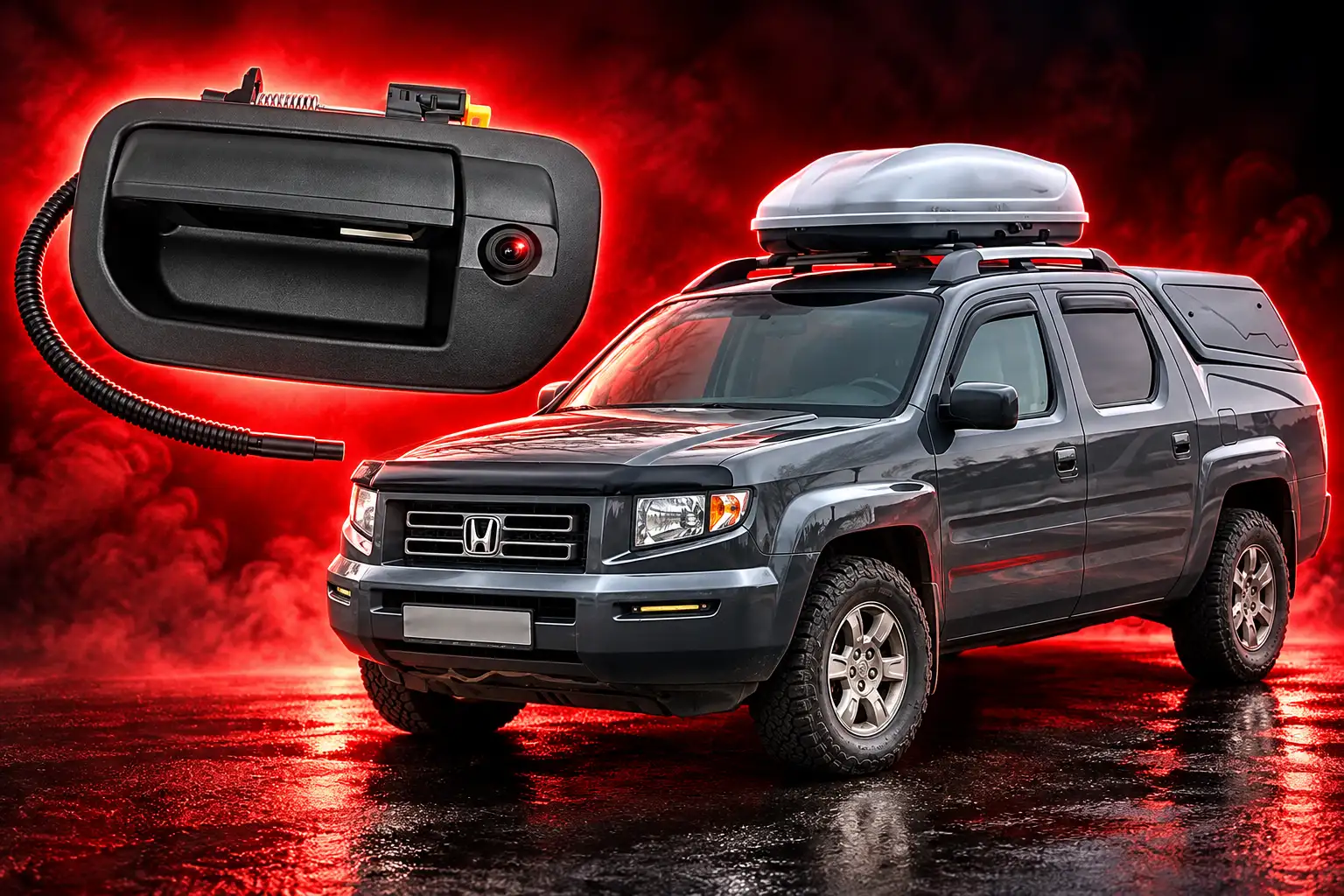
The 2022 Remedy Shared a Later-Recalled Supplier
The reason the query existed was not a flood of broken 2022 repairs. It was a parts overlap. On May 3, 2024, Honda filed a second camera-harness recall, 24V-321, for 2020 through 2024 Ridgelines. Honda’s fix on those newer trucks was a harness from a new supplier with tougher wire. The 2022 remedy parts, and the factory parts Honda then recalled on the newer trucks, used the same supplier and materials for critical pieces of the camera harness, which is why ODI opened RQ24011.
That 2022 part was also installed as a production piece on some 2019 Ridgelines, which helps explain why the engineering-analysis count sits above the original recall total. Honda named Aptiv as the harness maker on both defect reports, with different part numbers for the two generations.
The two faults are not the same wear story. On the older trucks the corrugated tube was too short and the zip tie too loose, so the wires took the bend every time the gate dropped. On the newer trucks a woven tube let water and road salt in; freeze and thaw opened cracks in the insulation until the wire broke. NHTSA spent the engineering analysis asking whether the first “improved” harness was, in practice, the second problem waiting to happen.
After the Ohio survey, the inspections, and the wear tests, the agency said it was not. It also wrote down a limit on what that close means.
The closing of this investigation does not constitute a finding by NHTSA that a safety-related defect does not exist. The Agency reserves the right to take additional action if warranted by future circumstances.
Office of Defects Investigation, EA25003 closing resume
A closed file is not a clean bill of health for every blank Ridgeline screen. It is a decision that this particular wear path on this particular 2022 part did not earn a second recall.
Most Camera Complaints Were Not the Harness
By the time the resume was written, ODI had 4 allegations of rear-view camera failures and Honda had 27 complaints of camera failure. Analysts judged that the majority of those reports involved different failure modes inside the camera or the harness, and could not be tied to the durability question the probe was built to answer.
That split is the part of the close that owners actually feel. A truck that already had the 2022 harness replaced, and then lost the camera image again, was the scenario that pushed the query into an engineering analysis. If those later blanks were mostly something else, a second free harness was never going to be the remedy NHTSA ordered.
Early complaints on the original defect had a pattern of their own. When ODI opened its first Ridgeline camera evaluation in 2022, it noted that most of those reports showed the failure arriving just after warranty mileage ran out, which is how a “quality” dispute becomes a safety file once a backup camera is treated as a crash-risk part rather than a convenience screen.
VRTC’s Ohio work did not recover the original break on the replacement part. Combined with the complaint review, that is why the agency stopped at a close instead of pushing Honda for another campaign on the 2017 through 2019 trucks.
Two Ridgeline Campaigns Cover Different Model Years
Owners keep mixing the two campaigns because both kill the same image on the same truck line. They are separate filings, with separate year ranges, separate physics, and separate Honda codes.
THE TWO RIDGELINE CAMERA RECALLS
| NHTSA ID | Model years | Trucks listed | Core fault Honda described |
|---|---|---|---|
| 22V-867 | 2017 through 2019 | 117,445 | Short corrugated tubing and a loose zip tie on the tailgate harness |
| 24V-321 | 2020 through 2024 | 187,290 | Salt water and freeze-thaw cracking of wire insulation |
Honda estimated that 7 percent of the 117,445 older trucks actually had the first defect, and 3 percent of the 187,290 Ridgelines from 2020 through 2024 had the salt-belt fault. Those percentages are Honda’s own estimates in the defect reports, not counts of failed cameras in the field.
Warranty volume tells a blunter story. Honda logged 3,437 claims on the older harness between December 2017 and October 2022, and 402 claims on the newer one between November 5, 2020, and April 5, 2024. Neither filing listed an injury or a death. The 2024 campaign also warned that the tailgate lock or the alarm could misbehave when the same harness is going, which is a useful clue if the camera is only flickering for now.
September’s close does not cancel 24V-321. That campaign was never the subject of EA25003. A 2022 through 2024 Ridgeline still needs its own VIN check, and a completed 2022 repair on an older truck does not speak to the later salt-freeze part.
Honda Told Safety Staff It Was Only Quality
Honda saw the older camera fault long before it filed a recall. The 22V-867 chronology starts on July 19, 2018, with a market-quality report on malfunctioning rear cameras in North America. Production changes followed, the last of them on June 3, 2019, and Honda kept watching the field.
FROM FIRST CAMERA FAULTS TO A CLOSED FILE
- July 19, 2018: Honda logs a trend of malfunctioning rear-view cameras on affected Ridgelines in North America.
- February 2022 through April 2022: NHTSA opens a preliminary evaluation, and Honda tells the agency the issue is quality, unrelated to safety.
- October 27, 2022: ODI notifies Honda that it considers the issue related to safety.
- November 17, 2022: Honda decides a safety defect exists, after logging 3,437 warranty claims through October 2022.
- November 23, 2022: Honda files 22V-867 for 117,445 trucks.
- January 16, 2023: Owner letters go out; Honda says parts are short and, for a time, only trucks with a dead camera are being repaired.
- August 2023: Honda tells remaining owners to book the free harness replacement at a dealer.
- May 3, 2024: Honda files 24V-321 after a new supplier change and a halt on Ridgeline shipments from April 25 through May 2, 2024.
- June 26, 2024: ODI opens RQ24011 on the long-term fitness of the 2022 remedy.
- February 11, 2025: The query becomes EA25003 after the 14 post-repair harness reports.
- September 18, 2026: NHTSA closes the engineering analysis without further action.
The January 2023 owner letter is the piece that still stings for people who waited. Honda estimated the repair at 1 hour and 30 minutes once parts existed, but it also said a limited supply meant only trucks with an inoperable camera were being fixed until more harnesses arrived. That gap, from the first letter to the August 2023 go-ahead, is why some owners still talk about the 2022 campaign as a letter they received twice.
How Owners Can Check a Ridgeline VIN
A closed engineering analysis does not close a recall that was never completed. If the 2022 harness was never installed, the original campaign is still the free path. If it was installed and the camera is dark again, the next stop is a dealer diagnosis, because NHTSA just declined to treat that second failure as the same wear defect.
HOW TO CHECK A RIDGELINE FOR OPEN RECALLS
- The VIN: Use the 17-character vehicle identification number from the dash or the driver’s door jamb, letters and numbers only.
- Honda first: Run Honda’s own VIN recall checker on the owners site, which lists safety recalls from the past 15 calendar years and flags open work.
- The federal file: Enter the same VIN on NHTSA’s recall lookup so a campaign Honda has not yet posted to its own tool still shows up.
- The dealer visit: Open recall repairs are free at authorized Honda dealers; Honda’s camera-harness line is 1-888-234-2138 if the VIN result is unclear.
Year and model searches are not enough. Honda’s own tool says a year-and-model hit still has to be confirmed by VIN, because build dates and factory harness changes do not line up cleanly with model-year badges. A 2019 Ridgeline can sit in the original campaign, in the EA population, or in the group that left the plant with the 2022-style part already fitted.
Frequently Asked Questions
Which Honda Ridgeline Years Had the 2022 Camera Recall?
Recall 22V-867 covers 2017 through 2019 Ridgelines built from October 29, 2015, through June 1, 2019, and Honda’s code for the campaign is 6RW. The production window starts before the 2017 model year on the window sticker, so a late-2015 build date can still be in the file even if a seller lists the truck as an early 2017.
Does the Closed Probe Cover 2020 Through 2024 Ridgelines?
No. EA25003 was limited to the 2017 through 2019 trucks and the long-term fitness of the 2022 remedy harness. The 2020 through 2024 trucks sit in a separate 2024 campaign, Honda number YI7, for salt-and-freeze wiring damage, and that filing was not the subject of the September 18, 2026 close.
How Long Does the Ridgeline Camera Harness Repair Take?
Honda told owners the tailgate-harness replacement would take about 1 hour and 30 minutes, while warning that the dealer might need the truck for a longer visit. The work is a harness swap, not a camera replacement, and it is free when the VIN shows an open campaign.
Can Owners Get Reimbursed for a Harness They Already Paid to Replace?
Yes, if the paid repair matches the defect Honda described. Both the 2022 and 2024 defect reports say owners who already paid for the harness work may be eligible for reimbursement under the recall reimbursement plan Honda has on file with NHTSA, which is worth asking the dealer to run before paying a second time.
What Warning Besides a Black Camera Did Honda List?
On the 2020 through 2024 campaign, Honda said the tailgate lock-and-unlock function and the alarm system may malfunction as the same harness fails. That side effect is a reason to book the YI7 repair even if the camera image is only dropping out in reverse, rather than staying black.
A Ridgeline whose 2022 harness was never fitted still has a free repair waiting at a Honda dealer. A truck whose camera went dark after that repair is now a diagnosis, unless NHTSA reopens EA25003 on new evidence the September 18 close said it is prepared to consider.

Edinburgh Opens a 2027 Tour Built for Time Trials

Korda Maps Auður From Meðalland to Irvine Bay

Apple Music Films Its New Logo in Mineral Oil

Oppo Prices the Pad Mini Above India’s iPad Mini

Austen Soaks Scotland Before Boelo Brings Weekend Gales

Volkswagen Sells the Osnabruck Plant to Clear a Board Fight

Apple’s Foldable iPhone Hinges on Samsung Display Supply

Saksham Gaur Finds He Is His Own Company’s Client

Tata Motors’ Iveco Tender Opens as Holders Still Decide

Onimusha Way of the Sword Preload Hits a Windows 11 Wall
-
 AUTO2 months ago
Volkswagen Sells the Osnabruck Plant to Clear a Board Fight
-
 NEWS2 months ago
Apple’s Foldable iPhone Hinges on Samsung Display Supply
-
 AUTO2 months ago
Tata Motors’ Iveco Tender Opens as Holders Still Decide
-
 BUSINESS2 months ago
Saksham Gaur Finds He Is His Own Company’s Client
-
 GAMING2 months ago
Onimusha Way of the Sword Preload Hits a Windows 11 Wall
-

 ENTERTAINMENT3 years ago
What is SD on Amazon Prime? – All You Need to Know
-

 BUSINESS2 months ago
Hyderabad 22-Carat Gold Jumps After a False Bargain
-

 NEWS2 months ago
iQOO 16 Locks 8,400 mAh While 100W Charging Holds