
BUSINESS
Mumbai CNG Hits Rs 91.50 as Drivers Face a Fare Fight
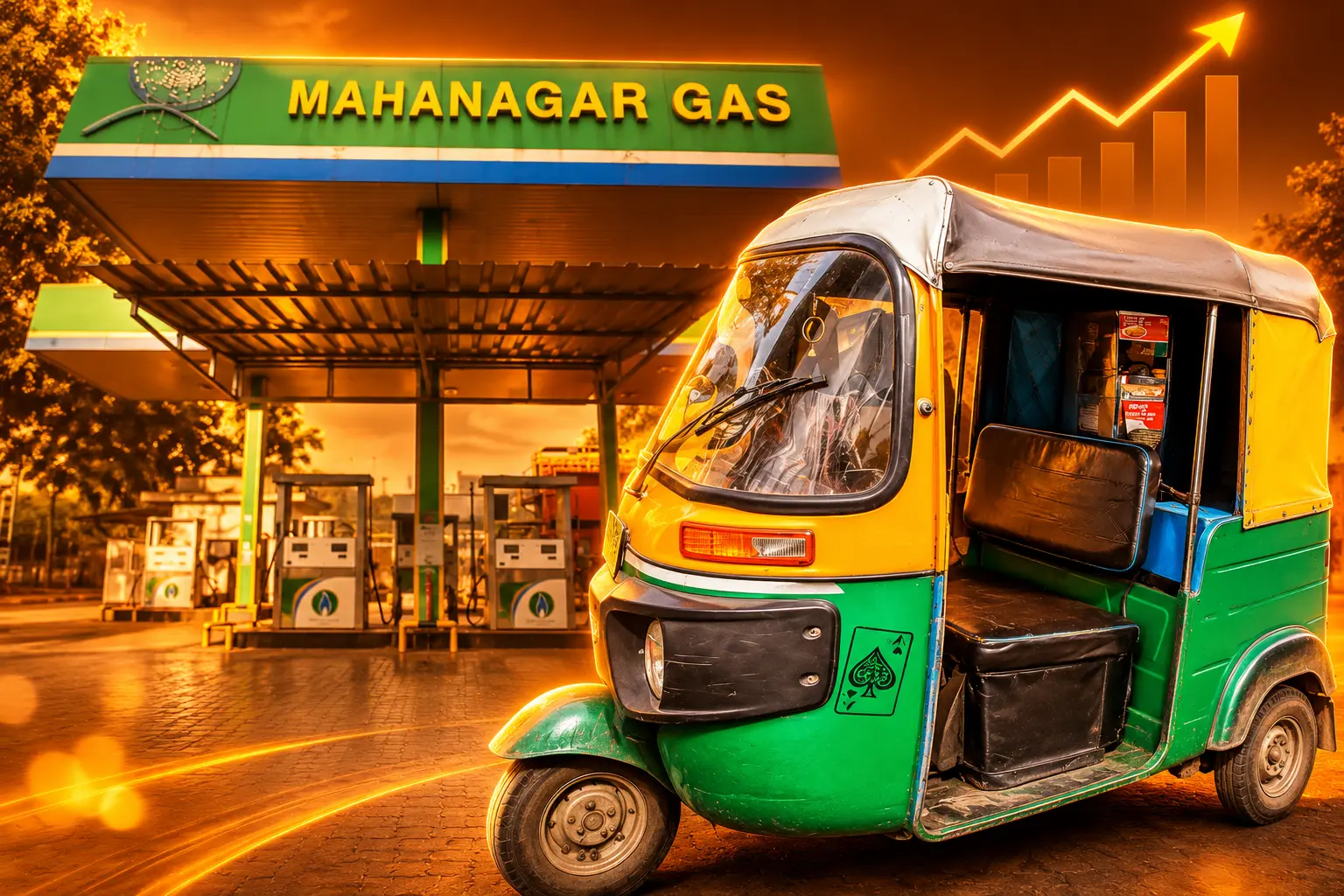
Mahanagar Gas raised Mumbai CNG to Rs 91.50 a kg, the eighth 2026 hike, after cheap domestic gas gave way to costly imports and auto unions pushed for Rs 29 fares.

Mahanagar Gas Limited raised Mumbai CNG by Rs 1.50 to Rs 91.50 a kg from November 15, the eighth increase of 2026.
The new rate runs across the Mumbai Metropolitan Region and lands on 12.93 lakh CNG vehicles. Piped cooking gas for nearly 33 lakh homes was left unchanged, so the bill sits with autos, taxis, private cars and buses, not with the kitchen pipe.
Rs 11 Extra Since January
CNG in MGL territory opened 2026 at Rs 80.50 a kg. Eight step-ups have added Rs 11, a rise of nearly 14%, and the company put the latest change into force from midnight on November 14 after a Saturday statement.
The autumn cluster is the steep part of the year. From Rs 86 after the May increases, the pump has moved Rs 5.50 in 75 days, the stretch that runs from the September 1 revision to November 15.
THE 2026 MUMBAI CNG LADDER
- January 2026: Retail CNG stands at Rs 80.50 a kg at MGL stations.
- February 2026: Price rises 50 paise a kg.
- April 2026: Price rises Rs 1 a kg.
- May 2026: Two separate Rs 2 increases take the rate to Rs 86 a kg.
- September 1, 2026: Price rises Rs 2 to Rs 88 a kg, and auto and taxi fares are revised the same day.
- October 1, 2026: Price rises Rs 1 to Rs 89 a kg.
- November 1, 2026: Price rises Rs 1 to Rs 90 a kg.
- November 15, 2026: Price rises Rs 1.50 to Rs 91.50 a kg.
MGL said the latest step only partly covers higher input costs and is meant to keep supply steady. Other city-gas firms have been moving too: Adani Total Gas has raised CNG by Rs 6.75 a kg across two steps since October 23.
Unions Want the Minimum Fare at Rs 29
The people who fill every day are the ones who cannot wait for the next ministry note. Thampi Kurien, leader of the Mumbai Rickshawmen’s Union, said the new pump rate has already cancelled the gain from the September fare rise, and that meters are still being reset for that earlier change.
In September the Mumbai Metropolitan Region Transport Authority lifted the minimum auto fare by Re 1 to Rs 27 for the first 1.5 km, using the Khatua panel formula that folds in fuel and other running costs. Black-and-yellow taxis went up by Rs 2 to a Rs 33 minimum for the same distance, the first fare change in 18 months after a February 1, 2025 revision.
Unions now put the next auto minimum at Rs 29 for the first 1.5 km, a further Rs 2, on the same formula. The transport department has set November 30 as the deadline for recalibrating meters from the September rise, so drivers are being told to finish one fare change while they argue for the next.
A Gulf shipping shock does not stay in a cargo contract. It shows up in the meter a commuter pays for a short hop, once the city-gas firm has passed the imported-gas bill through the pump and the union has taken that pump rate back to the fare panel.
Palghar’s Pump Is Rs 5.75 Cheaper
Kurien also pointed at a gap inside Maharashtra. Gujarat Energy, which supplies CNG in Palghar and rural Thane, last revised in August to Rs 85.75 a kg. Against MGL’s Rs 91.50, that is a Rs 5.75 spread on the same fuel in neighbouring talukas.
There is almost a Rs 5.75 difference in CNG prices charged by the two distributors.
Thampi Kurien, leader, Mumbai Rickshawmen’s Union
Drivers who work the edge of MGL’s map can see that spread on a single shift. Commuters in south Mumbai cannot. The Palghar rate is the local proof that “procurement costs” are not a single national number; they are a mix of whose cheap domestic gas a company still holds, and how much imported gas it has had to buy.
Why Mumbai CNG Rose Faster This Autumn
MGL’s Saturday note blamed the Middle East crisis, a smaller allotment of domestic gas, and a larger share of imported re-gasified liquefied natural gas, or RLNG, whose price tracks overseas benchmarks. Demand in the CNG slice, the company said, is strong, and that is the slice now carrying more of the imported gas.
Domestic gas sold under the administered price mechanism is the cheap barrel in this system. When that allotment shrinks, city-gas firms fill the gap with New Well Gas, which costs more, and with cargoes bought as RLNG. MGL has already seen APM volumes cut by about 18% in 2025, with the shortfall met by costlier New Well Gas.
The Petroleum Ministry still talks of CNG and household PNG as priority users. In April 2025 it moved to two-quarter advance domestic gas allocations for those two segments, folded New Well Gas from ONGC and Oil India nomination fields into the pool, and replaced New Well Gas auctions with a pro-rata share. The published ratios of domestic gas against projected city-gas demand stayed close to 55%: 54.68% in Q3 2024-25, 55.68% in Q1 2025-26, and a projected 54.74% in Q2 2025-26.
A ratio near 55% means almost half the molecules still have to be bought elsewhere. That is the lever auto drivers are paying for, and it sits in the domestic gas rules for city distributors rather than in a single Saturday press note.
Spot Cargoes Now Set the City Rate
Those missing molecules are no longer cheap. Wood Mackenzie put India’s LNG tender awards at $26.4 per million British thermal units in September, up from $16.8 to $18.8 between March and June, after West Asia fighting disrupted Qatar and UAE supplies and traffic through the Strait of Hormuz. On November 15 the Asian spot LNG near $30.74 a million British thermal units sat far above US Henry Hub.
WHAT THE IMPORT BILL LOOKS LIKE
- India tenders: Wood Mackenzie logged LNG awards at $26.4 per million British thermal units in September.
- Earlier 2026: The same awards sat between $16.8 and $18.8 from March through June.
- Asian marker: JKM was $30.74 per million British thermal units on November 15.
- Domestic share: Ministry figures still put allocated domestic gas near 55% of projected city-gas demand, so the rest is bought on those markets.
MGL put the same chain in one paragraph, and tied it to CNG rather than to the household pipe.
The ongoing Middle East crisis, coupled with reduced domestic gas allocation and increased dependence on higher-cost imported RLNG linked to international benchmarks, has significantly increased MGL’s gas procurement costs, particularly for the CNG segment, driven by strong demand and a higher share of imported gas in its input mix.
Mahanagar Gas Limited, statement, November 14, 2026
In March the Centre issued the Natural Gas (Supply Regulation) Order, 2026, and put PNG households, CNG transport and LPG production at the front of the queue for volume, based on the previous six months of use. Volume priority is not price protection. The order can keep the pump from running dry and still leave the rupee rate to follow the cargo.
A high-level panel for the Petroleum and Natural Gas Regulatory Board, chaired by former petroleum secretary D.K. Sarraf, had already asked in 2025 for priority APM gas to be restored to the CNG transport segment, and for any shortage to be shared across APM users rather than loaded onto city transport. That recommendation has not shown up in the Mumbai pump price.
City Rates From Rs 86.98 to Rs 112
Mumbai is not the dearest CNG city in the country after this hike, and it is no longer the bargain next to Delhi. Rate lists published on November 15 put the national capital at Rs 86.98 a kg and Hyderabad at Rs 112.
CNG RETAIL RATES ON NOVEMBER 15
| City | CNG price (Rs per kg) |
|---|---|
| Delhi | 86.98 |
| Mumbai (MGL) | 91.50 |
| Gurugram | 92.01 |
| Noida | 95.59 |
| Bengaluru | 99 |
| Chennai | 99.50 |
| Ahmedabad | 100.77 |
| Hyderabad | 112 |
Delhi’s Indraprastha Gas still sells a kg more than Rs 4 below MGL. Hyderabad is more than Rs 20 above Mumbai. The Palghar comparison remains the one that stings locally, because it is the same state and the same fuel on a different allocation book.
Piped Cooking Gas Did Not Move
MGL left domestic PNG where it was, which is why this hike has a transport face. The company has 529 CNG stations in the region. The vehicles that will pay Rs 91.50 a kg are not an abstract fleet.
WHO PAYS THIS HIKE
- Autorickshaws: About 4.7 lakh run on CNG in the Mumbai region, and their unions are already back at the fare formula.
- Taxis: About 2 lakh black-and-yellow and other cabs fill at the same stations.
- Private cars: Nearly 6 lakh CNG cars take the pump rate without a fare panel to pass it on.
- Public buses: BEST and other city and state buses are inside the 12.93 lakh total MGL supplies.
- PNG homes: Nearly 33 lakh piped-gas households were not moved in this round.
Private motorists who converted for the saving still have a cheaper fill than petrol, but the gap has narrowed eight times this year. MGL’s own customer notes still say a car conversion still costs Rs 25,000 to Rs 50,000, a bill that takes longer to earn back as the kg rate climbs.
The company said it is looking for ways to cut buying costs and pass any gain to customers, and that it still wants natural gas used as a cleaner fuel. The November 15 rate does the other job first: it keeps the imported-gas share from sitting on MGL’s books.
Drivers have until November 30 to get meters reset for the September fare, while they already want the next one. Until the ministry puts more cheap domestic gas back into the CNG line, that is the loop Mumbai is in.

Gold Prices Fall to a 14-Month Low Despite Strikes

SpiceJet Clears a Rs 5,500 Crore Raise After Mumbai Stalled

Honda Activa’s Record Month Came With a Share Loss

Sony Turns the GTA 6 Launch Into a Firmware Gate

Xiaomi 18 Leak Skips the Rear Screen for Battery

Volkswagen Sells the Osnabruck Plant to Clear a Board Fight

Apple’s Foldable iPhone Hinges on Samsung Display Supply

Saksham Gaur Finds He Is His Own Company’s Client

Tata Motors’ Iveco Tender Opens as Holders Still Decide

What Is SD on Amazon Prime?
-
 AUTO2 months ago
Volkswagen Sells the Osnabruck Plant to Clear a Board Fight
-
 NEWS3 months ago
Apple’s Foldable iPhone Hinges on Samsung Display Supply
-
 BUSINESS3 months ago
Saksham Gaur Finds He Is His Own Company’s Client
-
 AUTO3 months ago
Tata Motors’ Iveco Tender Opens as Holders Still Decide
-
 TECHNOLOGY3 years ago
What Is SD on Amazon Prime?
-

 BUSINESS3 months ago
Hyderabad 22-Carat Gold Jumps After a False Bargain
-

 GAMING3 months ago
Onimusha Way of the Sword Preload Hits a Windows 11 Wall
-
 BUSINESS3 months ago
UltraTech Ultravolt Launch Splits Friday Stocks to Watch