
BUSINESS
Mowi Bets a Public Grant on Semi-Closed Salmon Cages
Mowi Scotland will trial semi-closed post-smolt pens with a £1.78 million grant, copying a cage model it already runs at scale in Norway.

Mowi Scotland has won a £1.78 million public grant toward a £5.92 million trial of semi-closed containment for post-smolt salmon. The award covers 30 percent of the project, leaving the world’s largest salmon farmer to fund the rest as it tests a cage model it is already expanding in Norway.
The Scottish Government’s award register published on 7 October does not name the site, the kit maker, the capacity, or the timetable.
£1.78 Million Covers 30 Percent of a £5.92 Million Trial
The trial grant is one of the largest slices of Marine Fund Scotland for 2026-27, a round that on 7 October listed 99 seafood and aquaculture projects sharing more than £16 million and aimed at 122 jobs in coastal and island communities. Aquaculture takes £5.4 million of that pot. Mowi’s £1.78 million trial is a third of the aquaculture money.
A second award of £101,665 goes toward a £338,883 water and gravity feed system that the register calls Scotland’s first. Public money again covers 30 percent. The two grants come to about £1.88 million. Mowi is left with £4.14 million of the trial to fund itself.
MOWI’S TWO MARINE FUND AWARDS
| Project | Grant | Total cost | Public share |
|---|---|---|---|
| Semi-closed post-smolt trial | £1.78 million | £5.92 million | 30% |
| Water and gravity feed system | £101,665 | £338,883 | 30% |
Other aquaculture awards in the same round sit far below that scale. Kames Fish Farming gets £272,000 toward a £544,000 juvenile rainbow trout farm in the Trossachs. Cooke Scotland gets £75,950 to test side-scan sonar on seabed habitats. Salmon Scotland, the trade body, gets £50,000 for Label Rouge marketing in France.
Marine and Islands Minister Jim Fairlie tied the round to jobs and to a target of lifting aquaculture production and sales by £3.5 million. The fund has paid out over £86 million to 499 projects since 2021, which the government says has drawn more than £185 million of investment.
Our seafood and aquaculture sectors are of vital importance to our coastal and island communities and a crucial contributor to Scotland’s economy, so it is great that this £16 million round of the Marine Fund Scotland will support projects that aim to create a total of 122 jobs.
Jim Fairlie, Marine and Islands Minister, Scottish Government announcement, 7 October 2026
Mowi Scotland expects to harvest around 70,000 gutted-weight tonnes of salmon in 2026. A 30 percent grant rate matches the share recorded for both of its new awards. Marine Fund rules allow small and medium firms up to 50 percent of eligible costs on a commercial project; a company of Mowi’s size sits below that ceiling.
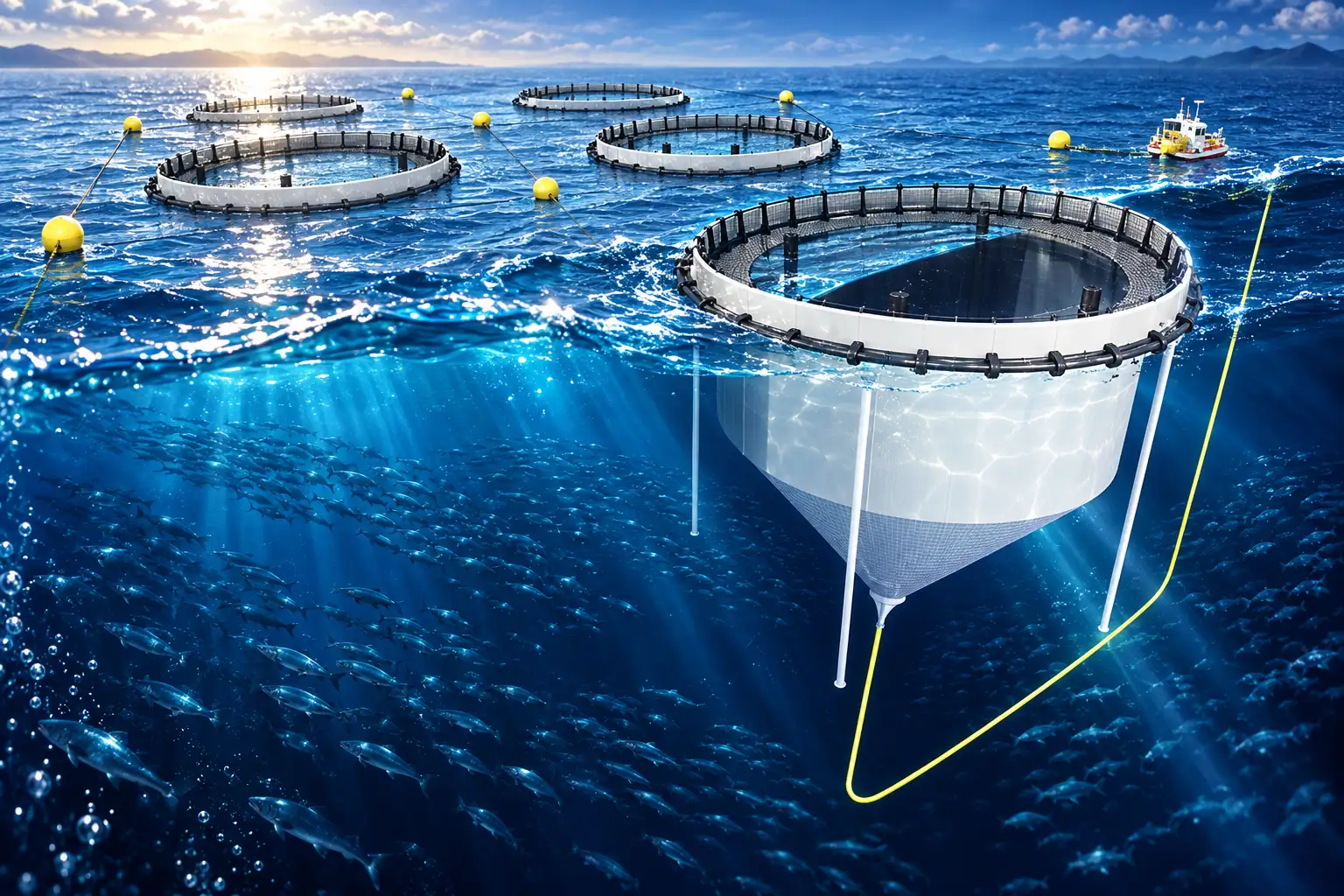
The Halfway House Between Open Pens and Land Tanks
Post-smolt rearing means growing young salmon to a larger size before they go into ordinary seawater pens. The point is to cut the months they spend in open water, where summer heat, jellyfish, plankton blooms and sea lice hit hardest. Mowi has already said larger juveniles are part of how it wants to handle warmer Scottish summers and the fish-health problems that come with them.
Semi-closed pens are the middle option. From the air they look like standard cages. Under the water an opaque outer wall sits around the inner net, and pumps draw water from deeper layers rather than from the lice-rich surface. Waste and uneaten feed can be caught at the bottom and taken ashore. The fish stay in the sea, but they are no longer in a fully open net.
WHAT A SEMI-CLOSED PEN CHANGES
- The wall: An impermeable outer barrier surrounds the inner net so the cage is no longer open to the loch at every depth.
- The water: Pumps pull seawater from deeper, colder layers instead of from the surface band where lice larvae concentrate.
- The waste: Uneaten feed and faeces can be collected at the base and brought ashore rather than falling straight onto the seabed.
- The lice load: A closed water path is meant to cut infestation so fish need fewer chemical and mechanical treatments.
- The escapes: A solid outer wall is harder for fish to leave than a torn net after a storm.
Fully land-based tanks do all of that, at a much higher build and energy cost. Mowi has already used Loch Etive’s cheap open pens as a post-smolt nursery and argued that this beats building a big land plant. The new trial asks whether a floating closed wall can add the missing piece, containment, without that land bill.
Loch Etive Already Grew the Fish to a Kilo
The biology of larger juveniles is not a new bet for Mowi in Scotland. It bought trout producer Dawnfresh Farming in 2023, won consents in late 2023 to grow Atlantic salmon in Loch Etive, and stocked the first fish in February 2024. The loch is brackish, with a sill at the mouth and a large freshwater catchment, so salinity stays lower than on most west-coast sites and sea lice struggle to thrive.
Mowi also emptied every Etive site at the same time, on six-month cycles, instead of fallowing cages one by one. Combined with the low salinity, that break is meant to knock lice down without a constant round of treatments. The company said it was proving a cheaper, lower-carbon alternative to land-based post-smolt plants.
THE ETIVE POST-SMOLT BUILD
- 2023: Mowi buys Dawnfresh and takes over trout sites on Loch Etive for a switch to salmon.
- Late 2023: Consents arrive to grow post-smolt salmon in the loch.
- February 2024: The first fish go into the pens for a long nursery cycle.
- End of September 2024: The first transfer leaves for marine pens off the Isle of Muck.
Ben Hadfield, Mowi’s farming chief for Scotland, Ireland, the Faroes and Atlantic Canada, used the move to argue that the loch had already shown the model works.
Not only are we proving that there is a sustainable alternative to land-based post smolt production, we are also using new sea lice modelling to achieve greater monitoring and control of sea lice, combined with a new approach to fallowing, all of which is resulting in healthy post smolts ready to continue growing at sea.
Ben Hadfield, COO, Mowi Farming Scotland, Ireland, Faroes and Atlantic Canada, on the first post smolts transferred from Loch Etive
Fish left Etive at around 1 kilogram after five to seven months, then had about nine months in open sea pens, a marine stage Mowi has described as closer to 12 months than the 22 months of a classic small-smolt cycle. A company video of the 2024 move put the Etive crop at 2.5 million fish. The aim was to miss the worst of the next summer’s jellyfish and lice and to harvest before the heat returned.
Mowi said overall biomass mortality across its Scottish seawater farms fell 35 percent in 2024, and 45 percent when counted as individual fish. In its second-quarter 2026 report it said Scottish seawater production, survival, feed conversion and superior share all improved on a year earlier, and it partly credited post-smolt stocking from Loch Etive. The open-net nursery, in a loch lice do not like, has already done a lot of what the new grant is supposed to prove.
Mowi Is Doubling Closed Cages in Norway
The Scottish trial is late to a Norwegian build-out. Mowi began closed-cage work at sea in 2013 at Slåttenes in Vestland, and it now calls itself the world’s largest operator of closed sea cages, with more than a third of Norway’s capacity in that segment on figures from analyst Kontali. About 20 million fish have gone through the units so far.
In January 2026 the company said it would nearly double closed-cage volume at sea. Four units are on order from FiiZK and one from Fishglobe Technologies, on top of six already running. When all 11 are in use, volume rises from about 170,000 cubic metres to about 320,000. Deliveries run through 2026 and 2027.
NORWAY CLOSED CAGES ON ORDER
- In the water now: Six closed units, about 170,000 cubic metres.
- On order: Five more, four from FiiZK and one from Fishglobe.
- When they arrive: Eleven units and about 320,000 cubic metres, nearly double today’s volume.
- The 2026 target: Post-smolts at 40 percent of Mowi’s Norwegian production, and 60 percent south of Namsos.
Typical smolts still enter the sea at about 150 grams. In the closed units Mowi wants them to reach around 700 grams before they move to open pens, which shortens the open-water stretch and, the company says, cuts lice treatments and lifts survival. It also says floating closed pens are not ready for a full grow-out to harvest size and remain too costly for that job. They are a nursery, not a replacement for ordinary cages.
That is the same halfway house the Scottish grant is buying. In 2021 Hadfield told investors Mowi planned a series of semi-closed operations in Scotland and a land-based post-smolt plant at Kyleakin on Skye, with fish going to sea at about 800 grams and coming back to harvest inside 12 months. Etive became the cheap version of that plan. The 2026 grant is the closed-wall version, five years later, with the state paying 30 percent.
What the Award Register Still Does Not Say
For a trial this size, the public file is thin. The register confirms the money, the 30 percent rate, and that the work is semi-closed containment for post-smolt rearing at operational scale. It does not say where the cages will sit, who will build them, how many fish they will hold, or when the first fish go in.
Mowi is not even first in the Scottish planning queue. Ministers approved Loch Long Salmon’s Beinn Reithe farm on 26 August 2025 after the national park authority had refused it. That project is a marine semi-closed farm with a biomass cap of 3,452 tonnes and about 12 full-time jobs. It is a different company, a partnership that includes Simply Blue Group, and it is still a consented scheme rather than a working farm. It does show that Holyrood has already accepted the technology in principle.
WHAT WE KNOW
- The money: £1.78 million toward a £5.92 million Mowi trial, plus £101,665 toward a £338,883 feed system.
- The job: Semi-closed pens for post-smolt salmon at operational scale, then a move to ordinary seawater sites.
- The precedent: Mowi already grows post-smolts in open pens at Loch Etive and runs closed sea cages as a nursery in Norway.
WHAT IS UNCONFIRMED
- The site: The register does not say whether the trial sits on Etive, on another west-coast loch, or elsewhere.
- The supplier: No equipment maker is named, so FiiZK, Fishglobe and other cage firms remain guesses.
- The clock: There is no published start date, biomass cap, or number of units.
Until those gaps close, the grant is a funding decision, not a farm anyone can visit. Mowi has not issued a separate Scottish statement setting out the kit or the loch.
A Second Year of Grants at the Same Scale
This is also the second year running that Marine Fund Scotland has put its biggest aquaculture cheque on a semi-closed farm. In the 2025-26 round the top award was £1,836,611 toward a nearly £4.6 million trout project at Ardnish on Loch Ailort, for Dawnfresh Farming, by then owned by SeaQureFarming, a vehicle of Gael Force Group owner Stewart Graham. SeaQureFarming had bought those trout assets from Mowi in 2025, after Mowi had taken Dawnfresh out of administration in 2023 and kept the Etive salmon plan for itself.
So public money is now backing both sides of that split: a trout closed system at Ardnish last year, and a salmon closed system for Mowi this year. The sums are almost the same. The policy signal is that Edinburgh will co-fund floating closed walls if companies put up most of the cash.
The other way to read the cheque is as a subsidy to a firm that can already pay for this kit. Mowi is financing a closed-cage doubling in Norway from its own capital, and it is booking strong Scottish biology from an open-net nursery it already owns. A grant covering 30 percent of a Scottish trial still leaves taxpayers inside a commercial project for the world’s largest salmon farmer. That is the complaint that met the 7 October list: public money is flowing to fish farms that make their own investment decisions at a much larger scale.
Open pens still fail in weather. On 5 October 2025 an estimated 75,000 salmon with an average weight of 860 grams left Mowi’s Gorsten farm in Upper Loch Linnhe during Storm Amy. Mowi later paid for a three-year genetic monitoring project with the River Lochy Association and UHI Inverness. A solid outer wall is meant to make that kind of loss harder. The Scottish trial is where that claim has to be tested in the water, on a timetable the register has not yet given.
The bet is now funded. The cages are not yet named, sited, or dated. Mowi will have to show that a semi-closed nursery in Scotland can do what Etive’s open pens cannot, and that the extra wall is worth the £4.14 million it is putting in beside the grant.

The BMW iX4 Undercuts Mercedes and Trails Its Twin

Scotland’s Ten Big Supermarkets Already Hold the Weekly Shop

Scotland EMS Faces a State Probe After a Wagram Death

Meritz Signs Ripple to Race Korea’s 2027 Token Rules

Pocognoli’s First Camp Leaves Scotland Third and Exposed

Volkswagen Sells the Osnabruck Plant to Clear a Board Fight

Tata Motors’ Iveco Tender Opens as Holders Still Decide

Saksham Gaur Finds He Is His Own Company’s Client

Onimusha Way of the Sword Preload Hits a Windows 11 Wall

The Frame Pro’s $1,200 Labor Day Cut Needs a Soundbar
-
 AUTO1 month ago
Volkswagen Sells the Osnabruck Plant to Clear a Board Fight
-
 AUTO1 month ago
Tata Motors’ Iveco Tender Opens as Holders Still Decide
-
 BUSINESS1 month ago
Saksham Gaur Finds He Is His Own Company’s Client
-
 GAMING1 month ago
Onimusha Way of the Sword Preload Hits a Windows 11 Wall
-
 NEWS1 month ago
The Frame Pro’s $1,200 Labor Day Cut Needs a Soundbar
-

 NEWS1 month ago
Apple’s Foldable iPhone Hinges on Samsung Display Supply
-

 BUSINESS1 month ago
Hyderabad 22-Carat Gold Jumps After a False Bargain
-

 AUTO1 month ago
Simple Wave Chases Range as Ather Konarc Cuts Price