
BUSINESS
Jio Platforms IPO Listing Recycles a 49-Year Wealth Fable
Jio Platforms lists October 28 after a 22.19-times IPO, as a ₹1,000 1977 Reliance stake is worth ₹52.93 lakh and the parent sits near a 52-week low.

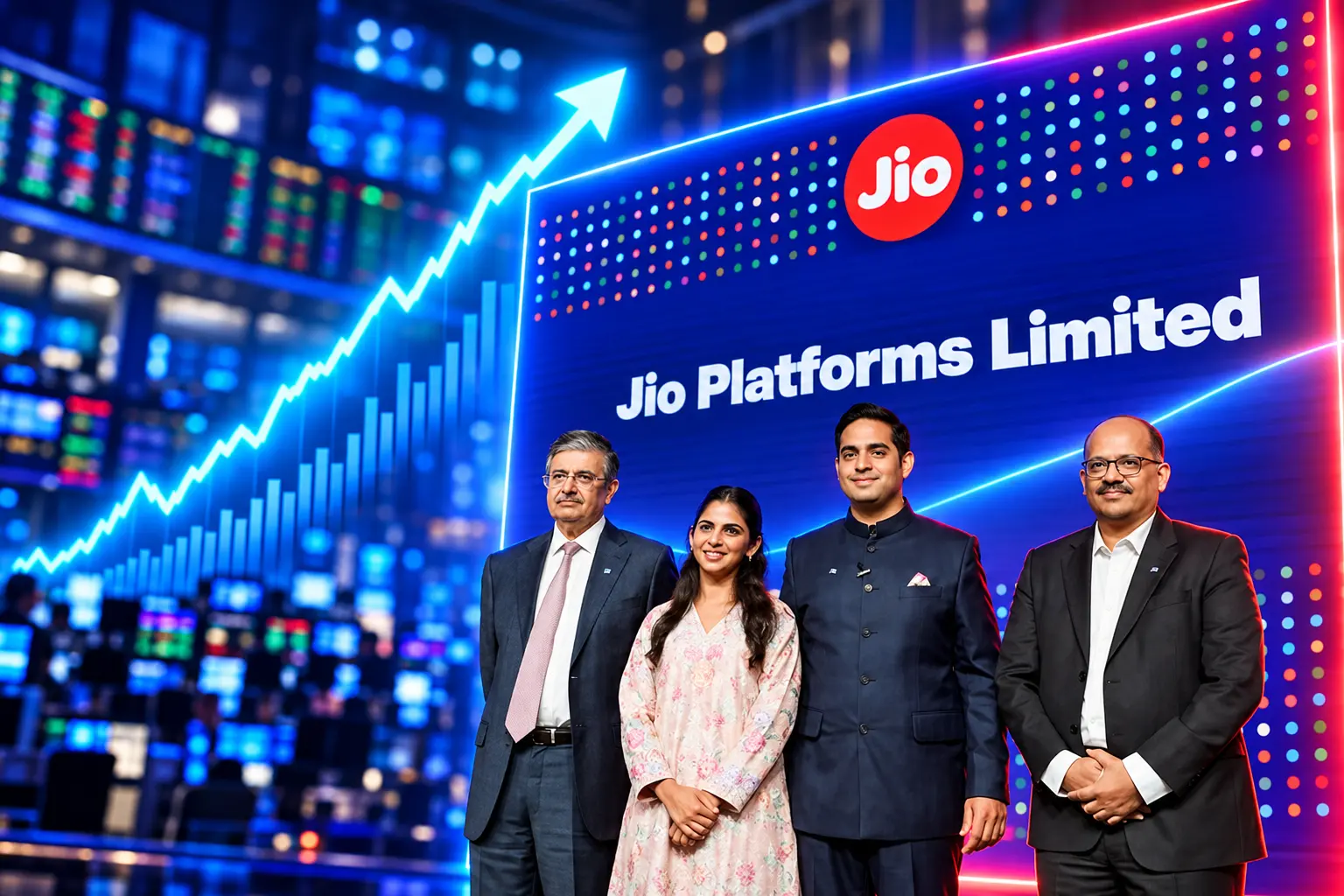
The Jio Platforms IPO listing is set for Wednesday, October 28, after a ₹30,213 crore issue that drew 22.19 times the stock on offer. Allotment was finalised on Monday, October 26, and unofficial grey-market deals were still adding about ₹244 a share, or 22%, to the ₹1,119 issue price.
The same week a 49-year fable has been doing the rounds: ₹1,000 put into Reliance Textile Industries in 1977 is now worth about ₹52.93 lakh. Reliance Industries, the parent that produced those returns, hit a 52-week low of ₹1,152.2 on October 13 and was still near ₹1,196 on October 27.
Jio Platforms Lists Wednesday After a 22-Times Book
The offer was a fresh issue of 27 crore shares, with no sale by existing holders, and it was priced at the cap after three days of bidding from October 21 to October 23. Qualified buyers covered their slice 70.55 times, non-institutional buyers 14 times, and the Reliance shareholder quota 7.60 times. Retail, the line most of the country was watching, covered 2.72 times in shares.
Public bids came to ₹4.9 lakh crore. Count the earlier anchor book and total demand reached ₹7.4 lakh crore, on 438.26 crore shares sought against 19.75 crore in the public offer. Anchors had already taken ₹8,110 crore at ₹1,119 a share. The issue drew more than 1.35 crore applications, the first Indian public offer past one crore, above the Waaree Energies mark of about 97 lakh.
HOW THE BOOK BROKE DOWN
| Category | Times covered | What the line shows |
|---|---|---|
| Qualified buyers | 70.55 | The 22.19-times headline lives here |
| Non-institutional | 14 | Large non-fund bids, still a lottery |
| Retail | 2.72 | Share cover, not the application odds |
| RIL shareholders | 7.60 | A reserved line for the parent’s holders |
| Overall public offer | 22.19 | Bids for 438.26 crore shares |
Retail applications numbered around 1.02 crore, with another 9.66 lakh in the non-institutional line and 3,143 from qualified buyers. The issue sold inside a price band of ₹1,065 to ₹1,119, and the BSE public-issue record for Jio puts the stock on both large Indian exchanges under the symbol JPL, in lots of 12, with a ₹54 discount only in the employee line.
Twelve Shares, One Lot, a ₹13,428 Ticket
A winning retail application is one lot. That is 12 shares at ₹1,119, a debit of ₹13,428, after a computer draw that hands each successful retail bid the minimum lot rather than a stack scaled to how many lots someone typed in. About 70.86 lakh such lots sat in the retail quota. Set that against about 1.02 crore retail applications and roughly seven in ten of those applications were in line for a single lot, even as the whole book printed 22.19 times.
That split is the part the fable skips. The 22-times figure is a qualified-buyer story. Retail was a crowded room in which most people who applied could still leave with 12 shares, and almost nobody could leave with a holding that looks like 1977.
WHAT ONE RETAIL LOT ACTUALLY IS
- The ticket: 12 shares at ₹1,119, so ₹13,428 leaves the bank if the draw lands.
- The unofficial pop: A ₹244 grey-market premium implies about ₹2,928 on that lot, if Wednesday opens there.
- The old comparison: The 1977 offer sold 100 shares for ₹1,000, a stake large enough to ride six bonus issues.
- The check: Applicants were pointed to allotment status at KFin Technologies, and to the BSE and NSE status pages, after the Monday draw.
Shareholder-quota bids were a different squeeze, covered 7.60 times, with a cap of ₹2 lakh per eligible Reliance holder and a reserved slice of up to ₹2,500 crore. Employees had a separate ₹500 crore line. Neither line recreates a textile-mill allotment from 1977. Both are small tickets on a company already valued at about ₹10.3 lakh crore at the cap, on 9,209.03 million shares once the new stock is in.
Almost Every Rupee Pays Down Jio’s Loans
Jio Platforms is not selling a growth cheque in the ordinary sense. The offer document earmarks up to ₹27,500 crore of net proceeds to repay or prepay borrowings at Reliance Jio Infocomm, the telecom unit that holds the licence and the spectrum. The rest is down as general corporate purposes. No rupee in the fresh issue goes to Reliance Industries, to Meta, to Google, or to the sovereign and buyout funds already on the register.
All our IPO proceeds go towards reducing our debt
Akash Ambani, Managing Director, Jio Platforms, at the October 15 press conference
Ambani also said the company was heading to be a net-debt-free company, and that the price, in the group’s usual phrasing, left enough on the table for people who stay. On the June 30 figures in the offer document, that debt claim is narrower than it sounds.
THE BALANCE SHEET THE CASH HITS
- Gross borrowings: ₹61,372.20 crore on June 30, of which ₹59,140.20 crore sat at Reliance Jio Infocomm.
- Cash and investments: ₹19,026.80 crore in cash and ₹32,806.30 crore in current investments, so net debt of about ₹9,539 crore.
- The leftover dues: Deferred payment liabilities of ₹1,04,513.70 crore, mostly long-dated, plus lease liabilities of ₹13,735.90 crore and ₹9,038.90 crore of capex contracts not yet booked.
- The loans being prepaid: Three overseas term facilities with about ₹29,917 crore outstanding, due in 2028, carrying 1.40% to 5.13%.
Pay the full ₹27,500 crore and gross borrowings on those June figures would fall to about ₹33,872 crore. Net debt could vanish on that arithmetic if the cash pile holds. The deferred spectrum-style dues do not. Jio still has to fund those, along with whatever it spends on broadband, 5G services, and the next round of digital products. For the year to March 2026 it reported revenue of ₹1.47 lakh crore and a consolidated net profit of ₹30,064 crore. As of June 30 it had 533.3 million customers and monthly average revenue of ₹215.6 per user. India was 96.62% of FY26 revenue.
Reliance Industries remains the promoter, with 66.43% before the issue and 64.48% after. Jaadhu Holdings, a Meta affiliate, and Google International stay as large pre-issue holders. They are not selling. The public is recapitalising the operating subsidiary so it can retire loans taken to build the network.
How ₹1,000 in 1977 Became ₹52.93 Lakh
The patience story is real, and it is also a story about people who never sold. Reliance Textile Industries offered 28.20 lakh existing shares at ₹10 in mid-November 1977, a sale by Dhirubhai H. Ambani and Natvarlal H. Ambani, not a fresh issue. The offer raised ₹2.82 crore, was covered 7.19 times, and the stock was listed on the BSE in January 1978, on January 23, with the Ahmedabad exchange. First-day deals were about ₹17 to ₹18, a 70% to 80% premium. The register after the offer ran to 57,949 names.
One hundred of those shares cost ₹1,000. Six bonus issues then multiplied the holding without a fresh cheque, and the 2023 demerger of Jio Financial Services added a second listed stock.
THE BONUS PATH FROM 100 SHARES
| Action | Ratio | Shares after |
|---|---|---|
| 1977 offer | ₹10 a share | 100 |
| 1980 bonus | 3:5 | 160 |
| 1983 bonus | 3:5 | 256 |
| 1997 bonus | 1:1 | 512 |
| 2009 bonus | 1:1 | 1,024 |
| 2017 bonus | 1:1 | 2,048 |
| 2023 Jio Financial demerger | 1:1 | 2,048 JFS beside 2,048 RIL |
| 2024 bonus | 1:1 | 4,096 RIL, still 2,048 JFS |
As of Friday, October 23, those 4,096 Reliance shares were worth about ₹48.74 lakh. The 2,048 Jio Financial shares, listed on August 21, 2023, were worth about ₹4.19 lakh, with Jio Financial closing at ₹205.03 that session. Together the pile came to ₹52.93 lakh, a 19.56% compound annual rate across 48 years and 11 months, before counting the cash dividends Reliance has paid along the way. The 2024 bonus, the sixth since listing, went ex on October 28, 2024.
That path required the 1977 buyer to sit through a promoter-family split in 2006, a 57% calendar-year fall in 2008, and a stretch from 2010 to 2016 when the stock went almost nowhere because the market had tired of capital-heavy oil and chemicals. Jio’s consumer launch in September 2016, and a 2017 rally of more than 70%, restarted the compounding. The ten-year rate into this decade was about 17%. That is not available to a 12-share allottee on Wednesday without a new decision to keep buying.
A 52-Week Low at Reliance, Jio’s Promoter
The company whose history is being used as the advertisement is having a rough year in the market. Reliance Industries’ January high was ₹1,611.20. It printed a 52-week low of ₹1,152.2 on October 13, and on October 27 it was still about 26% below that January peak, around ₹1,196, even as the subsidiary’s book was being closed and shares credited.
THE LONG ROAD BEHIND THE FABLE
- November 15-17, 1977: Reliance Textile Industries offers 28.20 lakh shares at ₹10 and is covered 7.19 times.
- January 23, 1978: The stock lists at about ₹17 to ₹18, a 70% to 80% first-day premium.
- 2006: The family split leaves Mukesh Ambani with Reliance Industries and the oil, gas and chemicals businesses; Anil Ambani takes power, telecom and finance.
- 2008: Reliance Industries falls more than 57% in a single calendar year in the global crash.
- 2010 to 2016: The stock stays range-bound as investors step away from the old capital-heavy businesses.
- September 2016: Jio launches consumer mobile service; 2017 brings a rally of more than 70%.
- August 21, 2023: Jio Financial Services lists after a one-for-one demerger.
- October 13, 2026: Reliance Industries hits ₹1,152.2, then the subsidiary lists on October 28.
The 2026 slide has sat on the energy side as much as on any doubt about Jio. Export levies on fuels returned during the year, crude moved sharply, and the oil-to-chemicals margin that funded the telecom build has been harder to read. Retail, another growth leg, has been asked to spend on delivery while profit growth stalled in at least one reported quarter. Jio’s own earnings before interest, tax, depreciation and amortisation were still rising, which is why the listing is being sold as a way to put a public price on the digital arm. The parent stock has not been given a free ride on that argument.
In Grey Trading, a ₹244 Premium
Unofficial deals in the grey market were quoting a ₹244 premium on October 27, implying an open around ₹1,363, about 22% above ₹1,119. That premium has spent most of the past two weeks between the low ₹200s and ₹273, which is a much calmer first-day story than the 70% to 80% Reliance Textile paid its public in January 1978.
A 22% open on 12 shares is about ₹2,928. It is a pleasant morning, not a generational stake. It is also unofficial. Grey-market quotes can move or vanish before the auction, and several large Indian listings in recent years have opened well away from the rumoured premium. Ambani’s own line, that the band was set with a discount to listed peers so new holders had room, fits a 22% hint better than it fits a 1977-style scramble.
The 1977 offer and the 2026 offer are different instruments. One was promoters selling a slice of a textile mill because lenders wanted a listing. The other is a digital holding company raising cash so its telecom unit can prepay 2028 loans, while the parent that still owns about two-thirds of it trades closer to a 52-week low than to its January high. Using the first as a poster for the second asks new holders to copy a 49-year sit-through with a starting position of 12 shares.
₹13,428 on the Line, Then the Bell
Refunds and demat credit were scheduled for Tuesday, October 27. By Wednesday morning the people who got stock will be staring at a 12-share line in a company that already carries 533.3 million customers and a ₹10.3 lakh crore price tag at the issue cap. The practical choice is whether to take the grey-market-sized gain, if it appears, or to treat those 12 shares as the first brick of another long hold.
The 1977 buyer who still holds now has 4,096 Reliance shares and 2,048 Jio Financial shares, together ₹52.93 lakh on October 23 prices, after crashes, a family split, six bonus issues and a demerger. The 2026 retail winner has a ₹13,428 ticket and a listing bell. Those are not the same trade, even when the same family is on the poster.
Disclaimer: This article is news reporting and analysis of the Jio Platforms public offer, the Reliance Industries share-price record, and related offer-document figures. It is for information only and is not a buy, sell, hold, or subscribe recommendation, and it is not investment, tax, or securities advice. Readers should consult a SEBI-registered investment adviser or a qualified financial planner who can judge their own capital, time horizon, and risk before acting on any IPO allotment, listing-day sale, or long-term holding. Issue prices, grey-market premiums, allotment outcomes, and market values change, and the figures here reflect the offer document, exchange issue records, and market prints cited above as of the dates named in the piece.

Gold Prices Fall to a 14-Month Low Despite Strikes

SpiceJet Clears a Rs 5,500 Crore Raise After Mumbai Stalled

Honda Activa’s Record Month Came With a Share Loss

Sony Turns the GTA 6 Launch Into a Firmware Gate

Xiaomi 18 Leak Skips the Rear Screen for Battery

Volkswagen Sells the Osnabruck Plant to Clear a Board Fight

Apple’s Foldable iPhone Hinges on Samsung Display Supply

Saksham Gaur Finds He Is His Own Company’s Client

Tata Motors’ Iveco Tender Opens as Holders Still Decide

What Is SD on Amazon Prime?
-
 AUTO2 months ago
Volkswagen Sells the Osnabruck Plant to Clear a Board Fight
-
 NEWS3 months ago
Apple’s Foldable iPhone Hinges on Samsung Display Supply
-
 BUSINESS3 months ago
Saksham Gaur Finds He Is His Own Company’s Client
-
 AUTO3 months ago
Tata Motors’ Iveco Tender Opens as Holders Still Decide
-
 TECHNOLOGY3 years ago
What Is SD on Amazon Prime?
-

 BUSINESS3 months ago
Hyderabad 22-Carat Gold Jumps After a False Bargain
-

 GAMING3 months ago
Onimusha Way of the Sword Preload Hits a Windows 11 Wall
-
 BUSINESS3 months ago
UltraTech Ultravolt Launch Splits Friday Stocks to Watch