
BUSINESS
Jefferies Bets $51 Billion Adani Capex Will Compound Earnings
Jefferies backs six Adani stocks for 23% earnings growth, even as $51 billion of power-heavy capex keeps group free cash flow negative through FY29.

Jefferies assigned Buy ratings to all six Adani Group stocks it covers, forecasting 23% annual earnings growth through FY29. The 16 November note still sees group free cash flow staying negative for three years, as the companies spend about $51 billion and Adani Power overtakes Ports in EBITDA.
The desk called Adani India’s largest hard-asset platform, with about $180 billion of market value and $29 billion of revenue at the covered companies. The wager is that a power-heavy build can compound like a utility even while the cash account stays in the red.
Six Buys, One $51 Billion Wager
The ratings sit on Adani Enterprises, Adani Green Energy, Adani Ports and SEZ, Adani Energy Solutions, Adani Power and Ambuja Cements. Jefferies expects about 23% compound growth in both EBITDA and earnings per share from FY26 to FY29, after a 20% EBITDA compound rate from FY17 to FY26.
Assets grew at about 22% a year over that same FY17-FY26 stretch. Group companies have delivered an aggregate equity return compound rate of about 38% since January 2020, the desk said, beating other large Indian groups and the main indices.
We expect AG to deliver ~23% CAGR in EBITDA and earnings over next three years, supported by volume growth, operating leverage, market share gains, and rising contributions from currently nascent businesses.
Jefferies, Decoding Indian Conglomerates note, 16 November 2026
At that 23% EBITDA pace, the covered companies “could be one of the fastest-growing large private sector groups,” Jefferies wrote. About 60% of the $51 billion is aimed at power utilities, and more than 65% of funds from operations is expected to come from regulated or sticky cash flows over FY27-FY29.
That mix is the point of the call. The group already holds 27% of India’s private port market. Adani Power and Adani Green together account for about 7% of installed generation. Adani Airports handles about 23% of passenger traffic. ACC and Ambuja rank second in cement, and Enterprises ranks second in airports.
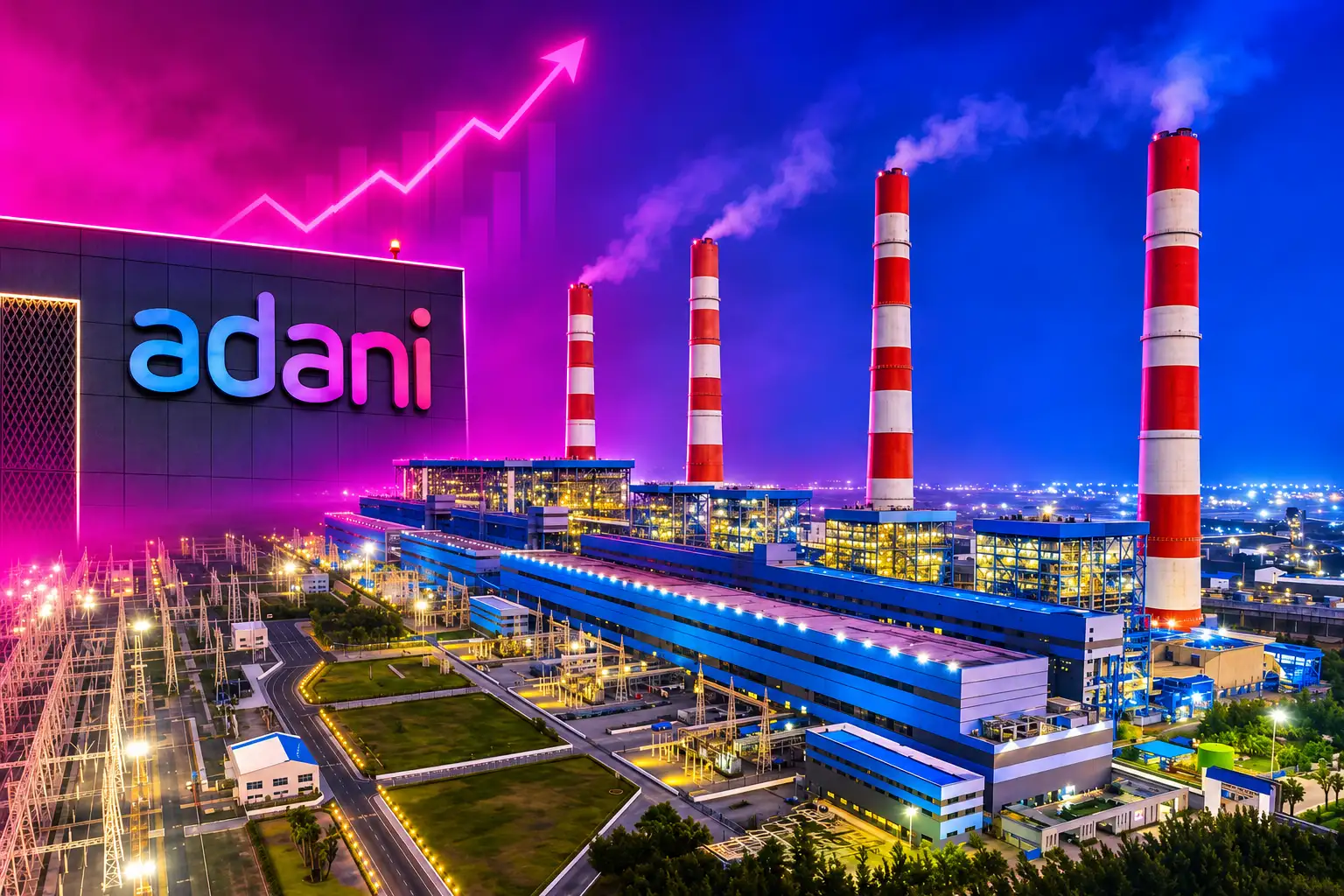
Adani Power Is on Track to Pass Ports
Ports is still the largest EBITDA contributor through FY27-FY29, Jefferies said. By FY29, Adani Power is projected to take that crown. The shift is already visible in the group’s own FY26 split, where the utility stack out-earned transport.
Adani Power posted a Q2 profit of ₹7,019 crore, up 142% from a year earlier, including prior-period items. Continuing EBITDA for that quarter rose 18.5% to ₹6,321 crore. The thermal producer is aiming for 42 GW by FY32, with 23.7 GW already locked in against 18.2 GW of current capacity.
FY26 EBITDA BY COMPANY
| Company | FY26 EBITDA (₹ cr) | Change vs FY25 |
|---|---|---|
| Adani Ports and SEZ | 25,228 | +23.2% |
| Adani Power | 23,321 | -2.5% |
| Adani Enterprises | 16,643 | -3.9% |
| Adani Green Energy | 12,075 | +14.6% |
| Adani Energy Solutions | 8,726 | +12.6% |
| Ambuja / Adani Cement | 7,586 | -12.2% |
Portfolio EBITDA was ₹94,834 crore, up 5.6%, with core infrastructure contributing 87%. Utility EBITDA was ₹45,377 crore, already well above transport’s ₹25,228 crore. Jefferies still models 22% EBITDA growth at Adani Power over FY26-FY29, and 18% EPS growth, even as group free cash flow stays negative because the build is so large.
How Jefferies Splits the $51 Billion
The $51 billion of planned spend over FY27-FY29 is about 28% of capex Jefferies counts across large private Indian groups. Adani Power and Adani Green are the joint largest spenders, at about 24% of the pool each. Enterprises is third.
Jefferies has already argued, in its Jefferies India energy transition research, that private groups will do most of the next capacity build. Monday’s Adani note turns that sector view into six stock ratings, with Green Energy taking about ₹1.2 trillion of capex over FY27-FY29, around a quarter of the group total.
CAPEX SHARE AND DEBT FUNDING
- Adani Power: About 24% of group capex, with only about 47% of that spend debt-funded and the rest from internal cash.
- Adani Green Energy: About one-fourth of group capex, with about 75% debt-funded against about 48% for the group as a whole.
- Adani Energy Solutions: About 15% of group capex and about 11% of EBITDA, with about 72% of its spend debt-funded.
- Adani Enterprises: Third-largest spender after Power and Green, with about 48% of its capex debt-funded, and the fastest EPS compound rate at 59%.
- Adani Ports: The only company Jefferies expects to cut debt, by about ₹19,000 crore, funding 100% of capex from cash generation.
- Ambuja Cements: Negligible long-term debt, with planned capex also funded from internal cash, and a 26% EPS compound rate.
Green Energy is the group’s second-fastest grower on Jefferies’ numbers, at a 28% EPS compound rate, behind only Enterprises. Energy Solutions is modelled at 22% EPS growth. The funding gap is the tell: the two transmission-and-renewables names borrow much more of their build than Ports, Ambuja or even Power.
Leverage Fell, and Free Cash Flow Still Goes Negative
Jefferies said the credit profile has normalised after the swing between January 2023 and November 2024. Aggregate net debt-to-EBITDA at the covered companies, including sponsor debt, fell to 4.1 times in FY26 from 6.9 times in FY22. Rating outlooks have stabilised, institutional ownership has risen, and promoter pledges are largely unwound. Leverage remains moderately elevated, the desk added.
Adani’s own portfolio figures sit on a different perimeter. The group reported portfolio net debt-to-EBITDA of 3.3 times at FY26, below its 3.5 times cap, after a record ₹1,52,967 crore of capex. Cash was ₹55,852 crore, equal to 15% of gross debt. The average borrowing cost fell to 7.8% from 9% two years earlier, and Adani said 100% of run-rate EBITDA now comes from assets rated A- or higher in India.
THE CREDIT CLOCK BEHIND THE NOTE
- 24 January 2023: Hindenburg Research publishes its short report, and Adani stocks and bonds sell off in the weeks that follow.
- November 2024: US SEC and Justice Department actions against group entities begin, opening a second stretch of funding stress.
- FY26 year-end: Jefferies’ covered-company net debt-to-EBITDA prints at 4.1 times; Adani’s portfolio ratio prints at 3.3 times, with pledges largely off.
- 16 November 2026: Jefferies publishes the conglomerate note with six Buys, and still flags moderately elevated leverage plus three years of negative free cash flow.
Promoter ownership of about 62-75%, above other Indian groups, gives extra room to inject equity, Jefferies said. That flexibility is part of the bet. It is also why the negative free cash flow line sits so close to the Buy list: the $51 billion will not fund itself from operations while the plants and lines are still going up.
Target Prices Versus Monday’s Tape
Jefferies set 12-month targets of ₹3,830 on Enterprises, ₹2,180 on Ports, ₹240 on Power, ₹1,695 on Green Energy, ₹1,980 on Energy Solutions and ₹475 on Ambuja. In Monday morning trade on 16 November, the six names were mixed to lower even as the broader tape held up.
JEFFERIES TARGETS VERSUS MONDAY MORNING PRICES
| Stock | Target (₹) | Monday morning (₹) | Implied upside |
|---|---|---|---|
| Adani Enterprises | 3,830 | 2,667.70 | 43.6% |
| Adani Energy Solutions | 1,980 | 1,435.70 | 37.9% |
| Ambuja Cements | 475 | 382.70 | 24.1% |
| Adani Green Energy | 1,695 | 1,392.70 | 21.7% |
| Adani Power | 240 | 205.73 | 16.7% |
| Adani Ports and SEZ | 2,180 | 1,902.80 | 14.6% |
Enterprises carries both the highest target upside and the 59% EPS compound rate, because it incubates airports, data centres, copper, defence and new energy. Ports, the cash engine, has the tightest upside on this sheet. The tape on 16 November did not re-rate the six names on the headline. The note is a three-year cash-flow argument, not a one-day catalyst.
Ports and Ambuja Carry No New Debt
Adani Ports is the exception that funds the story’s safer end. Jefferies expects it to remain the largest EBITDA contributor over FY27-FY29 even as Power catches up, and to be the only name that reduces overall debt, by about ₹19,000 crore, while paying for 100% of capex from cash. Cargo in FY26 was 500.8 million tonnes, up 11%, and the company closed the NQXT Australia purchase in December 2025.
Ambuja is the other self-funded line. Jefferies models a 26% EPS compound rate with negligible long-term debt and capex covered internally. Cement EBITDA fell 12.2% in FY26 to ₹7,586 crore, so the forward EPS math assumes a volume and utilisation recovery, not a repeat of last year’s drop. Cement sales were 73.7 million tonnes in FY26, up 16.1%, after the Orient Cement deal.
Those two balance sheets are why Jefferies can argue the group’s earnings will get steadier even as Green Energy and Energy Solutions borrow 75% and 72% of their spend. Ports and Ambuja are the cash ballast. Power sits in the middle: high capex, but only about 47% debt-funded, on a book Jefferies still calls strong.
The Wager Now Hinges on Execution
The live question is not whether Adani can announce capacity. It is whether a $51 billion programme, with free cash flow still negative, lands on time without the ratio drifting back up. Interlinked funding across group companies, project delays and the debt load at Green Energy and Energy Solutions are the risks Jefferies itself left on the page.
Sell-side opinion is not uniform on the fastest-spending utility. In August, Bernstein kept Outperform ratings on Ports and Power, with targets of ₹1,973 and ₹220, and kept Underperform on Green Energy with a ₹980 target, after cutting its FY27 EBITDA estimate by 10% and calling the stock expensive. Jefferies’ ₹1,695 Green Energy target was already in its work by October, after a Khavda site visit, so Monday’s six-stock stamp is a group wrapper around a utilities desk that had already chosen a side.
WHERE DESKS SPLIT ON GREEN ENERGY
- Jefferies, November 2026: Buy, target ₹1,695, 28% EPS compound rate, about ₹1.2 trillion of capex with 75% debt-funded.
- Bernstein, August 2026: Underperform, target ₹980, after a 10% cut to FY27 EBITDA and a rich-valuation call.
Enterprises is the swing incubator inside the same bet. Jefferies said in-house engineering and deal-making let the group scale fast, while Enterprises pushes into new energy, data centres, defence and copper. That 59% EPS path is the least utility-like number on the sheet, and it depends on those newer lines turning into cash rather than just capex slides.
Monday’s note asks investors to fund a utility conversion while the cash account stays negative for three years. Power is modelled to pass Ports. Green Energy is modelled to borrow three-quarters of a ₹1.2 trillion build. Ports and Ambuja are modelled to take on no new debt. The six Buys stand or fall on whether that mix is built as drawn.
Disclaimer: This article is news reporting and analysis of a published brokerage note, and it is for information only. It is not investment advice, a research report, or a recommendation to buy, sell or hold any Adani Group security or any other listed stock. Readers should consult a SEBI-registered investment adviser or other qualified financial professional who can consider their own objectives, risk limits and time horizon before acting. Ratings, target prices, capex plans, leverage ratios and trading prices reflect the cited sources as of 16 November 2026 and can change as earnings, funding and broker views move.

Gold Prices Fall to a 14-Month Low Despite Strikes

SpiceJet Clears a Rs 5,500 Crore Raise After Mumbai Stalled

Honda Activa’s Record Month Came With a Share Loss

Sony Turns the GTA 6 Launch Into a Firmware Gate

Xiaomi 18 Leak Skips the Rear Screen for Battery

Volkswagen Sells the Osnabruck Plant to Clear a Board Fight

Apple’s Foldable iPhone Hinges on Samsung Display Supply

Saksham Gaur Finds He Is His Own Company’s Client

Tata Motors’ Iveco Tender Opens as Holders Still Decide

What Is SD on Amazon Prime?
-
 AUTO2 months ago
Volkswagen Sells the Osnabruck Plant to Clear a Board Fight
-
 NEWS3 months ago
Apple’s Foldable iPhone Hinges on Samsung Display Supply
-
 BUSINESS3 months ago
Saksham Gaur Finds He Is His Own Company’s Client
-
 AUTO3 months ago
Tata Motors’ Iveco Tender Opens as Holders Still Decide
-
 TECHNOLOGY3 years ago
What Is SD on Amazon Prime?
-

 BUSINESS3 months ago
Hyderabad 22-Carat Gold Jumps After a False Bargain
-

 GAMING3 months ago
Onimusha Way of the Sword Preload Hits a Windows 11 Wall
-
 BUSINESS3 months ago
UltraTech Ultravolt Launch Splits Friday Stocks to Watch