
BUSINESS
India’s 1,150 kV Corridor Is Timed Past the 2030 Goal
NCT cleared a ₹68,816 crore, 1,150 kV west-east line on November 9, but the studies run to 2031-32 and new coal rides the same towers.

India’s National Committee on Transmission approved a ₹68,816 crore ($7.34 billion), 1,150 kV power corridor on November 9. The line would be the highest-voltage AC link the country has ever built, a jump above the 765 kV backbone that still carries most bulk power.
Planners present it as a path for Rajasthan solar toward Odisha industry. The studies that justify it run to 2031-32, after the 500 GW non-fossil date, and they put new coal plants on the same towers.
India’s First 1,150 kV Corridor Gets the Nod
The 45th meeting of the National Committee on Transmission cleared a first-of-its-kind ultra-high-voltage AC scheme linking the Western and Eastern Regions. Central Transmission Utility of India Ltd had taken the same corridor through a special joint consultation on September 21, after a CEA technical committee recommended 1,150 kV for future bulk flows.
CEA’s 2026 Manual on Transmission Planning Criteria, in force from October 15, already lists 1,150 kV as a planning voltage, one step above 765 kV. The NCT vote turns that line on a page into a build.
HOW THE 1,150 KV PLAN REACHED A VOTE
- September 21, 2026: CTUIL presents the 1,150 kV west-east corridor to a special joint consultation of the Western, Eastern and Northern Regions.
- October 15, 2026: CEA’s revised transmission planning manual takes effect with 1,150 kV in the rulebook.
- November 9, 2026: The 45th NCT meeting approves the project at ₹68,816 crore.
Phase 1, the slice now proposed for award, would plant new 1,150 kV substations at Raigarh Kotra-III in Chhattisgarh, Bolangir and Begunia in Odisha, and Chaibasa and Basantpur toward Jharkhand and West Bengal. A matching ±800 kV, 6,000 MW HVDC link from Bhadla-IV in Rajasthan into Raigarh is bundled with that first phase.
The full evolved backbone, including a later Maharashtra leg through Aurangabad, Wardha and Rajnandgaon, runs about 3,750 circuit kilometres, nine substations and 66,000 MVA of transformation. CTUIL told the September meeting the entire project cost would sit in the National Component for tariff-setting, so the bill is socialised across the inter-state grid rather than parked on one state.
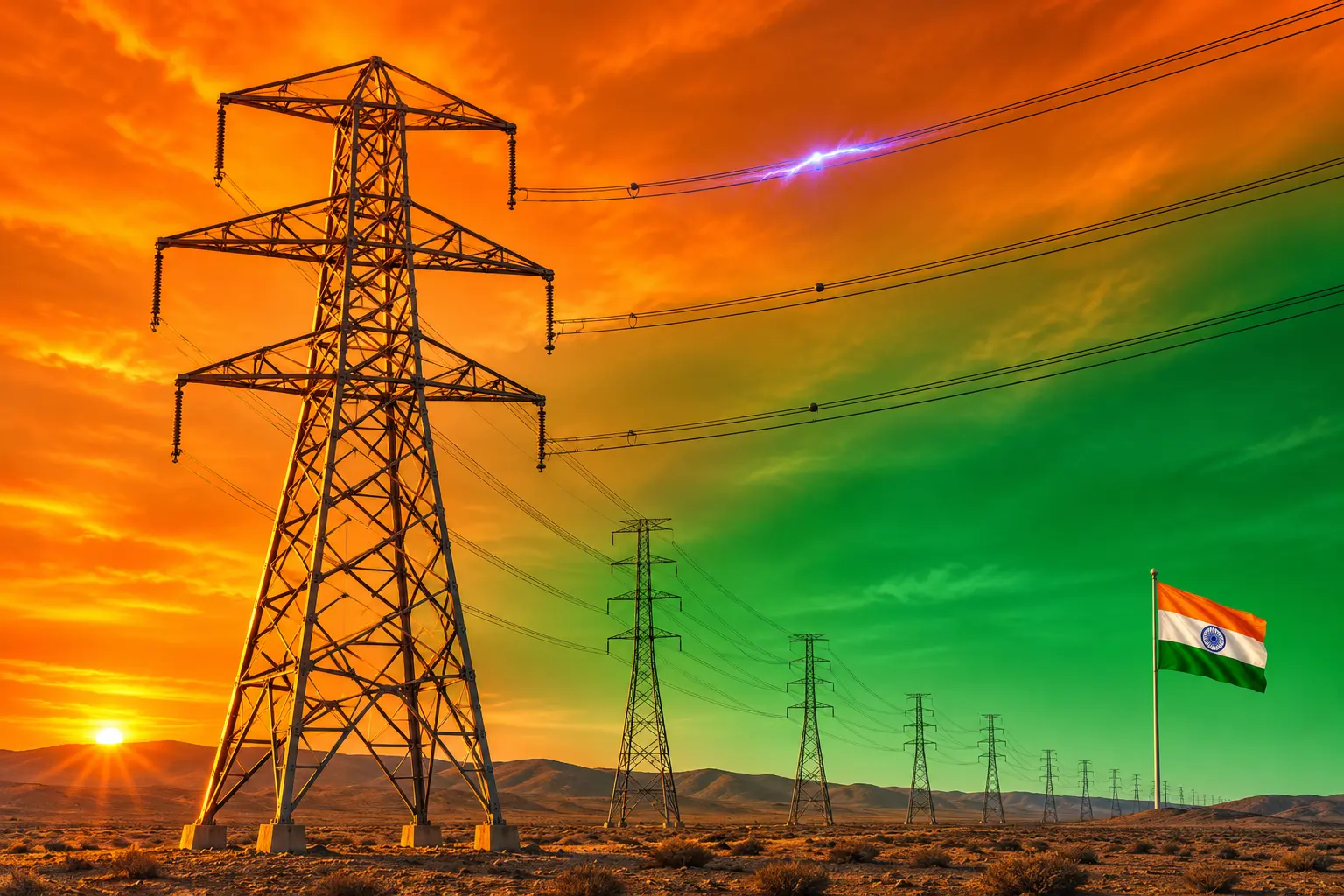
The Planning Year Is 2031-32
NCT minutes for November 9 say the supporting studies were run for 2031-32. That is the year after India has promised 500 GW of non-fossil capacity. New and Renewable Energy Minister Pralhad Joshi, speaking in early November, put non-fossil capacity at 310 GW and said the country still needed 190 GW and more than $220 billion to hit 500 GW by 2030.
On July 31 the tally had been 300.50 GW, more than 54% of installed generation. Joshi had already called the 500 GW goal within reach in August, and he has said transmission lines still take three to five years, a lag he named as a brake on faster renewable take-up.
Ember, the energy think tank, found India met only about 80 percent of annual transmission targets over the past five years, adding around 13,000 circuit kilometres a year against a target near 16,230. For FY2026-27 the ISTS target alone has risen to 25,146 circuit kilometres, with 61,411 circuit kilometres of extra ISTS pegged as needed by FY2029-30.
About one in four ISTS schemes due in FY2026-27 is already running a year or more late. Solar and wind plants still go up in 12 to 18 months. The 1,150 kV spine is being planned on thermal-era clocks for a grid whose new supply is not thermal.
These significantly influence future power flow patterns and are expected to increase bulk power transfer requirements between Western Region and Eastern Region.
Minutes of the 45th meeting of the National Committee on Transmission, November 9, 2026
Joshi has told investors the first 100 GW of clean capacity took decades, the next 100 GW took seven years, and the latest 100 GW took two. The wires have not matched that last burst. Ember’s Q1 2026 reading was blunt: 300 GWh of the 470 GWh of ISTS renewable energy curtailed in January to March was down to transmission constraints, mostly at northern and western pooling stations.
Raigarh Coal and Paradeep Hydrogen Share the Towers
The corridor is not a solar pipe with a single cargo. CTUIL’s September studies, which the NCT then adopted, stack new coal, new wind and solar, batteries, pumped storage and Odisha’s industrial load onto one backbone. About 5.2 GW of thermal plant at Raigarh Kotra-III sits in the model even though, the minutes note, no General Network Access applications had arrived at that substation.
WHAT THE 2031-32 STUDIES PUT ON THE LINE
| Cargo in the studies | Size | Location |
|---|---|---|
| Thermal at Raigarh Kotra-III | 5.2 GW | Godna 1,600 MW, Akaltara 1,800 MW, KSK Mahanadi 1,800 MW |
| Renewables at Bhadla-IV and Ramgarh-II | 12 GW | Rajasthan (6 GW each) |
| Batteries at those two nodes | 3,390 MW and 2,685 MW | Bhadla-IV and Ramgarh-II |
| HVDC from Bhadla-IV | 6,000 MW | Into Raigarh Kotra-III |
| Paradeep industrial demand, applications | 5.35 GW | Odisha (6 GW potential) |
| Gopalpur industrial demand, applications | 3.575 GW | Odisha (6 GW potential) |
Paradeep and Gopalpur are the eastern weights: green hydrogen and ammonia, steel, petrochemicals, solar-module plants and EV factories. CTUIL called those demand centres a principal driver of the corridor, and said 8 to 9 GW of ISTS load plus 1.5 to 2 GW of intra-state load in coastal Odisha still hangs off Angul and needs another path. Jeypore shows 2.9 GW of potential and no applications.
The same NCT minutes fold in about 124 GW of battery storage and 42 GW of pumped storage across the wider 2031-32 case, plus hydro and thermal in the North-East. A west-east 1,150 kV spine is being asked to move desert solar at noon, Chhattisgarh coal around the clock, and a hydrogen industry that has not yet proved how much power it will actually draw.
Why an NCT Expert Preferred a 765 kV Line
S.R. Narasimhan, an expert member of the NCT and former chairman and managing director of Grid Controller of India, put that mix on the record. The November 9 minutes log his view that the studies assume a 7.64% compound annual rise in peak demand from 2026-27 to 2031-32, which he called “quite high.”
He also warned of a “strong possibility” of low loading on the 1,150 kV lines in non-solar hours, tied to “uncertainty about power drawl by the green hydrogen and green ammonia projects.” On LinkedIn he wrote that a 765 kV line, or an extension of an existing HVDC link into the east, would be a “more elegant and practical arrangement.”
WHERE THE NCT SPLIT
- The planners: 2031-32 flows from Rajasthan, Maharashtra, Chhattisgarh and the North-East toward Odisha industry need a west-east ultra-high-voltage AC backbone and a 6,000 MW HVDC feed from Bhadla.
- Narasimhan: The demand growth rate is too steep, night-time loading looks weak if hydrogen slips, and 765 kV or more HVDC would do the job with kit India already knows.
CTUIL’s own loading tables for Phase 1 already show four of eight 1,150 kV lines above 4,000 MW in the base case, with Raigarh Kotra to Bolangir hitting 3,400 MW per circuit and 5,660 MW after a single-circuit outage. The disagreement is not whether east-west transfer will grow. It is whether India should open a new voltage class for it before the hydrogen offtake is bankable and before 765 kV and HVDC have been stretched further.
118.6 GW Felt the Back-Down Orders in September
The 2031-32 spine does nothing for the solar that was already turned down this monsoon. JMK Research and Analytics, working from Grid-India instructions, found 378.52 million units curtailed in September, equal to 1.28% of renewable generation. A cumulative 118.6 GW of capacity was touched by those orders, 96.9 GW of solar and 21.7 GW of wind. That is a sum of daily hits, not 118.6 GW switched off at once.
SEPTEMBER 2026 CURTAILMENT
- Where it landed: Gujarat 187.76 million units (49.6%) and Rajasthan 110 million units (29.1%) made up about 79% of the national total; Rajasthan’s slice was all solar, Gujarat took 43.75 million units of wind.
- What triggered it: 231.79 million units (61%) went out as Emergency TRAS Down, a balancing instruction, and 146.73 million units (39%) as real-time system constraints.
- The seasonal peak: Curtailment hit 1,166.52 million units in July after about 44.6 GW of solar was added in FY2026; September was 43.31% lower than August and 24% below September 2025, a seasonal dip, not a structural fix.
- The storage scale: 378.52 million units over the month averages 12.6 GWh a day, roughly 3 GW of four-hour batteries as an illustrative soak.
Wind’s share of curtailed energy jumped from 4.7% a year earlier to 17%, with output down 64.98 million units, nearly triple. Solar still supplied 314 million units, about 83%, of what was wasted. JMK’s point is that September’s back-downs were mostly the system refusing extra midday power, not only a blocked line.
That matches the geography of the new corridor only in part. Gujarat and Rajasthan, not Odisha, produced the dumped kilowatt-hours. Ember separately counts 20 GW of renewable capacity facing connectivity delays of more than four months in FY2026-27, and a 6- to 12-month wait can cut a project’s internal rate of return by 100 to 200 basis points. Plants on temporary grid access also get no pay when they are curtailed.
India was the world’s third-largest power user in 2025, with clean sources supplying 27% of electricity, solar 9.4% and wind plus solar 14%, on Ember’s figures. It had already climbed to fourth among clean-electricity producers. The constraint is no longer whether the plants get built. It is whether the noon surplus can move, or sit in a battery, before the evening peak.
Equipment Makers Get Two to Three Years to Tool Up
CTUIL set the build at 60 months from the date of allocation, not from the November 9 vote. The extra length is explicit: testing labs and a manufacturing base for 1,150 kV kit need the first two to three years after award. India has never run 1,150 kV as a commercial voltage. The 765 kV fleet is the high end of what factories now ship in volume.
On paper the new class earns its keep. CTUIL’s briefing gives the corridor a surge impedance loading of about 5,500 MW and a thermal transfer capability of about 14,000 MVA with octa-bundle Bersimis conductor. Terminal transfer sits near 9,500 MVA, in line with 5,000 A bay gear. One 1,150 kV double circuit is meant to replace several 765 kV corridors and spare right of way.
Those ratings assume the transformers, 1,200 kV reactors, 5 kA bays and insulator strings actually exist in series, not as a one-off test article. The 60-month clock is therefore also an industrial policy. Transformer and tower shops that have lived on 400 kV and 765 kV work are being asked to stand up a voltage class whose commercial order book, until November 9, was zero.
Right of way, forest clearances and a thin global HVDC supplier base already slow the ordinary 765 kV and ±800 kV jobs in Ember’s audit. A first-of-kind AC voltage adds type tests, spares and a workforce that has not built this kit at scale. If allocation slips, 60 months slides past 2032. If it holds, the line still arrives as a 2031-32 machine, which is exactly the year the studies used, and exactly not the year the 500 GW pledge comes due.
CEA’s Draft Storage Rule Hits New Plants in 2027
The near-term lever in the same files is batteries, not towers. Ember puts the soak that would absorb most transmission-tied curtailment at 3 to 4 GW of two-hour storage, against 236 GW of battery connectivity already queued at major pooling stations. It prices storage at INR 4.0 to 4.5 per kWh and solar at about INR 2.5, a delivered INR 7 to 8 against the INR 10 many states pay for peak power.
CEA has put that logic into draft construction standards. From 1 July 2027, new ground-mounted solar and onshore wind plants would need 10 percent co-located storage from July 2027, with a two-hour duration, plus grid-forming controls on at least 15% of inverters and on every battery converter. From 1 July 2029 through 30 June 2031 the duration would rise to four hours at the same 10% power share. A 100 MW solar plant would need 10 MW for two hours, then 10 MW for four.
WHAT THE CEA STORAGE DRAFT WOULD REQUIRE
- From 1 July 2027: Co-located storage equal to 10% of plant capacity for two hours on new ground-mounted solar and onshore wind, and grid-forming kit on 15% of inverters.
- From 1 July 2029 to 30 June 2031: The same 10% power share, held for four hours instead of two.
- Worked example: A 100 MW solar plant would carry 10 MW / 2 hours, then 10 MW / 4 hours in the later window.
- Status: Draft amending CEA construction standards, not yet in the gazette, so the dates can still move.
That draft, if gazetted, would start biting in 2027, four years before a 60-month 1,150 kV line allocated even in 2027 could carry a load. It would also start in Gujarat and Rajasthan, where September’s wasted units actually appeared, rather than on the Odisha coast where the hydrogen parks are still applications in a spreadsheet.
The NCT was right that 765 kV is running out of right of way, and that west-east transfer in the next decade will be larger than today’s corridors were built for. The ₹68,816 crore vote still leaves the 500 GW deadline on the existing grid, with new coal and unproven hydrogen booked on the same future towers, and with a factory base that the planners themselves say needs two to three years to exist.

Gold Prices Fall to a 14-Month Low Despite Strikes

SpiceJet Clears a Rs 5,500 Crore Raise After Mumbai Stalled

Honda Activa’s Record Month Came With a Share Loss

Sony Turns the GTA 6 Launch Into a Firmware Gate

Xiaomi 18 Leak Skips the Rear Screen for Battery

Volkswagen Sells the Osnabruck Plant to Clear a Board Fight

Apple’s Foldable iPhone Hinges on Samsung Display Supply

Saksham Gaur Finds He Is His Own Company’s Client

Tata Motors’ Iveco Tender Opens as Holders Still Decide

What Is SD on Amazon Prime?
-
 AUTO2 months ago
Volkswagen Sells the Osnabruck Plant to Clear a Board Fight
-
 NEWS3 months ago
Apple’s Foldable iPhone Hinges on Samsung Display Supply
-
 BUSINESS3 months ago
Saksham Gaur Finds He Is His Own Company’s Client
-
 AUTO3 months ago
Tata Motors’ Iveco Tender Opens as Holders Still Decide
-
 TECHNOLOGY3 years ago
What Is SD on Amazon Prime?
-

 BUSINESS3 months ago
Hyderabad 22-Carat Gold Jumps After a False Bargain
-

 GAMING3 months ago
Onimusha Way of the Sword Preload Hits a Windows 11 Wall
-
 BUSINESS3 months ago
UltraTech Ultravolt Launch Splits Friday Stocks to Watch