
BUSINESS
Anthropic’s IPO Puts Public Buyers Last in Line
Anthropic’s S-1 sells Claude’s growth to public buyers who get Class A economics, not the vote, while Amazon, Google and Microsoft already sit on three sides.

Anthropic filed for a Nasdaq listing on October 26, 2026, with $16.286 billion of first-half revenue and a founder share that keeps 50.1% of the vote. The price and the share count are blank. Class A buyers would own a slice of Claude, not the board and not the vote that settles ordinary fights.
The filing is not a rescue round. As of June 30, 2026, the company had already raised $141.1 billion and held $131.7 billion in cash and short-term investments. What the public is being offered is residual economics in a firm the founders, a trust and three cloud groups already run from other chairs.
Public Buyers Get Claude’s Cash Flow, Not the Steering Wheel
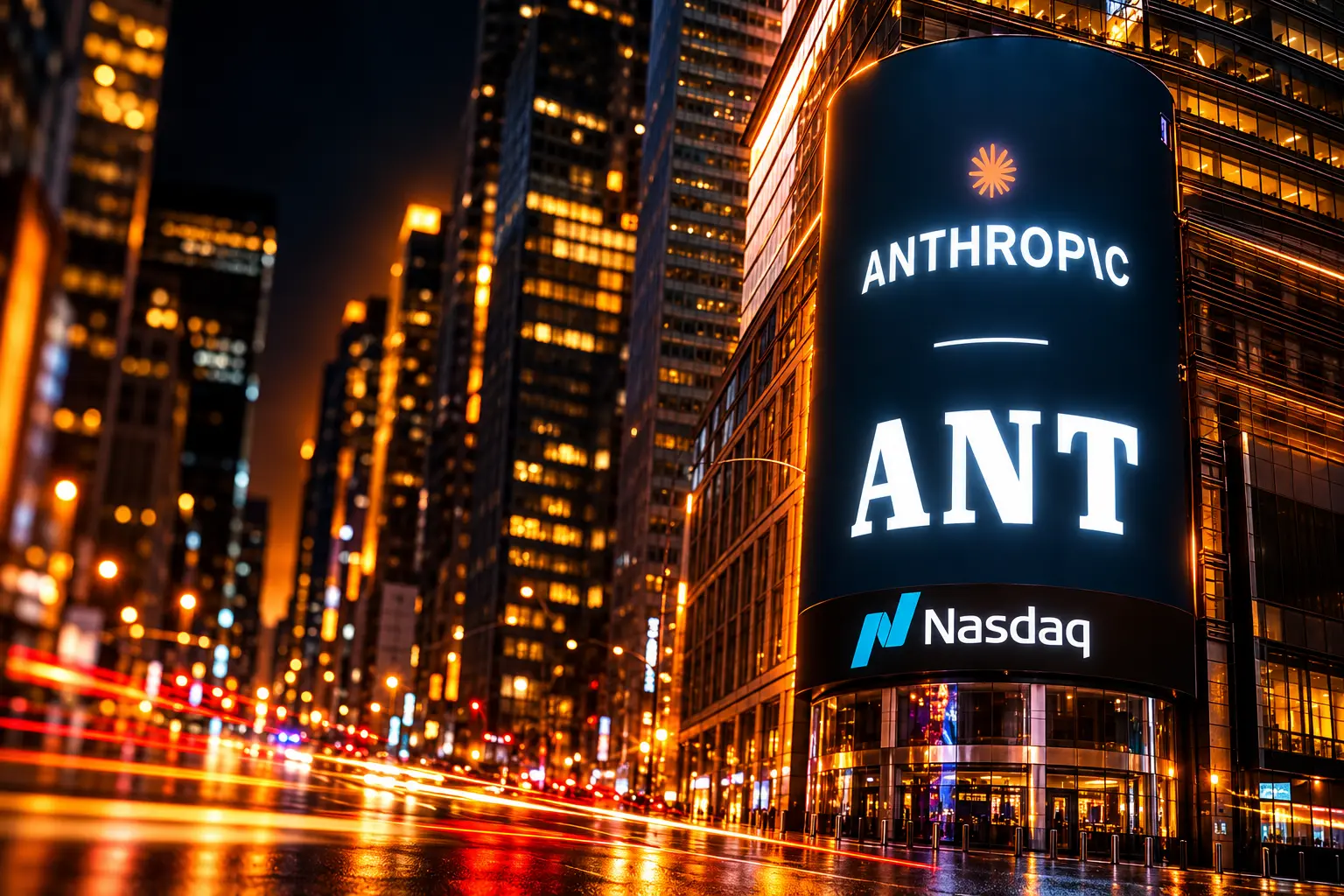
Anthropic, PBC, the Delaware public benefit corporation behind Claude, lodged a registration statement on Form S-1 at 9:00 a.m. Eastern on October 26, 2026, under file number 333-299633. It wants to list Class A common stock on the Nasdaq Global Select Market as ANT. Goldman Sachs and Morgan Stanley lead the books. The cover still prints the offer price as empty dollars.
The company says it is first and foremost a research lab. It sells model access, a platform for developers and ready tools such as Claude Code. About 80% of revenue is usage fees billed on tokens. About 20% is subscriptions. That mix can grow fast when customers hand Claude more work. It also means most of the top line is not locked under long contracts.
Use of proceeds is ordinary on the page: compute, hiring, working capital, and tax withholding on staff stock units. Selling stockholders will sell too, and the company will not see those checks. With $112.4 billion of cash and $19.3 billion of short-term investments already on the June 30 balance sheet, the listing is a public market and an exit path more than a search for survival money.
Three Hats on the Same Cloud Giants
Amazon, Google and Microsoft show up in the filing as investors, as the landlords of the chips and data centers Claude runs on, and as the stores that collect a large share of sales. That is one set of firms sitting on three sides of the same company.
THE THREE HATS
- The equity: Amazon and Google hold non-voting Class N stock, the class built for strategic partners, and Amazon’s notes are written to convert into more of that class, with a 12% cap unless it waives the limit.
- The bill: Named floors in the filing run at least $114.5 billion at Google Cloud to July 2033, at least $110 billion at Amazon to April 2036, and at least $44.9 billion at Microsoft to May 2033, in each case payable even if the capacity sits idle.
- The till: Sales through cloud marketplaces were 11% of revenue in 2023, 32% in 2024, 47% in 2025 and 48% in the first half of 2026.
Those storefronts belong to groups that also train rival models. The prospectus says partners have not supplied all the compute Anthropic asked for. When capacity is tight, the same names can feed Claude, feed themselves, or do both while still collecting rent. Google also holds an option to buy more non-voting stock at the IPO price, which would put it on the bid as well as on the invoice.
Booked sales through those channels can look like pure demand. Some of the dollars are still moving through companies that already own a piece of Anthropic and already sell it power. That does not make the revenue fake. It does make the public the last party to see a clean split between customer pull and supplier self-dealing.
Why Founders Keep 50.1% After Listing
Immediately before the offering closes, Anthropic will issue one Class F share to Founder LLC. The first members are chief executive Dario Amodei, president and board chair Daniela Amodei, Tom Brown, Jack Clark, Jared Kaplan, Sam McCandlish and Christopher Olah. That single share has no claim on profits. It is entitled to 50.1% of the vote on matters put to stockholders generally, including the directors the trust does not pick.
Our Class F common stock, which will be held by the Founder LLC, will be entitled to an aggregate number of votes that equals 50.1% of the total voting power of our outstanding shares of capital stock with respect to matters submitted to stockholders generally, including the election of our directors other than the Class T directors. Our Class F common stock will not have any economic rights.
Anthropic, PBC, Form S-1, October 26, 2026
Class A, the stock the public can buy, gets one vote per share. Class N, the strategic class, gets none except where the law forces a vote, and converts to Class A if it is sold to an unaffiliated buyer. New issues do not knock Class F off 50.1%. The share cannot be sold in the ordinary way. Public buyers can own a large economic stake and still lose every ordinary show of hands.
THE FIVE SHARE CLASSES
| Class | Who holds it | Vote | Economics |
|---|---|---|---|
| Class A | Public buyers | One vote per share | Yes |
| Class N | Strategic partners | None, except as required by law | Yes |
| Class T | Long-Term Benefit Trust | Elects a majority of the board | No |
| Class F | Founder LLC | 50.1% on ordinary matters | No |
| Class E | Employees other than the co-founders | Narrow special matters only | No |
The filing calls the setup novel and says it has no direct public-company precedent. It also warns that the design will likely block unsolicited mergers, tenders and proxy fights, which can keep Class A holders from selling into a premium bid. Nasdaq will treat Anthropic as a controlled company because the trust can elect a board majority, which lets it skip some independent-committee rules.
A Trust of Disinterested Trustees Picks the Board
The Long-Term Benefit Trust holds the one Class T share. That share does not vote on ordinary stockholder business. It generally elects and removes the Class T directors, who form a majority of the seven authorised seats. The trust is meant to be financially disinterested, with people drawn from AI safety, national security, public policy and social enterprise. Neil Shah chairs it. Ben Bernanke, Richard Fontaine and Christopher Stubbs sit as trustees, with one seat open.
The current board is chaired by Daniela Amodei and includes Dario Amodei, Reed Hastings, Christopher Liddell, Vas Narasimhan and Yasmin Razavi, with one vacancy. After the listing, the trust and Founder LLC will, together, be able to elect every director. The company’s stated public benefit is the responsible development and maintenance of advanced AI for the long-term benefit of humanity. Directors must balance that purpose against stockholder money and the interests of people the business affects.
On October 18, 2026, Anthropic said it would put 5% of Anthropic’s shares into a Public Benefit Fund, with another 2% added, at the board’s discretion, each time the company’s value rises 50% above a set baseline. The co-founders had already pledged 80% of their equity, and the company said the combined pool would be about 20% of shares aimed at public-benefit uses, before any extra milestone grants. That is real dilution tied to success. It is not a vote for Class A.
$16.286 Billion in Six Months, Then a First Operating Profit
The growth line is the reason anyone will look past the vote. Revenue was $41 million in 2023, $386 million in 2024 and $4.585 billion in 2025. For the six months ended June 30, 2026, it was $16.286 billion, up 1,300% from $1.163 billion a year earlier, and more than three times the whole of 2025. Second-quarter sales were $11.555 billion, up 1,368% year on year.
FIRST-HALF RESULTS IN THE FILING
| Period | Revenue | Operating result |
|---|---|---|
| Full year 2025 | $4.585 billion | $8.060 billion loss |
| First half 2025 | $1.163 billion | $2.135 billion loss |
| First half 2026 | $16.286 billion | $693 million loss |
| Second quarter 2026 | $11.555 billion | $974 million profit |
That second-quarter operating profit is the first in the quarterly table. The half still lost $693 million at the operating line, on $8.945 billion of compute and infrastructure and $3.152 billion of personnel. The net loss for the same half was $80.748 billion. Of that, $72.388 billion, nearly 90%, is a fair-value charge on convertible notes, related instruments and SAFEs as the private valuation rose. Full-year 2025 net loss was $41.965 billion. The charge is not cash leaving the building. It is the accounting cost of paper that got more valuable because the company did.
The optical loss will be the first number many readers see. Strip the mark-to-market and the operating hole is still there, only smaller than a year ago. Booked revenue is also not the same as cash in the door until receivables and deferred amounts are laid next to it. The filing’s own customer math is sturdier than either headline.
CUSTOMERS AS OF SEPTEMBER 30, 2026
- $100,000-plus: More than 11,900 customers on a trailing-twelve-month basis.
- $1 million-plus: More than 1,900 customers, with about 250 at $10 million or more.
- Repeat spend: Net revenue retention about 900%, meaning the measured cohort spent about nine times as much as a year earlier.
- Top of the book: No customer above 10% of revenue for the nine months ended September 30, 2026; about 79% of third-quarter revenue sat outside the top five, so those five were about 21%, down from about 36% in the first quarter.
Model versions released in the six months through September 30, 2026, accounted for over 80% of third-quarter revenue. The filing says Claude Opus 5.5 cut customer cost per task by 40% versus Opus 5. Cheaper tasks can lift usage and still pressure price. Anthropic’s own summary claims Claude has had the fastest enterprise adoption of any technology in history. That is the company’s line, not a third-party audit.
Pay the Compute Bill Even If Demand Cools
Compute is the largest operating cost, and it is mostly spoken for. The three named cloud floors alone add to $269.4 billion. The Google, Amazon and Microsoft contracts require payment whether the machines are full or not. Other counterparties in the same stack include Broadcom on equipment leases, plus a compute option with SpaceX and capacity from specialists such as Nscale and Lambda. Some summary lines in the public S-1 still print the grand total as a blank dollar figure.
NAMED CLOUD COMPUTE FLOORS
| Partner | Stated floor | Stated term |
|---|---|---|
| Google Cloud | At least $114.5 billion | April 2026 to July 2033 |
| Amazon | At least $110 billion | May 2026 to April 2036 |
| Microsoft | At least $44.9 billion | November 2026 to May 2033 |
| Three-cloud total | $269.4 billion | Through 2036 at the far end |
If usage keeps compounding at the 900% retention rate, those contracts look like a queue ticket for scarce chips. If growth cools, they look like rent on empty rooms, owed to the same groups that hold Class N stock and run the marketplaces. The public does not sit on those contracts. It sits on what is left after they are paid.
Blank Spaces Where the Price Should Sit
The May 2026 private round valued the company at $965 billion. Hallway talk since then has put a listing anywhere from $1.5 trillion to $2 trillion, with a possible raise of $100 billion or more and a target week around November 16. That is not on the cover. Anthropic’s own notice says the number of shares and the price range has not yet been determined, and that the registration is not yet effective. Securities cannot be sold until it is.
THE PATH TO A PUBLIC S-1
- June 1, 2026: Anthropic confidentially submits a draft S-1 to the SEC, keeping the numbers off the public file.
- October 18, 2026: It commits 5% of shares to the Public Benefit Fund, with extra grants tied to 50% value steps.
- October 26, 2026: The public S-1 lands at 9:00 a.m. Eastern, ticker ANT, price and share count still blank.
WHAT WE KNOW
- The vote: Founder LLC holds 50.1% on ordinary matters; the trust elects a board majority; together they can fill every seat.
- The books through June 30: $16.286 billion of first-half revenue, a $693 million operating loss, a $974 million second-quarter operating profit, and an $80.748 billion net loss driven mostly by note revaluations.
- The cash: $131.7 billion in cash and short-term investments after $141.1 billion raised.
WHAT IS UNCONFIRMED
- The ask: Share count, price range and proceeds are empty in the filed cover.
- The listing week: Mid-November talk is from people around the deal, not from a dated company timetable in the S-1.
- Third-quarter dollars: The audited tables stop at June 30, 2026; circulating later-quarter figures are outside that statement.
Class A is a claim on Claude’s growth under a research-lab charter, a trust-picked board and a founder share that does not shrink. The cloud groups that already fund, host and resell the product keep their three seats at the table. Until Goldman Sachs and Morgan Stanley print a number, that is the deal the filing actually describes.
Disclaimer: This article is news reporting and analysis of Anthropic’s public S-1 and related company notices, and it is for information only. It is not a recommendation to buy, sell or hold ANT or any other security, and it is not tax, legal or investment advice. Readers should consult a licensed financial adviser or securities professional who can consider their own objectives and risk limits before acting on any IPO. Figures, share-class terms and offering details reflect the cited documents as dated and can change in later amendments, in the priced prospectus, or after listing.

Gold Prices Fall to a 14-Month Low Despite Strikes

SpiceJet Clears a Rs 5,500 Crore Raise After Mumbai Stalled

Honda Activa’s Record Month Came With a Share Loss

Sony Turns the GTA 6 Launch Into a Firmware Gate

Xiaomi 18 Leak Skips the Rear Screen for Battery

Volkswagen Sells the Osnabruck Plant to Clear a Board Fight

Apple’s Foldable iPhone Hinges on Samsung Display Supply

Saksham Gaur Finds He Is His Own Company’s Client

Tata Motors’ Iveco Tender Opens as Holders Still Decide

What Is SD on Amazon Prime?
-
 AUTO2 months ago
Volkswagen Sells the Osnabruck Plant to Clear a Board Fight
-
 NEWS3 months ago
Apple’s Foldable iPhone Hinges on Samsung Display Supply
-
 AUTO3 months ago
Tata Motors’ Iveco Tender Opens as Holders Still Decide
-
 BUSINESS3 months ago
Saksham Gaur Finds He Is His Own Company’s Client
-
 TECHNOLOGY3 years ago
What Is SD on Amazon Prime?
-

 BUSINESS3 months ago
Hyderabad 22-Carat Gold Jumps After a False Bargain
-

 GAMING3 months ago
Onimusha Way of the Sword Preload Hits a Windows 11 Wall
-

 ENTERTAINMENT2 years ago
Andy Scott’s Steel Loon Repeats the Kelpies Regeneration Bet