
NEWS
Statkraft Turns On a 50 MW Grid-Forming Battery at Neilston
Statkraft’s 50 MW Neilston battery is a NESO Pathfinder inertia plant on a site already consented for 750 MW, not a simple storage switch-on.

Statkraft has switched on a 50 MW grid-forming battery at Neilston Greener Grid Park in Renfrewshire, its first plant of that type in the UK. The Norwegian generator recorded commercial operation on 12 November 2026 and called the scheme one of the first of its kind to reach that stage on the British system.
The live plant is a stability machine on a Pathfinder contract. Scottish ministers have already consented 750 MW on the same field, fifteen times the capacity now running.
A 50 MW Switch-On With 750 MW Behind It
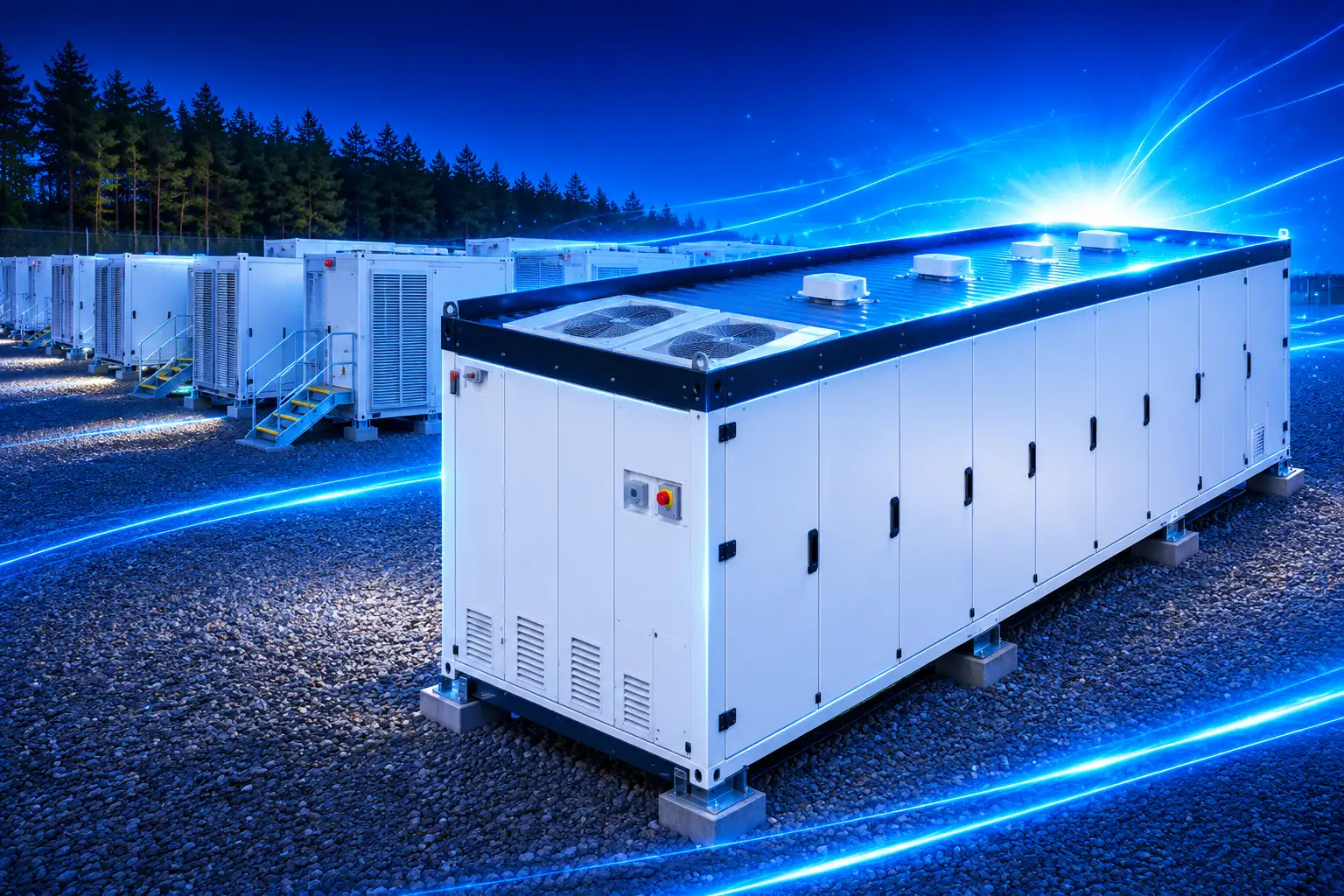
Statkraft, which describes itself as Europe’s largest generator of renewable energy, said it had completed the commissioning of phase one at the park just outside Paisley. The 50 MW battery energy storage system sits opposite Neilston substation on Gleniffer Road. It can store surplus power and send it back out, and it can also hold frequency and system strength when the network is hit.
Kevin O’Donovan, Statkraft’s UK and Ireland country manager, tied the switch-on to bills, security and the next wave of wind and solar.
Innovative projects like Neilston Greener Grid Park will help us to move away from fossil fuels to a low-carbon electricity system, stabilising consumer bills and strengthening Great Britain’s energy security. Urgent action is needed to transform our electricity grid and make it fit for the future. This scheme will enable more renewables to be connected to it, which will help mitigate the worsening impacts of our changing climate.
Kevin O’Donovan, UK and Ireland Country Manager, Statkraft
The company put the plant inside more than £2bn it has spent on UK renewable infrastructure since it entered the market in 2006. It also said it was the first firm to put dedicated community funds on battery and grid-stability projects from the construction phase, and that more than £50,000 has already gone to groups near the park.
NEILSTON IN NUMBERS
- Live now: 50 MW of grid-forming battery plant in commercial operation from 12 November 2026.
- Consented on site: 750 MW of approved operating capacity, including the 50 MW already running.
- UK spend: more than £2bn in renewable infrastructure since Statkraft arrived in 2006.
- Local fund: £20,000 a year in community benefit, with more than £50,000 already paid out.
Those four figures sit on one site. The 50 MW unit is the Pathfinder deliverable. The 750 MW figure is the planning envelope Scottish ministers signed off in August 2026, and it is not generating yet.
NESO Bought Inertia in a £323 Million Scottish Tender
The National Energy System Operator is the customer that made the 50 MW bankable. On 11 November 2026, NESO said the first projects from Stability Pathfinder Phase 2 had gone live in Scotland, including a grid-forming battery. Statkraft posted Neilston’s commercial operation the next day.
Phase 2 awarded ten contracts worth £323 million to four companies. The package was designed to secure 11.55 GVA of short circuit level in Scotland and 6.75 GVA seconds of inertia for Great Britain, using five synchronous condensers and five grid-forming batteries. NESO now puts the estimated cost-saving benefits over the 10-year contracts at about £500 million.
The original tender notice was blunt about why Scotland was first in line. Nuclear plant in Scotland and northern England was heading for closure, onshore and offshore wind was still rising, and the system was due to lose the spinning mass that holds frequency steady after a fault. The 10-year deals were written to start in April 2024. Neilston’s battery did not actually enter commercial operation until November 2026.
Matt Magill, NESO’s director of engineering and customer solutions, treated the go-live as a consumer-cost story as much as an engineering one.
These projects will help to accelerate progress towards the transition to a sustainable future by securing network resilience for consumers in Scotland and Great Britain. These sites will support network stability during disturbances and lower the cost of maintaining inertia on the system.
Matt Magill, Director of Engineering and Customer Solutions, NESO
The contracts run for ten years. From 2035 the same plant can bid into dedicated stability markets, which NESO says should pull in more competition. Until then, Neilston is paid to be a zero-carbon stand-in for the turbines that used to do this job by simply spinning.
It is not the first Pathfinder battery on the system. Zenobē put Blackhillock into commercial operation on 3 March 2025 at 200 MW and called it the first transmission-connected battery in the world to deliver full stability services to NESO. Kilmarnock South, a 300 MW Zenobē site, followed on 21 January 2026 as the second UK battery to do that work with grid-forming inverters. Statkraft’s wording is narrower, and accurate: Neilston is Statkraft’s first grid-forming battery, and one of the first in the UK.
What Grid-Forming Changes at the Neilston Node?
A conventional grid-scale battery follows the voltage and frequency already on the wires. It can shift energy in time and it can bid into fast frequency markets, but it needs a stable waveform to lock onto. Grid-forming inverters create their own voltage and frequency. They can hold a node up when the rest of the system is wobbling, which is the service NESO actually bought.
NESO’s own note puts most inverters today in the following camp. As more of that plant connects, the operator says a minimum level of grid-forming capability will be needed to keep the system stable. The Pathfinder batteries are meant to supply that floor in Scotland without keeping a gas unit running for its spinning mass.
WHAT THE INVERTERS MUST DO
- Own the waveform: Grid-forming plant sets voltage and frequency rather than tracking a waveform made by someone else.
- Hold inertia: When frequency starts to slide, the inverters inject or absorb power in line with the rate of change, the electronic version of a heavy rotor.
- Feed a fault: They push current into a short circuit so protection gear can see the fault and the voltage does not collapse.
- Ride a phase jump: They stay stable when the voltage angle on the system snaps, a test NESO uses because inverter plant has historically tripped there.
Julian Leslie, then head of networks at National Grid ESO, said at the contract award that the five Scottish batteries would be the first time grid-forming inverters had been used in several places across one region as a system-wide answer to short circuit level and inertia. That claim was about the map, not about a single 50 MW site. Neilston is one pin on that map.
Two Contracts Now Sit on One Renfrewshire Substation
Neilston was chosen because it is a thick node. Statkraft’s 2022 statement of need said the site is strongly tied into the Scottish transmission grid, that ScottishPower Transmission had plans to add connections there, and that 132 kV, 275 kV and 400 kV options all sat on the doorstep. The Pathfinder tender did not give Statkraft the node to itself.
WP Grid Services 9 Ltd won a separate Phase 2 contract for a synchronous condenser at Neilston. So the substation now has a battery that mimics a power station in software, and a free-spinning machine that mimics one in steel, paid under the same NESO round, owned by different firms.
STABILITY PATHFINDER PHASE 2 CONTRACTS
| Company | Location | Technology |
|---|---|---|
| Statkraft | Neilston | Grid-forming battery |
| Statkraft | Coylton | Grid-forming battery |
| Zenobe Energy Limited | Blackhillock | Grid-forming battery |
| Zenobe Energy Limited | Kilmarnock South | Grid-forming battery |
| Zenobe Energy Limited | Eccles | Grid-forming battery |
| WP Grid Services 9 Ltd | Neilston | Synchronous condenser |
| WP Grid Services 3 Ltd | Gretna | Synchronous condenser |
| WP Grid Services 8 Ltd | Rothienorman | Synchronous condenser |
| WP Grid Services 1 Ltd | Thurso South | Synchronous condenser |
| TINZ Programme 1 ProjectCo 3 Ltd | Beatrice | Synchronous condenser |
The split is even: five batteries, five condensers. Statkraft holds two of the battery slots, Neilston and Coylton. Zenobē holds the other three. WP Grid Services holds four of the five condensers, including the second machine at Neilston. The battery that went live this week is therefore one tenth of the tender, and one of two Pathfinder assets pointing at the same substation.
Fluence Delivered the Transmission-Connected Battery
The boxes on Gleniffer Road are not a Statkraft in-house build. On 31 August 2023 Fluence said Statkraft had chosen Fluence Energy UK to deliver its first battery project connected straight to the transmission network, the 50 MW Neilston scheme, under Pathfinder Phase 2. It was the pair’s third project together in the UK and Ireland.
Lloyd Godwin, then Statkraft’s principal project manager, said Fluence was providing the technology and that construction had recently started. Brian Perusse, managing director of Fluence Energy UK, called Statkraft a pioneer in UK grid-stability services and said the battery was there to raise stability and let more low-cost renewable plant run.
Getting to that start line took an appeal. Statkraft lodged the scheme with Renfrewshire Council in January 2021. The council refused it in October 2021. Scottish ministers granted consent in 2022 after the company won its appeal, and the Energy Consents Unit recorded the first-phase permit in April that year.
THE NEILSTON DATES
- January 2021: Statkraft submits the first-phase planning application to Renfrewshire Council.
- October 2021: The council refuses the grid-stability scheme.
- 2022: Scottish ministers grant consent on appeal; the Energy Consents Unit records the first-phase permit in April.
- August 2023: Construction starts, and Fluence is named as the transmission battery supplier.
- August 2025: Phase two of the park receives consent.
- August 2026: Scottish ministers approve a Section 36 application raising operating capacity from 50 MW to 750 MW.
- 12 November 2026: Phase one, the 50 MW grid-forming battery, enters commercial operation.
Statkraft’s own project page still puts typical Greener Grid Park construction at 18 months. Work on this one ran from August 2023 to November 2026. The Pathfinder contracts were written to start in April 2024. The battery that NESO is now counting as live missed that start by two and a half years.
Behind the 50 MW, an 88-Container Plan
The planning fight was never only about 50 MW. Statkraft’s Section 36 papers describe a battery storage facility of up to 750 MW, with up to 88 battery storage container blocks, welfare buildings, diesel generators, a SuDS basin, a perimeter fence and an underground grid cable. The red line fully covers the consented 50 MW site, so phase one is inside the larger permission rather than sitting beside it.
The project page now lists 750 MW of approved capacity as a headline figure, with 50 MW marked operational. That is the sleeper in this week’s announcement. The Pathfinder contract pays for a 50 MW stability node. The consent in Statkraft’s pocket is a 750 MW storage park on the same field, and none of the extra 700 MW class units have been commissioned.
The rest of Statkraft’s UK stability list is still moving. A second grid-forming battery is under construction at Coylton in East Ayrshire, the other Pathfinder slot the company won. In August 2026 it also secured consent for an extra 100 MW of batteries on that site, entirely inside the existing boundary, while the 50 MW first phase was in late commissioning. Coylton is already a crowded corner of the network; other battery plant at Coylton already sits beside a 150 MW generation park.
Two large synchronous compensator schemes are also in build, at Swansea in Wales and Necton in Norfolk, this time under NESO’s Stability Pathfinder Three. Those machines do the old job with flywheels rather than inverters. Neilston is the software version of the same product, now running, on a site that has permission to grow by a factor of fifteen.
Phase one is a live stability asset on Gleniffer Road. The rest of the 750 MW still has to be built.
Frequently Asked Questions
What is a grid-forming battery?
It is a battery whose inverters can set voltage and frequency on their own, so the plant can support a weak grid instead of waiting for a strong one. Most inverters in service are grid-following and need an existing waveform; NESO says a minimum volume of grid-forming plant will be required as more of that following kit connects. The Neilston units are specified to provide short circuit level and inertia by copying the behaviour of a classic generator in their control code.
Where is Neilston Greener Grid Park?
The site sits on land about 400 m northwest of Sergeantlaw, off Gleniffer Road, Paisley, opposite the existing Neilston substation, with a nearest postcode of PA2 8UY. The underground cable route also takes in land north of Gleniffer Road beside the substation. Community funds are aimed at groups within a 3 km radius, with most of the money meant for the Paisley South West ward.
What did NESO’s Stability Pathfinder Phase 2 buy?
It bought 10-year stability contracts for five grid-forming batteries and five synchronous condensers, aimed at 11.55 GVA of short circuit level in Scotland and 6.75 GVA seconds of inertia across Great Britain. The tender drew 225 proposals from 21 companies and selected ten. Phase 1, run in 2020, had already secured 12.5 GVA seconds of inertia over six years at a cost of £328 million, a separate round from the £323 million Phase 2 package.
How large can Neilston Greener Grid Park grow?
The Section 36 consent covers a facility of up to 750 MW, made up of as many as 88 battery storage container blocks plus associated kit, including diesel generators, welfare space, lighting, a drainage basin and a perimeter fence. That red line swallows the 50 MW phase already running, so further build-out is an expansion of the live park rather than a neighbour on a new plot. Phase two of the project had already received a separate consent in August 2025, before ministers approved the 750 MW envelope in August 2026.
Who supplied the Neilston battery?
Fluence Energy UK Ltd, a subsidiary of Fluence Energy, Inc., was contracted in August 2023 to supply the 50 MW transmission-connected system, the third Statkraft-Fluence project in the UK and Ireland at the time. Lloyd Godwin, Statkraft’s principal project manager, said Fluence was providing the technology as construction started. Brian Perusse, Fluence Energy UK’s managing director, said the plant was meant to raise grid stability and let more low-cost renewable generation run.

Gold Prices Fall to a 14-Month Low Despite Strikes

SpiceJet Clears a Rs 5,500 Crore Raise After Mumbai Stalled

Honda Activa’s Record Month Came With a Share Loss

Sony Turns the GTA 6 Launch Into a Firmware Gate

Xiaomi 18 Leak Skips the Rear Screen for Battery

Volkswagen Sells the Osnabruck Plant to Clear a Board Fight

Apple’s Foldable iPhone Hinges on Samsung Display Supply

Saksham Gaur Finds He Is His Own Company’s Client

Tata Motors’ Iveco Tender Opens as Holders Still Decide

What Is SD on Amazon Prime?
-
 AUTO2 months ago
Volkswagen Sells the Osnabruck Plant to Clear a Board Fight
-
 NEWS3 months ago
Apple’s Foldable iPhone Hinges on Samsung Display Supply
-
 BUSINESS3 months ago
Saksham Gaur Finds He Is His Own Company’s Client
-
 AUTO3 months ago
Tata Motors’ Iveco Tender Opens as Holders Still Decide
-
 TECHNOLOGY3 years ago
What Is SD on Amazon Prime?
-

 BUSINESS3 months ago
Hyderabad 22-Carat Gold Jumps After a False Bargain
-

 GAMING3 months ago
Onimusha Way of the Sword Preload Hits a Windows 11 Wall
-

 BUSINESS3 months ago
UltraTech Ultravolt Launch Splits Friday Stocks to Watch