
BUSINESS
Vedanta’s Post-Demerger Quarter Pays Off the Zinc Bet
Vedanta Q2 results show a ₹6,202 crore profit and net debt at 0.1 times EBITDA as zinc cash pays off the demerger bet.

Vedanta Limited reported a ₹6,202 crore quarterly profit on October 28, up 151% from a year earlier on continuing operations. Revenue rose 57% to ₹25,812 crore and EBITDA more than doubled to ₹9,938 crore, the first full quarter after the May 1 demerger took aluminium, oil, power and steel off the books.
Net debt fell by ₹4,624 crore to ₹3,675 crore, or 0.1 times EBITDA. Hindustan Zinc, silver prices and a $703-a-tonne zinc cost line did the work the split was sold on.
The May Split Left Zinc Holding the Cash
The scheme of arrangement took effect on May 1, 2026, after National Company Law Tribunal orders in December 2025 and January 2026. Shareholders kept Vedanta Limited and received one share in each of four new companies, which listed on June 15. What remains is zinc and silver through Hindustan Zinc, Zinc International, copper, ferrochrome at FACOR, the Vizag cargo berth, and a small book of new mineral and display bets.
Vedanta still holds 60.71% of Hindustan Zinc. Vedanta Resources, Anil Agarwal’s parent, holds 54.72% of Vedanta Limited. The residual company was meant to be the cash engine. The September quarter is the first three-month print with no stub from the businesses that left.
THE PATH TO A ZINC-ONLY VEDANTA
- May 1, 2026: Demerger takes effect and the record date is set; April 30 is the ex-date because May 1 is a market holiday.
- June 15, 2026: Vedanta Aluminium Metal, Vedanta Power, Vedanta Oil and Gas, and Vedanta Iron and Steel begin trading.
- October 8, 2026: The board approves a first post-split interim dividend of ₹5 a share.
- October 19, 2026: Hindustan Zinc reports its own record quarter, a week before the parent.
- October 28, 2026: Vedanta files unaudited results for the half year and the continuing-operations scorecard.
Comparisons in the release are restated for continuing operations, which is why profit is shown against ₹2,471 crore a year ago, not against the old combined group. Sequential profit from continuing operations rose 17% from ₹5,294 crore in the June quarter, when April still included a month of the demerged businesses.
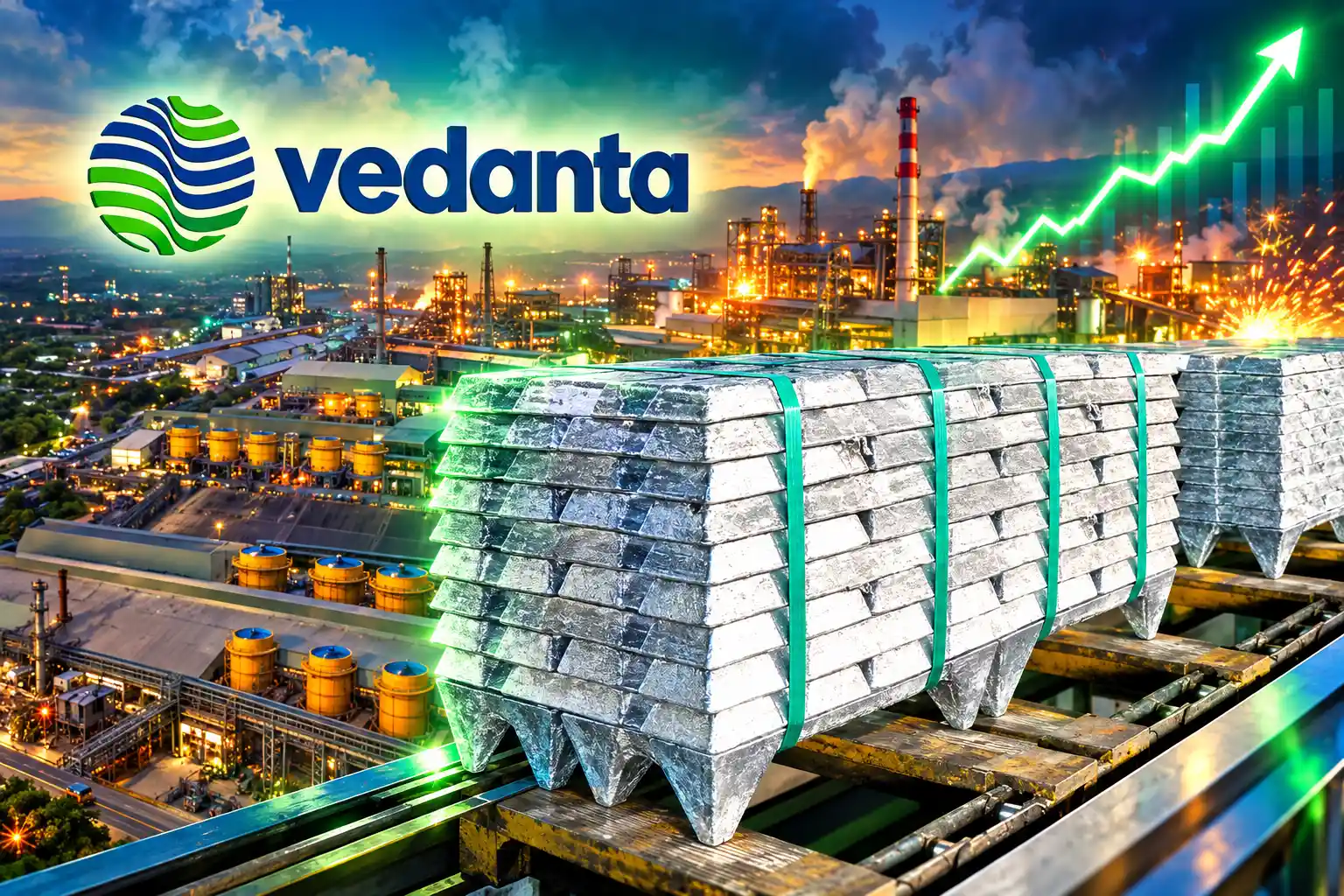
Silver Now Supplies About 45% of Zinc Profit
Zinc India, the Hindustan Zinc consolidation inside Vedanta, posted revenue of ₹14,525 crore, up 76%, and EBITDA of ₹9,243 crore, more than double the year-ago ₹4,434 crore. That operating profit sat under a group EBITDA of ₹9,938 crore. Copper, FACOR and Zinc International added the rest, and copper added almost none.
HOW THE RESIDUAL BOOK EARNED THE QUARTER
| Business | Q2 revenue (₹ crore) | YoY | Q2 EBITDA (₹ crore) |
|---|---|---|---|
| Zinc India | 14,525 | 76% | 9,243 |
| Zinc International | 1,730 | 40% | 550 |
| Copper | 9,280 | 41% | 80 |
| FACOR | 320 | 49% | 77 |
On its own books, Hindustan Zinc’s second-quarter net profit was ₹6,412 crore, up 142%, on revenue of ₹15,093 crore. Silver sales revenue there rose 141% to ₹4,111 crore. Vedanta’s own deck says silver contributed about 45% of Hindustan Zinc’s first-half profitability, which is why a zinc miner is now a silver story as well.
Record Tonnage Met a $703 Cost Line
Mined metal at Zinc India hit a second-quarter record of 271,000 tonnes, up 5%, and refined metal rose 7% to 264,000 tonnes. Cost of production excluding royalty fell 29% to $703 a tonne from $994, and 17% from $851 in the June quarter, which the company called the lowest since the underground transition. Average zinc on the LME was $3,825 a tonne, up 35%.
ZINC INDIA’S RECORD BOARD
- Mined metal: 271,000 tonnes in the quarter, 539,000 tonnes in the first half, a sixth straight year of first-half growth.
- Saleable silver: 173 tonnes, up 20% from 144 tonnes, with first-half output at 321 tonnes.
- Zinc price: LME average $3,825 a tonne against $2,825 a year earlier.
- Silver price: LBMA average $62.6 an ounce, up 59% from $39.4.
Those production numbers for the September quarter were already public on October 3. Hindustan Zinc then reported on October 19, so the parent’s profit print on October 28 was the consolidation, not a surprise. Depreciation rose 19% to ₹1,339 crore, mainly on higher ore at Hindustan Zinc, and the tax charge jumped to ₹2,188 crore from ₹736 crore, for a normalised rate of 26%.
Silver’s 45% Share of First-Half Profit
Lead on the LME actually fell 6% to $1,857 a tonne, so the metal mix did not lift every line. Silver did. At $62.6 an ounce, a $1 move in silver is worth about ₹200-225 crore of annual EBITDA on Vedanta’s own sensitivity table, which is why the 59% price jump did more work than the 5% volume gain in mined metal.
Arun Misra, executive director, said the quarter was “marked by record mined metal production of 271 kt and record 1H mined metal production for the 6th consecutive year” plus the Gamsberg Phase II start and record cathode output at Copper India. Volume was not the whole story. Price and cost were.
A ₹3,675 Crore Net Debt Print
Cash from the zinc engine showed up on the balance sheet faster than on the income statement’s headline. Free cash flow before capex was ₹5,803 crore, against ₹4,412 crore in the June quarter, and ₹10,215 crore for the first half. Growth capex was ₹1,135 crore in the quarter and ₹2,283 crore in the half, and free cash flow after capex was ₹4,668 crore.
THE SEPTEMBER BALANCE SHEET
- Net debt: ₹3,675 crore on September 30, down ₹4,624 crore from ₹8,299 crore at the end of June.
- Gross debt: ₹30,297 crore, against cash and cash equivalents of ₹26,622 crore, up from ₹19,992 crore in June.
- Leverage: net debt to EBITDA at 0.1 times, from 0.3 times in the June quarter.
- Finance cost: ₹696 crore, down 9% from ₹761 crore, with investment income up 44% to ₹495 crore.
ICRA and CRISIL have Vedanta Limited at AA+/Stable, the highest reading since 2014, and overall borrowing cost at the India company is about 8.3%. Hindustan Zinc itself is in a net cash position of ₹11,268 crore, which is why group net debt can sit this low while gross debt is still above ₹30,000 crore.
Strong cash generation of ₹5,803 crore during the quarter enabled us to reduce net debt by ₹4,624 crore to ₹3,675 crore.
Ajay Goel, Group CFO, Vedanta Limited
Goel also pointed at Hindustan Zinc, Zinc International, FACOR, copper and ports as the next growth engines. The record quarterly profit of ₹6,202 crore is the earnings proof. The 0.1 times ratio is the balance-sheet proof the demerger pitch needed.
Vedanta Resources Still Carries $5.2 Billion
The India company is almost out of net debt. The parent is not. Vedanta’s own deck puts Vedanta Resources’ standalone net debt at $5.2 billion, with an average borrowing cost near 7% and average maturity over 4.5 years. S&P and Fitch have the holdco at BB with a stable outlook; Moody’s is at Ba3 with a positive outlook.
In the first half the parent raised $2.15 billion of international bonds at an average coupon of 7.4% and average maturity of 7.6 years, plus a $1.85 billion syndicate loan at SOFR plus 265 basis points. That refinancing buys time. It does not replace the dividend cheque from Mumbai.
On October 8 the board had already approved a first post-demerger interim dividend of ₹5 a share, a ₹1,955 crore payout with an October 14 record date. At a 54.72% stake, about ₹1,070 crore of that cheque goes to Vedanta Resources. Brand fees from the five listed companies are meant to cover a large share of parent interest. Dividends cover the rest. A zinc quarter this large is how that machine is supposed to run.
Shares of Vedanta closed at ₹233.05 on the NSE, up ₹7.45 or 3.30% from ₹225.60, after opening at ₹227.35. The stock had dropped about 10% over the prior month with other metal names. The bounce prices a clean print, not a new holdco rating.
Why Fujairah Copper Sales Fell 74%
Copper is the part of the residual book that did not pay. Segment revenue still rose 41% to ₹9,280 crore because the LME copper price averaged $14,104 a tonne, up 44%, and Copper India sales rose 16% to 52,000 tonnes. EBITDA was only ₹80 crore, against a ₹13 crore loss a year earlier. That is a rounding error next to Zinc India’s ₹9,243 crore.
International copper rod sales were 6,000 tonnes, down 74% from 22,000 tonnes, and down 43% from the June quarter. Vedanta blamed the closure of the Strait of Hormuz for supply-chain disruptions at Fujairah. Operations have been revived, and the company is aiming for a run rate above 20,000 tonnes a quarter by the December quarter. A 155,000-tonne-a-year rod plant in Saudi Arabia is still slated to start in that same quarter.
Copper India did hit its highest quarterly cathode output, 46,000 tonnes, up 17%. FACOR, the ferrochrome unit, raised revenue 49% to ₹320 crore and EBITDA to ₹77 crore from ₹21 crore, with ferrochrome output up 26% to 24,000 tonnes and the first underground ore from Ostapal. Ports at Vizag dispatched a record 1.74 million tonnes, up 26%. Those lines are real. They are not the de-leveraging engine.
Gamsberg Phase II Is Running in South Africa
Zinc International commissioned Gamsberg Phase II in the September quarter, adding 200,000 tonnes a year of metal-in-concentrate and taking total international capacity to 500,000 tonnes. Vedanta has put the expansion at a $600 million investment. Gamsberg mined 46,000 tonnes in the quarter, and Black Mountain mined 7,000 tonnes, for 53,000 tonnes in all, down 12% from a year earlier.
EBITDA at Zinc International still rose 47% to ₹550 crore on the same $3,825 zinc price that lifted India. Volumes abroad went the wrong way in the quarter the new plant started, which is the usual commissioning lag. First-half international mined metal was 102,000 tonnes, down 13%.
Guidance for Zinc India mined metal is 1,140,000 to 1,160,000 tonnes for the full year, with cost of production excluding royalty now guided at $825 to $850 a tonne after the $703 print. Silver guidance is 670 to 690 tonnes. Group first-half revenue was a record ₹49,268 crore, up 54%, with first-half EBITDA of ₹18,407 crore, up 103%, and first-half profit of ₹11,496 crore, up 151%.
A record-breaking quarter that sets new benchmarks for India’s growth story.
Vedanta Limited’s record-best Q2 FY27 performance reflects the strength of our businesses, exceptional financial growth and an unwavering focus on operational excellence.
Building on this remarkable… pic.twitter.com/1bmNKjN3NF
— Vedanta Group (@Vedanta_Group) October 28, 2026
The demerger bet was that a simpler Vedanta, funded by zinc and silver, could retire net debt and still send cash up to the parent. This quarter did both. The next one has to do it with copper still repairing Fujairah and with zinc costs guided back up from $703 toward the $825 to $850 band.
Frequently Asked Questions
How Much Was Vedanta’s First Post-Demerger Dividend in Total?
The October 8 interim was ₹5 a share on a face value of ₹1, a ₹1,955 crore payout with an October 14 record date, and it is the first dividend after the split. In 2025-26 Vedanta paid ₹34 a share through three interims, so the new cheque is smaller even though residual leverage is now much lower.
What Is Hindustan Zinc’s Cost Guidance After the $703 Print?
Management cut full-year FY27 zinc cost of production excluding royalty to $825-$850 a tonne from $975-$1,000, after the September quarter came in at $703 and the June quarter at $851. The new band is not a promise that $703 holds; it is an average that already assumes costs rise from this quarter’s low.
What Stake Does Vedanta Still Hold in Hindustan Zinc?
Vedanta Limited held 60.71% of Hindustan Zinc as of September 30, 2026, after earlier offers for sale, and that stake is the core asset of the residual company. Vedanta Resources in turn held 54.72% of Vedanta Limited on the same date, which is why a Hindustan Zinc cash quarter still funds the parent’s $5.2 billion of holdco debt.
When Does Vedanta’s Saudi Copper Rod Plant Start?
The 155,000-tonne-a-year copper rod plant in Saudi Arabia is slated for commissioning in the third quarter of FY27, the same window in which Fujairah is supposed to get back above 20,000 tonnes of quarterly sales. Until those two lines run, Copper India’s 52,000 tonnes of sales remain the only copper volume that showed up in this print.
Disclaimer: This article is news reporting and analysis of Vedanta Limited’s published second-quarter figures and related filings, and it is for information only. It is not investment advice, a recommendation to buy or sell Vedanta, Hindustan Zinc or Vedanta Resources securities, or a forecast of metal prices, dividends or credit ratings. Readers should consult a SEBI-registered investment adviser or other qualified financial professional before acting on any figure in this piece. Profit, debt, production and price numbers reflect company filings and exchange data as dated in the article and will change with later quarters, restatements and market moves.

Gold Prices Fall to a 14-Month Low Despite Strikes

SpiceJet Clears a Rs 5,500 Crore Raise After Mumbai Stalled

Honda Activa’s Record Month Came With a Share Loss

Sony Turns the GTA 6 Launch Into a Firmware Gate

Xiaomi 18 Leak Skips the Rear Screen for Battery

Volkswagen Sells the Osnabruck Plant to Clear a Board Fight

Apple’s Foldable iPhone Hinges on Samsung Display Supply

Saksham Gaur Finds He Is His Own Company’s Client

Tata Motors’ Iveco Tender Opens as Holders Still Decide

What Is SD on Amazon Prime?
-
 AUTO2 months ago
Volkswagen Sells the Osnabruck Plant to Clear a Board Fight
-
 NEWS3 months ago
Apple’s Foldable iPhone Hinges on Samsung Display Supply
-
 BUSINESS3 months ago
Saksham Gaur Finds He Is His Own Company’s Client
-
 AUTO3 months ago
Tata Motors’ Iveco Tender Opens as Holders Still Decide
-
 TECHNOLOGY3 years ago
What Is SD on Amazon Prime?
-

 BUSINESS3 months ago
Hyderabad 22-Carat Gold Jumps After a False Bargain
-

 GAMING3 months ago
Onimusha Way of the Sword Preload Hits a Windows 11 Wall
-
 BUSINESS3 months ago
UltraTech Ultravolt Launch Splits Friday Stocks to Watch