
NEWS
Adobe Bets Editable AI Will Keep Pros Paying
Adobe opened two MAX Sneaks in Labs a day after Relight shipped, betting native editable AI keeps professionals on Creative Cloud.

Adobe opened two MAX Sneaks in a public web lab on Nov. 11, a day after Photoshop 28.0 shipped Relight at 30 credits a render. The company is betting native, editable AI will keep professionals inside Creative Cloud even as it wipes billed hours off retouching and sound work.
Actor Terry Crews hosted the session in Miami Beach, where Adobe staged 10 research innovations at MAX Sneaks and, for the first time, let anyone try a pair of them the same night. None of the 10 has a product date. Two of them are already under your cursor.
Deep Brush and Hands On Open in the Browser
Adobe’s own write-up calls this the first year Sneaks leave the stage. Labs Playground now holds research previews of Project Deep Brush and Project Hands On, plus a separate Photoshop experiment named Project Custom Filters that was not one of the 10. The company is collecting votes with muscle memory instead of applause.
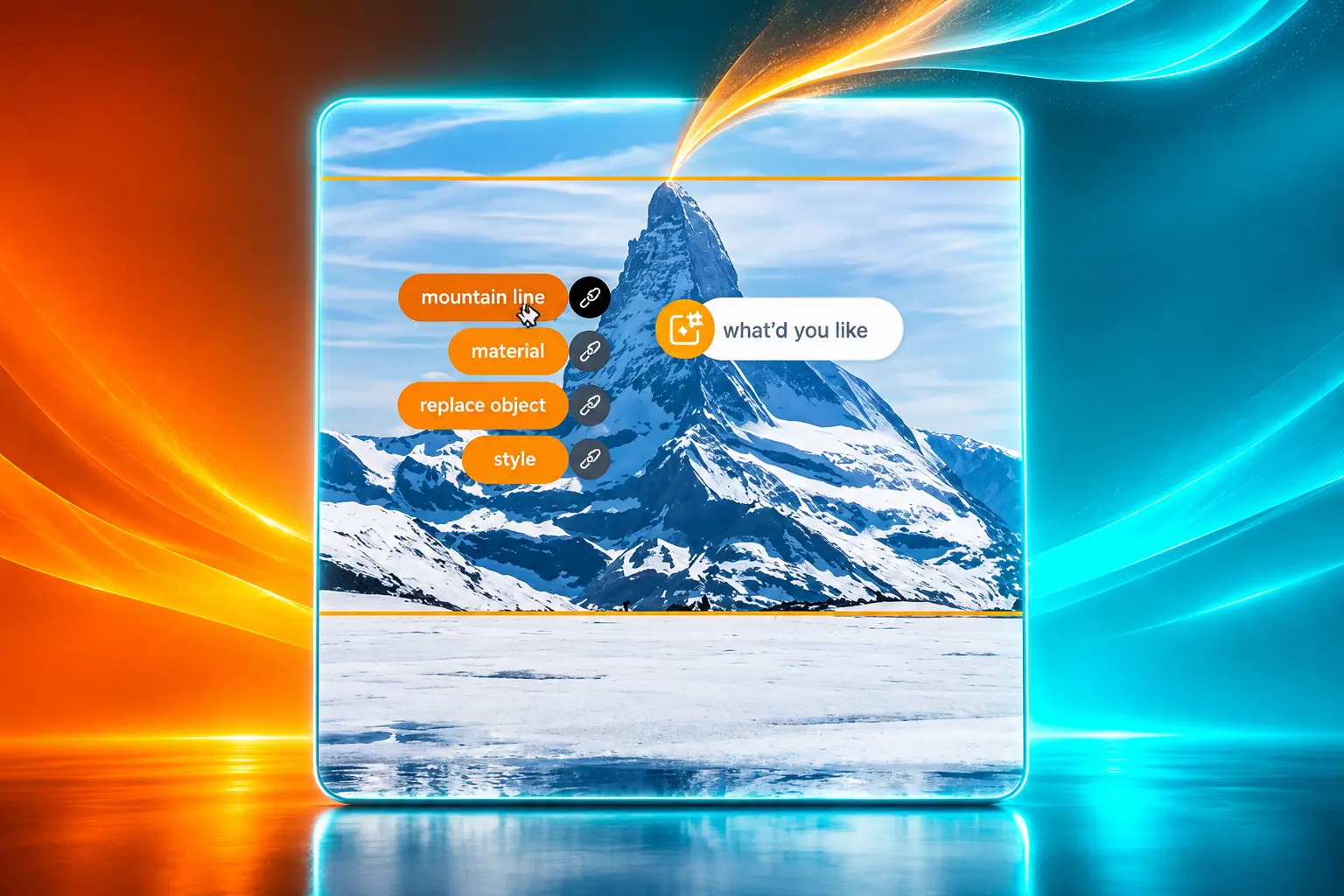
Deep Brush, led by researcher Iliyan Georgiev, breaks a photo into what the team calls physically decomposed layers of shape, color and light. The pitch is brushstrokes that follow a surface, so graffiti wraps a concrete wall, a logo sits on a curved bottle, and lipstick respects a face instead of floating as pixels. Hands On started from object properties that already exist in Firefly’s Edit object tool. The new build drops control points on a mug handle or a sofa arm so you drag the thing itself instead of rewriting a prompt.
OPEN IN LABS PLAYGROUND
- Project Deep Brush: A research preview that paints with the photo’s geometry and lighting, already running in a browser for anyone who signs in.
- Project Hands On: On-canvas handles for reshape work, built so a drag replaces a new text prompt.
- Project Custom Filters: A live, non-destructive filter built from a description, shared by a reference number; it sits beside the Sneaks and is not counted among them.
The other eight projects still ask you to watch a demo and request a ping. That split is the new tactic. Adobe used to wait a year, ship a renamed feature, and hope the MAX clip still lived in someone’s head. This time the two most tactile image tools are the ones you can fail with tonight’s files.
Relight’s 30-Credit Meter
Design evangelist Kelsey Sleigh reminded the room that Relight, shown at last year’s Sneaks, is now a standard Photoshop feature. She was pointing at the pipeline, not a trophy. Relight landed in Photoshop beta on Sept. 28, 2026, then in Photoshop 28.0 on Nov. 10 as MAX opened. You place up to three lights, set color, intensity and diffusion on the canvas, and preview at low resolution. Hitting Done is the bill.
RELIGHT IN PHOTOSHOP 28.0
- Three lights: Each light is movable on the canvas, with color, intensity and diffusion, and the original layer stays intact.
- The meter: Committing a result costs 30 generative credits and needs a live connection; every later Done costs 30 again.
- The wait: Last year’s sneak was Project Light Touch. The menu name is Relight, one MAX later.
That meter is the fine print on Adobe’s control speech. The lights are tactile. The output is a layer you can reopen. The company still charges a credit stack each time you commit, which is how a “keep them paying” bet can feel like a taxi meter to a studio that relights a catalogue of 200 SKUs. Gautham Mysore, a senior principal research scientist at Adobe, put the official line in plainer words.
Making these interactions more intuitive is also about giving experienced creatives more precise control.
Gautham Mysore, senior principal research scientist at Adobe
He pointed at Sound Bender’s mix canvas and Sight Span’s camera placement as the spots where a professional’s eye still has somewhere to go. The Sneaks are built so judgment has a handle. They are also built so the handle lives inside apps that already bill by the month, then by the credit.
Adobe Built These 10 Around a Hand
The official grouping is four video projects, one audio project and five image or design projects. Read them as a single instruction to the labs: stop asking people to describe the edit, and start letting them point at it. A still becomes a room. A character becomes someone you can interview. A finished Photoshop move becomes something you can paste onto the next bottle in the pack shot.
THE 10 SNEAKS AT MAX
| Project | What it does | Status |
|---|---|---|
| Scene Sweep | Applies one video edit across cuts, characters and camera angles | Demo only |
| Screen Test | Builds a character’s look, voice and personality through conversation | Demo only |
| Live Set | Changes subject, setting or camera while generated video keeps playing | Demo only |
| On Cue | Draws or extracts a timing curve so an action hits a beat | Demo only |
| Sound Bender | Pulls a sound from a mix or a description, then shapes it on a canvas | Demo only |
| Deep Brush | Paints with a photo’s shape, color and lighting | Try in Labs |
| Sight Span | Turns a flat image into a space you can walk for a new angle | Demo only |
| Hands On | Drops drag handles on objects in the frame | Try in Labs |
| Rinse Repeat | Copies Photoshop edits, not pixels, onto other objects | Demo only |
| Link Up | Drags an Illustrator object into a scene and matches scale, style and view | Demo only |
Adobe’s blog frames the image tools as brushstrokes and gestures that keep “judgment and craft at the center.” That sentence is doing business work. If the result is a Firefly flat, a freelancer can take the job to any generator. If the result is a stack of Photoshop layers and masks, the file still wants a Creative Cloud seat in the morning.
What Rinse Repeat Copies From a Finished Edit
Project Rinse Repeat is the sneak that names the wager out loud. Lead Ansh Gupta’s team tried a version that suggested edits for a person to accept or reject. It worked as a demo and felt nothing like a retoucher’s day. They went back to copy and paste. You finish a move the usual way, copy the edit, and the system adapts it to the next subject. Shadows follow a smaller bottle. Skin work on one face maps onto the rest of the group. The output is recreated with native Photoshop tools, so a senior can still tear the layers apart.
Creators told the Project Rinse Repeat team that they want AI to help them do their work better, not to do it for them.
Adobe Labs, Project Rinse Repeat
That line is catnip for pros and a warning for anyone who bills by the hour on repetitive craft. The Labs page lists the jobs it has in mind, and they are the jobs studios currently invoice as “we’ll take the hero and match the line.”
WHERE RINSE REPEAT AIMS FIRST
- Product packs: Light one bottle, then push the same treatment across a collection, still as editable layers.
- Group retouch: Copy corrections from one person onto everyone else in the frame.
- Campaigns: Set a look on a few examples and extend it through the set.
- Type: Build a treatment once, then wrap it onto new shapes with live text.
A production desk that clocks this will not talk about magic. It will talk about the junior hours that used to live between the hero shot and the 40 SKU variants. Adobe wants those hours to stay in Photoshop. The client may decide they no longer want to pay for them at all.
Generated Video Finally Gets Timing and a Talking Lead
Four of the 10 Sneaks are video tools, and they all attack the same hole in prompt-only footage: you can say what should happen, and you still cannot conduct it. Project Scene Sweep reads characters, places and shots so a wardrobe or prop change can ride through a sequence instead of being painted onto every cut. Adobe’s own example is the one-line restyle that used to mean a reshoot. Project Live Set keeps the clip playing while you swap a subject, rewrite the room or swing the camera, which is closer to directing a take than to rolling the dice on a new generate.
Project On Cue is the timing dial those generates have lacked. You draw an event curve by hand, or pull it out of a piece of music or another clip, and an action (a light flash, a gesture, a hit) lands on that curve. Project Screen Test, which former filmmaker Gabi Duncombe built after watching AI clips copy a face and miss a person, starts before a frame exists. You set a look, a voice and a baseline (anxious, shy, awkward), then talk to the character until a personality profile exists. That profile is supposed to ride into the generate so you are not restating the backstory in every prompt.
Sound Bender is the audio twin of that canvas habit. You describe a noise or lift one out of a finished mix, then drag across a square field to change the blend in real time. Mysore cited it as a place for professional ears. Foley stages and sound libraries should hear something else: a lot of “find me a whoosh that moves with this pan” work just got a sketchpad.
People who already wrestle generated footage keep running into two failures, and these demos map onto both. Characters drift from shot to shot, and motion misses the music. Screen Test and On Cue are Adobe’s answers, still on stage. Sight Span, over in the stills group, is the same idea for photography. A flat frame becomes a space with extra walls, so a product shot or a location still can be re-angled without a second visit. One dry way to put it is that a photograph now comes with a floor plan.
The Year Between a Sneak and a Menu Item
Sneaks have always been a maybe. Adobe says so every year, and plenty of prototypes die in the lab. The recent pattern for the tactile ones is shorter than the disclaimer. Project Perfect Blend, shown in October 2024 as a way to match color, light and shadow when you drop a person into a new scene, shipped about a year later as Harmonize. Project Light Touch, shown in October 2025, is Relight in Photoshop 28.0. Deep Brush and Hands On skipped the waiting room and went to a browser tab.
THE PATH FROM SNEAK TO SHIPPING FEATURE
- October 2024: Project Perfect Blend is shown at MAX Sneaks as automatic matching of light, color and shadow for composites.
- October 2025: Harmonize ships as the product name for that idea, and Project Light Touch is shown as after-the-fact lighting.
- September 28, 2026: Relight opens in Photoshop beta, with a 30-credit charge to commit a full-resolution result.
- November 10, 2026: Relight ships in Photoshop 28.0 as MAX opens in Miami Beach.
- November 11, 2026: Ten new Sneaks take the stage, and Deep Brush and Hands On open in Labs Playground the same night.
Link Up belongs on that list as a tell even if it never ships under that name. Drag a car into a drawn parking bay and the tool matches perspective, scale and style, then leaves you with editable vectors. That is Illustrator’s version of the same bet: the AI does the ugly spatial math, the file remains a file a human can pick apart. Scene Sweep is Premiere’s version. One decision, many shots, still a sequence you own.
Who Still Bills for the Work These Demos Eat
If these tools land, the invoice line that breaks first is not “art direction.” It is the work that exists because software used to be clumsy. Matching a retouch across a product line. Painting a logo onto a curved can. Relighting a portrait because the stand-in bulb was wrong. Replacing a jacket through six camera angles. Building a whoosh that follows a pan. Walking a still so a client can see the other side of a shelf. Those are hours. They are also the hours Adobe needs to keep inside its apps, because if they move to a prompt box the subscription has to justify itself on taste alone.
WORK THESE DEMOS WOULD REPLACE
- Catalogue retouch: Rinse Repeat and Deep Brush go after the hero-to-line extension that junior teams still grind.
- Reshoots: Scene Sweep and Live Set treat wardrobe, props and camera as things you change after wrap.
- Second angles: Sight Span invents a viewpoint a still did not contain, which is a problem for anyone selling extra plates of the same scene.
- Foley and library pulls: Sound Bender turns “find me that sound, then ride it” into a canvas drag.
- Casting for generated leads: Screen Test tries to hold a personality so a generative clip stops changing the person every take.
Adobe already sells stills and footage through Adobe Stock, so some of the blast hits its own shelf. Smaller teams get the other side of the same tools: a two-person shop can mock a wrap, a new camera height and a wardrobe pass without a truck. That wider pool is how Adobe grows seats while the old billable units shrink. The bet only works if those new seats still need Photoshop, Premiere and Illustrator because the AI output is a layer stack, not a flattened surprise.
Eight of the 10 remain demos with a notify button. Relight is the proof that a sneak can become a menu item, and the 30-credit charge is the proof that Adobe will meter it. Deep Brush and Hands On are the new move, putting a brush and a handle in a browser so the next Harmonize does not have to win a room first. The professionals Adobe is trying to keep will decide the wager in the files, not in the keynote, and they will decide it by whether those handles still feel like craft once the credits start to move.

Gold Prices Fall to a 14-Month Low Despite Strikes

SpiceJet Clears a Rs 5,500 Crore Raise After Mumbai Stalled

Honda Activa’s Record Month Came With a Share Loss

Sony Turns the GTA 6 Launch Into a Firmware Gate

Xiaomi 18 Leak Skips the Rear Screen for Battery

Volkswagen Sells the Osnabruck Plant to Clear a Board Fight

Apple’s Foldable iPhone Hinges on Samsung Display Supply

Saksham Gaur Finds He Is His Own Company’s Client

Tata Motors’ Iveco Tender Opens as Holders Still Decide

What Is SD on Amazon Prime?
-
 AUTO2 months ago
Volkswagen Sells the Osnabruck Plant to Clear a Board Fight
-
 NEWS3 months ago
Apple’s Foldable iPhone Hinges on Samsung Display Supply
-
 BUSINESS3 months ago
Saksham Gaur Finds He Is His Own Company’s Client
-
 AUTO3 months ago
Tata Motors’ Iveco Tender Opens as Holders Still Decide
-
 TECHNOLOGY3 years ago
What Is SD on Amazon Prime?
-

 BUSINESS3 months ago
Hyderabad 22-Carat Gold Jumps After a False Bargain
-

 GAMING3 months ago
Onimusha Way of the Sword Preload Hits a Windows 11 Wall
-

 BUSINESS3 months ago
UltraTech Ultravolt Launch Splits Friday Stocks to Watch