
BUSINESS
Unimech Aerospace Hits Rs 2,025 as Export Orders Lead
Unimech Aerospace stock hit Rs 2,025 after a 110.53% six-month run, on 95% export sales and a 117 times earnings multiple.

Unimech Aerospace shares printed a record Rs 2,025 on November 12, extending a 110.53% six-month run that left the Sensex far behind. The stock was up as much as 5.52% in the morning session and changed hands at Rs 2,008 at 9:41 am, while the BSE Sensex was 0.4% higher at 82,206.
Almost 95% of its sales still go to overseas aerospace customers, even as defence index funds hold the ticker. Ravi Singh, chief research officer at Master Capital Services, put the multiple at 117 times earnings and still called the stock expensive.
Why Unimech Aerospace Shares Hit a Record High
The print followed the September-quarter numbers, released on October 27, and a breakout above a weekly range that had capped the stock since late September. On the BSE, about 22,000 shares worth Rs 4.48 crore changed hands, against a two-week average of about 16,000. Later in the November 12 session, data compiled by StockAnalysis showed the stock at Rs 1,983.90, with a market value of Rs 10,098 crore on 50.90 million shares.
Singh said revenue has grown at a 60% compound annual rate between FY22 and FY26, and that the second half of FY27 should be larger than the first. He also noted a near 190% move over eight months, which tracks the climb from the 52-week low of Rs 695 toward the new high.
UNIMECH VERSUS THE SENSEX
| Period | Unimech | Sensex |
|---|---|---|
| Six months | +110.53% | +10.23% |
| Year to date | +121.54% | -3.53% |
| Past year | +100.93% | -2.70% |
That six-month gap is 100.30 percentage points. Over two weeks the stock was up 21.67%, and over three months it was up 42.13%. The tape is filing all of that under defence. The customer list is not.
What Unimech Aerospace Makes
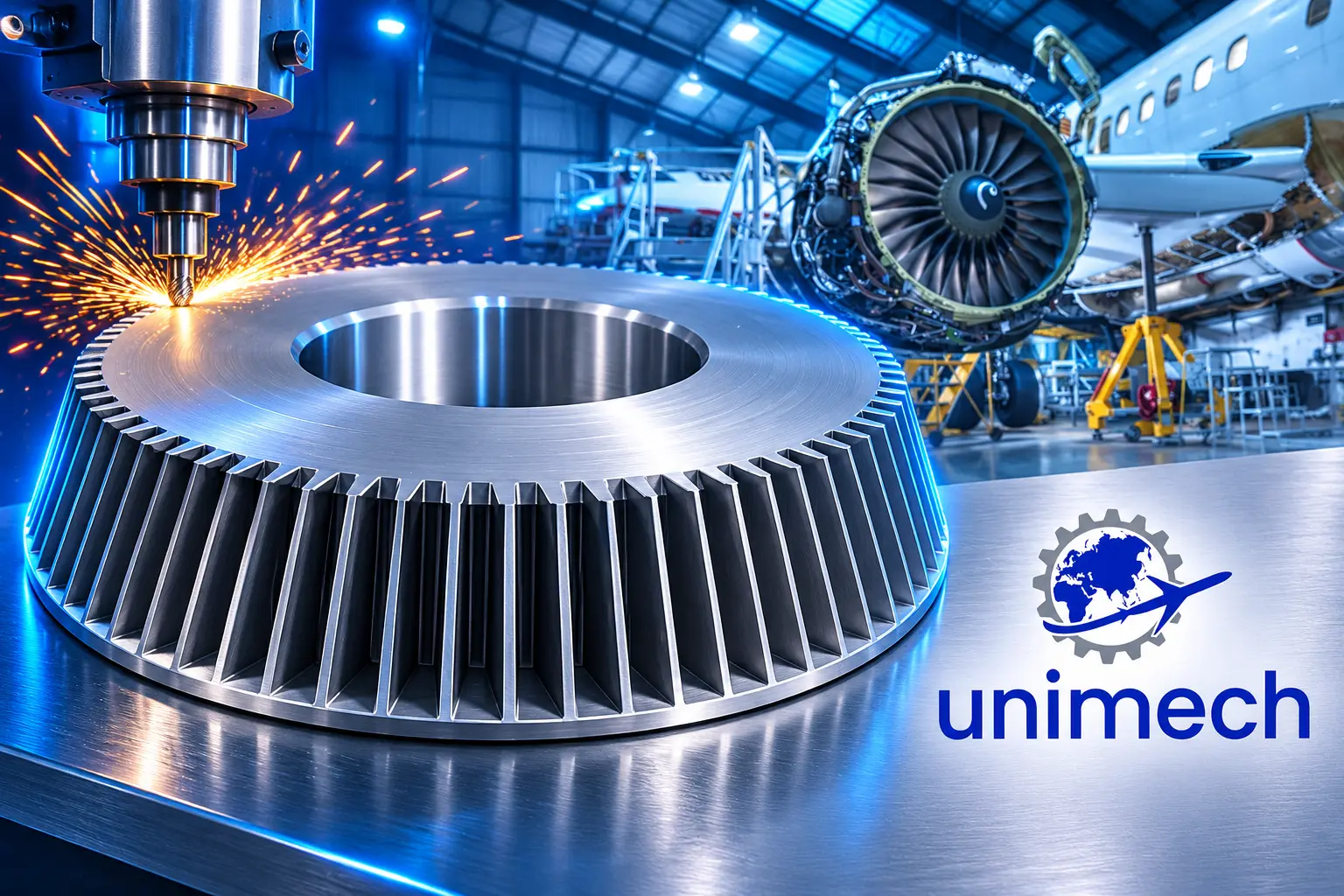
Unimech Aerospace and Manufacturing Ltd, founded in 2016, runs factories in Bengaluru’s Hitech Defense and Aerospace Park. It cuts, fabricates and assembles the tools and parts that engine and airframe lines need, mostly on a build-to-print basis for foreign OEMs and their licensees. Its own aerospace page presents the firm as a maker of high-precision components for aviation programs, from commercial aircraft to military work.
The core is still aero tooling: engine stands, lifting beams, calibration gear, airframe platforms and ground-support equipment. Management is trying to layer on “flying parts” that go onto the aircraft itself, plus a smaller book of semiconductor-equipment pieces, nuclear sub-assemblies and, through Hobel Bellows, metallic bellows. Hobel has been in the accounts since May 1, 2026, so some of the year-on-year jump is purchased growth, not just the old shops running hotter.
WHAT THE BENGALURU SHOPS ACTUALLY SHIP
- Engine tooling: Lifting beams, transportation stands, and assembly and calibration tools used on aero-engine lines.
- Airframe kit: Assembly platforms and ground-support equipment for wing and fuselage work.
- Flying parts: Aerostructure and engine components under multi-year deals with FACC, Honeywell Aerospace and a French Tier-1 supplier.
- Other programs: Semiconductor-equipment pieces, nuclear sub-assemblies, and bellows from the Hobel plant.
Precision components and assemblies were 33% of first-half revenue. Semiconductor work was about 3% of that slice. The chip-fab story that has followed the stock is still a sliver of the group. Tooling and the rest of the book still pay the bills.
Rs 855 Crore on the Books, Rs 266 Crore in Firm Orders
The number everyone is repeating is the consolidated order book of Rs 855 crore as of September 30, 2026, up 715% from a year earlier. Chairman and Managing Director Anil Kumar Puttan told investors the group had “fundamentally transformed our growth profile.” The mix inside that headline is less tidy.
HOW THE RS 855 CRORE BOOK BREAKS
| Slice | Rs crore | Share of book |
|---|---|---|
| Firm purchase orders | 266 | 31% |
| Long-term deals and award letters | 589 | 69% |
| Total | 855 | 100% |
Firm orders alone were up 153% from Rs 105 crore in September 2025. The larger Rs 589 crore block is five-to-ten-year paper: a $7.5 million five-year FACC deal for aerostructure parts, a 10-year Honeywell Aerospace deal for engine components and control systems that can run two more years, and a French Tier-1 award of about $43 million over 10 years. Those figures sit in the filed October earnings call transcript, with qualifications still under way on several programs.
Management said it had qualified more than 250 parts by the end of the first half, with 340-plus in the pipeline and a target of more than 590 by year-end so that serial production can build in FY28. Whole-time director Rajanikanth Balaraman called the flying-parts wins “a strong validity of our capabilities” and said they mark the firm’s entry into high-precision parts that actually fly. Award letters are not the same as billed output. The louder risk on this stock is whether that paper turns into cash before working-capital days stretch from 110 toward the 150 to 160 range the board itself is signalling for the end of FY27.
Promoters Still Hold Nearly 80% of the Stock
A thin free float is doing as much work as the order book. Promoters held 79.75% as of September 2026. The public slice is about 20.25%, and StockAnalysis puts the float at 10.31 million shares. When 22,000 shares can add more than 5% to the price, the defence-ETF bid does not need much size to leave a mark. Mirae Asset’s BSE India Defence ETF held 0.49% in September, and Motilal Oswal’s Nifty India Defence products held 0.38% each.
WHO OWNS UNIMECH
- Promoters: 79.75% as of September 2026, with Anil Kumar Puttan the largest at 26.22%.
- Public float: About 10.31 million of 50.90 million shares outstanding, or roughly 20%.
- Institutions: FIIs 1.01% and DIIs 4.66%, with India defence index funds among the named holders.
- The gap: Public holding is still short of the 25% floor, and an early-2027 share sale is under review.
That 20% public slice sits below the 25% floor in India’s minimum public shareholding rules, which is why a sale is now on the calendar. On the October 28 call, management said it was evaluating an equity fundraise in early calendar 2027, subject to need and markets, also to meet that minimum. A board meeting on August 3, 2026 had already put a qualified institutions placement on the agenda. Fresh paper at these prices would thicken the float. It would also test a multiple that has been fed by scarcity.
A 117 Times Multiple Leaves Little Room for Error
The September quarter was the fundamental excuse for the breakout. Revenue from operations was Rs 123 crore, up 98.4% from Rs 62 crore a year earlier and up 14% from the June quarter. Profit after tax was Rs 31.77 crore, up 103% from Rs 15.67 crore. EBITDA was Rs 49.01 crore, up 164% from Rs 18.54 crore, and the margin widened 990 basis points to 39.8% from 29.9%.
First-half operating revenue was Rs 230.6 crore, up 85%, and equal to about 96% of all of FY26. First-half profit was Rs 59.64 crore, up 71%. First-half EBITDA was Rs 88.26 crore at a 38% margin. Shops were running at about 65% utilisation, and the board is still talking about a Rs 1,000 crore revenue aspiration on the existing block, with Hobel meant to supply about 20% of that vision.
Long-term supply agreements and award programs with premier global aerospace OEMs are successfully transitioning Unimech from short-cycle tooling into recurring, high-volume ‘flying part’ manufacturing.
Anil Kumar Puttan, Chairman and Managing Director, Q2 results press release
Puttan said in the Q2 results press release that first-half revenue of Rs 2,306 million came with “early returns from our strategic growth initiatives.” Singh’s 117 times earnings line is the other half of that sentence. Global buyers paused some orders in the tariff year of FY26, then the book rebuilt. A multiple this rich assumes the rebuild does not stall again, and that margins hold as the mix shifts from short-cycle tools toward longer-cycle flying parts, which management already says sit a point or two below tooling.
Honeywell, FACC and the Shift Into Flying Parts
The named counterparties are Western, not the Ministry of Defence. FACC is a five-year aerostructure deal that Balaraman said could, with qualification, stretch in both tenure and value. Honeywell Aerospace is a 10-year engine-component and controls contract. The French Tier-1 award is a 10-year aerostructure program of about $43 million. The same names are laid out in the quarterly investor presentations filed with the exchanges.
A joint venture with the Yusuf Bin Ahmed Kanoo Group in Saudi Arabia, sized at about $30 million, is meant to be ready for commercial manufacturing in March or April 2027, aimed at local oil-and-gas machining rather than Indian defence production. Special-process cells (plating, heat treatment, inspection) are due to be commissioned in December 2026, with Nadcap certification targeted for March 2027. Associate Dheya Engineering is building indigenous micro gas turbines in 20 kg to 100 kg thrust classes, with a 48 kg unit into serial production, but that is still a side bet, not the thing that doubled quarterly profit.
FROM THE IPO TO THE RECORD
- December 31, 2024: Lists at Rs 1,491 on the BSE, an 89.9% premium to the Rs 785 issue price, after a Rs 500 crore offer subscribed 175.31 times.
- May 1, 2026: Starts consolidating Hobel Bellows, adding bellows capacity and some of the year-on-year growth.
- September 30, 2026: Closes the quarter with a Rs 855 crore consolidated order book.
- October 27, 2026: Posts Q2 results, with operating revenue of Rs 123 crore and profit of Rs 31.77 crore.
- October 28, 2026: Hosts the earnings call and flags an early-2027 fundraise to help meet the 25% public-shareholding floor.
- November 12, 2026: Prints Rs 2,025, then trades back near Rs 1,984 later in the session.
From the Rs 785 issue price to Rs 2,025 is a 158% gain in under two years. From the listing print of Rs 1,491 the further rise is 36%. Most of the violent part of the chart is the eight-month climb off Rs 695, which is the move Singh is using to both justify a Rs 2,400 swing target and to warn late buyers.
Singh’s Rs 2,400 Target Meets a Lower Street Average
Sudeep Shah, vice president of technical research at SBI Securities, said the stock had been stuck in a Rs 1,458 to Rs 1,901 weekly band since late September, and that the breakout came with a rise in volumes. He said the weekly RSI had turned up from the 60 mark, and that the Rs 1,880 to Rs 1,900 zone is the first support. “As long as the stock sustains above this zone, the positive momentum is likely to continue, with scope for further upside,” Shah said.
Singh’s map is more specific and more cautious in the same breath. Medium-term traders can watch Rs 2,400, he said, with Rs 1,500 an important support, and “given the sharp rally, fresh entry should be considered cautiously.” StockAnalysis’s three-analyst average target is Rs 1,841, which was 7.20% below the Rs 1,983.90 print later on November 12. That average is a fundamental desk number. Singh’s Rs 2,400 is a momentum target. They are not the same claim, and the market is already through the lower one.
WHERE ANALYSTS SPLIT ON THE RALLY
- The technical target: Singh maps Rs 2,400 for medium-term holders and Rs 1,500 as support, while calling 117 times earnings expensive.
- The chart support: Shah says the move stays intact above the Rs 1,880 to Rs 1,900 zone after the weekly breakout.
- The Street average: Three analysts compiled by StockAnalysis sit at Rs 1,841, below the November 12 market price.
Management has already flagged an equity sale in early 2027 to thicken the public float, and working-capital days are guided toward 150 to 160 as longer-cycle programs take more of the mix. Those two facts, not another breakout list, are what a Rs 2,025 price has to live with.
Disclaimer: This article is news reporting and analysis of Unimech Aerospace’s share price, results and disclosures, and is for information only. It does not constitute investment advice, a research recommendation, a solicitation, or an offer to buy or sell any security or derivative. Readers should consult a SEBI-registered investment adviser or their own broker before acting on any price, multiple, target or holding mentioned here. Figures, shareholding, order-book splits and guidance reflect company filings, exchange data and named analysts as of November 12, 2026 and may change with the next session or the next disclosure.

Gold Prices Fall to a 14-Month Low Despite Strikes

SpiceJet Clears a Rs 5,500 Crore Raise After Mumbai Stalled

Honda Activa’s Record Month Came With a Share Loss

Sony Turns the GTA 6 Launch Into a Firmware Gate

Xiaomi 18 Leak Skips the Rear Screen for Battery

Volkswagen Sells the Osnabruck Plant to Clear a Board Fight

Apple’s Foldable iPhone Hinges on Samsung Display Supply

Saksham Gaur Finds He Is His Own Company’s Client

Tata Motors’ Iveco Tender Opens as Holders Still Decide

What Is SD on Amazon Prime?
-
 AUTO2 months ago
Volkswagen Sells the Osnabruck Plant to Clear a Board Fight
-
 NEWS3 months ago
Apple’s Foldable iPhone Hinges on Samsung Display Supply
-
 BUSINESS3 months ago
Saksham Gaur Finds He Is His Own Company’s Client
-
 AUTO3 months ago
Tata Motors’ Iveco Tender Opens as Holders Still Decide
-
 TECHNOLOGY3 years ago
What Is SD on Amazon Prime?
-

 BUSINESS3 months ago
Hyderabad 22-Carat Gold Jumps After a False Bargain
-

 GAMING3 months ago
Onimusha Way of the Sword Preload Hits a Windows 11 Wall
-
 BUSINESS3 months ago
UltraTech Ultravolt Launch Splits Friday Stocks to Watch