
BUSINESS
Reliance Places a 30-Year Coal Gasification Bet in Andhra
Reliance will put Rs 43,000 crore into Andhra coal gasification as a 30-year option on deep Eluru coal, while a national subsidy round drew no private bids.

Reliance Industries is set to sign a 30-year deal with Andhra Pradesh to build an underground coal gasification complex, with Rs 43,000 crore in the first two phases. People familiar with the plan said a memorandum of understanding was due on November 12, 2026, and that lifetime spending could reach Rs 2.70 lakh crore ($4.59 billion for the opening two phases, at Rs 93.64 to the dollar).
Phase 2 cash is not automatic. It waits on a pilot, a detailed project report and regulatory clearances, which is how a 30-year energy wager is actually placed.
The MoU Locks a 30-Year Option in Eluru
The agreement, as described by those people, is a state facilitation pact, not a construction start order. The Andhra Pradesh Economic Development Board will be the nodal agency, helping Reliance with land, water and power and with files that have to move through central ministries. The complex is tied to two coal blocks the Union coal ministry already awarded in Eluru district. Reliance did not comment.
Phase 1 is budgeted at Rs 3,000 crore for exploration, seismic surveys, geological assessment and a pilot demonstration. Phase 2 is planned at about Rs 40,000 crore only after that work is done. The two stages add to Rs 43,000 crore, about one-sixth of the Rs 2.70 lakh crore lifetime figure attached to the same plan. The project is expected to support 5,000 direct jobs and 35,000 indirect jobs in the state.
THE TWO PHASES AND THE 30-YEAR TAIL
| Stage | Outlay | Trigger |
|---|---|---|
| Phase 1 | Rs 3,000 crore | Exploration, seismic work, geology and a pilot |
| Phase 2 | Rs 40,000 crore | Pilot done, detailed project report, clearances |
| Lifetime potential | Rs 2.70 lakh crore | Thirty years, if the geology and the chemistry hold |
That is a cheap option on a very large plant. Rs 3,000 crore buys holes in the ground and a trial. The rest of the money stays on the other side of a technical and commercial gate.
WHAT WE KNOW
- The blocks: Reliance holds Chintalpudi Sector A1 and Recherla in Eluru after the 14th commercial coal auction.
- The near cash: Rs 3,000 crore for Phase 1 and Rs 40,000 crore for Phase 2, together Rs 43,000 crore.
- The jobs claim: 5,000 direct and 35,000 indirect roles, as written into the state-facing plan.
WHAT IS UNCONFIRMED
- The signature: People said the MoU would be signed on November 12, 2026; Reliance issued no public confirmation.
- The product slate: Syngas can become hydrogen, methanol, ammonia or synthetic natural gas; the November plan does not lock a mix.
- Phase 2: The Rs 40,000 crore step still depends on the pilot, a detailed project report and approvals.
Exploration is due to begin in January 2027, with work starting at Chintalpudi rather than on both blocks at once. The company is aiming to finish the pilot by mid-2028, running survey work and the trial on overlapping calendars.
What the Chintalpudi and Recherla Blocks Contain
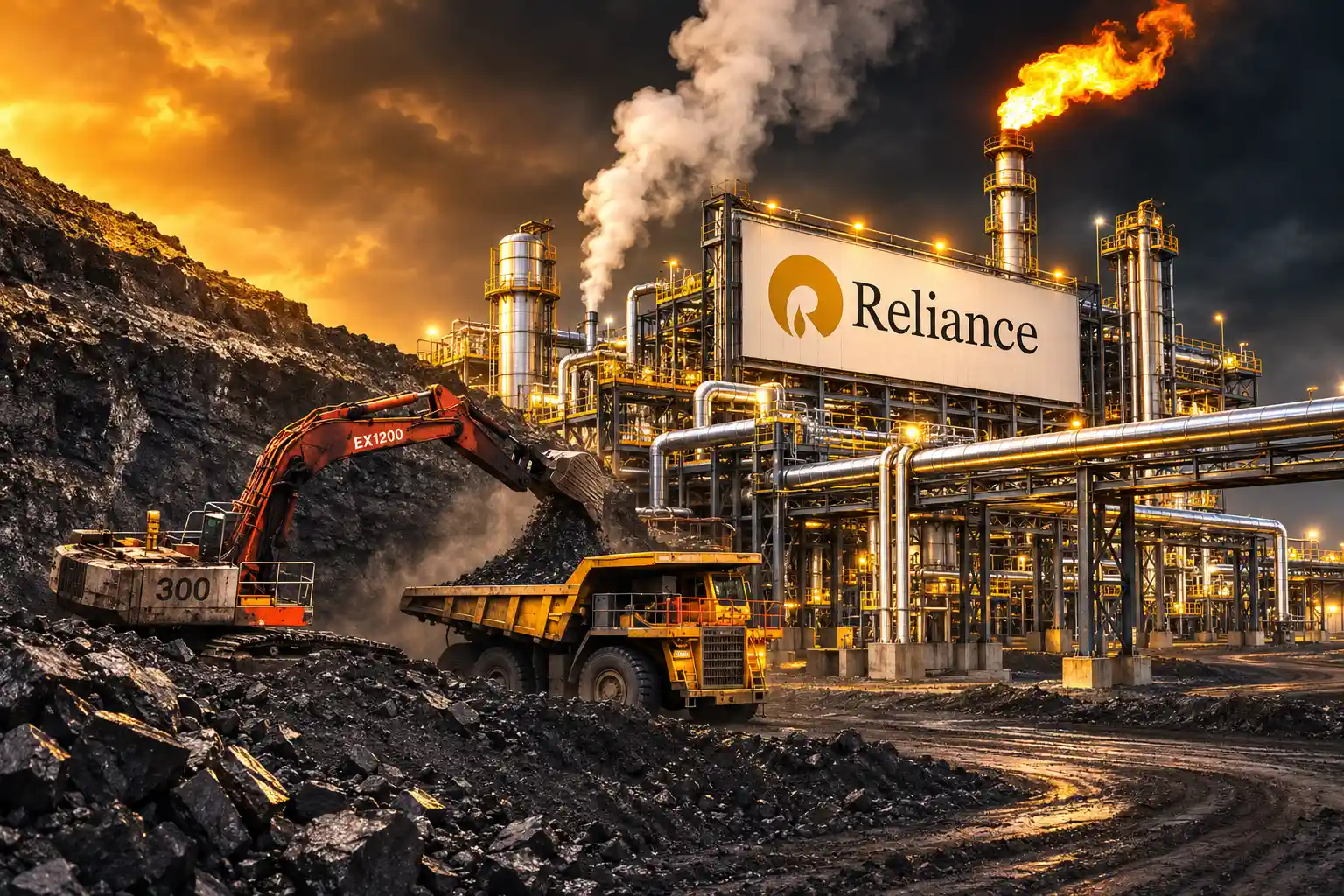
These are not ordinary open-cast pits. Officials have said the seams sit more than 600 metres down, too deep for a conventional mine at any sensible cost. Underground coal gasification burns and converts the coal in place, then pipes synthetic gas to the surface, so the coal itself never comes up as a heap.
Chintalpudi Sector A1 covers about 3,000 acres and is estimated at 904.94 million tonnes of G-12 coal. Recherla covers about 5,500 acres and is estimated at 2,225.67 million tonnes of G-13 coal. Together the two blocks hold 3,130.61 million tonnes.
THE ELURU BLOCKS RELIANCE ALREADY HOLDS
| Block | Area | Reserves | Grade |
|---|---|---|---|
| Chintalpudi Sector A1 | 3,000 acres | 904.94 million tonnes | G-12 |
| Recherla | 5,500 acres | 2,225.67 million tonnes | G-13 |
| Combined | 8,500 acres | 3,130.61 million tonnes | Mixed |
Reliance was named preferred bidder for both mines in an April 11, 2026 notice from the nominated authority, at a 5.50% revenue share on each. Coal Mine Development and Production Agreements followed on April 28, 2026, in the first commercial auction round that wrote underground gasification into the contracts. Axis Energy Ventures India took the other two mines in that four-block set, in Odisha.
The process Reliance plans to use is Controlled Retracting Injection Point gasification, a method that walks the injection point back along a horizontal well as the coal is consumed. Company-side briefings have also described a desalination plant at Machilipatnam in Krishna district so the trial does not lean on local freshwater, grid power for the pilot, and a captive plant later if full-scale output begins.
India’s 100-Million-Tonne Target Is Still Mostly Paper
New Delhi has spent five years trying to turn coal into chemicals instead of only into power-station burn. The National Coal Gasification Mission wants 100 million tonnes of gasification capacity by 2030. On July 27, 2026, minister of state for coal and mines Satish Chandra Dubey told the Rajya Sabha the country had only 22.6 million tonnes a year of capacity in operation or under way.
THE MISSION VERSUS THE STEEL IN THE GROUND
- The 2030 target: 100 million tonnes of coal gasification capacity.
- In place or in build: 22.6 million tonnes a year, which is 8 million at Jindal Steel, 2.6 million at Talcher Fertilisers, and about 12 million across eight projects under a Rs 8,500 crore incentive from January 24, 2024.
- The gap: 77.4 million tonnes still to be found, financed and built.
- The promised saving: about Rs 1.5 lakh crore a year in imports once the Rs 8,500 crore scheme, a newer Rs 37,500 crore scheme, and Talcher Fertilisers are all running.
The Union Cabinet approved that Rs 37,500 crore surface-gasification scheme on May 13, 2026, aiming to use about 75 million tonnes of coal and lignite. The political prize is import substitution. Cabinet papers put the hole in plain figures: more than half of India’s liquefied natural gas is imported, about 20% of urea, almost all ammonia, and methanol is 80 to 90% imported.
Parliament was also told the policy kit for underground projects is sweeter than a normal mine. Coal used for gasification gets a 50% rebate on revenue share. For a block auctioned for underground gasification, the floor price is 2%, down from 4% for underground mining, with the upfront payment waived and a 50% rebate on the performance bank guarantee. Reliance’s 5.50% bids sit on that cheaper floor.
A New Jamnagar, Built Underground
Reliance’s public energy story has been the opposite of a 30-year coal seam. The company has a net carbon zero target by 2035, a pledge to enable 100 GW of solar by 2030, and it says it has put Rs 75,000 crore ($10 billion) into a renewable-energy build that includes solar modules, batteries, electrolysers, fuel cells and power electronics at Jamnagar. Its own carbon page is blunt about fossils.
The age of fossil fuels cannot continue much longer.
Reliance Industries, carbon reduction strategy
The Eluru plan does not cancel that build. It sits beside it. Syngas from deep coal can feed the same molecule chains the company already runs at Jamnagar, hydrogen for treating fuels, methanol and ammonia for chemicals, synthetic gas for heat, without buying quite so much imported LNG or methanol. People briefed on the company’s thinking have described a mandate to lock cheap energy and to grow new Jamnagar-scale complexes on the east coast, using oil-and-gas drilling skill and old coal-bed methane work on a method India has barely run at commercial size.
That is the wager. Green hydrogen at Jamnagar is the brochure. Eluru is a 30-year option on molecules that still come from coal, only the coal never comes to the surface. If the pilot works, Reliance gets a feedstock hub next to a coast, and Andhra gets a chemicals complex that does not look like an open-cast mine. If it fails, the company has spent Rs 3,000 crore to learn the geology.
Why Private Firms Skipped the Centre’s Subsidy
Two days before the Andhra MoU was due, the coal ministry closed Round 2 of the Rs 37,500 crore surface-gasification scheme. The official haul was two applications from NTPC Limited, one aimed at urea and one at methanol and dimethyl ether. Round 3 opened the same day, November 10, 2026, with a deadline of January 11, 2027.
Reliance is not filling that form. The Eluru complex is underground gasification on mines the company already won, not a surface plant bidding into the new subsidy. The empty private column in Round 2 still matters, because it shows what capital thinks of coal-to-chemicals when the geology is ordinary and the incentive is cash from Delhi. High-ash Indian coal has chewed through more than one gasifier design, and Atanu Mukherjee, chief executive of Dastur Energy, has said the country still needs proven kit adapted to that ash and modular plants that can actually be repeated.
A 30-year underground project with a Rs 3,000 crore first cheque is, in that light, a way around the queue. It is also an admission that the 100 million tonne target will not be hit by subsidy rounds alone. State firms can file. Private boards, so far, have mostly watched.
Groundwater, Subsidence and a Desalination Plant
The environmental question is the one the MoU does not answer, and it is the right question. Underground gasification moves mine risk under the water table. Combustion in the seam can leave phenols, benzene, tars and metals in a cavity that later fills with groundwater. Cavities can sag. Gases can leak. The coal ministry’s own draft mining-plan guidelines for underground coal and lignite gasification blocks list the same trio, subsidence, fire and water contamination, as the hazards a plan must treat.
WHAT THE GUIDELINES TELL OPERATORS TO WATCH
- Water: Residual chemicals can dissolve once groundwater returns to the burned cavity, which is why baseline aquifer data and buffer distances sit in the draft rules.
- Ground: Burning out a seam can leave voids; surface sag is a named risk for farms, roads and houses above the well field.
- Fire and gas: Injection and production wells have to hold pressure, or carbon monoxide and other gases find their own path.
- Water supply: The Machilipatnam desalination plant is the company’s answer to a thirsty process that should not drain Eluru’s existing sources.
India also has a habit of energy-plant pledges that look firm at the signing table and thin on the ground. Compressed biogas is the recent example people reach for when a headline gets ahead of commissioning. Until drillers are on the Chintalpudi pad, the Andhra complex is still a plan.
HOW THE WAGER WAS ASSEMBLED
- April 11, 2026: Reliance is named preferred bidder for Recherla and Chintalpudi Sector A1 at a 5.50% revenue share.
- April 28, 2026: Development and production agreements are signed, with underground gasification written into the commercial terms.
- May 13, 2026: The Cabinet clears the Rs 37,500 crore surface-gasification scheme aimed at about 75 million tonnes of coal and lignite.
- January 2027: Exploration is due to start at Chintalpudi.
- Mid-2028: The pilot is supposed to be complete, which is the gate for the Rs 40,000 crore second phase.
The cash that is real in 2027 is Rs 3,000 crore for surveys and a trial at Chintalpudi. Phase 2’s Rs 40,000 crore, the 5,000 direct jobs and the Rs 2.70 lakh crore lifetime line all wait on that result, a detailed project report, and whether syngas from 3,130.61 million tonnes of deep coal can be sold for less than the imports it is meant to replace.

Gold Prices Fall to a 14-Month Low Despite Strikes

SpiceJet Clears a Rs 5,500 Crore Raise After Mumbai Stalled

Honda Activa’s Record Month Came With a Share Loss

Sony Turns the GTA 6 Launch Into a Firmware Gate

Xiaomi 18 Leak Skips the Rear Screen for Battery

Volkswagen Sells the Osnabruck Plant to Clear a Board Fight

Apple’s Foldable iPhone Hinges on Samsung Display Supply

Saksham Gaur Finds He Is His Own Company’s Client

Tata Motors’ Iveco Tender Opens as Holders Still Decide

What Is SD on Amazon Prime?
-
 AUTO2 months ago
Volkswagen Sells the Osnabruck Plant to Clear a Board Fight
-
 NEWS3 months ago
Apple’s Foldable iPhone Hinges on Samsung Display Supply
-
 BUSINESS3 months ago
Saksham Gaur Finds He Is His Own Company’s Client
-
 AUTO3 months ago
Tata Motors’ Iveco Tender Opens as Holders Still Decide
-
 TECHNOLOGY3 years ago
What Is SD on Amazon Prime?
-

 BUSINESS3 months ago
Hyderabad 22-Carat Gold Jumps After a False Bargain
-

 GAMING3 months ago
Onimusha Way of the Sword Preload Hits a Windows 11 Wall
-
 BUSINESS3 months ago
UltraTech Ultravolt Launch Splits Friday Stocks to Watch