
NEWS
The iPhone Duo Jams With Sand Despite Its IP68 Rating
Apple’s iPhone Duo carries IP68 and a matte crease-hiding screen, then jammed with sand in its first public hinge test against Galaxy Z Fold 8.

Zack Nelson’s sand-and-bend run on October 24 left Apple’s $1,999 iPhone Duo stuck open, its inner screen dead, a day after the foldable went on sale. Samsung’s Galaxy Z Fold 8, rated IP48 against the Duo’s IP68, had already come through the same tester’s sand and reverse-bend work in August.
Apple sold the first folding iPhone as dust-tight. The first public hinge test filled that hinge with grit, and a small number of retail inner screens have cracked along the same fold.
Apple Published IP68. The Hinge Ate Sand.
Apple unveiled iPhone Duo on September 9, opened pre-orders on October 16, and put it on sale on October 23 in Night Sky and Star White, starting at $1,999. The pitch was a 7.6-inch inner OLED and a 5.4-inch cover that still fits a pocket. The durability copy was just as loud.
WHAT APPLE PUBLISHED FOR DURABILITY
- Ingress rating: Apple lists an IP68 rating to 6 meters for 30 minutes under IEC 60529, the same published mark as iPhone 18 Pro.
- Hinge build: A precision hinge of more than 100 hinge components, a 3D-printed titanium cover, and a magnet array that is meant to pull the phone shut.
- Shell: Grade 5 titanium, Ceramic Shield 2 on the outer front with 3x the prior scratch resistance, Ceramic Shield on the back.
- Inner cover: A custom polymer Apple says is 40 percent stiffer than the industry standard, over high-strength glass, with adhesives that let the layers glide.
Nelson, who runs JerryRigEverything, put a Star White unit through his usual scratch, dust, heat, and bend sequence on October 24. The outer Ceramic Shield 2 only showed faint marks at Mohs 7. The inner panel marked at Mohs 2, and a fingernail left a dent. The matte nano-texture made some of those marks hard to see. It did not keep grit out of the joint.
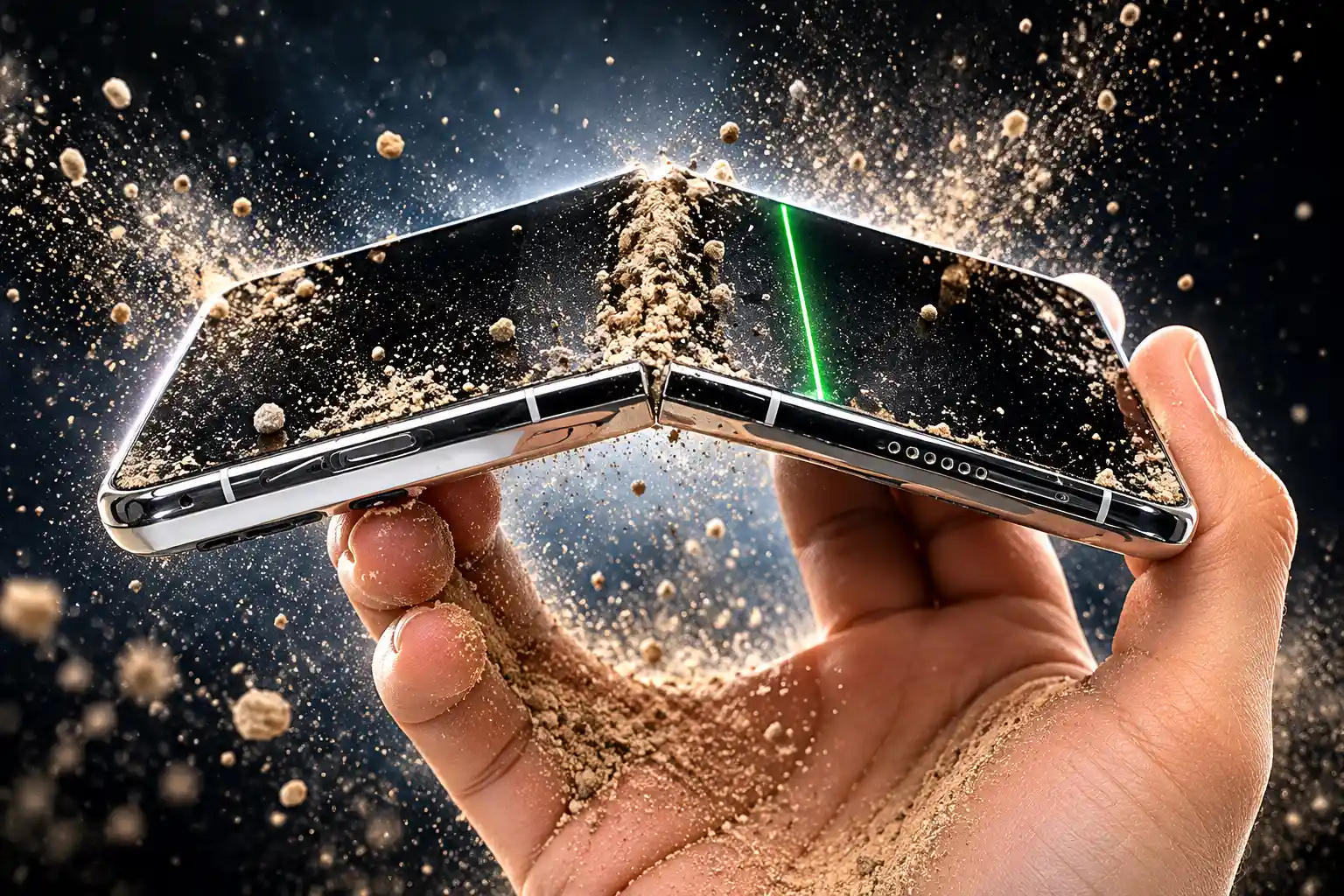
Sand and dirt packed into the titanium hinge through several gaps. The magnets could not pull the halves shut against that debris, so the phone stayed partly open. Nelson then bent the open body against its fold. The frame flexed and stayed in one piece. A permanent green line ran from the center of the inner display to the titanium edge. A second bend added two more lines. Touch on that panel then died, while the image still showed.
I’ve been testing these folding phones since the first generation seven years ago. Most do survive. The iPhone Duo did not.
Zack Nelson, JerryRigEverything
He also said the dusty Duo is damaged, and that he could not tell whether trapped grit caused the bend failure or the hinge was not rigid enough on its own. Apple’s spec sheet still carries the IP68 line, with the usual note that splash, water, and dust resistance are not permanent and can fall with wear, and that liquid damage is not covered under warranty.
How IP68 Is Tested on a Foldable
The fight on X since the clip landed is not really about the crease. It is about a dust-tight rating on a phone that packed with sand once someone worked the hinge. That gap is built into how the rating is earned.
IEC 60529’s IP6X run is a talc chamber test. Fine powder, sieved to about 75 microns, hangs in the air around a sealed enclosure, often with a slight vacuum pulling air through any gap, for up to eight hours. The pass for a 6 on dust is no deposit inside the enclosure as tested. IP4X, the dust digit on Samsung’s Fold 8, only claims protection against solid objects 1 millimeter or larger.
TWO DIFFERENT DUST TESTS
- The lab: Talc in a chamber, the sample in its tested state, no beach grit, and no requirement to fold and unfold a phone for hours while the powder is in the joint.
- The channel: Sand, dirt, and soil on the hinge, then repeated open-close cycles so particles can ride the moving parts.
- The pocket: Lint and grains well under 1 mm, which sit inside an IP48 rating and can still find a path in an IP68 hinge if the moving seam is the leak.
Apple has not published a fold-cycle rating, and it has not said whether the IP68 sample was open, closed, or both. Matching iPhone 18 Pro’s 6-meter, 30-minute water figure on a moving seam is the launch claim. Nelson’s clip is a different exam, and Google’s IP68 Pixel 10 Pro Fold already showed sand in the hinge on the same kind of run. Honor’s Magic V6 publishes IP68 and IP69. Apple was not first to print a 6 on a foldable, and it is not the first 6 to eat grit when the joint is worked.
Samsung’s Fold 8 Already Survived This Routine
Samsung announced Galaxy Z Fold 8 on July 22 and put it on sale on August 7. U.S. pricing starts at $1,899 for 12 GB and 256 GB, then $2,099 and $2,499 for the 512 GB and 1 TB builds, $100 under the Duo’s starting price. Official specs list it at 201 grams and 4.5 mm unfolded, 9.7 mm closed. The Duo is 254 grams, 5.2 mm open, and 11.3 mm closed, 53 grams heavier.
Both inner screens are 7.6 inches. Samsung stayed at IP48: water to 1.5 meters for 30 minutes, dust only above 1 mm. The cover uses Gorilla Glass Ceramic 3. The back is Gorilla Glass Victus 2. The frame is Armor Aluminum. Under the fold, Flex Titanium adds a titanium-alloy film about one-third as thick as a human hair, which Samsung says is 20 times stiffer than its older polymer film, plus a perforated titanium plate.
Nelson ran the Fold 8 through the same sequence in August. The cover glass marked at Mohs 6, with deeper grooves at 7. The inner plastic still marked at Mohs 2. After sand on the inner panel, the sides, the back, and the hinge, the Fold 8 kept opening and closing. Closed, it barely flexed. Open and bent backward, the 4.5 mm body flexed hard and did not break.
JERRYRIG RESULTS, TWO PHONES
| Test | iPhone Duo (October 24) | Galaxy Z Fold 8 (August) |
|---|---|---|
| Published IP rating | IP68, 6 meters, 30 minutes | IP48, 1.5 meters, 30 minutes |
| Sand and dirt on the hinge | Packed the joint; magnets could not close it | Hinge kept working |
| Inner panel scratch | Mohs 2 | Mohs 2 |
| Cover glass scratch | Faint marks at Mohs 7 | Marks at Mohs 6, deeper at 7 |
| Reverse bend | Green lines, then a dead inner screen | Body flexed, stayed intact, survived |
That table is one tester and two units, not a failure rate. iFixit’s own Fold 8 work on August 13 is the other data point that belongs next to it. Repair staff poured much finer UV powder, around 0.04 mm, plus sand grains around 0.16 mm, both well under the 1 mm IP48 line. After they worked the phone open and closed, the hinge started making crunching noises and it stopped opening normally. The boards and batteries stayed clean. iFixit’s provisional repair score is 4 out of 10, because the inner display and hinge still look like one brutal assembly. Samsung’s eighth Fold survived Nelson’s sand. It is not a sealed slab.
Retail Units Split Along One Hinge Line
The abuse clip is not the only inner-screen story. From launch day, owners posted bright lines on the folding panel, often from the center toward the right, sometimes after a pop in the hinge, sometimes within hours and with no drop. Some of those images look cooked. Enough of them share one crack height that teardown work has been chasing a repeated contact, not a random smash.
YouTuber CuriousHagi cracked a unit, then pulled the hinge apart and found a thinner link that snapped at a notch. Separate hinge models place stress on a center support bar that may not drop far enough when the phone closes. Nelson has also floated a small hinge part pressing the panel from behind. That is not a root-cause memo from Apple.
FROM LAUNCH TO APPLE’S STATEMENT
- September 9, 2026: Apple unveils iPhone Duo as splash, water, and dust resistant with an IP68 rating.
- October 16, 2026: Pre-orders open.
- October 23, 2026: The phone goes on sale. Owners begin posting inner-screen cracks along the fold.
- October 24, 2026: Nelson’s dust-and-bend video lands; the test unit will not close and the inner display dies.
- October 26, 2026: Apple says it is aware of an inner display issue on a small number of units and tells owners to contact AppleCare for a replacement.
Apple’s wording is narrow. It is aware of an issue impacting the inner display on a small number of iPhone Duo units, and people who see it should contact AppleCare for a replacement. Some stores have swapped phones on the spot. That is a defect path, not Nelson bending a sample backward. The two sit on the same hinge, and that is why they are being read together.
A Matte Layer Hid the Crease Buyers Photograph
Apple’s visual bet was the inner finish. A nano-texture layer, written onto a polymer cover, scatters light so the fold line is harder to see head-on. Hands-on units still show a crease at a rake angle. Looked at straight, it is fainter than the Fold 8’s line, which Flex Titanium has flattened but not erased.
Tom Marieb, Apple’s vice president of Hardware Engineering, told interviewers the matte face is also a hedge as the hinge ages, because glossy glass makes small height changes easy to spot. He asked people to hold the company to that.
Hold us accountable to that, please.
Tom Marieb, VP of Hardware Engineering, Apple
Nelson gave that coating a rare aside: some scratch marks seemed to vanish in the matte. The same inner stack still died in the bend, and the same joint still packed with sand. CEO John Ternus called Duo the most transformational change to iPhone since the original. The part buyers photograph is the crease. The part that took the phone out of the test is the hinge and the folding OLED behind it.
Both panels list 3000 nits peak outdoor brightness, 1600 nits peak HDR, and a 2,000,000:1 contrast ratio. The inner grid is 1878 by 2670 at 430 ppi. The outer is 1398 by 2034 at 460 ppi. Apple put high-strength glass above and below the folding panel and a titanium plate under it. Ten thin layers, stiffer polymer, and a matte top did the cosmetic job. They did not make the moving seam behave like a sealed iPhone 18 Pro.
What a Cracked Inner Display Costs to Fix
Apple’s own service menu is the clean number on a dead folding panel. Out of warranty, inner display damage is $999. With AppleCare+, that inner job is $99. The thin cover layer on the fold is $49 out of warranty and $19 with the plan. Outer display damage is $379 out of warranty and $29 with AppleCare+. Other damage, the bucket that can swallow a wrecked hinge, is $1,499 out of warranty and $99 with the plan.
APPLE’S PUBLISHED IPHONE DUO REPAIR PRICES
| Service | Out of warranty | AppleCare+ |
|---|---|---|
| Inner display damage | $999 | $99 |
| Cover layer damage | $49 | $19 |
| Outer display damage | $379 | $29 |
| Other damage | $1,499 | $99 |
Nelson flagged that inner figure while the test unit sat dead. Samsung’s Fold 8 path is not cheap either. iFixit found the inner OLED and hinge still look like a full teardown, with both battery cells at risk and a 4 out of 10 repair score. The difference is the public sample: the Fold 8 Nelson abused still opened. The Duo sample did not, and a $999 inner panel is the bill if you are not on AppleCare+ when that happens.
The IP48 Phone Is the One That Still Opened
Demand did not wait for the sand clip. Apple had already moved to limited walk-in Duo stock after ship dates sped up. In Korea, Fold 8 sales in Korea rose after Apple’s debut, so the incumbent is still taking units while the first iPhone foldable absorbs the launch heat.
Apple is replacing a small number of inner screens through AppleCare. The spec sheet still says IP68. Nelson’s Duo still would not close, and the Fold 8 that went through the same sand routine in August still would.

Gold Prices Fall to a 14-Month Low Despite Strikes

SpiceJet Clears a Rs 5,500 Crore Raise After Mumbai Stalled

Honda Activa’s Record Month Came With a Share Loss

Sony Turns the GTA 6 Launch Into a Firmware Gate

Xiaomi 18 Leak Skips the Rear Screen for Battery

Volkswagen Sells the Osnabruck Plant to Clear a Board Fight

Apple’s Foldable iPhone Hinges on Samsung Display Supply

Saksham Gaur Finds He Is His Own Company’s Client

Tata Motors’ Iveco Tender Opens as Holders Still Decide

What Is SD on Amazon Prime?
-
 AUTO2 months ago
Volkswagen Sells the Osnabruck Plant to Clear a Board Fight
-
 NEWS3 months ago
Apple’s Foldable iPhone Hinges on Samsung Display Supply
-
 BUSINESS3 months ago
Saksham Gaur Finds He Is His Own Company’s Client
-
 AUTO3 months ago
Tata Motors’ Iveco Tender Opens as Holders Still Decide
-
 TECHNOLOGY3 years ago
What Is SD on Amazon Prime?
-

 BUSINESS3 months ago
Hyderabad 22-Carat Gold Jumps After a False Bargain
-

 GAMING3 months ago
Onimusha Way of the Sword Preload Hits a Windows 11 Wall
-
 BUSINESS3 months ago
UltraTech Ultravolt Launch Splits Friday Stocks to Watch