
NEWS
OnPath’s 200MW Bathgate Battery Is Aimed at 2031
OnPath’s 200MW Pond battery in Bathgate is consented, aimed at 2031, and still unbuilt while NESO treats batteries as oversupplied.

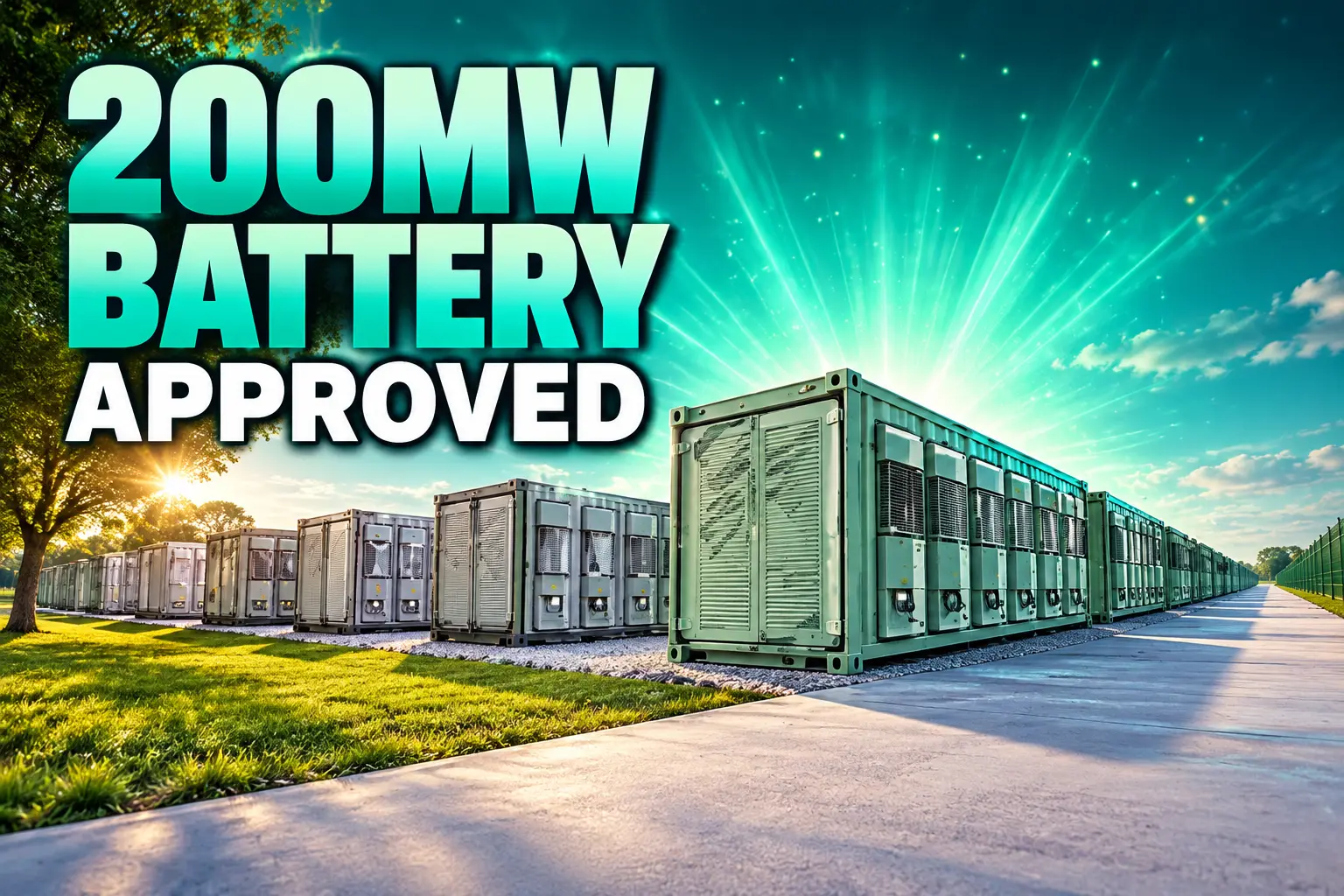
Scottish ministers approved OnPath Energy’s 200MW Pond Flexible Energy Park near Bathgate on 24 March 2025. The two-hour battery is rated to cover peak demand for about 240,000 homes.
OnPath has said it hopes the park will be live by 2031. The build itself is listed at 18 months.
A Car Park on Whitburn Road
The scheme sits on Pond Industrial Estate on Whitburn Road, on the south-east edge of Bathgate, on land already used as an industrial estate and car park. OnPath says the fenced compound will take up to two hectares, so it does not take green field. The consented kit is 74 container battery units, a substation building, access tracks, cabling, walls, fencing, a SuDS pond and temporary compounds, plus wildflower, shrub and tree planting.
OnPath, then still named Banks Renewables on the paperwork, filed under Section 36 of the Electricity Act 1989. The Energy Consents Unit logged the application on 13 May 2024 as a non-EIA generating station and published the Section 36 consent record as ECU00004765. West Lothian Council’s executive committee backed the plans in October 2024 with every vote. Scottish Gas Networks had objected over a nearby high-pressure gas pipeline classed as a major accident hazard; OnPath filed a technical note on mitigation, and the consented scheme includes that assurance. No member of the public objected.
A week earlier, on 17 March 2025, ministers had also consented a 456MW battery at Gretna Green for a Gresham House development company. Pond was the next stamp in a busy month. Michael Newton, then OnPath’s sustainability developer, said battery sites such as Pond “are going to have a huge role to play in achieving net zero.”
FROM CONSENT TO A QUIET PROJECT PAGE
- 13 May 2024: Banks Renewables files the Section 36 application for Pond Flexible Energy Park.
- October 2024: West Lothian’s executive committee backs the plans with no dissenting vote.
- 24 March 2025: Scottish ministers grant consent for a battery of up to 200MW.
- 8 July 2025: OnPath starts construction at Mill Rig Wind Farm in South Lanarkshire, a 33.4MW, £155 million project due to run in 2026.
- 8 December 2025: NESO publishes the reformed connections pipeline and treats batteries as oversupplied.
- 19 May 2026: OnPath signs a southern Scotland wind option as part of a £1 billion five-year plan.
- 14 September 2026: Annual results list new wind and solar capacity and do not mention Pond.
The company’s own project page still describes the scheme as granted and invites residents to sign up for updates. It does not announce a start on site.
The Build Itself Lasts 18 Months
OnPath’s fact sheet puts construction at 18 months and the working life at up to 50 years. Eighteen months after the consent letter, that build period has already elapsed on the calendar, and the park is not up. A job that short, aimed at 2031, means most of the wait is the grid date, not the civils.
THE PARK ON PAPER
- Export rating: 200MW for two hours, which is 400MWh of stored energy when full.
- Homes covered: Peak demand for about 240,000 homes for two hours, or average demand for about 600,000 homes over the same spell.
- Money in: Around £130 million of investment on up to two hectares of existing industrial land.
- Carbon claim: About 36,000 tCO2e saved a year against fossil fuel based storage, per OnPath.
The firm’s public page sells the park as 200MW for two hours, enough, it says, to meet those peak loads when wind and solar drop. It also says most grid balancing is still done by importing power or burning gas, and that Pond would sit on a car park rather than new countryside.
WHAT WE KNOW
- The consent: Ministers granted Section 36 consent on 24 March 2025 for a battery of up to 200MW at Pond Industrial Estate.
- The build time: OnPath lists an 18-month construction period and around 80 jobs on site while it is being put up.
- The hope: At consent, OnPath said it hoped the park would be operational by 2031.
WHAT IS UNCONFIRMED
- Queue place: NESO has not published a named Gate 2 or Gate 1 outcome for Pond.
- Start date: OnPath has not announced when, or whether, construction will begin.
- Final year: 2031 is the company’s stated hope, not a published connection offer.
NESO’s Phase 2 transmission offers, the band that covers projects needed between 2031 and 2035, were scheduled from early September 2026 into mid-January 2027. Until a named offer is public, Bathgate has a planning letter and a target year, not a socket date.
OnPath Steered Its Scottish Cash to Wind
The silence on Pond sits beside a loud year for turbines. For the 12 months to the end of 2025, OnPath recorded turnover of £73.4 million and operating profit of £22.7 million, against £95.7 million and £69.4 million in the 15 months to the end of September 2024. Combined wind capacity at year end was 252MW. Simon Fisher, chief financial officer, said wind yields in 2025 were below average, “but we have still delivered solid commercial returns while continuing the evolution of the business towards a primary focus on developing and building new onshore wind farms across the UK.”
That focus is visible on the ground. Mill Rig, 33.4MW near Darvel, broke ground on 8 July 2025 with a £155 million budget and a 2026 start. Early in 2025 the firm bought Pates Hill, a seven-turbine, 14MW wind farm south of West Calder, in the same council area as Pond. On 19 May 2026 it signed an option with Wilson Forest Products for Bankend Rig II, Bankend Rig III and Hawkwood, 18 turbines and 121MW in South Lanarkshire, inside a plan to put about £1 billion in southern Scotland over five years.
When this agreement is concluded it will take our presence in southern Scotland to over 500MW, which reflects our confidence in the sector and the region as a renewables powerhouse, exporting energy across the UK and generating hundreds of Scottish jobs.
Robin Winstanley, Sustainability and Community Director, OnPath Energy
Richard Dunkley, the chief executive, called that billion-pound southern Scotland spend central to becoming the UK’s leading renewable energy developer. The owner behind him is Brookfield Asset Management, which OnPath says holds over 46,000MW of operating renewable capacity worldwide. OnPath has built 14 onshore wind farms and was operating 12 at the last count, with another 73MW due from Mill Rig and Barnsdale Solar Park. Storage is on the books, including 100MW of batteries in the revised Bodinglee wind proposal, but the cash and the press list in 2026 have gone to blades, not containers.
Batteries Filled the Queue Three Times Over
The National Energy System Operator spent 2025 ripping up first-come-first-served connections. On 8 December 2025 it said it had a new pipeline of 283GW of generation and storage, with 132GW aligned to the UK’s Clean Power 2030 target, down from an old contracted stack of more than 700GW. Batteries did not starve in that cut. They crowded it.
NESO BATTERY SLOTS IN THE REFORMED QUEUE
| Technology | Prioritised for 2030 | Prioritised for 2035 | Gate 1, not prioritised |
|---|---|---|---|
| Battery | 34.5GW | 48.7GW | 152.9GW |
| Offshore wind | 32.1GW | 37.8GW | 4.5GW |
| Solar | 29.9GW | 29.1GW | 35.9GW |
| Onshore wind | 13.1GW | 4.8GW | 13.4GW |
Those battery columns add to 83.2GW with a confirmed Gate 2 path, and another 152.9GW parked at Gate 1. NESO’s own write-up said batteries were “significantly oversupplied, with around three times more projects than the permitted capacity,” and that protected projects with planning already in hand had taken the slots. For the next application window it said there would be no permitted battery capacity unless more than 55GW of Gate 2 batteries leave the pipeline, or a future strategic plan raises the cap.
Protected Batteries Took the 2030 Slots
The 2030 column is the one that matters for Clean Power. NESO put 34.5GW of batteries by 2030 into the delivery pipeline, just above offshore wind at 32.1GW and solar at 29.9GW. A later NESO note with the Energy Networks Association said that by 10 June 2026, 713 of 1,223 projects in the pre-2030 pipeline had received offers, 58 percent, covering 37GW of new capacity. Offers name a date, a node and the works needed. They are what turns a consent letter into a build programme.
Action to Protect Rural Scotland, using NESO modelling released under freedom of information, put Scotland’s own need at 5.9GW to 6.4GW of batteries by 2030, and 6.4GW to 7.6GW by 2045. It counted 24.8GW in the Scottish planning pipeline in June 2025 and 13.5GW already consented, rising to 18.2GW by November 2025 after another 4.74GW of decisions on schemes over 50MW. That is the mismatch sitting behind a 200MW park that can be built in 18 months and is still aimed at 2031.
Phase 2 Offers Run Into 2027
Gate 2 Phase 1 covers projects needed by 2030. Phase 2 covers 2031 to 2035. NESO’s published timetable had Phase 2 transmission and large embedded offers running from early September 2026 to mid-January 2027, with distribution offers into mid-March 2027. A Bathgate scheme whose public go-live hope is 2031 would live in that second band if it is in the pipeline at all. OnPath has not said which band, if either, Pond occupies.
What the Bathgate Site Pays Locally
West Lothian’s interest is not the queue table. It is rates, wages and a fund that only starts when the containers arrive. OnPath’s local offer is specific, and it is timed to construction and then to operation, so a 2031 start pushes every pound to the right.
WHAT POND WOULD PAY BATHGATE
- Construction jobs: About 80 posts while the park is built, with OnPath saying it will use local contractors where it can.
- Wages on site: Around £1.6 million in annual wages during the 18-month construction period.
- Business rates: About £950,000 a year once the park is running, earmarked by the firm for local services.
- Community fund: £20,000 a year, decided by a local panel, and over £1,000,000 across a life of up to 50 years.
Those figures only move when the compound is built. An 80-job spike in 2029 or 2030 is a different local event from an 80-job spike in 2026. The rates line, nearly a million pounds a year, is the durable one, and it does not start on a consent letter. The community fund is modest by the standards of a £130 million plant, £20,000 a year on a 50-year clock, and it is also gated to operation.
The political fight over storage in Scotland has been about giant units in open country and the pylons that serve them. Pond is a car park on an industrial estate between Edinburgh and Glasgow. It drew no public objections, and it has drawn almost no public argument since the decision letter. The batteries people can already point to are the ones that hold a live connection, such as Zenobē’s 300MW / 600MWh site at Blackhillock, which was being cited in late 2025 as Europe’s largest when it went live.
Other Scottish Batteries Are Already Going Up
Consent is not a freeze for every Scottish battery. Copenhagen Infrastructure Partners has committed more than €270 million to Kilmarnock South, a 350MW / 1,400MWh four-hour system in South Ayrshire developed with Noriker Power, with commercial operation expected in the first quarter of 2028 and construction under way. CIP has also pointed to Coalburn 1 in operation and Coalburn 2 and Devilla being built, a four-site Scottish set it puts at 1.85GW / 4.4GWh. Those projects have dates a builder can staff.
Ministerial paper has kept moving too. French developer Qair has Qair’s Aberdeenshire battery approval for a large storage scheme, and Balance Power has a consented 29.9MW East Ayrshire storage site at Coylton. Each of those is a separate planning story. Together they show how fast Scottish ministers have been willing to stamp batteries, and how little that stamp, on its own, says about first power.
OnPath’s Pond page still reads like a project that has cleared its last public hurdle. The last hurdle that pays wages in Bathgate is a connection offer with a year on it. Until that year is named, a 200MW park with an 18-month build remains a granted application on a car park, aimed at 2031, while the same developer pours Scottish capital into wind.

TCS Opens Q2 as Mid-Cap IT Keeps the Growth

Bitcoin’s Jobs Rally Fails While December Hike Odds Hold

The Heat Turn a Bucks Rematch Into Vice City Night

The G7 Opens Diesel Tanks While Carriers Head East

Kia Bets Fortuner Money on a Made-in-India Sorento

Volkswagen Sells the Osnabruck Plant to Clear a Board Fight

Tata Motors’ Iveco Tender Opens as Holders Still Decide

Saksham Gaur Finds He Is His Own Company’s Client

Onimusha Way of the Sword Preload Hits a Windows 11 Wall

The Frame Pro’s $1,200 Labor Day Cut Needs a Soundbar
-
 AUTO4 weeks ago
Volkswagen Sells the Osnabruck Plant to Clear a Board Fight
-
 AUTO1 month ago
Tata Motors’ Iveco Tender Opens as Holders Still Decide
-
 BUSINESS1 month ago
Saksham Gaur Finds He Is His Own Company’s Client
-
 GAMING1 month ago
Onimusha Way of the Sword Preload Hits a Windows 11 Wall
-
 NEWS4 weeks ago
The Frame Pro’s $1,200 Labor Day Cut Needs a Soundbar
-

 NEWS1 month ago
Apple’s Foldable iPhone Hinges on Samsung Display Supply
-

 BUSINESS1 month ago
SEBI Reopens How F&O Settles After the Closing Auction
-

 BUSINESS1 month ago
The Rs 4.66 Lakh Crore IPO Queue Is Mostly Paper