
BUSINESS
Carbon Cheques Are Clearing Sheep Off Scotland’s Hills
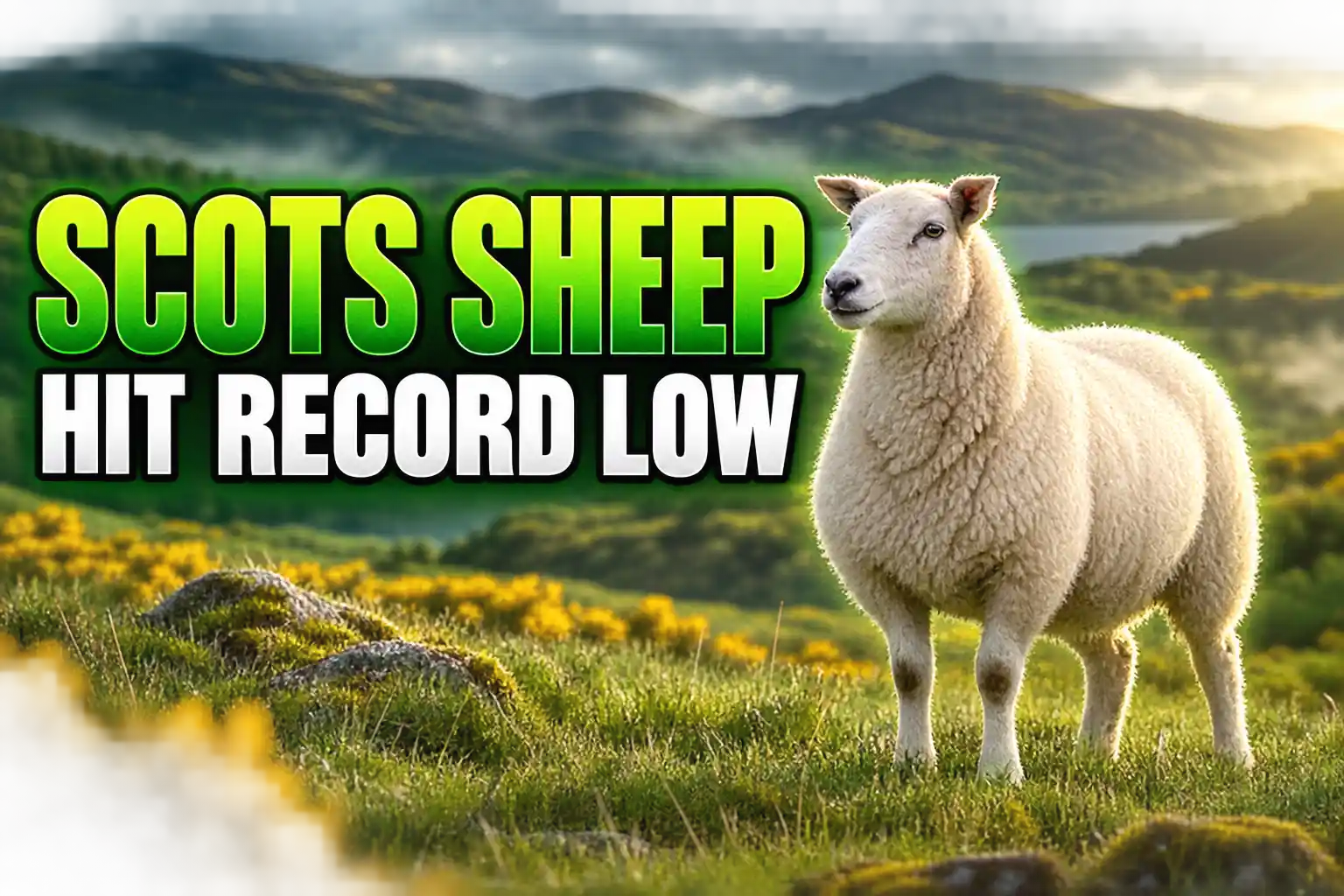
Scotland’s breeding ewes fell to 2.45 million, then barely recovered, as carbon, trees and rewilding outbid hill flocks for the same ground.

Scotland’s breeding ewes fell to 2.45 million in 2024, the lowest count the National Sheep Association says it can find in the records. Peter Myles, then NSA Scotland chair, said the association had to go back through wartime dips and the 2001 foot-and-mouth outbreak to find anything close.
The glens did not empty on their own. Carbon schemes, commercial trees and rewilding estates now bid for the same hill that used to carry a flock, and a later census bounce did not put those ewes back.
Breeding Ewes Fell to 2.45 Million in 2024
The Scottish Government’s June Agricultural Census, published on 24 October 2024, recorded 2.45 million breeding ewes in 2024, 3.7 percent below the five-year average. Total sheep stood at 6.47 million, 3.8 percent below that average, and lambs at 3.15 million, down 4.4 percent.
That was the floor Myles was describing when he spoke in June 2025. “We’ve never seen these numbers before,” he said. He put the long slide at around half a million ewes across 125 years, from about 3 million breeding ewes in 1900.
The next census, published on 30 October 2025, did not restore the hill flocks. Breeding ewes used in the previous season were 2.47 million, still 2.1 percent below the five-year average. The total sheep count of 6.54 million was 1.1 percent up on 2024 and 2.2 percent below the five-year average. Lambs rose 1.0 percent on the year to 3.18 million, remaining 2.7 percent below the five-year average. Sheep aged one year and over kept for breeding or other uses rose 3.0 percent to 800,800.
SCOTLAND’S SHEEP, TWO JUNE COUNTS
| Count | June 2024 | June 2025 |
|---|---|---|
| Breeding ewes | 2.45 million (3.7% below 5-year average) | 2.47 million (2.1% below 5-year average) |
| Total sheep | 6.47 million (3.8% below 5-year average) | 6.54 million (up 1.1% on 2024) |
| Lambs | 3.15 million (4.4% below 5-year average) | 3.18 million (up 1.0% on 2024) |
A 1.1 percent rise in the national head count is a better lambing year and a few more hoggs kept on, not a return of destocked Highland ground. Myles was already asking, in June 2025, how long the rundown would run and when the push to take sheep off would stop.
The 51 Highland Estates That Destocked
NSA Scotland surveyed 51 Highland estates and found whole breeding flocks gone, replaced by carbon projects, “regenerative” schemes or commercial forestry. More than 50,000 breeding ewes had left those hills in a decade, most of them in the previous ten years.
WHAT THE ESTATE SURVEY FOUND
- The sample: 51 Highland estates, many of them fully destocked.
- The loss: more than 50,000 breeding ewes off the hills in ten years.
- The remnant: 12 estates kept a smaller flock, some cutting from around 1,000 ewes to 200.
- One exit: a Skye flock gave up after sea eagle kills, Myles said.
Twelve remnant flocks are not a restocking. Myles argued that a smaller flock can still hold grass carbon, keep ground-nesting birds, and hold maternal genetics, food and wool, which he called better than no livestock at all. The survey’s other finding is blunter. Once a glen is emptied for trees or credits, the shepherding skill leaves with the ewes.
Who Pays More Than a Sheep Rent
Myles put the mechanism in one line. Upland sheep rents cannot match carbon-offsetting income or biodiversity credits. “We cannot blame the estate for wanting to diversify income and future-proof itself, it is government policy nationally and internationally that we question.”
Where land used to go to farming, it’s now going to industries with much deeper pockets. This is a fantastic sector, but it’s physically and mentally tough.
Gregor Ingram, Aberdeenshire sheep farmer
Ingram told interviewers that the land being bought for carbon offsetting tends to sit in marginal country such as the Highlands. That is the same country that carried the 50,000 missing ewes. A working flock pays rent from lambs. A carbon buyer pays from a credit book, and does not need a shepherd on the ground once the trees are in tubes.
The other bid is woodland itself. Forest cover already occupies 1.51 million hectares, 19.4 percent of Scotland. A 2025 economic paper in Forest Policy and Economics found woodland expansion could be an efficient land-use choice on 8.4 percent to 16.4 percent of Scottish land at carbon prices from £10 to £100 per tonne of CO2, with up to 19.6 percent of Scottish land meeting stricter tests used in voluntary carbon markets. Average new planting has run around 10,000 hectares a year against a Climate Change Plan target of 18,000 hectares by 2024/25. That gap still pulls money toward plantable hills.
Named projects show the scale. Rewilding Affric Highlands talks of 200,000 hectares in the north-west. Cairngorms Connect covers 60,000 hectares of habitat restoration. BrewDog bought the 9,300-acre Kinrara Estate for woodland and carbon. None of those uses needs 1,000 Blackface ewes on the open hill.
Some farms try to hold both. David Girvan at Corrimony, on an upland unit with about 150 suckler cows and 180 breeding ewes, has joined a 1,024-hectare blanket-bog restoration with Trees for Life’s Dundreggan and neighbouring Guisachan. That is the mosaic Myles wants. It is not what the 51-estate survey described as the main trend.
Land that can take trees also trades in a different room. A share of plantable ground never reaches an open sale, so a neighbouring flock never gets to bid. Carbon does not need shearing, and that is the point of the new rent.
LFA Sheep Farms Made No Profit Without Support
The Scottish Government’s Farm Business Income estimates for 2023-24, published on 3 April 2025, show why a hill tenancy folds when a higher bidder arrives. Average farm business income fell 51 percent to £35,500, the lowest since 2019-20 after inflation. Lowland cattle and sheep income fell 87 percent to £2,600. Average income on Less Favoured Area livestock farms fell 32 percent to £17,400.
For LFA sheep farms, no farms in the survey made a profit without support payments, down from 8 percent the previous year. The share of lowland cattle and sheep farms running at a loss rose from 20 percent to 68 percent.
Myles’s comment on that survey was that once rent and labour are counted, many units struggle to wash their face. The current lamb trade, he said, should be a green flag for people still in, and for new keepers, because sheep turn over fast and do not need a huge fixed kit. Policy that destocks the uplands cuts against that flag.
Eleanor Kay, senior policy adviser for agriculture at Scottish Land & Estates, said expectations of Scotland’s land had changed over a decade, with food, nature restoration, carbon and rural jobs all demanded from the same acres. She backed livestock, and said the findings showed a need for clear, long-term government support because the risks were too high for many businesses to invest or even survive.
Empty Hills Lose Hefting, Marts and Fire Control
The NSA’s warning after the estate survey was not only about fewer lambs in the book. It was about the kit of a hill that only works while sheep are on it.
WHAT LEAVES WITH THE FLOCK
- Hefting and dogs: knowledge of a particular hill, and the trained dogs that work it, is not taught in a college course and is hard to rebuild once a glen is empty.
- Marts and abattoirs: fewer sheep through the ring and the slaughter line cuts the businesses that live on throughput, including animal-health suppliers.
- Ground-nesting birds: the association says unmanaged hill grows rank and shades out habitat that a grazed sward kept open.
- Wildfire: dry vegetation builds when grazing stops, raising fire risk for wildlife and for houses at the foot of the hill.
- Ticks: routine parasite control walks off with the flock, and tick loads rise on ungrazed ground.
Hill keepers also argue that some of what is sold as rewilding is commercial Sitka, an ecological dead zone of a different kind. That dispute sits inside the same land market. A credit-funded native woodland and a spruce block both start by taking the ewes off.
NSA has pushed for carbon accounts that use GWP metrics separating methane from long-lived fossil gases, so a breeding flock on grass is not scored as if it were a coal plant. That argument has not changed the cheque a carbon buyer can write.
Young Keepers Still Want In
Myles has been careful not to write the next generation off. “We know a lot of passionate young people who want to be part of this industry,” he said in June 2025, then added that until there is more confidence, and until policy reflects it, the struggle remains.
NSA Next Generation ran a pre-lambing workshop on 10 December 2025 at SRUC’s Auchtertyre Farm in Crianlarich, aimed at young and progressive keepers on upland systems. Anna Wilson, the organiser, said the point was to fit advice to Highland units rather than lecture people whose ewes live on a different hill. Pamela Nicol, a farm manager at Eastmill Farm in Glenisla with 500 ewes on 492 hectares of hill and in-bye, used a December 2025 trustee note to say that if keepers do not speak up, decisions get made without them.
The barrier is not a shortage of interest. It is the entry price of land that now has a carbon bid on it, plus the loss of starter tenancies when estates destock. Upland sheep still have low capital needs and a fast cash cycle, which is why NSA keeps calling them a step onto the farming ladder. A ladder needs a rung that has not been sold to a credit fund.
Scottish flocks also still beat English ones on a crude productivity score drawn from census data. Michael Priestley, writing in the NSA Scotland December 2025 edition, put lambs per ewe at 1.28 in Scotland and 1.21 in England, against more than 1.3 in 2011 south of the border. That is a thin consolation if the ewes themselves are leaving the glens.
Fairlie Held the Cheques as the Flock Contracted
Agriculture Minister Jim Fairlie said the government was keeping direct payments to support food production and rural communities, including the Less Favoured Areas and Upland Sheep Support schemes. The Farm Management Handbook used by Scottish advisers listed the Upland Sheep Support Scheme’s 2024 rate of £63.49 per ewe hogg, an annual payment that moves with the number of claims. Coupled schemes of that kind, NSA policy officer Faye Bryce noted in December 2025, were under review as Scotland shifted toward a four-tier support model under the Agriculture and Rural Communities Act.
THE POLICY DATES BEHIND THE FLOCK
- 3 April 2025: Farm Business Income estimates show LFA sheep farms in the survey making no profit without support.
- 17 June 2025: NSA calls the breeding-ewe count the lowest in its records and names carbon offsetting and rewilding as the main pressures.
- 30 October 2025: June 2025 census shows 2.47 million ewes and a 1.1 percent rise in total sheep, still below the five-year average.
- 10 December 2025: NSA Next Generation trains young upland keepers at Auchtertyre while Myles reports a First Minister assurance of no plan to cut livestock numbers.
- 7 January 2026: NSA writes to Fairlie before the spring Holyrood vote, asking for ring-fenced multi-year support and warning that UK sheepmeat could fall short by 37,000 tonnes by 2030.
- 13 January 2026: the draft 2026-27 agriculture budget is £703.2 million, after £719.0 million in 2025-26 and a £666.2 million outturn in 2024-25; NSA figures, adjusted with ONS CPI, put that as a 4.4 percent real-terms fall from the 2025-26 peak.
The January letter also asked for clarity on the Sea Eagle Management Scheme, including lethal control in isolated cases once other options are exhausted, and for transparency on the £21 million Farming and Food Infrastructure Scheme. Myles wrote that the national flock was still contracting under economic pressure, land-use change and predation, and that with markets strong it was the moment to grow numbers on marginal land where grazing is still the most effective use.
Fairlie’s schemes are still in the bank. They are not matching the bid from carbon and trees. Alec Telfer was due to take the NSA Scotland chair in February 2026 with that mismatch still on the table, and with the destocked estates still destocked.
The 2.45 million ewes of 2024 remain the trough in the official series. The 2.47 million of 2025 did not refill the 51 glens. Until a hill rent can beat a credit, those flocks stay off the ground that used to hold them.

The BMW iX4 Undercuts Mercedes and Trails Its Twin

Scotland’s Ten Big Supermarkets Already Hold the Weekly Shop

Scotland EMS Faces a State Probe After a Wagram Death

Meritz Signs Ripple to Race Korea’s 2027 Token Rules

Pocognoli’s First Camp Leaves Scotland Third and Exposed

Volkswagen Sells the Osnabruck Plant to Clear a Board Fight

Tata Motors’ Iveco Tender Opens as Holders Still Decide

Saksham Gaur Finds He Is His Own Company’s Client

Onimusha Way of the Sword Preload Hits a Windows 11 Wall

Apple’s Foldable iPhone Hinges on Samsung Display Supply
-
 AUTO1 month ago
Volkswagen Sells the Osnabruck Plant to Clear a Board Fight
-
 AUTO1 month ago
Tata Motors’ Iveco Tender Opens as Holders Still Decide
-
 BUSINESS1 month ago
Saksham Gaur Finds He Is His Own Company’s Client
-
 GAMING1 month ago
Onimusha Way of the Sword Preload Hits a Windows 11 Wall
-
 NEWS1 month ago
Apple’s Foldable iPhone Hinges on Samsung Display Supply
-

 NEWS1 month ago
The Frame Pro’s $1,200 Labor Day Cut Needs a Soundbar
-

 BUSINESS1 month ago
SEBI Reopens How F&O Settles After the Closing Auction
-

 BUSINESS1 month ago
The Rs 4.66 Lakh Crore IPO Queue Is Mostly Paper