
BUSINESS
Meritz Signs Ripple to Race Korea’s 2027 Token Rules
Meritz Securities signed Ripple to review custody before Korea’s February 2027 tokenized-securities rules.

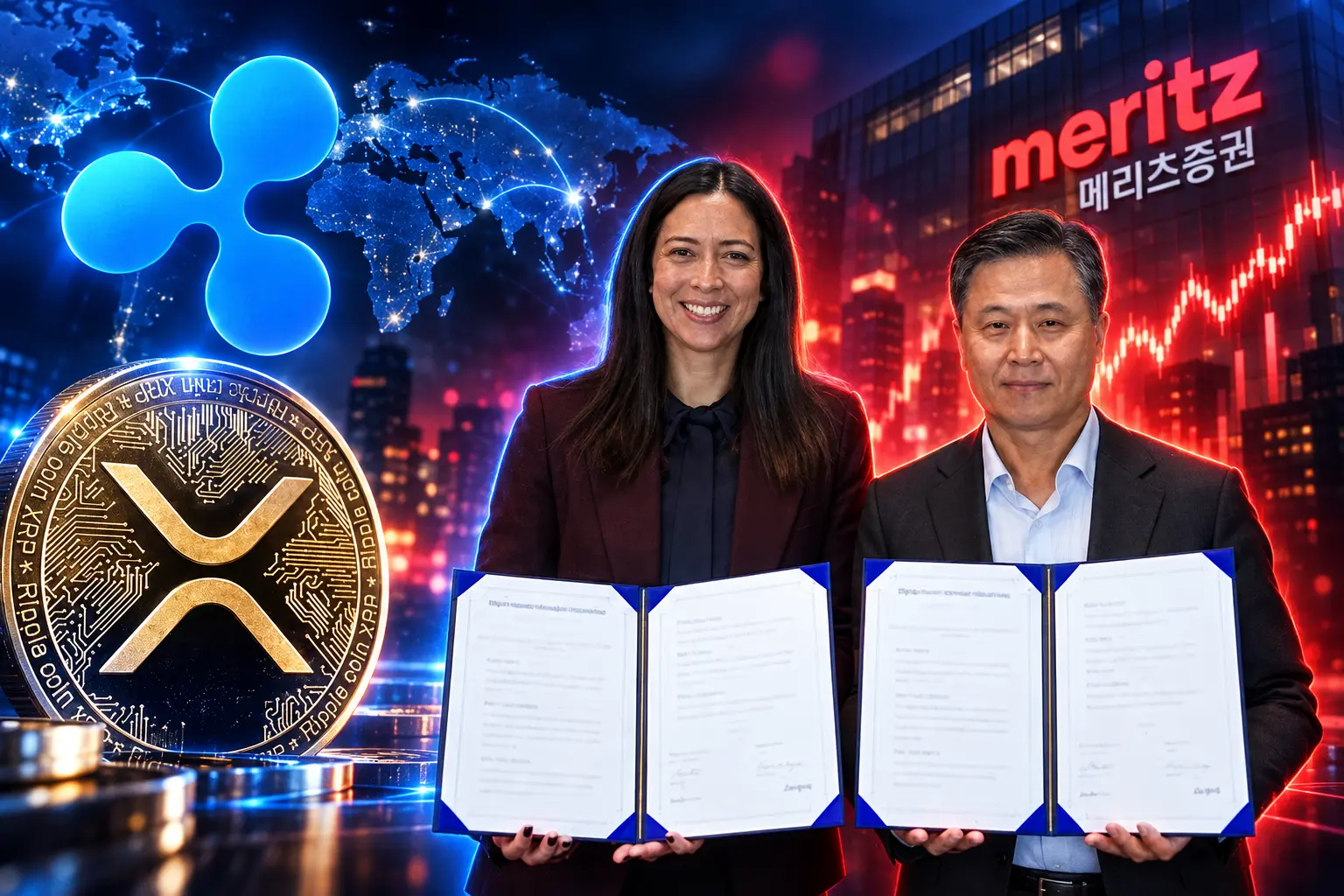
Meritz Securities signed Ripple on October 1 to review custody and tokenization for Korean capital markets, then made the deal public on October 7.
Chief executive Jang Won-jae and Ripple president Monica Long signed at Meritz’s Yeouido headquarters in Seoul. The firms will study Ripple Custody and Ripple’s tokenization tools inside current securities rules. Neither side named a product, a customer, a launch date, or a settlement asset.
Meritz Signed Ripple for a Custody Review
Meritz described the pact as a way to test whether Ripple’s stack can sit inside Korea’s capital markets as local rules change. Work starts with what securities law already allows. Broader cooperation, the firm said, can widen only as the digital-asset regime develops.
Ripple’s offer on the table is institutional digital-asset custody software plus a tokenization layer that mints, tracks, and redeems assets on the same controls. The product page lists HSM or MPC key management, hot, warm, and cold vaults, and deployments on-premise, in the cloud, or hybrid. It also lists SOC 2 Type II, ISO 27001, and FIPS 140-2 Level 4 through partners, depending on the setup.
A Meritz official said the tie-up “lays the groundwork for combining Ripple’s global digital asset infrastructure with our capital markets capabilities,” and that the broker will prepare services “in stages, as the domestic regulatory environment evolves.”
We look forward to exploring how digital asset infrastructure can support the continued development of Korea’s capital markets.
Fiona Murray, Managing Director, Asia Pacific, Ripple
Meritz is not a fringe name on Yeouido. The firm, ticker 008560, held 8.35 trillion won ($5.96 billion) in equity capital at the end of the first half, fourth among Korean brokers on that measure. On September 23 the Financial Services Commission approved it as the ninth house licensed to issue short-term notes, with room to raise up to about 16.7 trillion won.
That is the buyer. It already runs a global digital-assets desk. Samuel Shim, who leads that book, spoke at XRP Seoul on October 3, four days after the private signing and four days before the public notice. The vendor choice is the news. The conversion story is not.
Seoul’s Token Law Opens on February 4
The reason both sides moved now sits in statute, not in a token ticker. Amendments to the Electronic Registration Act and the Financial Investment Services and Capital Markets Act passed the National Assembly on January 15 and were promulgated on February 3. Most of that package takes effect on February 4, 2027.
On October 1, the same day Jang and Long signed in Yeouido, the FSC proposed the subordinate rules that will make those amendments operational. The drafts opened a comment period from October 2 to November 11, then move through approvals before the February date.
THE SEOUL TOKEN CLOCK
- Law date: Tokenized stocks, bonds, and funds become a legal form of securities on February 4, 2027.
- Comment window: Subordinate FSC rules are open for views from October 2 to November 11, 2026.
- Retail cap: Individual investors face an annual net-purchase limit of KRW 100 million on each OTC venue.
- Issuer floor: An issuer that also runs customer accounts needs at least KRW 4 billion in equity capital and four named specialists.
Meritz already clears that capital bar by a wide margin. The February date is the one that matters for product design, because that is when a distributed ledger can serve as a legal securities register in Korea.
What the First Phase Allows
The FSC’s September 4 three-phase tokenization roadmap is the map Meritz is reading. Phase one is narrow on purpose. Private money-market funds and private bonds for institutions, unlisted shares via a trust, and publicly offered fractional products go first. Public offerings of ordinary stocks and bonds wait. Stablecoin settlement waits longer still, and it still needs a separate law.
THE THREE TOKENIZATION PHASES
| Phase | Timing | What can be tokenized |
|---|---|---|
| Phase 1 | From February 4, 2027 | Private MMFs and bonds for institutions; unlisted stocks through a trust; publicly offered fractional securities |
| Phase 2 | After phase 1 is judged stable | Publicly offered securities of all types |
| Phase 3 | Left flexible; needs stablecoin legislation | On-chain payments linked to stablecoins |
Existing securities firms do not need a new charter to handle tokenized paper inside the licenses they already hold. They do need a prior consult with the Financial Supervisory Service before they intermediate those trades over the counter. For Meritz, that is the operational path: plug a custodian into books it already runs, then ask the supervisor before it makes a market.
The ledger rules are stricter than the license rules. A distributed ledger must be shared across two or more account managers, including issuer-account managers, plus the Korea Securities Depository. Direct fees for using that ledger are banned, on the ground that a public register should not become a toll booth. Custody software, tokenization controls, and brokerage still look like billable work. Metering the chain itself does not.
Issuer-account managers, the new class that can issue tokens and run customer accounts, need KRW 4 billion in equity, one account-management specialist, one internal-control specialist, and two information-technology specialists. Fractional deals that use non-monetary trust certificates get a suggested subscription cap: the smaller of KRW 30 million and 5 percent of the issue.
Securitize and LG CNS Arrived on October 6
Ripple is not walking into an empty room. One day before Meritz spoke, Securitize and LG CNS, the IT arm of LG Group, announced a memorandum covering tokenized funds, equities and stablecoins for Korean institutions. Securitize, listed as SECZ, put its tokenized-asset book at about $5 billion as of September 2026 and named Apollo, BlackRock, BNY, Hamilton Lane, KKR, and VanEck among the managers on its rails.
DEALS FILED AROUND THE RULES
| Parties | Date | What was put on paper |
|---|---|---|
| Financial Services Commission | October 1, 2026 | Subordinate rules for tokenized stocks, bonds, and funds |
| Meritz and Ripple | October 1, 2026; disclosed October 7 | Joint review of custody and tokenization, no launch |
| Securitize and LG CNS | October 6, 2026 | MOU on tokenized funds, equities, stablecoins, and market links |
Carlos Domingo, Securitize’s co-founder and chief executive, treated Korea as a distribution fight, not a science project.
South Korea has one of the world’s most sophisticated technology and financial markets, making it an important market for the next phase of institutional tokenization.
Carlos Domingo, Co-Founder and CEO, Securitize
Hongkeun Kim, executive vice president and head of digital business at LG CNS, said the pair wants “practical, regulatory-compliant applications” for Korean institutions. Any product under that memorandum still needs Korean approvals and each firm’s own compliance sign-off, the release said.
The stack war has a second front. On September 17, SBI Digital Practice and Kyobo Life said they had finished a Japan-Korea transfer test on the Canton Network, using test tokens rather than live cash. The design converted a yen-denominated stand-in directly into a won-denominated stand-in and skipped the dollar. That is the same Kyobo that already has a Ripple custody brief for government bonds. Korean institutions are dual-tracking vendors while the comment period runs.
Ripple’s Korea Path Ran Through Kyobo First
The Meritz review is a brokerage chapter of a campaign Ripple has been running in Seoul since spring. Custody first, then a wider menu if the supervisor allows it. The pattern is consistent even when the product names change.
RIPPLE’S KOREA DATES
- April 15, 2026: Ripple and Kyobo Life announce a plan to hold and settle tokenized Korean government bonds through Ripple Custody, aiming to cut a two-day cycle toward near real-time.
- April 30, 2026: Ripple says Kbank, Korea’s first internet-only bank, will deploy wallet-as-a-service through Ripple Custody.
- August 18, 2026: Ripple says Jeonbuk Bank becomes the first regional Korean bank to deploy Ripple Payments for cross-border remittances.
- October 1, 2026: Jang and Long sign the Meritz review in Yeouido; the FSC posts its subordinate token rules the same day.
- October 7, 2026: Meritz discloses the Ripple pact.
The Kyobo brief is the closest cousin to what Meritz is now studying. Ripple’s April release on its tokenized government-bond work with Kyobo Life put Ripple Custody under issuance, holding, transfer, and settlement, and said the pair would also weigh the legal feasibility of tokenized Treasury settlement in Korea. Jin Ho Park, a senior executive vice president at Kyobo, called it a test of whether “traditional financial instruments can operate securely and efficiently on blockchain.” The chain was not named.
That omission keeps showing up. Ripple Custody is built to run across multiple ledgers. A Korean supervisor that forces shared registers through KSD can accept a vendor without accepting XRP, RLUSD, or the XRP Ledger as the settlement asset. The Meritz text copies that silence.
Jeonbuk is the live-payments end of the same campaign, and Kbank is the wallet end. Meritz is the securities end. The open question in Seoul is not whether Ripple can sign Korean names. It is whether a review, a pilot, and a payments hook become a supervised custody book by the day the register law turns on.
What Meritz Is Reviewing Beyond Custody
The Ripple pact is the pipe. Meritz has also listed five businesses it is studying as digital assets move into the regulated system. None of them is an announced product. None is tied, in the disclosure, to a specific Ripple module.
FIVE LINES UNDER REVIEW
- Spot digital-asset ETFs: Exchange-traded funds that hold coins directly, if Korean fund rules allow the wrapper.
- Fractional investment: Small-lot products that map onto the FSC’s trust-certificate and investment-contract tracks.
- Tokenized securities and STOs: The February 2027 register is the legal on-ramp for this line.
- Digital-asset trading platforms: A broker-run venue, still inside securities and digital-asset rules.
- Won-denominated stablecoins: A Phase 3 settlement tool under the FSC map, and still waiting on separate legislation.
Custody and tokenized securities are the two lines that actually match what Ripple was hired to study. Spot ETFs, a trading platform, and a won coin can run on other vendors, or not run at all. Treating the five-item list as a Ripple product roadmap overstates the filing.
The FSC’s own sequence also clips the ambition. A won stablecoin used to settle tokenized bonds is Phase 3 language, and Phase 3 is “flexible” until a stablecoin statute exists. Fractional products and private institutional funds are the work that can start on February 4. That is the book a broker can reasonably hope to open first if the custody review holds up.
XRP Stayed Off the Signing Table
The public tape still read the filing as an XRP event. On Upbit, XRP’s 24-hour trading value was about $111.4 million at 1:36 a.m. ET on October 7, against about $104.7 million for bitcoin and about $59.2 million for ether. The partnership text does not give XRP, RLUSD, or the XRP Ledger a job.
That gap is the whole trade for anyone buying the token on a brokerage headline. Ripple the software vendor, Ripple Custody the product, and XRP the asset are three different things. A Korean securities firm can license the first two and never touch the third. The Kyobo bond brief already showed how that split looks in practice.
WHAT WE KNOW
- The paper: Meritz and Ripple signed on October 1 in Yeouido and Meritz disclosed the review on October 7.
- The scope: Joint study of Ripple Custody and tokenization tools, starting inside current securities rules.
- The clock: FSC subordinate rules are in comment until November 11, 2026, with tokenized securities legally recognized from February 4, 2027.
WHAT IS UNCONFIRMED
- The product: No named service, customer group, or go-live date.
- The rails: No choice of ledger or settlement asset, including XRP, RLUSD, or the XRP Ledger.
- The money: No fee, volume, or exclusivity terms in the public notice.
The louder misread is to treat a custody review as a Korean listing. The quieter risk sits on the other side: Korean pacts this year have mixed “deploy” language at banks with “assess” language at the insurer, and Meritz used “review.” Signing day is not production day. The comment period still has to close. KSD still has to screen whatever ledger the broker brings. The FSS still has to be consulted before OTC intermediation starts.
Meritz now has a named custodian and a calendar. It does not have a live tokenized book. The next fact that would change that is a supervised product, a chosen register, and a settlement asset written into an operating model, not another ceremony in Yeouido.
Disclaimer: This article is news reporting and analysis of a corporate partnership and of Korean securities-rule changes. It is for information only and is not investment, trading, legal, or tax advice. It does not recommend buying, selling, or holding XRP, RLUSD, Meritz shares, Securitize shares, or any other security or digital asset, and it does not advise any firm on custody or tokenization vendors. Readers should consult a licensed financial adviser and, where relevant, Korean legal counsel before acting on anything described here. Figures, product statuses, and rule timelines reflect the company statements and FSC texts cited as of the sources’ dates and may change as the comment period, approvals, and reviews proceed.

The BMW iX4 Undercuts Mercedes and Trails Its Twin

Scotland’s Ten Big Supermarkets Already Hold the Weekly Shop

Scotland EMS Faces a State Probe After a Wagram Death

Meritz Signs Ripple to Race Korea’s 2027 Token Rules

Pocognoli’s First Camp Leaves Scotland Third and Exposed

Volkswagen Sells the Osnabruck Plant to Clear a Board Fight

Tata Motors’ Iveco Tender Opens as Holders Still Decide

Saksham Gaur Finds He Is His Own Company’s Client

Onimusha Way of the Sword Preload Hits a Windows 11 Wall

Hyderabad 22-Carat Gold Jumps After a False Bargain
-
 AUTO1 month ago
Volkswagen Sells the Osnabruck Plant to Clear a Board Fight
-
 AUTO1 month ago
Tata Motors’ Iveco Tender Opens as Holders Still Decide
-
 BUSINESS1 month ago
Saksham Gaur Finds He Is His Own Company’s Client
-
 GAMING1 month ago
Onimusha Way of the Sword Preload Hits a Windows 11 Wall
-

 NEWS1 month ago
The Frame Pro’s $1,200 Labor Day Cut Needs a Soundbar
-
 BUSINESS1 month ago
Hyderabad 22-Carat Gold Jumps After a False Bargain
-

 AUTO1 month ago
Simple Wave Chases Range as Ather Konarc Cuts Price
-
 BUSINESS1 month ago
The Rs 4.66 Lakh Crore IPO Queue Is Mostly Paper