
NEWS
Mull’s Miracle Eagle Has Flown Into Adult Territory
Kinky, Mull’s miracle white-tailed eagle, is flying at three with a bent wing, just as adult pairs start driving young birds out.

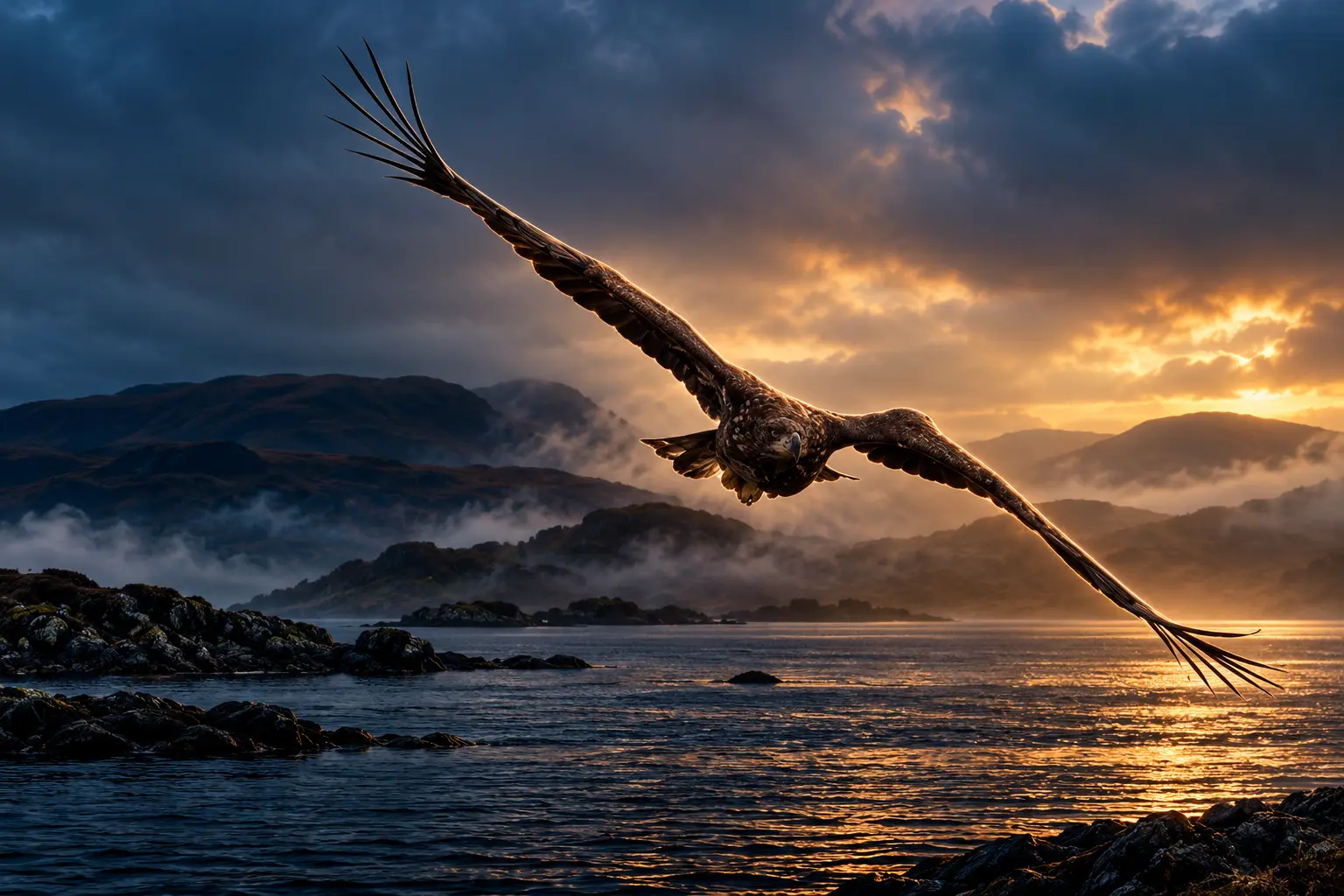
A three-year-old sea eagle with a permanently bent left wing has been photographed soaring over Loch Spelve on the Isle of Mull. The bird is Kinky, the white-tailed eagle that fell from its nest in a July 2023 storm and was not expected to live. Retired RSPB officer Dave Sexton, who has watched Mull’s eagles for more than 20 years, called the sighting incredible.
That survival now puts him into the years when adult pairs on the island stop treating young birds as family.
His Parents Gave Up a Breeding Year
White-tailed eagles, the largest UK bird of prey, usually see their young off in autumn and breed again. Kinky’s left wing broke when the nest came down in bad weather in July 2023, on a territory that takes in Mull and the nearby shore of Ulva. His sibling walked away unhurt and fledged on schedule. He stayed on the ground, dragging the broken wing, unable to get up onto safer perches.
A local skipper named him for the bump that set as the bone healed. The two adults kept bringing fish to a chick that could not hunt. Sexton watched them fly in, and watched the youngster hobble over to feed, through the rest of that season. In autumn the bone had fused enough for take-off, though the flight was wobbly and the kink stayed visible.
The next spring, the adults did not lay. They moved to a new nest and still fed a bird more than a year old. Sexton, out on a Mull Charters monitoring run, heard the screech young eagles use when they want food, then saw the juvenile chase its father and take a fish the adult had lifted from the boat. He later said he had never seen that in 30 years of watching the species, and that other eagle workers at home and abroad had not reported it either.
We normally think of eagles as hard-wired and unemotional but clearly there might be another side to their nature.
Dave Sexton, retired RSPB Mull officer
That skipped season is the hidden bill for the miracle. A typical clutch is two eggs. One damaged son lived because two adults parked a breeding year, and because boat crews kept passing them fish.
A WhatsApp at 2pm Said He Lives
By late autumn 2024 the family dropped out of sight as the boats stopped. The adults were breeding again in 2025. RSPB Scotland put out an appeal in April 2025, asking people to look for a young eagle with an unmistakable kink in the left wing, and Sexton said he doubted the bird could have got through winter without them.
KINKY’S FIRST THREE YEARS
- July 2023: Falls when the nest comes down in a storm and breaks his left wing.
- Autumn 2023: Sibling fledges on time; Kinky takes off weeks later with a wobbly, bent wing.
- Breeding season 2024: Parents skip laying and keep feeding him at a new nest.
- Late autumn 2024: Last sighting before he vanishes for the winter.
- April 2025: RSPB Scotland asks the public to report a young eagle with a bent wing.
- 1 July 2025: Blair Ketteringham photographs him over Eorsa and messages Sexton, “He lives!”
- 2026: Beth Sheils photographs him over Loch Spelve on the south-east coast of Mull.
Ketteringham, a crew member on the Mull Charters boat Lady Jayne, saw an immature bird circling Eorsa in Loch na Keal on 1 July 2025, caught the kink in a photograph, and sent it at 2pm. Sexton was having a cup of tea and said he nearly spilled it. The bird soared, came down, and had a brief meeting with a different adult sea eagle, not his parents.
Martin Keivers had already photographed the family in the long year of feeding. The 2026 frame, from Sheils, is the one that shows him still in the air over Loch Spelve, the crooked wing readable at distance. He has now lived through two winters without the adults that saved him.
Mull Has Little Spare Sky
Mull is where the species first bred again in 1985, and NatureScot still lists it among the main concentrations of territories, with Skye, mainland Argyll and the Outer Hebrides. Young white-tailed eagles often roam with birds of the same age and learn the feeding grounds together. Problems start when a sub-adult drifts into a range that already has a pair.
Sexton put that in plain words after the Loch Spelve pictures. He is in awe of the bird. He also said the next phase, the sub-adult years, could be dangerous, because established adults will no longer treat him as an immature and the “you’re not welcome here” behaviour can be pretty severe. In 2024 he had already asked what would happen when this youngster reached that stage in three or four years. 2026 is that stage.
The July 2025 meeting with a different adult was short. It is also the first public sign that other eagles are no longer in the business of feeding him. On an island this packed, a bird that flies a little wrong is still a rival when he lands in the wrong bay.
Most Young Eagles Are Dead by Age Three
Ringing work published by the British Trust for Ornithology sets the odds before anyone talks about a bent bone. The table below is the usual path against the one this bird has actually taken.
A TYPICAL YOUNG EAGLE AGAINST THIS ONE
| Stage | Usual path | Kinky |
|---|---|---|
| First autumn | Fledge and leave | Grounded for weeks, then wobbly flight |
| Age 1 | Independent, and unwelcome if still at home | Still fed while the parents skip breeding |
| First winter alone | Heavy losses | Missing from late 2024, found 1 July 2025 |
| Age 3 | 39.5 percent still alive | Photographed over Loch Spelve |
| Age 5 | Typical first breeding | Not yet |
Those juvenile survival to age three figures already assume two working wings. Sexton has said a broken wing is a death sentence for most eagles because they cannot hunt. He has also said this one can live on deer, seal and bird carcasses if the kink keeps him from clean kills. Adult survival in the same dataset is 0.936, and a bird that reaches breeding age often lives around 20 years, so the remaining risk is concentrated in these middle seasons, not in old age.
Chicks fledge at 70 to 75 days in a normal nest. Kinky spent extra weeks on the floor after that clock had already run. The bone fused. The flight profile never went back to straight.
Scotland Shot Its Last Eagle in 1918
The last breeding pair in Scotland was on Skye in 1916. The last known bird, an albino female, was shot in Shetland in 1918. Small releases in Argyll in 1959 and on Fair Isle in 1969 failed. The project that stuck began in 1975, when the Nature Conservancy Council, now NatureScot, put Norwegian chicks out on the first release site on Rum.
HOW THE BIRDS GOT BACK
- 1916: Last Scottish breeding pair is present on Skye.
- 1918: Last known bird is shot in Shetland.
- 1975 to 1983: 82 Norwegian birds are released on Rum.
- 1985: First successful wild breeding of the return takes place on Mull.
- 1993 to 1998: 58 birds go out in Wester Ross.
- 2007 to 2012: 85 birds go out in Fife.
- 2021: UK conservation listing moves from Red to Amber.
- June 2025: NatureScot puts the population at around 200 breeding pairs.
The three release phases add up to 225 birds. NatureScot, marking 50 years since the Rum start, now records around 200 breeding pairs in Scotland, mostly in the west, with birds also turning up inland and making the 66km sea crossing to St Kilda. They are a Schedule 1 species, so it is illegal to disturb them. Pairs mate for life, add to the same nest until it can reach 1.8 metres across, and take fish, rabbits, hares, birds and carrion.
The return has a farm bill attached. Lamb turns up in some nests, and the hit is uneven. NatureScot runs help for farms dealing with sea eagles, and the Scottish Government added £534,000 for 2025-26, taking that scheme to £970,000. Kinky is one bird. The island he is trying to stay on is already full of pairs, and some of those pairs are already in that argument.
Charter Crews Keep the Record
Official nest checks do not explain how this particular youngster keeps turning up. The people who see him are on the water for a living. Mull Charters crews watched him through the grounded summer and the wobbly autumn. Sexton was on their boat when the year-old bird robbed its father of a fish. Ketteringham was on Lady Jayne when the winter silence broke. Sheils was on the south of the island for the Loch Spelve pictures.
WHO HAS ACTUALLY SEEN HIM
- A local skipper: Gave him the name after the bump in the left wing.
- Mull Charters crews: Tracked the grounded chick and the extra year of feeding.
- Dave Sexton: Saw the 2024 fish pass and has read every later photograph.
- Blair Ketteringham: Shot the 1 July 2025 frames over Eorsa and sent “He lives!”
- Beth Sheils: Made the 2026 Loch Spelve pictures that show the kink still in the sky.
A 2022 RSPB study, cited by NatureScot, put wildlife tourism of this kind at £5-8 million a year for Mull. The same fleet that sells eagle trips is the unofficial census. In September 2025 Sexton was still using those boats to go looking, and he said as much on his own account when BBC Radio 4’s Inside Science came to Loch na Keal.
https://t.co/k98VbIXvAQ
A few 'Kinky' minutes as we head to Loch na Keal on Mull to search for a very special young sea eagle… #InsideScience #BBCR4 #BBCSounds @Vic_Gill
Special thanks to @mullcharters who have been on this remarkable journey too @Natures_Voice @RSPBScotland🦅— Skye and Frisa (@skyeandfrisa) September 25, 2025
The public copy around the new pictures still reads like a postcard. The people who have followed him since the nest fell know the postcard is the easy part.
What Happens to a Sub-Adult Sea Eagle?
White-tailed eagles typically breed at five. Kinky hatched in 2023, so 2028 is the first year he would even be on that clock. Until then he has to eat, keep out of adult ranges, and fly with a left wing that does not match the right. Sexton called him a born survivor and said he is keeping everything crossed.
WHAT HE WALKS INTO NOW
- Adult pairs: They no longer treat him as a youngster and will see him off.
- Crowded ranges: Mull’s territories already sit tight against one another.
- A weak hunting stroke: If the kink costs him fish, he has to make do with carcasses.
- Other eagles: Golden eagles share the island and will fight when they have to.
The parents who parked a breeding year have moved on. The brief meeting over Eorsa in 2025 was with a stranger. The Loch Spelve pictures show that the wing still works well enough to hold a three-year-old in the air. They do not show anyone making room for him on the ground.
Sexton said the unwelcome behaviour can be pretty severe sometimes. He also said this bird has already done the part nobody thought he would do. Two more winters sit between that crooked silhouette and the age at which a white-tailed eagle is even supposed to try for a nest of its own.

The BMW iX4 Undercuts Mercedes and Trails Its Twin

Scotland’s Ten Big Supermarkets Already Hold the Weekly Shop

Scotland EMS Faces a State Probe After a Wagram Death

Meritz Signs Ripple to Race Korea’s 2027 Token Rules

Pocognoli’s First Camp Leaves Scotland Third and Exposed

Volkswagen Sells the Osnabruck Plant to Clear a Board Fight

Tata Motors’ Iveco Tender Opens as Holders Still Decide

Saksham Gaur Finds He Is His Own Company’s Client

Apple’s Foldable iPhone Hinges on Samsung Display Supply

Onimusha Way of the Sword Preload Hits a Windows 11 Wall
-
 AUTO2 months ago
Volkswagen Sells the Osnabruck Plant to Clear a Board Fight
-
 AUTO2 months ago
Tata Motors’ Iveco Tender Opens as Holders Still Decide
-
 NEWS2 months ago
Apple’s Foldable iPhone Hinges on Samsung Display Supply
-
 BUSINESS2 months ago
Saksham Gaur Finds He Is His Own Company’s Client
-
 GAMING2 months ago
Onimusha Way of the Sword Preload Hits a Windows 11 Wall
-

 ENTERTAINMENT3 years ago
What is SD on Amazon Prime? – All You Need to Know
-

 AUTO2 months ago
Simple Wave Chases Range as Ather Konarc Cuts Price
-

 BUSINESS2 months ago
Hyderabad 22-Carat Gold Jumps After a False Bargain