
BUSINESS
Scotland’s Land Reform Act Leaves Lotting Power Idle
Holyrood’s 1,000-hectare lotting power sits unused while 408 owners still hold half of private rural land, with live rules parked until 2028.

Holyrood’s Land Reform (Scotland) Act 2025 gives ministers a public-interest power to split sales of holdings over 1,000 hectares, yet that lotting duty is still not in force. MSPs passed the Bill on 5 November 2025 by 85 votes to 28, with 9 abstentions, after almost 400 amendments.
Royal Assent followed on 16 December 2025. The sale rules, community notice and a new Land and Communities Commissioner remain prospective, and the ownership pattern the Act was written to loosen has tightened again.
A Sale-Only Break-Up Power Reached the Statute Book
The Scottish Government said the Bill, passed by Parliament in November 2025, would help create new small holdings, modernise farm tenancy law and give ministers a public-interest power to split landholdings over 1,000 hectares when they are sold. Rural Affairs Secretary Mairi Gougeon, who took the Bill through Stage 3, told MSPs that concentrated ownership had developed over centuries and had left control “in the hands of the few for too long.”
Part 1 deals with large holdings. Part 2 rewrites how small landholdings are created and how agricultural tenancies work, including compensation when a tenant is removed. A promised consultation on the Tenant Farming Commissioner’s powers was due after the vote. Cabinet Secretary Gillian Martin, who now holds the rural brief, has still to publish a full Part 2 timetable.
WHAT THE 2025 ACT PUTS ON THE BOOKS
- Lotting on sale: An owner of a large holding must seek a ministerial lotting decision before most transfers, and ministers may require the land to be sold in smaller lots if they judge that to be in the public interest.
- Advance notice: Planned sales of large holdings must be notified so ministers can alert community bodies and pause a deal while a Right to Buy application is explored.
- Land management plans: Owners in scope must publish a plan, after community engagement, setting out how the land is run and whether a sale is in view.
- A new commissioner: A Land and Communities Commissioner inside the Scottish Land Commission will enforce engagement duties and advise ministers on lotting.
- Tenancy rewrite: Part 2 updates small landholdings, compensation, diversification and the Tenant Farming Commissioner’s codes, with more of the detail left to later regulations.
None of those Part 1 tools, including lotting, can be used until commencement regulations and guidance are in place. The first commencement order left them off.
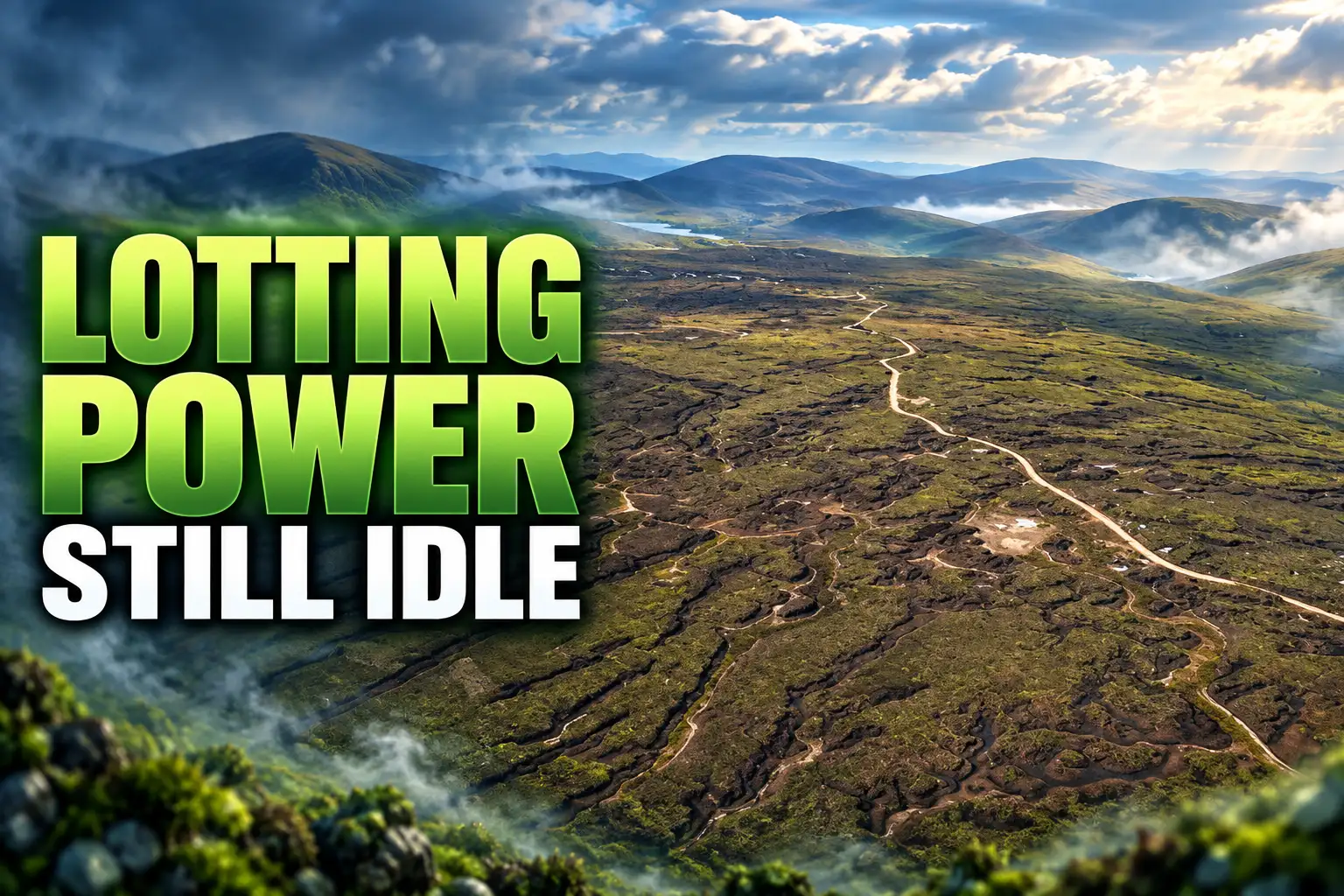
What the 1,000-Hectare Test Does
The transfer test applies when someone tries to sell or transfer a holding over 1,000 hectares, or a slice over 50 hectares that forms part of such a holding. Ministers then decide whether the public interest, framed around community sustainability, is better served by splitting the land into lots before it goes to market. Holdings that are never offered for sale are outside that trigger.
Composite holdings are in scope too. Land in the same or connected ownership that lies within 250 metres can be added together, even if a road or river sits between the parcels. Connected companies in the same group can be treated as one owner. That is how a forestry portfolio assembled title by title can still meet the threshold.
The design has a quiet consequence. A family that never sells, or a fund that keeps buying neighbouring ground, does not meet the lotting gate. The Act regulates the moment of transfer. It does not cap how much one person or company may hold, and it does not force a living estate onto the market.
Scottish Greens MSP Ariane Burgess told the chamber the package showed a “lack of ambition.” NFU Scotland had wanted the large-holding line set at 3,000 hectares so family farms would stay clear, and it argued for lotting to be dropped until the effects had been modelled. The 1,000-hectare line stayed in.
More Than a Thousand Holdings Sit Over the Line
The government’s business and regulatory impact assessment, drawing on James Hutton Institute modelling, counted 1,066 landholdings above 1,000 hectares. Those holdings cover 4.32 million hectares, about 55% of Scotland. Rural land is 7.62 million of the country’s 7.79 million hectares, or 98% of the map.
HOLDINGS CAUGHT BY THE HECTARE THRESHOLDS
| Size threshold | Holdings | Area (million ha) | Share of Scotland |
|---|---|---|---|
| 500 ha and above | 1,907 | 4.90 | 63% |
| 1,000 ha and above | 1,066 | 4.32 | 55% |
| 3,000 ha and above | 414 | 3.22 | 41% |
Most farm units will never see this test. The June Agricultural Census used in the assessment recorded 44,698 agricultural holdings, and over 95% of them were under 500 hectares. Community ownership, on 2022 government figures, covered about 212,000 hectares, around 3% of Scotland.
Lowering the old 3,000-hectare idea for some duties down to 1,000 hectares pulled in that middle band of 1,066 holdings. It still leaves the Act aimed at a small number of very large units, and only when those units are sold.
The Live Rules Sit Parked Until Late 2028
The Land Reform (Scotland) Act 2025 (Commencement No. 1) Regulations 2026, made on 3 March 2026, brought sections 8, 9 and 12 into force on 16 March 2026. Those sections cover extra Land Commissioner functions on natural capital markets and a model lease for hutting. Lotting, pre-sale notice, land management plans and the new commissioner post were not in the order.
On 3 August 2026, Gillian Martin wrote to the Rural Affairs Committee with a sequence. She said the first public consultation, due in autumn 2026, would focus on community engagement and the content of land management plans. After the new commissioner is in post, a further consultation on draft regulations is expected in autumn 2027. She then expects to lay the community-engagement regulations in late 2028, under the affirmative procedure.
Lotting and pre-notification come after that package, in a later set of regulations, with a grace period before enforcement. Martin has chosen to start with management plans so a published plan can inform any later lotting advice. Until the commissioner exists, that advice function has no office-holder.
THE ROAD FROM BILL TO LIVE RULES
- 14 March 2024: The Scottish Government publishes the Bill and its impact assessment, with lotting aimed at holdings over 1,000 hectares.
- 5 November 2025: Parliament passes the Bill by 85 votes to 28, with 9 abstentions.
- 16 December 2025: The Bill receives Royal Assent and becomes the Land Reform (Scotland) Act 2025.
- 16 March 2026: The Commencement No. 1 Regulations in March start sections 8, 9 and 12 only.
- 3 August 2026: Martin sets out a plan for the appointment of the new Commissioner by April 2027, with community-engagement regulations in late 2028 and lotting after that.
- Early November 2026: Advertising for the commissioner post is due to open, with interviews in January 2027 and a parliamentary vote in March 2027.
That sequence is the second-order trap. The Act says ministers must consult the Land and Communities Commissioner before making several of the key regulations. Recruitment is not due to finish until April 2027, so the consultation duty cannot be met until then. The vacant post is a block in the statute’s own wiring, not a missing press release.
408 Owners Still Hold Half the Private Rural Land
Andy Wightman, the land researcher behind Who Owns Scotland and a former Green MSP, published his 2025 census on 23 February 2026, using records as at 31 December 2025. He found that 408 landowners own half of private rural land. The year before it was 421. In 2012 it was 440. Fewer owners now hold that same half.
PRIVATE RURAL LAND IN FEWER HANDS
- Half the private rural land: 408 owners in the 2025 census, against 421 in 2024 and 440 in 2012.
- Sixty and seventy percent: 877 owners hold 60%, and 2,413 hold 70%.
- Who holds rural Scotland: 83% is in private hands and 11.3% is public, on Wightman’s reading of 7,872 records covering about 77% of rural land.
- The public estate: It has shrunk by 58,650 hectares, or 6.3%, since 2012.
The slide continues a pattern already recorded in an earlier tally of 420 owners holding half of Scotland’s private rural land. Wightman wrote that existing owners are still adding ground, and that financial buyers such as Gresham House have been assembling forestry and carbon portfolios they did not hold a decade ago. Wildland Ltd, the vehicle of Danish businessman Anders Holch Povlsen, has grown from 64,457 hectares in 2012 to 89,061 hectares, a 38% rise.
He was blunt about the gap between ministerial language and the map. “Despite the professed desire by Scottish Ministers to tackle Scotland’s concentrated pattern of landownership, nothing meaningful has been done to do so,” he wrote. “Scotland is going backwards.”
Lotting cannot touch those purchases until the buyer, or a later owner, tries to sell. A market that keeps concentrating through acquisition is the case the sale-only test is weakest against, and it is the case the 2025 census recorded while the Bill was becoming an Act.
Sarah-Jane Laing Warned of Years of Extra Work
Scottish Land & Estates spent the Bill years arguing that forced lotting would fracture viable businesses, slow forestry and renewables, and scare off buyers. Chief executive Sarah-Jane Laing said it was “utterly absurd” for ministers to be “effectively acting as an estate agent,” and she warned of court challenges. After the vote she went further.
The reality is that many of the Bill’s provisions are so badly drafted that it will take years of additional work by government and others before they can be implemented in practice, and some may never come into effect at all. No one emerges as a winner from this, not government, not landowners, not rural businesses, not communities, and certainly not the taxpayer who will bear much of the cost of the added bureaucracy.
Sarah-Jane Laing, chief executive, Scottish Land & Estates
That forecast now matches the official timetable more closely than the night the Bill passed. Martin’s own letter puts community-engagement rules in late 2028 and lotting later still. NFU Scotland president Andrew Connon struck a different worry, aimed at tenants rather than title: “Our position has always been that land reform must not compromise access to land for tenants or the next generation of farmers. We have concerns that this Bill does not align with this.”
SLE director of policy Stephen Young said repeated tenancy changes had failed to give landlords the confidence to offer new lets, and that Part 2 “further entrench[ed] an imbalanced and unfair framework.” The union, for its part, was disappointed that lotting survived, welcomed some exemptions for quiet transfers, and kept pressing for land management plans to stay simple, with fines of up to £40,000 treated as a last resort.
Community Land Scotland had called lotting one of the most potentially useful tools in the Bill and backed prior notification of large sales. Those tools are the ones still marked prospective on the statute book.
Tenant Protections Can Move Without Lotting
Part 2 is the chapter that does not depend on a 1,000-hectare sale. It extends Tenant Farming Commissioner functions to small landholdings, updates compensation for improvements and game damage, and creates new routes around resumption and the end of a tenancy. Gougeon’s own statement on passing night put tenants first.
Tenant farmers and small landholders are vital to the fabric of our rural communities, and these reforms will help them to make a decent living on their holding and make improvements on the land they work on. It will allow them to work in a way that promotes sustainable and regenerative agricultural production, and, possibly most importantly, be protected from being removed from their holding without fair compensation.
Mairi Gougeon, Rural Affairs Secretary, Scottish Government news release, 5 November 2025
Even that chapter still needs secondary legislation, codes and, on the government’s own promise, a consultation on enforcement and other ways to settle disputes. Martin told the committee her officials would come back with a Part 2 timetable. The next dated step on Part 1 is more concrete: advertising for the Land and Communities Commissioner is due to open in early November 2026, with an appointment target of April 2027.
Until that post is filled, and until the late 2028 community-engagement regulations are laid and then followed by lotting rules, the power to split a large Scottish estate on sale remains a section in an Act. The holdings over 1,000 hectares are still there. The 408 owners who hold half of private rural land are still there. The law that was meant to meet them at the point of sale has not yet been switched on.

TCS Opens Q2 as Mid-Cap IT Keeps the Growth

Bitcoin’s Jobs Rally Fails While December Hike Odds Hold

The Heat Turn a Bucks Rematch Into Vice City Night

The G7 Opens Diesel Tanks While Carriers Head East

Kia Bets Fortuner Money on a Made-in-India Sorento

Volkswagen Sells the Osnabruck Plant to Clear a Board Fight

Tata Motors’ Iveco Tender Opens as Holders Still Decide

Saksham Gaur Finds He Is His Own Company’s Client

Onimusha Way of the Sword Preload Hits a Windows 11 Wall

The Frame Pro’s $1,200 Labor Day Cut Needs a Soundbar
-
 AUTO4 weeks ago
Volkswagen Sells the Osnabruck Plant to Clear a Board Fight
-
 AUTO1 month ago
Tata Motors’ Iveco Tender Opens as Holders Still Decide
-
 BUSINESS1 month ago
Saksham Gaur Finds He Is His Own Company’s Client
-
 GAMING1 month ago
Onimusha Way of the Sword Preload Hits a Windows 11 Wall
-
 NEWS4 weeks ago
The Frame Pro’s $1,200 Labor Day Cut Needs a Soundbar
-

 NEWS1 month ago
Apple’s Foldable iPhone Hinges on Samsung Display Supply
-

 BUSINESS1 month ago
SEBI Reopens How F&O Settles After the Closing Auction
-

 BUSINESS1 month ago
The Rs 4.66 Lakh Crore IPO Queue Is Mostly Paper