
BUSINESS
NatWest’s Campus Bet Pays in Rooms and App Accounts
Since March 2025 NatWest has opened Accelerator rooms on four campuses and recast its 10,000-founder goal as a 50,000-account community for 2026.

NatWest has opened Accelerator rooms on four university sites since it pledged campus hubs in March 2025, and recast its 10,000-founder target as a 50,000-account community.
The 10-year programme, which started in Birmingham in 2015, had 12 hubs when that wager was struck. The new rooms are real. The headcount that now travels with them is a different unit.
The March 2025 Campus Wager
NatWest used the Accelerator’s tenth anniversary to promise two things at once: 10,000 entrepreneurs in the community in 2025, and partnerships with up to 10 UK universities to open new accelerators within three years. That was the original campus expansion plan, aimed at technology, healthcare tech, life sciences and fintech.
Robert Begbie, then as now chief executive of NatWest’s Commercial and Institutional franchise, said the bank believed “by unlocking the potential of entrepreneurs we can support sustained economic growth.” He also launched NatWest Accelerator Pitch, a £1 million grant contest with £100,000 on the table at each live final.
The decade’s book, self-reported by participants and last checked in June 2024, sat behind those promises.
THE 10-YEAR BOOK
- Businesses coached: 9,737 firms had gone through the hubs since 2015.
- Investment raised: Those firms said they had raised £684 million.
- Jobs added: They reported 12,831 jobs created.
- Turnover claimed: Combined sales were put at £1,254 million.
David Plumb, chief innovation officer at the University of Warwick, backed a wider higher-education rollout. Warwick was already the template. In 2021 NatWest opened its first university hub at The Junction on campus, with a first intake of 40 businesses and 10 places reserved for students.
Four Universities Signed in November
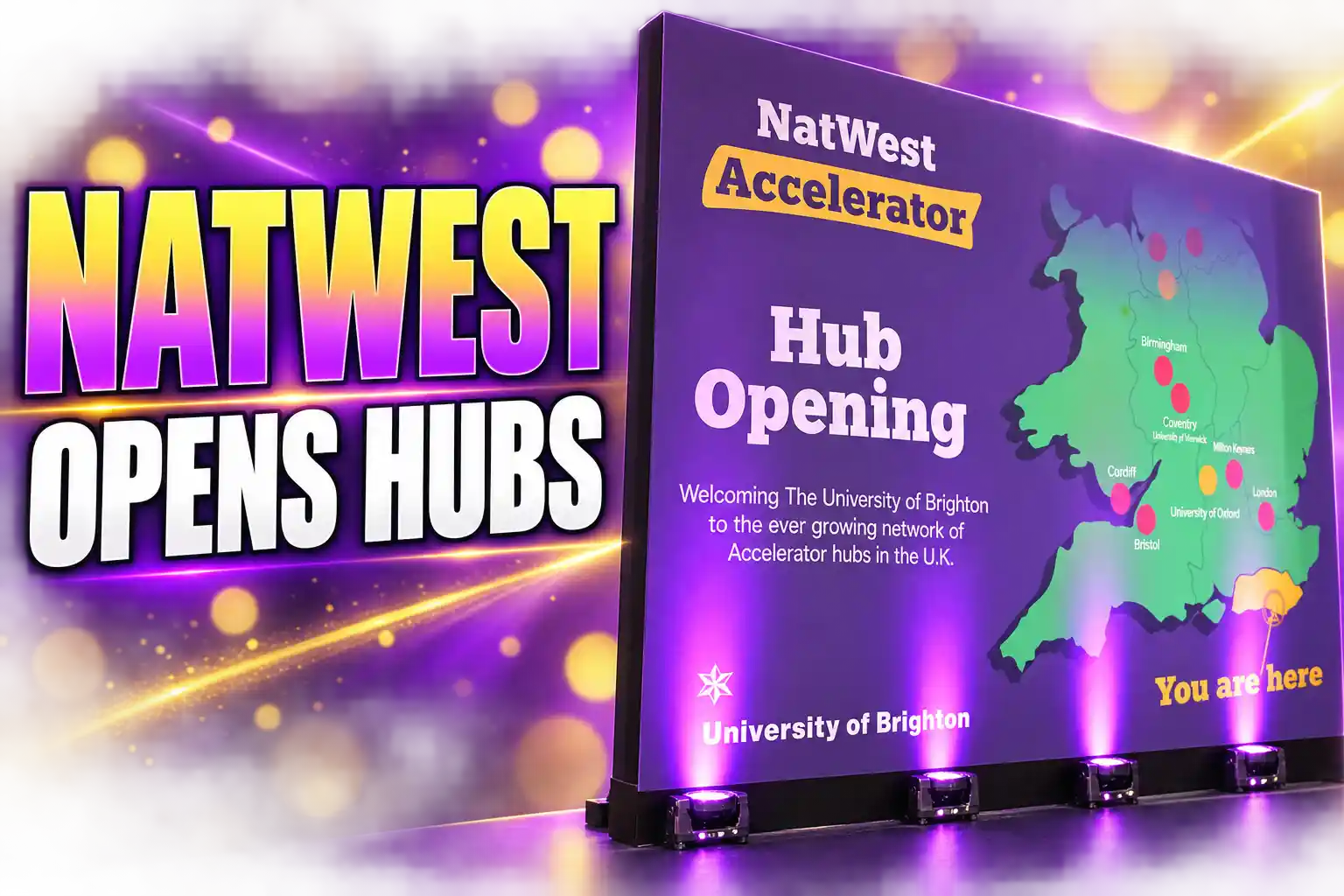
On 27 November 2025 the bank said it had signed the first wave and beaten the 10,000-member target. The University of Manchester, the University of Brighton and the University of York joined for early-stage firms, student founders and spinouts. NatWest also joined Equinox, a growth partnership led by the University of Oxford. Six further university deals were pencilled in by the end of 2027.
Only York and Brighton were promised onsite hubs in that announcement, on top of the existing 12-strong network. Manchester was in the partnership list without a separate opening story. A new flagship hub at 250 Bishopsgate in London opened the same day, with group chief executive Paul Thwaite on the floor and a Pitch final in the building.
Professor Kiran Trehan, pro-vice-chancellor for enterprise, partnerships and engagement at York, said the deal would bring “students, staff, regional founders, and scale-ups” into one support offer, and let academics push work toward commercial use. Begbie called the November round proof that the 2025 ambition had been surpassed, with a larger community still to come in 2026.
UNIVERSITY PARTNERSHIPS SINCE THE PLEDGE
| University | Deal date | What opened |
|---|---|---|
| Warwick | 2021 (pilot) | The Junction; still running |
| Manchester | 27 Nov 2025 | Partnership signed; no separate hub opening found |
| Oxford (Equinox) | 27 Nov 2025 | Hub at The Oxford Trust’s Centre for Innovation, Sep 2026 |
| Brighton | 27 Nov 2025 | Elm House, Moulsecoomb, opened 14 May 2026 |
| York | 27 Nov 2025 | Innovation Centre, York Science Park, opened 11 Jun 2026 |
| Edinburgh | 24 Apr 2026 | Staff link plus cash into the AI Accelerator; no new hub |
| Wolverhampton | Sep 2026 | Campus hub in the Green Innovation Corridor |
| Cranfield (MK:U) | Aug 2026 | Milton Keynes hub relocating to Bouverie House |
The March wording was “up to 10” new university partners in three years. Warwick was already on the map, so it does not fill one of those 10 slots. By early autumn 2026 the bank had named Manchester, Oxford, Brighton, York, Edinburgh, Wolverhampton and Cranfield as additions of different kinds, which puts the logo count inside the original envelope with 2027 still to run.
Rooms Opened From Brighton to Wolverhampton
Signatures in November did not put desks on campus. That took another six to ten months, and the rooms that did open are not carbon copies of one another.
CAMPUS ROOMS THAT OPENED
- 14 May 2026: Brighton’s hub opens in Elm House on the Moulsecoomb campus, with free workspace, meeting rooms, workshops and mentoring. Vice-chancellor Donna Whitehead and NatWest leaders Jon Neil and Darren Pirie speak at the launch.
- 11 June 2026: York opens a hub at the Innovation Centre on York Science Park, plugged into Enterprise Works, with a live pitch on the day. Trehan cuts the ribbon; Pirie, head of Accelerator, attends.
- July 2026: A Pitch notice from the bank puts the free Accelerator at 15 UK locations and online, up from the 12 city list published in February.
- August 2026: The Milton Keynes hub is told it will move into Cranfield University’s MK:U Innovation Hub at Bouverie House in the autumn, a relocation rather than a new city.
- September 2026: A hub opens at the University of Wolverhampton in the city’s Green Innovation Corridor, adding to a Midlands cluster the university lists as Birmingham, Warwick and Tyseley Energy Park. Oxford’s hub opens at The Oxford Trust’s Centre for Innovation with the university and the Trust; Olga Kozlova, Oxford’s director of innovation and engagement, calls it the first Equinox deliverable from the November deal.
Brighton’s offer is written as a regional SME room as much as a spinout lab. The university put the NatWest operation in Elm House on Moulsecoomb campus, home to the School of Business and Law, and said students would sit alongside Sussex firms. York’s hub at York Science Park is sold as a 24/7 app plus coaching for campus researchers and local owners in the same building.
Wolverhampton is the most industrial of the new sites, aimed at manufacturing, engineering, construction, digital and creative firms across the Black Country. Cranfield is the odd one out: NatWest already had Milton Keynes on the February 2026 hub list, and the university deal moves that room into MK:U rather than adding a fifteenth city. A sales workshop is already listed for 8 October 2026 at Bouverie House.
Edinburgh Joins Through the Royal Bank
Scotland’s piece of the campus wager does not look like Elm House. On 24 April 2026 the Royal Bank of Scotland, the NatWest Group brand north of the border, tied itself to the University of Edinburgh around four headings: Accelerator, innovation, research, and student experience and recruitment.
A bank staff member is to sit with the university’s AI Accelerator team and join Edinburgh founders to the Royal Bank Accelerator community. The bank also put £30,000 for Edinburgh’s AI Accelerator, so cohort firms can buy time with academics, PhDs and other university resources. That programme has backed more than 100 companies, which the university says have raised over £120 million, and was recruiting its 10th cohort at the time of the deal.
The same notice restated a Royal Bank aim to support 5,000 Scottish startups in 2026, and listed Oxford, Manchester, York, Brighton and Warwick as the UK university names already signed. Edinburgh is coordination and cash into an existing university accelerator, not a NatWest floorplate with a new address.
Heidi Simpson, regional Accelerator director for the Royal Bank, said the alliance was about “helping founders turn them into real businesses” inside a university that already had the pipeline. Douglas Graham, director of innovation clusters at Edinburgh Innovations, called the link “great news for the entrepreneurs across our cohorts.” For a Scottish newsroom, that is the local return on a UK campus strategy that still runs most of its new rooms in England.
The 50,000 Target Counts App Accounts
On 6 February 2026 NatWest raised the 2025 ambition fivefold. It said it wanted 50,000 registered community accounts by the end of 2026, after a 2025 in which the community grew to just over 12,000. The bank said that single year beat “the total number it had supported over the previous ten years in total.”
The small print on the same page is the load-bearing clause. For 2026 the ambition “is measured as the total number of registered Accelerator community accounts.” That includes “all individuals with an account that has not been deleted,” spanning “customers, non-customers, colleagues and wider supporters.”
WHAT A MEMBER IS
- The unit: An undeleted registered account on the Accelerator community, not a company that finished a six-month coaching cohort.
- Who is in: Customers, non-customers, bank colleagues and wider supporters, according to the February 2026 notes.
- The 2025 stock: Just over 12,000 such accounts at the end of 2025, against a 10,000 target set in March.
- The 2026 aim: 50,000 accounts by 31 December 2026, five times the 2025 goal.
The 9,737 figure from March 2025 counted businesses the hubs had supported since 2015. Just over 12,000 is larger than 9,737, so the arithmetic of “more than the previous decade” is true on the page. It is not a like-for-like count of coached firms. Colleagues with an app login sit in the same bucket as a founder who used The Junction.
That is how a 12-hub coaching network becomes a mass-membership product without 50,000 desks. The app, built with Google tools in the bank’s telling, is the pipe. Campus rooms and Pitch nights are the prestige layer that makes the membership drive look like industrial strategy. Blair McDougall, then minister for small business, called the 50,000 pledge “the exact kind of action we need.” Aaron Asadi, chief executive of Enterprise Nation, said no other bank was doing more for UK small firms. Neither speech lingered on the definition of an account.
Who Walked Away With Pitch Grants
The other March 2025 promise was cash on a stage. Each live final splits £100,000 as a grant: £70,000, £20,000 and £10,000, paid by BACS, with winners given three months to spend it. Entrants must be UK limited companies, trading one to five years, with revenue up to £1 million. By April 2026 the bank said three events had already paid out nearly £300,000.
The first final was in Manchester on 31 July 2025 at the Spinningfields hub. Hanan Tantush of Cheshire won £70,000 for Intotum, an adapted-fashion brand she built after watching her grandfather struggle to find clothes during cancer treatment. Jas Schembri-Stothart of Luna Life, a teenagers’ healthcare app that began as an Oxford Saïd MBA project, took £20,000. Alex Somervell of Ask Silver, a scams-protection tool, took £10,000.
The first London final, tied to the Bishopsgate opening, went to Dr Mark Cox of Orli, a behavioural platform for childhood emotional wellbeing, who took the £70,000 top prize. On 18 June 2026 the contest moved into Saïd Business School. Five finalists, drawn from more than 600 applicants, pitched to judges from Google, JCDecaux, Coutts and the university in front of more than 400 people.
NAMED PITCH WINNERS
- Manchester, 31 July 2025: Intotum £70,000; Luna Life £20,000; Ask Silver £10,000.
- London, November 2025: Orli, founded by Dr Mark Cox, £70,000.
- Oxford, 18 June 2026: Peripear £70,000; Daughters of Mars Ltd £20,000; Join Tangent Ltd £10,000.
- Wolverhampton, 10 September 2026: Fibraxis, founded by Rebecca Bognold, among the winners of that £100,000 split.
- London, 19 November 2026: Next live final at 250 Bishopsgate; entries run on the Pitch site.
Nina van Schaick, a former midwife and co-founder of Peripear, which makes a device meant to cut perineal tearing in childbirth, took the Oxford pot. The line she gave after the result is the clearest specimen of what the contest actually buys, a grant and a room full of investors, not a lecture about hubs.
I spent fourteen years as a midwife watching women sustain birth injuries that didn’t have to happen. I built Peripear because no one else did. Winning £70,000 in front of 400 people at the Saïd Business School in Oxford, against 600 applicants, is the moment I let myself believe that this is actually going to happen.
Nina van Schaick, co-founder and COO, Peripear, after the Oxford final
Second at Oxford was Lucy Hope, an Oxford alumna, for a bioactive tampon at Daughters of Mars Ltd. Third was Gary Izunwa of Join Tangent Ltd, an AI video-recruitment firm, who also left with a JCDecaux marketing prize. The next London final on 19 November is open to Accelerator community members from anywhere in the UK, provided they can travel to Bishopsgate.
Founder channels treated those nights as a grant lottery with a 60-second video at the door, which is what the rules describe. The campus openings, by contrast, drew little public argument. The live update after March 2025 was operational: a Milton Keynes move onto a Cranfield floor, a Black Country room, another London final in the diary.
What the 104 Percent Growth Figure Measures
From November 2025 onward, almost every Accelerator notice has carried the same pair of impact stats. Businesses that go through the programme, the bank says, grew turnover by 104% year on year, against 20% in a control group. Nine in 10 that complete it are still trading three years later, against four in 10 in that control group. ONS data cited in the same notes put average three-year survival for firms born between 2017 and 2019 at 56%.
Those numbers are not a report card on Brighton’s Elm House or York Science Park. The February 2026 notes say they come from NatWest customer data on businesses that took part in 2020, watched over the following three years, and “has not been independently verified by a third party.” Aston University built the benchmark from 298 control firms, 156 of them matched to the 2020 cohort and 142 to 2021.
The campus wager is therefore being sold with a pre-campus dataset. That does not make 104% false. It means the figure describes an older, smaller coaching intake, not the just-over-12,000 app accounts of 2025, and not the student founders now walking into Moulsecoomb.
Where a university room and the old programme overlap, the bank points to Carnot Engines, a Milton Keynes manufacturer that went through the Clean Accelerator at Warwick. Carnot worked with Warwick experts, took £11.5 million of Innovate UK grants, raised £4.3 million, and in August 2024 added Mitsui OSK Lines, a large shipping group, as a major investor. Jeremy Howard-Knight, its head of business development, said the programme gave him “the space, both physically through access to the climb, and emotionally through access to mentors, coaches and other business participants.”
That is the product universities are buying: a bank-funded room, a national app, and a handful of grant nights, with a jobs-and-spinout story they can show funders. NatWest is buying deal flow in life sciences and deep tech that a high-street franchise does not meet on the high street, plus a membership metric that can be scaled without building 50,000 desks. The remaining university slots run to the end of 2027. The membership clock runs to 31 December 2026. The next cash on stage is in London on 19 November 2026.

TCS Opens Q2 as Mid-Cap IT Keeps the Growth

Bitcoin’s Jobs Rally Fails While December Hike Odds Hold

The Heat Turn a Bucks Rematch Into Vice City Night

The G7 Opens Diesel Tanks While Carriers Head East

Kia Bets Fortuner Money on a Made-in-India Sorento

Volkswagen Sells the Osnabruck Plant to Clear a Board Fight

Tata Motors’ Iveco Tender Opens as Holders Still Decide

Saksham Gaur Finds He Is His Own Company’s Client

Onimusha Way of the Sword Preload Hits a Windows 11 Wall

The Frame Pro’s $1,200 Labor Day Cut Needs a Soundbar
-
 AUTO4 weeks ago
Volkswagen Sells the Osnabruck Plant to Clear a Board Fight
-
 AUTO1 month ago
Tata Motors’ Iveco Tender Opens as Holders Still Decide
-
 BUSINESS1 month ago
Saksham Gaur Finds He Is His Own Company’s Client
-
 GAMING1 month ago
Onimusha Way of the Sword Preload Hits a Windows 11 Wall
-
 NEWS4 weeks ago
The Frame Pro’s $1,200 Labor Day Cut Needs a Soundbar
-

 NEWS1 month ago
Apple’s Foldable iPhone Hinges on Samsung Display Supply
-

 BUSINESS1 month ago
SEBI Reopens How F&O Settles After the Closing Auction
-

 BUSINESS1 month ago
The Rs 4.66 Lakh Crore IPO Queue Is Mostly Paper