
BUSINESS
Adobe Bets on Experience Cloud’s Anil Chakravarthy as CEO
Adobe named Experience Cloud president Anil Chakravarthy as CEO from December 1, a board bet on enterprise AI software more than on Photoshop.

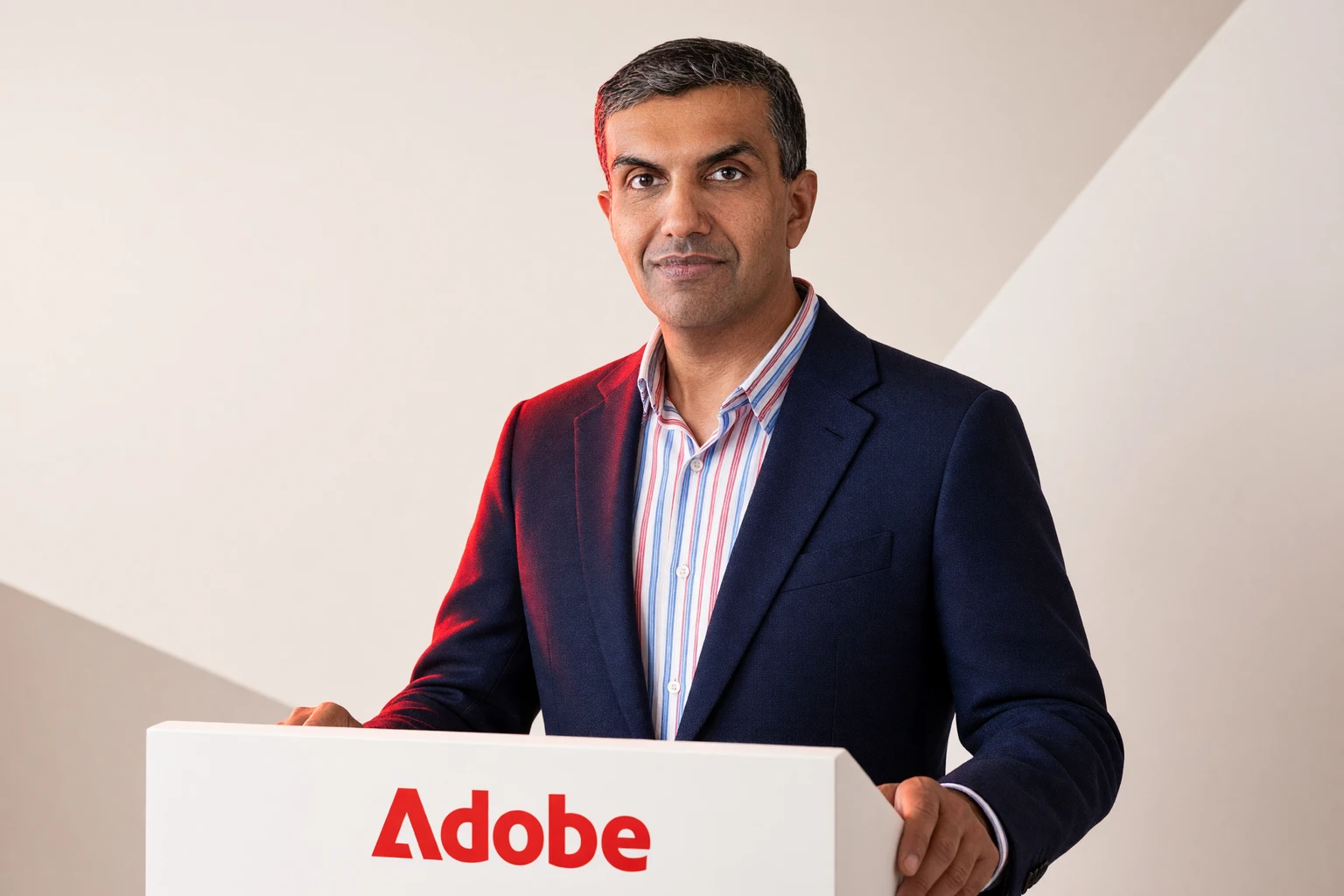
Adobe named Anil Chakravarthy as chief executive on September 3, with the job starting December 1. He runs the company’s customer experience software and its worldwide field operations. He will succeed Shantanu Narayen, chief executive since 2007, who becomes executive chair.
The board is giving the company to the president of its marketing software business. That unit brought in about a quarter of last year’s sales. Photoshop, Acrobat and Creative Cloud still bring in most of the rest.
Adobe’s Next Chief Comes From Experience Cloud
Chakravarthy, 58, will also join the board on December 1. Adobe’s directors said he will become the company’s next president and chief executive, and that Narayen will stay close as executive chair through the handoff.
He joined Adobe in January 2020 as executive vice president of Digital Experience, after about four years as chief executive of Informatica, the data-management software firm. In September 2020 he added worldwide field operations, the enterprise sales, services and customer-success teams that sell Adobe’s full lineup, including creativity and productivity apps. In December 2021 he became president of Digital Experience. Early in 2026 the title shifted to president of Customer Experience Orchestration.
Frank Calderoni, Adobe’s lead independent director, led the special committee on the search. “The Board has unanimously determined that Anil is the right leader for Adobe’s next chapter of growth,” Calderoni said. He pointed to “six and a half years” in which Chakravarthy had expanded the customer-experience business and field operations.
Narayen called him “an experienced transformational leader” with “a deep knowledge of our business.” Chakravarthy, in turn, said he wants Adobe to lead “the next era of agentic software for creativity, productivity and customer experience.”
That last clause is the bet. The famous products are still the ones on a designer’s desktop. The new chief’s own P&L, and the products he has put on stage, sit in marketing software for large brands.
The Board Looked Outside and Still Picked Him
Narayen told employees on March 12 that he would leave the chief executive job once a successor was named, and that the earnings call he was about to hold would be his 100th. He said he would work with Calderoni and the board on the choice, and would stay as chair, as Adobe’s co-founders had done when he took over.
People familiar with the search said the two leading internal names were Chakravarthy and David Wadhwani, president of the Creativity and Productivity business. Wadhwani runs Photoshop, Illustrator, Premiere, Acrobat and the rest of the apps most people mean when they say Adobe. Those people said the company also hired Heidrick & Struggles to look outside, and that Microsoft executive vice president Charles Lamanna held talks about the job before stepping away.
Wadhwani had long been treated inside the company as the heir. He rejoined Adobe in 2021 and was the executive Figma’s chief would have reported to under the $20 billion purchase Adobe struck in 2022. That deal later collapsed under regulatory pressure and cost a $1 billion termination fee. In January 2026, Adobe’s compensation committee still treated the two presidents as peers, granting each 42,200 target performance shares.
The public search itself was a tell. Announcing a hunt in March undercut the idea that the Creative Cloud president was a lock. Almost six months later, the board went to the other internal, the one whose customers are brand and marketing teams, not illustrators.
Digital Experience Was a Quarter of Sales
Adobe’s last full fiscal year, which ended November 28, 2025, still read as a Creative Cloud company with a marketing-software annex. Digital Media, the group that holds Creative Cloud and Document Cloud, delivered $17.65 billion of the $23.77 billion in sales, or 74%, and grew 11%. Digital Experience delivered $5.86 billion, or 25%, and grew 9%. Publishing and Advertising, a leftover line, was $256 million.
ADOBE SALES IN FISCAL 2025
| Segment | Revenue | Share of sales | Growth |
|---|---|---|---|
| Digital Media | $17.65 billion | 74% | 11% |
| Digital Experience | $5.86 billion | 25% | 9% |
| Publishing and Advertising | $256 million | 1% | -7% |
Gross margin tells the same split. Digital Media ran at 95% in fiscal 2025. Digital Experience ran at 72%, because implementation work and services weigh more on the enterprise side. Recurring revenue was healthier than the headline growth gap: Digital Experience subscription sales were $5.41 billion, up 11%, matching Digital Media’s pace even as total Experience revenue lagged.
The clean split is already fading on paper. In the first quarter Adobe combined its former segments into one operating line, a change it tied to unified selling and shared product work. Chakravarthy’s second job is the practical version of that shift. His worldwide field operations for enterprise customers already sell Creative Cloud and Acrobat beside Experience Cloud. The board did not hire a stranger to Photoshop. It hired the man who has been selling Photoshop to companies, and building the tools those companies use after the file leaves the designer.
He Championed Workfront and the Semrush Deal
Adobe’s announcement listed the products he is credited with bringing to market: Adobe CX Enterprise, GenStudio and Brand Visibility, plus the scaling of Adobe Experience Platform and a coworker agent inside CX Enterprise. On the June 11 earnings call he said the enterprise push now sits on three AI-first pillars.
THE PRODUCTS HE PUT IN MARKET
- Experience Platform: The data and activation layer for customer engagement, with native apps around it.
- GenStudio: A content supply-chain suite whose ending ARR grew more than 25% year over year in the second quarter.
- Brand Visibility: Search and generative-engine tools, pulled together after the Semrush purchase and shown with Experience Manager agentic web apps.
- CX Enterprise: An agentic system launched April 20 at Adobe Summit in Las Vegas, with a coworker agent that runs tasks against business goals.
He also “championed the acquisitions and integration of Workfront and Semrush,” the company said. Semrush is the one with fresh numbers. Adobe completed the purchase on April 28, 2026 for $1.87 billion, mostly cash, at $12.00 a share. The quarterly filing says the buy is meant to add search-engine, generative-engine and agentic-search tools for marketers. About $480 million of Semrush book sat inside Adobe’s $27.10 billion of annualized recurring revenue when the second quarter closed. Full-year guidance now folds in about $280 million of Semrush sales.
Chakravarthy personally worked the price up with Semrush chief executive William Wagner, from an early $10.00 indication to the $12.00 that closed. That is deal work, not desktop-app work. The same is true of CX Enterprise, which he described at Summit as a way for companies to move “beyond AI experiments to tangible business outcomes.”
On that June call, Narayen said customer-experience AI-first ARR had grown 4 times year over year, and that companywide AI-first ARR exceeded $500 million, triple the prior year. Those are the figures the board can point to when it is asked why the marketing-software president got the job.
Narayen Grew Adobe From Boxed Software to Subscriptions
Narayen joined Adobe in 1998 and became chief executive in 2007. In his March 12 note to staff he measured the run in round numbers: about 3,000 employees to more than 30,000, and sales from under $1 billion to more than $25 billion. He oversaw the move off boxed Creative Suite into Creative Cloud, then the build-out of Experience Cloud, then the generative-AI push around Firefly.
The stock did not treat the succession as a victory lap. Shares fell more than 7% after hours on March 12, even though the first-quarter report had beaten forecasts, with sales of $6.40 billion. By then the shares were down 23% for the year, part of a wider software selloff tied to fear that AI tools would eat creative software. A second jolt landed in June, when finance chief Dan Durn said he was leaving and Adobe said it would chase freemium users harder, deferring planned Creative Cloud price changes.
THE SUCCESSION CLOCK
- March 12, 2026: Narayen tells employees he will leave the chief executive job once a successor is named, and will stay as board chair.
- June 11, 2026: On the second-quarter call he says the search is “progressing well” and that the next chief should be in place to shape fiscal 2027 plans. Durn’s exit is announced the same day.
- September 3, 2026: The board names Chakravarthy, effective December 1, and says Narayen will become executive chair.
- September 10, 2026: Adobe is due to report third-quarter results, still with Narayen as chief executive.
- December 1, 2026: Chakravarthy becomes president and chief executive and joins the board, on the first days of Adobe’s fiscal 2027 year, which runs December through November.
The December 1 date is not ornamental. Narayen had already told analysts the next chief should put a stamp on fiscal 2027 planning. Adobe’s year starts in December, so the new boss arrives as that year opens, not in the middle of a quarter.
What Chakravarthy Inherits on December 1
The company he takes over is growing and cheaper than it used to be. Second-quarter sales were $6.62 billion, up 13% as reported and 11% in constant currency. GAAP earnings were $4.25 a share and non-GAAP earnings were $5.96. Adobe raised its fiscal 2026 sales target to $26.5 billion to $26.6 billion. Ending ARR was $27.10 billion.
THE COMPANY HE TAKES ON DECEMBER 1
- The stock: Shares closed at $285.75 on September 3, up 2.13%, then slipped to $281.47 after hours, a 1.50% drop from the close, leaving a market value of about $113.59 billion.
- The range: The 52-week span runs from $190.12 to $370.86, a reminder of how far the multiple has compressed since the AI scare took hold.
- The funnel: Creative freemium monthly users went from 50 million to 90 million year over year. Acrobat and Express monthly users went from more than 700 million to more than 850 million.
- The finance seat: Steve Day, a 20-year Adobe finance executive who had been CFO of the Customer Experience Orchestration unit, is interim finance chief after Durn’s departure.
Firefly, the generative app most outsiders treat as Adobe’s AI answer, is still a small book. Ending ARR, including apps, credit plans and enterprise Firefly, was approaching $300 million in June, against $27.10 billion of company ARR. The creative AI product is a growth seed, not the P&L. The money is still in subscriptions to Photoshop, Acrobat and Experience Cloud.
That is the awkward part of the bet. Chakravarthy has to keep the 74% side healthy while the board’s story is about agents, brand visibility and in-house marketing platforms. Wadhwani is still in the building. The September 10 call will be Narayen’s, not the new chief’s. Day, the interim finance chief, comes out of Chakravarthy’s own unit, which will look to some investors like the Experience Cloud bench taking over the corporate center.
Agentic Software Is the Line He Used
Chakravarthy’s first public sentence in the job was not about brushes, layers or PDFs. It was about agents.
I’m energized by the opportunity to fuel growth and drive Adobe’s leadership in the next era of agentic software for creativity, productivity and customer experience.
Anil Chakravarthy, incoming president and CEO, Adobe announcement, September 3, 2026
He has been rehearsing that pitch for months. At Summit, with more than 14,000 people in the room, he rolled out CX Enterprise as an end-to-end agentic system with skills, Model Context Protocol endpoints and a governance layer. Adobe’s newsroom now says 99% of the Fortune 100 use its AI, that Experience Platform powers more than 1 trillion experiences a year, and that about 20,000 enterprise customers sit on the books. Those are brand-side claims. They are also the claims of a man who has never been the public face of Photoshop.
The conversation around the naming split the same way. A lot of it treated the story as one Indian-born chief handing the job to another, from IIT Varanasi and MIT, after Narayen’s long run. The sharper split is the product one. Adobe just put a customer-experience operator over a company whose household name is still a creative suite, at a moment when Firefly’s book is small and Experience Cloud’s growth has lagged Digital Media’s.
He starts December 1. Until then Narayen remains chief executive, including on the September 10 call, and the bet is still only a press release.
Disclaimer: This article is news reporting and analysis of a leadership change at a public company, and it is for information only. It is not investment advice, a recommendation to buy or sell Adobe shares, or a forecast of the company’s results. Readers who are considering an investment decision should consult a licensed financial adviser who can look at their own holdings and risk tolerance. Share prices, revenue figures, annualized recurring revenue and job titles are taken from company filings and statements as of the dates cited and may change after Adobe’s next earnings report or as the December 1 transition proceeds.

The BMW iX4 Undercuts Mercedes and Trails Its Twin

Scotland’s Ten Big Supermarkets Already Hold the Weekly Shop

Scotland EMS Faces a State Probe After a Wagram Death

Meritz Signs Ripple to Race Korea’s 2027 Token Rules

Pocognoli’s First Camp Leaves Scotland Third and Exposed

Volkswagen Sells the Osnabruck Plant to Clear a Board Fight

Tata Motors’ Iveco Tender Opens as Holders Still Decide

Saksham Gaur Finds He Is His Own Company’s Client

Onimusha Way of the Sword Preload Hits a Windows 11 Wall

Simple Wave Chases Range as Ather Konarc Cuts Price
-
 AUTO1 month ago
Volkswagen Sells the Osnabruck Plant to Clear a Board Fight
-
 AUTO1 month ago
Tata Motors’ Iveco Tender Opens as Holders Still Decide
-
 BUSINESS1 month ago
Saksham Gaur Finds He Is His Own Company’s Client
-
 GAMING1 month ago
Onimusha Way of the Sword Preload Hits a Windows 11 Wall
-
 AUTO1 month ago
Simple Wave Chases Range as Ather Konarc Cuts Price
-

 BUSINESS1 month ago
Hyderabad 22-Carat Gold Jumps After a False Bargain
-

 BUSINESS1 month ago
The Rs 4.66 Lakh Crore IPO Queue Is Mostly Paper
-

 BUSINESS1 month ago
UltraTech Ultravolt Launch Splits Friday Stocks to Watch