
NEWS
New Bat Family Tree Places Their Origin in Europe
103 bat genomes trace the first flying mammals to Europe and map the genes behind flight, sonar and disease resistance.

A Nature study of 103 bat genomes and 44 fossils traces the first bats to Europe about 65 million years ago. The paper, published on 23 September 2026, is Phase 1 of Bat1K, a project built to read every living bat species.
Researchers say the new family tree is the map they needed to hunt the genes for flight, sonar, long life and viral tolerance.
Where Did Bats First Evolve?
The team’s dating and range models put the ancestor of living bats in Europe in the late Palaeocene, with a 99.2% probability. That result rejects older placements in North America, Africa or Asia. Powered flight, on this account, first evolved there too, because bats are the only mammals that truly fly.
Mirjam Knörnschild, a professor of evolutionary ethology at Humboldt University of Berlin and a co-author, posted the finding as the paper went live.
Our new study suggests that bats originated in Europe around 65 million years ago and revises our understanding of how several major bat groups are related. Proud to be part of the international Bat1K team behind this work.https://t.co/pn6ARM1x3w pic.twitter.com/IGZhKJjDn5
— Mirjam Knörnschild (@MKnornschild) September 23, 2026
Ariadna E. Morales, Yan Liang and colleagues analysed chromosome-level genomes from 103 bat species, including 42 new assemblies, covering all 21 living families. They folded in a bone-and-tooth matrix of 699 characters for 65 species, 44 of them pre-Quaternary fossils. One hundred and thirty-seven researchers in 64 countries took part.
WHERE THE ORIGIN ARGUMENT STOOD
| Claimed birthplace | What supported it | This study |
|---|---|---|
| North America | Older fossil-informed models | Rejected |
| Africa | Early models based on living ranges | Rejected as the start point; later a hub |
| Asia | Newer models that used living species only | Rejected |
| Europe | 103 genomes plus 44 fossils | Late Palaeocene ancestor, 99.2% probability |
The oldest known bat bones already turn up in the early Eocene, about 56 to 52 million years ago, in Asia, North America, Europe and Australia. That scatter made a single birthplace hard to pin down. The new models have the first descendants leaving Europe for Africa, then using a Europe-Africa hub to reach Asia, the Americas and Australia as the four living superfamilies split in the early Eocene, about 56 million years ago.
Liliana M. Dávalos, a senior author at Stony Brook University, said the method can identify the oldest fossil group while still using the genomes, and can recover when and where bats arose. Emma Teeling, Bat1K co-director at University College Dublin, said the same result points to Europe as the most likely place where mammalian powered flight first evolved.
Madagascar’s Sucker-Footed Bats Join the Vesper Group
Morales, an evolutionary biologist at the American Museum of Natural History and incoming assistant professor at the City University of New York, said the evolutionary tree of bats changed. Different parts of the genome tell different stories, she said, and several lines of evidence had to agree before the team drew the branches.
The new tree moves groups that older studies had parked far apart. Sucker-footed bats from Madagascar, family Myzopodidae, sit as the earliest branch inside Vespertilionoidea, the superfamily that holds vesper bats, the most common bats on Earth. Sac-winged bats, Emballonuroidea, come out as the sister group of that vesper clade, not as distant relatives.
THREE BRANCHES THAT MOVED
- Sucker-footed bats: Myzopodidae, once grouped with neotropical families, is now the earliest branch inside the vesper superfamily.
- Sac-winged bats: Emballonuroidea is recovered as the sister group of Vespertilionoidea, closing a long argument about yangochiropteran order.
- Rare endemics: The sample includes Craseonycteridae, Mystacinidae and Myzopodidae, plus the recently named families Cistugidae, Rhinonycteridae and Miniopteridae.
Building that set took decades of field work. Among the animals are bumblebee bats from Thailand and Myanmar, widely treated as the smallest living mammal; Madagascar’s sucker-footed bats, which cling to smooth leaves with cups on the wrists and ankles; and New Zealand’s lesser short-tailed bat, which walks the forest floor on folded wings. Sarah Olson and Alain Ondzie at the Wildlife Conservation Society supplied tissue for the hammer-headed bat, Hypsignathus monstrosus, Africa’s largest mainland species.
Teeling said none of it would have been possible without field researchers working through Bat1K, from New Zealand to Madagascar. Phase 1 was designed as the first slice of a longer plan to sequence the genomes of all living bat species.
Vielasia Puts Sonar Near the Root
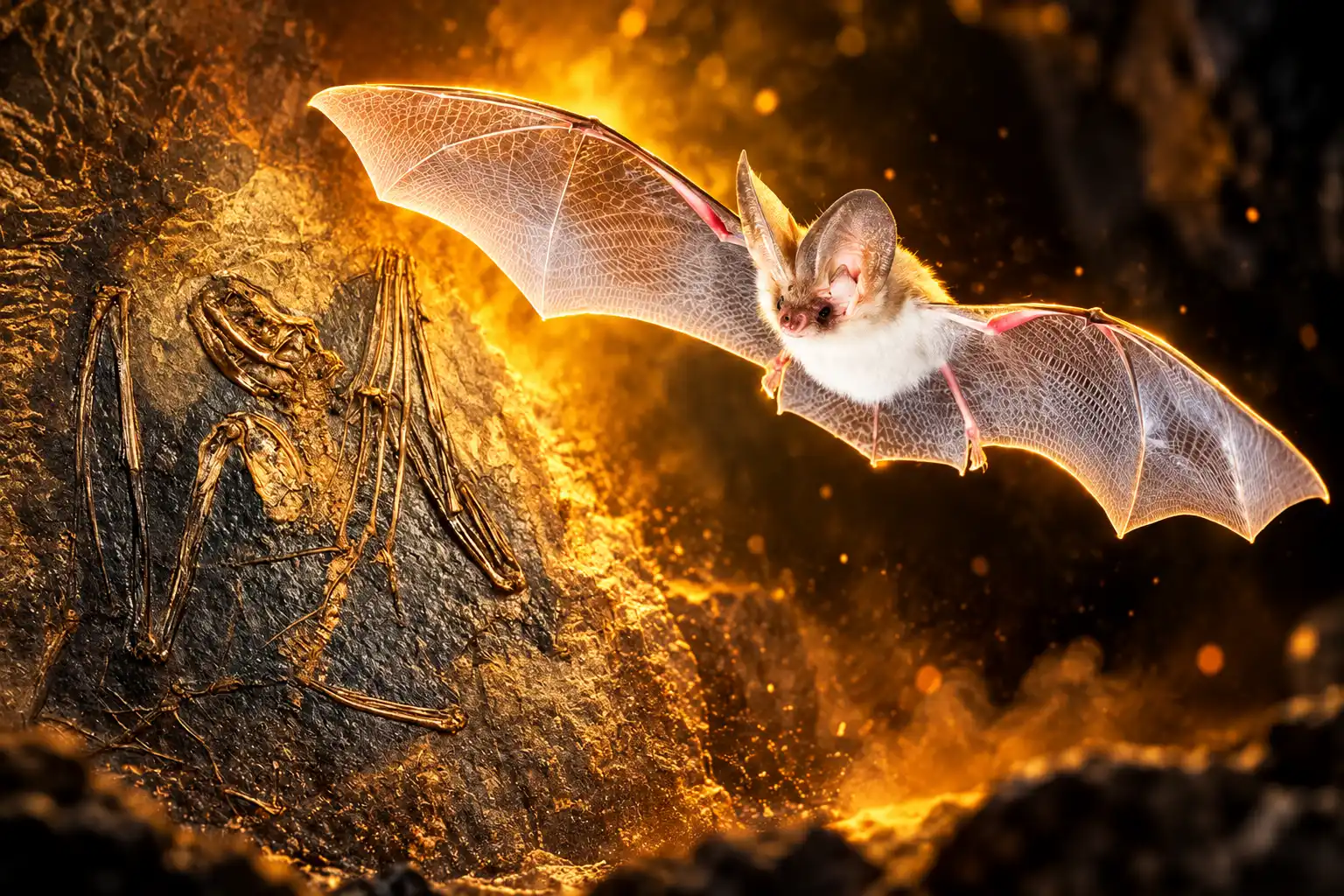
The paper places the fossil Vielasia on the oldest “Eochiroptera” branch, outside the living families. That placement means laryngeal echolocation, the sonar most bats make with the voice box, was already present before today’s families split. Flight and sonar both sit near the base of the tree.
Vielasia sigei was named in 2023 from cave rock in the Quercy Phosphorites of southwestern France, about 50 million years old. Suzanne J. Hand and colleagues described the oldest uncrushed bat skull yet found, with inner-ear traits of modern laryngeal echolocators, including a cochlea that takes up about 25 percent of basicranial width. At least 23 animals were buried together, which also points to cave roosting by the end of the early Eocene.
That finding collides with a 2008 reading of Onychonycteris finneyi, a Wyoming fossil that could fly but lacked the bony marks of laryngeal sonar. Nancy Simmons, now curator emerita at the American Museum of Natural History, helped describe that bat as evidence that flight came first. On the new tree she still will not call the order settled.
It looks pretty clear that echolocation evolved before the diversification of all living families. We’re back where we were years ago: flight and echolocation seem to have evolved at the base of the tree. We still don’t know which came first.
Nancy Simmons, curator emerita, American Museum of Natural History
WHERE EXPERTS DISAGREE
- Flight first: The 2008 Onychonycteris skeleton from the Green River Formation was read as a flyer without laryngeal sonar, which supported flight before echolocation.
- Sonar at the base: Vielasia’s ear and its place on the oldest fossil branch indicate laryngeal echolocation already existed before living families diversified.
- Still open: Simmons says both traits sit at the base of the tree and the order between them remains unknown.
Those two claims can both be true. Sonar before the split of living families is not the same question as which of the two tools appeared first in the ancestral lineage. The paper reopens the second question; it does not close it.
The X Chromosome Settled Decades of Split Trees
Earlier trees kept coming apart because bat genomes are messy in a specific way. Lineages split fast. Genes moved between early branches. Different chromosomes then record different histories, a mosaic the paper says explains why older studies were misled.
A stretch of the X chromosome kept a cleaner record of the underlying relationships, which let the team resolve conflicts that had lasted for decades. Zixia Huang, an assistant professor at University College Dublin, said the chromosome-level genomes open a window into hidden stretches of bat DNA once dismissed as “junk,” regions that are hard to assemble and now look like active players in bat evolution. Yan Liang, at the Wellcome Sanger Institute, said those overlooked regions can carry strong evolutionary signal.
Chromosome reconstructions also recover 26 ancestral bat chromosomes. Bat genomes are among the smallest in mammals, about 2 Gb, yet they still hold a dense record of old viral insertions and, in several families, active DNA transposons that are rare in other mammals.
The Gene Map Bat1K Was Built to Use
Bat1K exists because bats do things other mammals do not. They fly. Most of them hunt in the dark by sound. Some live 8-10 times longer than their body size would predict, with little cancer. Several carry a wide range of viruses without obvious illness. Over 1,500 living species make up more than one fifth of all mammals.
Without a stable tree, shared genes cannot be told apart from later, local changes. With the tree, a trait that sits on the ancestral branch can be hunted in all 21 families, and a trait that evolved only in horseshoe bats can be left out of that search. That is the second product of the paper, and the one the co-directors keep naming.
It is extraordinary, after decades of research and conflicting findings, we finally have a robust phylogenetic tree that we can now use to properly understand how bats’ unique traits evolved. We also have the genomes to uncover the molecular basis of these spectacular adaptations and know where the fossil bats fall in this tree.
Emma Teeling, Bat1K co-director, University College Dublin
A 2025 Bat1K paper had already found an excess of immune gene adaptations on the ancestral bat branch, including changes in viral entry, detection and inflammation control. Morales, who worked on both studies, has tied those immune changes to the same deep node as the origin of bats. The new tree is what makes that kind of mapping honest.
Sonja Vernes, Bat1K co-founding director at the University of St Andrews, called bats one of evolution’s greatest experiments and said the genomes finally let the group see how that biology evolved. Michael Hiller, a senior author at the Senckenberg Research Institute in Frankfurt, said the team used current sequencing and computing to generate the genomes and identify the genes they contain. David Ray, a senior author at Texas Tech University, said the resource lets other labs study everything from single-base changes to large missing stretches that differ between lineages.
Researchers Rebuilt the Ancestor’s Genome
The Sanger group and its partners also reconstructed the genome of the ancestor of all living bats, the first time that ancestral sequence has been rebuilt. It is a working draft of what the genome of an early flying mammal looked like, and a baseline for asking which genes changed when flight, sonar, long life and viral tolerance appeared.
A CLOCK FOR EARLY BATS
- Late Palaeocene, about 65 million years ago: Bats, and thus powered flight, arise in Europe on the new tree.
- Early Eocene, about 56 million years ago: The four living superfamilies radiate, and descendants spread from a Europe-Africa hub.
- About 56 to 52 million years ago: The oldest known bat bones appear in Asia, North America, Europe and Australia.
- About 50 million years ago: Vielasia in France already shows inner-ear marks of laryngeal echolocation.
- 47 to 48 million years ago: Palaeochiropteryx tupaiodon is preserved in Germany’s Messel oil shale, a later European snapshot of the radiation.
Graham Hughes, at University College Dublin, said the genetic code for those traits is in the DNA, and that large comparisons of this kind are how both the traits and the history become readable. Teeling has called the paper a springboard. The origin in Europe is now the working answer. The gene hunt is the work the tree was built to start, and the order of flight and sonar is still the open question sitting at the root.
Frequently Asked Questions
How Many Living Bat Species Are There?
The Nature paper counts over 1,500 living species, more than one fifth of all mammals, on every continent except Antarctica. They pollinate plants, move seeds and eat large numbers of insect pests, which is why a rewritten family tree also matters for ecology, not only for lab genetics.
What Is the Bat1K Project?
Bat1K is a consortium whose stated aim is to sequence every living bat species in three phases: one species from each of the 21 families (this paper), then remaining genera, then all other species. The about page frames the point as mining genomes for longer healthspans, flight, echolocation and disease resistance, not only drawing a prettier tree.
What Is Vielasia sigei?
It is an early Eocene stem bat from cave sediment at Vielase in southwestern France, about 50 million years old. Hand and colleagues reported a near-complete three-dimensional skull, a petrosal only loosely attached to the basicranium, a long basilar membrane, and a cave assemblage of at least 23 individuals, which together argue for advanced laryngeal echolocation and cave roosting before the living families diversified.
Did Flight or Echolocation Evolve First in Bats?
That order is still not settled. Onychonycteris finneyi, described in 2008 from the Green River Formation of Wyoming and dated to about 52 million years, could fly but had a small cochlea, a small knob on the malleus, and a stylohyal without an expanded tip, so Simmons and colleagues treated it as flight first. Vielasia’s ear pulls sonar back to the oldest fossil branch; the 2026 paper says both traits sit near the origin and does not rank them.
Why Do Bat Genomes Matter for Human Disease Research?
A 2025 Bat1K comparison of 115 mammal genomes found selection on immune genes was more common in bats than in other mammal orders, with extra changes on the ancestral bat branch in viral entry, detection and inflammation control. In rhinolophid and hipposiderid bats the antiviral gene ISG15 carries residue changes, and earlier Bat1K genomes also showed expansions of APOBEC3 antiviral genes and loss of some pro-inflammatory regulators, which is why ageing and infection labs want the new tree as a map.

The BMW iX4 Undercuts Mercedes and Trails Its Twin

Scotland’s Ten Big Supermarkets Already Hold the Weekly Shop

Scotland EMS Faces a State Probe After a Wagram Death

Meritz Signs Ripple to Race Korea’s 2027 Token Rules

Pocognoli’s First Camp Leaves Scotland Third and Exposed

Volkswagen Sells the Osnabruck Plant to Clear a Board Fight

Saksham Gaur Finds He Is His Own Company’s Client

Tata Motors’ Iveco Tender Opens as Holders Still Decide

Onimusha Way of the Sword Preload Hits a Windows 11 Wall

Apple’s Foldable iPhone Hinges on Samsung Display Supply
-
 AUTO1 month ago
Volkswagen Sells the Osnabruck Plant to Clear a Board Fight
-
 BUSINESS2 months ago
Saksham Gaur Finds He Is His Own Company’s Client
-
 AUTO2 months ago
Tata Motors’ Iveco Tender Opens as Holders Still Decide
-
 GAMING2 months ago
Onimusha Way of the Sword Preload Hits a Windows 11 Wall
-
 NEWS2 months ago
Apple’s Foldable iPhone Hinges on Samsung Display Supply
-

 NEWS1 month ago
The Frame Pro’s $1,200 Labor Day Cut Needs a Soundbar
-

 AUTO2 months ago
Simple Wave Chases Range as Ather Konarc Cuts Price
-

 NEWS1 month ago
iQOO 16 Locks 8,400 mAh While 100W Charging Holds