
NEWS
The Priest Who Sold a Hebridean Colony in Alberta
Father Andrew MacDonell sold a Catholic Gaelic colony Ottawa never approved, as around 300 islanders left on the SS Marloch for unready Alberta farms.

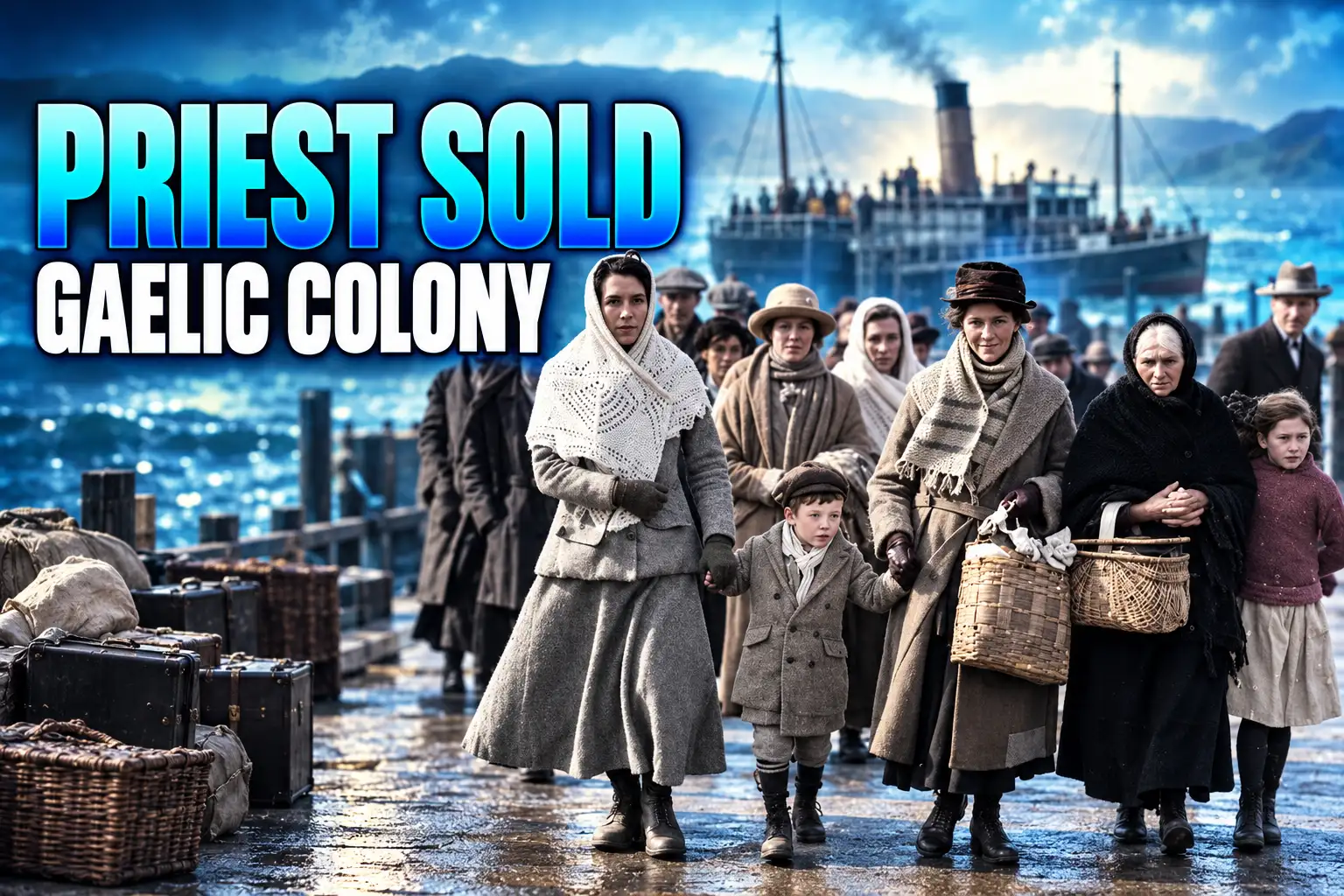
Around 300 Catholic islanders left Lochboisdale on the SS Marloch on 15 April 1923 for a Gaelic colony their priest had not declared to Canada. They were family groups from Barra, Eriskay, South Uist and Benbecula, sold free land and a parish of their own on the Alberta prairie.
The landing was at Red Deer, not at the later town called Clandonald. Houses were green wood. Implements were missing. In 1927 the Bishop of Argyll and the Isles banned priests from the work.
Three Hundred Leave From Lochboisdale Pier
The liner took on a Catholic passenger list. Barra sent 120 people across on the SS Hebrides to join the sailing. Father Michael MacDonald, parish priest of Ardkenneth in Iochdar, who has spent years on the letters, says 45 parishioners came from Ardkenneth and 96 from Bornish, with the rest from Benbecula and Barra.
Half of those who boarded had no money at all. They had sold stock and gear on the promise of free land and loans in advance. Several families failed the medical after the sale and had to walk back to crofts that were already empty.
The Daliburgh parish priest had already told his bishop he did not know how people lived. Eight families on Eriskay had been on the Bishop’s Fund that year. As far as that priest was concerned, the choice was emigrate or starve. Herring could not even be given away in Glasgow. Crofting townships were being broken up as the war economy shut down.
THE SAILING IN FIGURES
- On the pier: Around 300 people left on 15 April 1923, with 120 of them coming from Barra on the SS Hebrides.
- Cash in hand: Half the passengers had no money, against an original plan for 18 families holding $1,000 or at least $750.
- On the Atlantic: 100 children contracted measles, and a doctor and nurse had to be hired at New Brunswick.
- Through 1924: Father Andrew MacDonell brought 1,200 settlers to Canada between April 1923 and December 1924.
The Metagama left Stornoway eight days later, on 23 April, with a different social mix: young single men bound for hired work. The Marloch carried households. That is why a botched colony cut deeper than a labour draft. Whole streets of kin went together, and whole streets had to live with what they found.
The Priest Sold Bishops a Secret Colony
Father Andrew MacDonell was a Benedictine from Fort Augustus and a paid recruitment agent for the Canadian government. He had been a chaplain to the Canadian Seaforths and held the Military Cross. After the war his job was to pick settlers by morals and by money. He used a second pitch on the Scottish bishops that he kept off the Canadian files.
The islanders, he told the hierarchy, were “innocent as the day is long” and would lose the faith in a secular country. He wanted a wholly Catholic, Gaelic-speaking settlement on the prairie. That line won him the Archbishops of Glasgow, St Andrews and Edinburgh, and Edmonton, and the Bishop of Argyll and the Isles. He made Father Donald MacIntyre, a Kilpheder man then serving in Barra, his second-in-command.
Fr MacDonnell never said, other than to Bishops and people like that, that he was involved in such a selection process. And he certainly never said it to the Canadian Government. He would never have got away with it, not a chance.
Father Michael MacDonald, parish priest of Ardkenneth
MacDonald, reading the surviving letters, says MacDonell talked about shielding Catholic faith and the Gaelic language from the world. The Canadian Emigration Department was not told that the package was strictly denominational. MacDonald’s word for it is double dealing.
One Uist priest stayed off the bandwagon. Father Willie Gillies, born in Fort William, wrote to the bishop that he had first backed the plan, then watched the chaos. There was no sign of MacDonell. News came “through the grapevine.” He feared the islanders would be left in the lurch, and he did not trust “the hand that presumably guides these matters,” from “sad knowledge of former failings.”
The land deal that finally produced Clandonald did not close until the end of February 1926, almost three years after the ship left. The partners were the British government, the Canadian Pacific Railway, and MacDonell’s Scottish Immigrant Aid Society, which he had incorporated in 1923 as a non-profit under Dominion law.
THE THREE PARTNERS IN THE 1926 LAND DEAL
| Partner | Job on paper | What they put in |
|---|---|---|
| British government | Empire Settlement money | Funds for stock, equipment, cottages and barns |
| Canadian Pacific Railway | Land, ships and rails | Passages, the Vermilion tract, and the job of paying out the building money |
| Scottish Immigrant Aid Society | Recruitment and colony | The Catholic settler list, cottages and barns, and day-to-day control |
The railway “took responsibility for disbursing monies invested by the British Government in stock equipment, and by both the British Government and the Society in cottages and barns.” Lady Gordon Cathcart, who still owned the Long Island Estate the families were leaving, was a CPR shareholder. In the 1880s she had already backed small, supported emigrations to Saskatchewan on railway land. Island memory yoked the 1923 priest to that landlord, whether he meant it or not.
What Ottawa Was Told About the Land
Westminster had passed the Empire Settlement Act in 1922 so the Secretary of State could join dominion governments and private bodies in agreed schemes for land settlement, passages, training and start-up allowances. On 25 June 1923, with the Marloch families already in Canada, the Commons asked what those Hebrideans would actually get.
Lieut-Colonel Buckley, answering for the Overseas Trade Department, said he understood they would receive a grant of land from the Canadian government. Under Canadian law, he told the House, each settler could select 160 acres as a free homestead, so long as no more than 25 acres was wooded. No clearing allowance was needed, he said, because a man could pick a homestead free of bush. The regular train, he added, would generally be no more than 15 miles away.
That was the official picture in London two months after the sailing. It was not the picture on the ground. MacDonell’s own first plan, agreed with a four-man Hebridean delegation in 1922, had been eighteen families with cash, based at a former Indian industrial school of 1,100 acres about five miles from Red Deer, renamed Ard-moire. He had thirty-five farms appraised west of town at Eckville. Then, in his telling, a CPR cable arrived “as a bolt from the blue.”
Colonel Dennis of the railway wired that fifty families had sold out and were ready to sail, half of them with no money. MacDonell wrote that the delegates, except MacIntyre, had kept quiet about the eighteen-family cap. One of them, Norman MacLeod, posted a bill of sale on the church door, “and then the race began.” Alberta’s minister of agriculture, after delays, wired his regrets: the government was “unable to settle any one of your families.” Ottawa’s Mr Blair wanted the penniless households split across Manitoba, Saskatchewan and Alberta.
Red Deer Cheered Them Off the Train
MacDonell stood on the dock at St John on 28 April 1923 and watched the ship tie up. Floods then trapped the CPR party for four days at McAdam Station. When the families regrouped in Winnipeg he said Mass in Gaelic at the Church of the Immaculate Conception and told them the eighteen-family plan was dead. He moved west with thirty families, ten of them ex-servicemen bound for Soldier Settlement Board training.
On 8 May at 10.45am the first party reached Red Deer. A piper was playing. The mayor, Mr Welliver, gave speeches. Townspeople put the new arrivals into cars for the old school, where dinner and clean beds were waiting. The second party got the same welcome at 5pm. MacDonell later wrote that about three hundred souls landed, and that the town housed them for the best part of two months.
Within weeks, fifteen of the twenty families that officials had parked in other provinces had drifted back. Down payments on the Eckville farms scared every household that looked at them. The cottages on spare soldier farms near Chaten were slimly built and had stood empty. MacDonell, in a 1924 memo to the minister of immigration and colonisation, still called the party “satisfactorily settled.” The settlers’ list of missing items was longer.
WHAT WAS PROMISED AND WHAT WAS MISSING
- Broken land: Each Clandonald family was later promised a 160-acre farm with 10 acres already broken in for a first crop. The breaking-in never happened.
- Implements: Tools that were supposed to be waiting were not there, and the ground that was supposed to be ploughed had not been.
- Stock: The promised animals were not supplied. Families bought on the open market at prices inflated by their need, on loans stretched over 30 years.
- Houses: First habitations were built of unseasoned green wood and were not insulated, a complaint that followed the party from the training school onward.
MacDonell later placed nearly fifty families on Soldier Settlement farms, some of them around Westlock, where a Barra man with four sons eventually sold a half-section for $23,000. That was not the compact Gaelic parish the bishops had signed. It was scatter, debt and hired work, with a training farm as a holding pen.
A Settlers’ Union Takes On Ottawa
Father John MacMillan, a Hebridean, went out in 1924 as chaplain. He listened, then organised a settlers’ union and petitioned Ottawa through Alfred Steadman, the MP for Red Deer. MacDonell had him called home. The charge was that MacMillan, on a visit back to the islands, had “over-egged” the offer and told people there was a farm for everyone, when the real menu was cottages, farm labour, and a farm after a year or two if they were lucky.
In 1925 the assistant deputy minister at Immigration and Colonisation wrote looking for the passage money. Only around 15 percent of residents paid the travel loans back. Many had moved on across Canada or into the United States and would not give their names. Those still in reach said they would pay when the promises were kept.
Late spring 1926 finally put 48 Hebridean families, after the Red Deer training years, onto the new Vermilion tract named Clandonald. Eleven Irish families followed, then 41 from England and Scotland, 100 households in all if every group stayed. St Columba’s church opened in 1926. Mass had begun in a tent on a parishioner’s farm. A convent and a Catholic school followed. The prairie winters did not wait for the barns.
From reading the letters, MacDonald thinks shame is why the islands went quiet. The betrayal, in the minds of people who went, had been carried out by a priest, “one of the emigrants’ own.” One later comment, which he records, was that MacDonell had abetted Lady Cathcart, who wanted them off the crofts. MacDonell kept writing to Canadian officials. They ignored him, then gave him an MBE for services to Canada. He went back to Fort Augustus in 1956 and died in Glasgow in 1960.
Argyll’s Bishop Shuts the Scheme Down
Bishop Martin of Argyll and the Isles had been an early enthusiast. The complaints and the splits were enough. In 1927 he issued a pastoral letter saying the Church would not support these schemes again. The next year he wrote round the priests and banned them from taking any part.
That ban is the buried verdict on the Marloch. It is not a footnote to island silence. It is the hierarchy walking away from a colonization product it had blessed, after the product met measles, green wood, unpaid loans and a settlers’ union. Emigration had been sold as the fix for a crowded estate. MacDonald’s line on the longer trend is blunt. Depopulation had run since the early nineteenth century, including the 1848-1851 clearances from the Long Island Estate, when 3,500 people were moved on false promises and seventy of them petitioned at Quebec that they would “perish with want.” “The emigration hasn’t solved anything.”
Canadian officials, in the same years, were capable of describing the new arrivals as “a clannish people of peculiar psychology.” The colony MacDonell wanted was built to keep that clannishness as a Catholic fact. Ottawa had funded settlers, not a denominational enclave, and the gap between those two products is where the houses failed.
Stones From Empty Crofts, and a Parish That Lasted
On 15 April 2023, a century to the day, South Uist unveiled a ship-like memorial of croft stones at the Gateway Garden in Lochboisdale. Stòras Uibhist, the community owner of the estate, asked townships for stones no longer than 30 centimetres from the ruined houses of families who sailed. The outer face is a smooth black hull. The seating is the old crofts. A log from a Fort William mill became the funnel. Flags were tied for Uist and Canada. Gillebride MacMillan wrote a song for a massed schools choir. Kildonan Museum put on an exhibition the same afternoon.
Stòras Uibhist said it was able “to include a part of so many townships from across the Estate in this very important monument remembering our ancestors and the difficult lives they endured and the choices they had to make.” The design was aimed at everyone who has left, by force or by choice, and at those who stayed. Community ownership, MacDonald argued, was the only setting in which that bitter memory could be looked at straight.
FROM THE PIER TO THE JUBILEE
- 15 April 1923: The SS Marloch leaves Lochboisdale with around 300 Catholic islanders.
- 8 May 1923: The first party reaches Red Deer to pipes, speeches and two months in the old industrial school.
- 1924: Father John MacMillan arrives, forms a settlers’ union, and is recalled.
- February 1926: The British government, the CPR and the Scottish Immigrant Aid Society buy the Vermilion land for Clandonald.
- Late spring 1926: 48 Hebridean families take farms there; St Columba’s is built.
- 10 June 1927: Archbishop Henry Joseph O’Leary blesses the church, in the same year Bishop Martin ends Church backing for the schemes.
- 15 April 2023: The Lochboisdale memorial is blessed, built from the stones of the houses those families left.
- 23 August 2026: St Columba Parish marks its centenary with the Archdiocese of Edmonton.
The prairie end of the story did not vanish when the islands went quiet. On 23 August 2026 the Archdiocese of Edmonton marked 100 years of St. Columba Parish beside Holy Name’s golden jubilee in Vermilion. Bishop Emeritus Paul Terrio cut the cake and confirmed 12 young parishioners. Since 1990 the Clandonald church has been served from Vermilion. The first resident pastor, in 1927, was Rev. Malcolm MacDonald. A larger church went up in 1961.
The Catholic colony MacDonell advertised is, in that narrow sense, still on the map. The free, broken, tooled 160-acre start that London described to Parliament in June 1923 is not. The silence that followed was not mystery. It was what a parish does when the priest who organised the leaving is the man who has to be explained.
Frequently Asked Questions
What Was the SS Marloch Before She Called at Lochboisdale?
She was launched in 1904 as the RMS Victorian for the Allan Line, the world’s first turbine-powered ocean liner, 10,687 tons and 517 feet long, built by Workman, Clark in Belfast. Canadian Pacific took her over and ran her first Atlantic voyage under the Marloch name on 20 December 1922. She was broken up in 1930.
How Did the Marloch Sailing Differ From the Metagama?
The Metagama left Stornoway on 23 April 1923 with about 300 people whose average age was 22. All but 20 were young men heading for farm labour, with those 20 young women booked as domestic servants, and the ship was bound for Montreal. The Marloch, eight days earlier, carried Catholic family groups under a colony plan, not a labour draft.
Where Is Clandonald, and Does the Settlement Still Exist?
Clandonald is a hamlet in Alberta’s County of Vermilion River, about 58 kilometres northwest of Lloydminster and 28 kilometres north of Highway 16, well east of the Red Deer training school where the 1923 party first lived. The parish founded in 1926 is still served, now from Holy Name in Vermilion, and marked its centenary on 23 August 2026.
How Much Could Britain Spend on Empire Settlement Schemes?
The Empire Settlement Act of 1922 capped the Secretary of State at £1,500,000 in the financial year the Act passed and at £3,000,000 in any later year, not counting interest or repayments coming back in. By the end of May 1923, Lieut-Colonel Buckley told the Commons, 19,170 people had already migrated under the Act.

The BMW iX4 Undercuts Mercedes and Trails Its Twin

Scotland’s Ten Big Supermarkets Already Hold the Weekly Shop

Scotland EMS Faces a State Probe After a Wagram Death

Meritz Signs Ripple to Race Korea’s 2027 Token Rules

Pocognoli’s First Camp Leaves Scotland Third and Exposed

Volkswagen Sells the Osnabruck Plant to Clear a Board Fight

Tata Motors’ Iveco Tender Opens as Holders Still Decide

Saksham Gaur Finds He Is His Own Company’s Client

Onimusha Way of the Sword Preload Hits a Windows 11 Wall

Simple Wave Chases Range as Ather Konarc Cuts Price
-
 AUTO1 month ago
Volkswagen Sells the Osnabruck Plant to Clear a Board Fight
-
 AUTO1 month ago
Tata Motors’ Iveco Tender Opens as Holders Still Decide
-
 BUSINESS1 month ago
Saksham Gaur Finds He Is His Own Company’s Client
-
 GAMING1 month ago
Onimusha Way of the Sword Preload Hits a Windows 11 Wall
-
 AUTO1 month ago
Simple Wave Chases Range as Ather Konarc Cuts Price
-

 BUSINESS1 month ago
Hyderabad 22-Carat Gold Jumps After a False Bargain
-

 BUSINESS1 month ago
UltraTech Ultravolt Launch Splits Friday Stocks to Watch
-

 NEWS1 month ago
Apple’s Foldable iPhone Hinges on Samsung Display Supply